 Quran

| Key Takeaways |
| According to the stronger scholarly position, held by Ibn Taymiyyah, Ibn Baz, and Ibn Uthaymeen, a menstruating woman may recite Quran from memory without restriction throughout her cycle. |
| The hadith most commonly cited to prohibit menstrual recitation is classified as weak by the majority of hadith scholars, including Ibn Taymiyyah and Imam al-Albani, meaning the prohibition lacks a verified textual basis. |
| Touching the physical Mushaf during menstruation is prohibited by scholarly consensus in all four madhabs, but reciting from memory or reading from a phone or tablet carries no such restriction under the stronger scholarly view. |
| Menstruation and janabah differ in a critical legal respect: a person in janabah can end that state immediately through ghusl, while a menstruating woman cannot, which is why many scholars applied greater leniency specifically to her case. |
| Hifz students are actively encouraged by scholars to continue memory review during menstruation to prevent forgetting retained portions of the Quran across repeated cycles. |
The question of whether a menstruating woman can recite Quran from memory affects the daily spiritual lives of millions of Muslim women each month. Hifz students, Quran teachers, and sisters who rely on recitation face this question directly, and they deserve a precise, evidence-based answer.
What Islamic scholarship concluded on this matter is more nuanced than popular summaries suggest. This article examines the scholarly positions, the hadith evidence underlying them, and the practical guidance that follows for every category of Muslim woman.
Can I Recite Quran from Memory on My Period?
Yes. According to the stronger scholarly position, a menstruating woman may recite Quran from memory without restriction. This is the conclusion of Shaykh al-Islam Ibn Taymiyyah, Shaykh Ibn Baz, and Shaykh Ibn Uthaymeen.
The condition attached to this permissibility is that she does not touch the physical Mushaf directly. Reciting Quran from memory during menstruation, or reading from a phone or tablet, is permissible under this position.
This ruling is not a modern concession or a minority fringe view. It is grounded in a detailed examination of the hadith evidence and represents one of the two main positions recorded in classical Islamic jurisprudence.
Two Scholarly Positions on Reciting Quran During Menstruation
Islamic scholarship produced two main positions on this question, and understanding both is essential before following either.
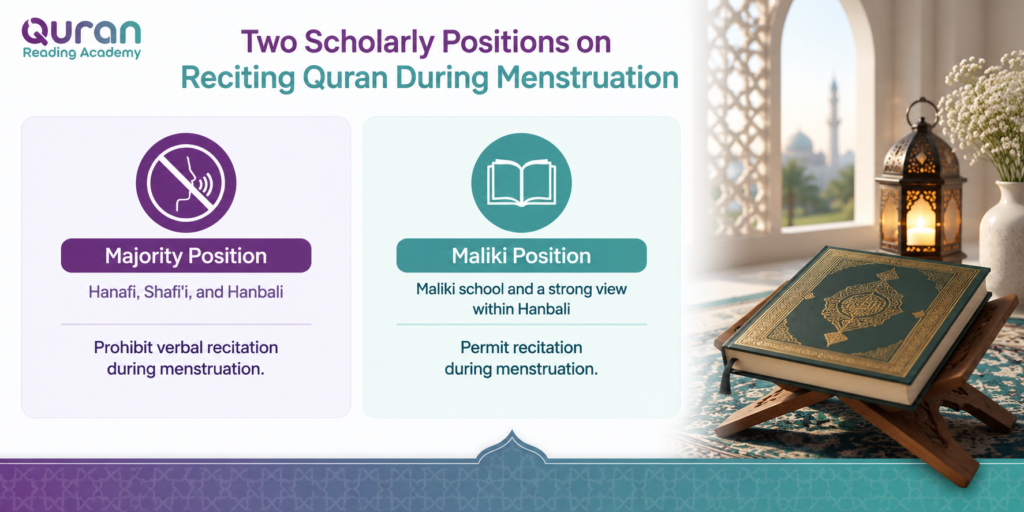
1. The majority position among classical Hanafi, Shafi’i, and Hanbali scholars prohibited verbal recitation during menstruation.
These scholars drew a legal analogy between menstruation and janabah, the state of major ritual impurity following sexual relations. Both states require ghusl to exit, and so these schools treated them as carrying identical restrictions
2. The Maliki school, along with a significant strand within Hanbali scholarship, held a different view. Scholars in this tradition concluded that menstruation and janabah are not legally identical for purposes of Quran recitation.
This position permits recitation during menstruation and forms the basis of what Ibn Taymiyyah developed into one of classical fiqh’s most carefully argued rulings.
Read also: When Can You Not Read Quran?
Why the Hadith Evidence Is Contested Among Classical Scholars?
Two hadiths are typically cited in support of the prohibition on menstrual recitation, and both have been subject to detailed scrutiny by hadith scholars.
One hadith, transmitted through Ali ibn Abi Talib, establishes that the Prophet would not be prevented from any act except Quran recitation during janabah. Scholars who prohibit recitation during menstruation extended this ruling to menstruation by legal analogy, equating the two states.
The second hadith, attributed to Ibn Umar, explicitly mentions both the menstruating woman and the person in janabah and prohibits recitation for both. However, hadith scholars classified this narration as weak due to a problem in its chain of transmission.
Ibn Taymiyyah was direct on this point, stating that this hadith does not meet the standard required to establish a prohibition.
The Ali narration, by contrast, speaks only about janabah. Extending it to menstruation by analogy is a juristic inference, not a direct prophetic text.
Scholars who permitted menstrual recitation argued that this inference is insufficient to remove a woman from one of Islam’s greatest acts of worship for days each month.
What Ibn Taymiyyah and Later Scholars Concluded from the Evidence?
Ibn Taymiyyah examined the hadith evidence in detail and arrived at a clear conclusion: there is no authentic prophetic text that explicitly prohibits a menstruating woman from reciting Quran.
His reasoning rested on an observed historical fact. Women menstruated throughout the prophetic era, and the Mothers of the Believers transmitted many rulings related to menstruation in precise detail.
Had verbal recitation been prohibited, that prohibition would have been transmitted with the same clarity as the prohibition on Salah. The command to recite Quran is general and applies to all believers. Allah says in Surah Al-Muzzammil:
وَرَتِّلِ الْقُرْآنَ تَرْتِيلًا
(Wa rattilil-Qur’āna tartīlā)
This command is not qualified in its own verse by a condition of ritual purity. Removing a woman from it for several days each month requires a clear, verified prophetic text.
Ibn Taymiyyah concluded that no such text exists for menstruation, making the prohibition a juristic inference rather than a prophetic ruling.
Quran Reading Academy offers Quran Reading Classes for Sisters taught by certified female instructors who guide sisters through both the Fiqh rulings on recitation and the practical skills needed to maintain Quran connection at every point in the month.

Begin Your Quran Journey with Expert Female Instructors
Why Scholars Applied Lighter Restrictions to Menstruation Than to Janabah?
One of the strongest arguments for permissibility rests on a distinction that the prohibition-view scholars did not fully account for: menstruation and janabah are different in a practical and legally significant way.
A person in janabah can end that state immediately by choosing to perform ghusl. That impurity is temporary in a controllable sense. A menstruating woman cannot end her state through any act of worship or purification. Her condition lasts for days, entirely outside her will.
Scholars who recognized this distinction argued that applying identical restrictions to a state the woman controls and a state she does not creates undue hardship that Islamic law seeks to avoid wherever possible.
| Aspect | Janabah | Menstruation |
| Cause | Voluntary act | Involuntary biological process |
| Can the state be ended immediately? | Yes, via ghusl | No, cycle must complete naturally |
| Quran recitation from memory | Prohibited until ghusl | Permitted under the stronger view |
| Reading Quran from a phone | Permitted after ghusl | Permitted |
| Touching the physical Mushaf | Prohibited | Prohibited by consensus |
| Listening to Quran recitation | Permitted | Permitted |
| Ghusl removes all restrictions | Immediately | Only after menstruation ends |
This table reflects why many scholars across different traditions applied leniency to the menstruating woman that they did not extend to those in a state of janabah.
Read also: Can You Go to Heaven Without Reading the Quran?
Can You Read Quran from a Phone or Tablet During Menstruation?
Reading Quran from a phone or digital device during menstruation is permissible according to the contemporary scholarly consensus, including the Egyptian Dar al-Ifta and scholars affiliated with Al-Azhar University.
The reasoning is rooted in the legal definition of Mushaf. A Mushaf is a physical object dedicated entirely to the preserved text of the Quran, inscribed permanently on bound pages. A smartphone is a general-purpose device on which Quranic text appears as electronic data rendered temporarily on a screen.
Because of its sacred status as a dedicated container of Allah’s words, the ruling on touching applies to the physical Mushaf.
A phone holds no such dedicated status, and the scholars who ruled on this classified it clearly outside the legal category of Mushaf.
Wudu is not required to hold or navigate a phone even when Quranic text is visible on screen. Sisters pursuing Hifz can open a Quran app, follow along with their memorized portions, and review new material this way at every point in their cycle.
Quran Reading Academy offers a Quran Hifz Course that trains students in systematic memorization techniques with qualified instructors who guide each student on structuring their revision schedule on every day of the month.

Start Your Hifz Journey with Certified Instructors
Why Touching the Physical Mushaf Remains Prohibited During Menstruation?
While recitation from memory is permitted under the stronger scholarly view, direct contact with the physical Mushaf remains prohibited by consensus within all four madhabs. This ruling has a clear textual basis.
Allah says of the Quran in Surah Al-Waqi’ah:
لَّا يَمَسُّهُۥٓ إِلَّا الْمُطَهَّرُونَ
(Lā yamassuhu illal-muṭahharūn)
“None shall touch it except the purified.”
Scholars of all four schools understood “the purified” to mean those free from major ritual impurity, a category that includes both janabah and menstruation. This ruling, unlike the recitation question, carries no authenticity disputes and is based on a clear Quranic text.
A menstruating woman who must read from the physical Mushaf for a formal study session or teaching purpose may do so using a clean barrier, such as gloves or a cloth, between her hand and the pages. Direct skin contact with the pages is what the ruling prohibits.
Read also: Can You Read Quran on a Computer Without Wudhu?
How Hifz Students Can Maintain Memorization During Menstruation?
For sisters actively memorizing the Quran, the days of menstruation present a specific practical challenge.
Under the stronger scholarly view, this challenge largely disappears: recitation from memory continues without restriction, and Hifz review proceeds as normal.
Even among scholars who adopt the prohibition on verbal recitation, exceptions are recognized for situations involving retention of memorized Quran. The Maliki school specifically permitted recitation for teachers and students when stopping would cause them to lose what they had retained.
Scholars who held this exception noted that a prohibition resulting in a woman forgetting retained Quran over repeated months cannot reflect the intention of Islamic law.
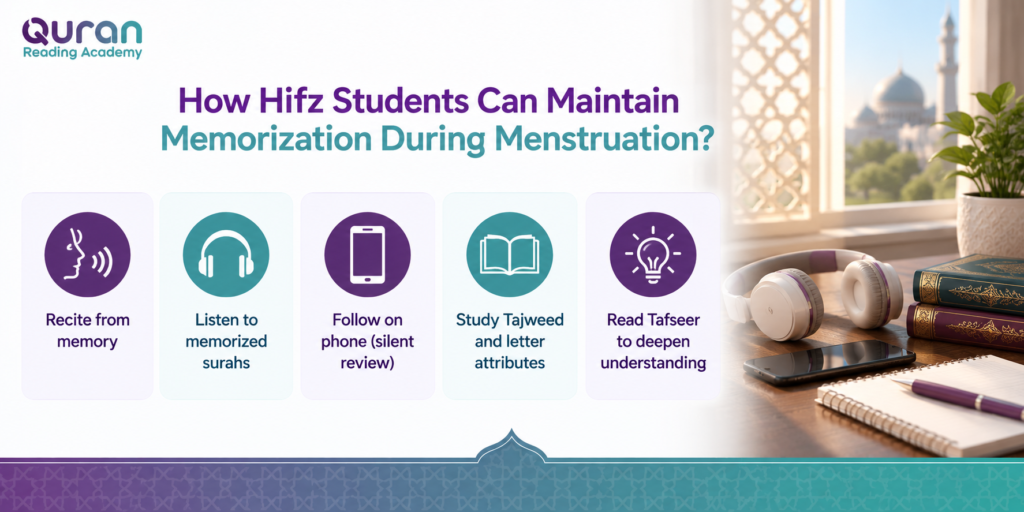
Practical strategies for Hifz students during menstruation include the following:
- Reciting memorized portions from memory for active retention under the stronger scholarly view.
- Listening to memorized surahs through headphones for passive but effective reinforcement.
- Following recitation on a phone screen without physical Mushaf contact for silent review.
- Studying Tajweed theory, articulation points, and letter attributes during this time.
- Reading the Tafseer of memorized portions to deepen understanding before resuming vocal review.
Quran Reading Academy offers a Quran Recitation Course that trains students in the art of Tarteel, teaching the measured, rhythmic cadence that the Prophet commanded, with instructors who address how to maintain recitation quality and progress consistently each day of the month.

Begin Recitation Training with Expert Instructors
Read also: Is It Haram to Force Someone to Read Quran?
Listening to Quran, Studying Tafseer, and Making Dhikr During Menstruation
Menstruation restricts only specific acts of worship. It does not suspend a woman’s broader spiritual relationship with Islam or with the Quran. Listening to Quran recitation is universally permitted under every scholarly opinion, and it carries full spiritual reward.
Scholars unanimously agree on this point. A menstruating sister who is reviewing memorized material can listen to those surahs repeatedly, a method Hifz instructors recognize as highly effective for long-term retention.
Studying Tafseer, the commentary and interpretation of Quranic verses, is also fully permitted. Books of Tafseer and translations are not classified as Mushafs and may be handled and read freely.
Using this time to study the meanings of memorized verses often deepens the quality of recitation when it resumes.
Dhikr, dua, and all general Islamic learning remain open in their entirety. The restrictions recorded in classical scholarship were narrow and specific. They did not extend to the full scope of worship and knowledge-seeking that defines a Muslim woman’s relationship with her deen at every phase of her life.
Quran Reading Academy offers a Reading and Memorizing the Quran Course that fuses accurate recitation with systematic memorization in one structured program, ensuring students build both correct pronunciation and lasting retention under certified instructor guidance.
Join the Reading and Memorizing Course Today
Inside Our Live Classroom
We believe in complete transparency. Take a look inside our virtual classrooms to experience our premium teaching tools and engaging learning environment firsthand.
Start Your Quran Learning Journey Today
Join Quran Reading Academy and begin structured, step-by-step Quran reading with expert guidance.
Try your first class for freeStart Learning Quran with Quran Reading Academy Expert Female Instructors
Maintaining a consistent relationship with the Quran each week of the month is fully achievable, and Islamic scholarship gives Muslim women the evidence-based foundation to do so.
Quran Reading Academy provides structured, one-on-one online instruction designed to support exactly this goal.
Why sisters choose Quran Reading Academy:
- Ijazah-certified female instructors who teach both the Fiqh rulings and the practical recitation skills that go with them.
- One-on-one live sessions scheduled around each student’s personal timetable and learning pace.
- A curriculum covering Tajweed, Hifz, recitation, and Quranic Arabic in a single supportive environment.
Our Quran Courses
- Quran Reading Classes
- Quran Reading Classes for Kids
- Quran Reading Classes for Adults
- Quran Reading Classes for Female/Sisters
- Quran Reading Classes for New Muslims
- Quran Reading Course for Beginners
- Online Quran Reading Course with Tajweed
- Reading and Memorizing the Quran Course
- Noorani Qaida Course
- Quran Course for Beginners
- Quran Tajweed Course
- Quran Recitation Course
- Quran Hifz Course
- Online Quran Qirat Classes

Reserve your free trial lesson
Conclusion
The question of whether a woman can recite Quran from memory on her period has a clear answer from the strongest scholarly position: yes, she can.
Ibn Taymiyyah, Ibn Baz, and Ibn Uthaymeen all concluded that no authentic prophetic text prohibits menstrual recitation from memory, and that the general Quranic command to recite applies to women throughout their cycle with no break in practice.
The physical Mushaf prohibition stands firm by scholarly consensus, but recitation from memory or a digital device remains open. For sisters pursuing Hifz, continuing memory review during menstruation is not only permissible; scholars who understand what forgetting retained Quran over repeated cycles costs a student actively encourage it.
Frequently Asked Questions About Reciting Quran from Memory on Your Period
Can I recite Quran silently in my mind during menstruation?
Yes. Even scholars who prohibit verbal recitation during menstruation generally permit silent mental reflection on Quranic verses. Reviewing memorized portions in the mind without moving the lips is considered permissible under every scholarly opinion without exception.
Does reciting Quran from memory during my period require wudu?
No. Wudu is required for Salah and for touching the physical Mushaf, not for verbal recitation from memory under ordinary conditions. The question of menstrual recitation is governed by a separate body of scholarship from the wudu requirements.
Can a Hifz student attend her Quran class during her period?
Yes. A student pursuing Hifz can and should continue attending online Quran classes during menstruation. Listening, reviewing memorized portions from memory, and studying Tajweed theory are all permissible. Under the stronger scholarly view, active vocal recitation also continues without restriction.
Is there a difference between what the Maliki and Hanafi schools say about this question?
Yes. The Maliki school permits recitation during menstruation outright, particularly for students and teachers. The Hanafi school prohibits verbal recitation but permits silent mental review. Ibn Taymiyyah’s position, followed by many contemporary scholars globally, permits recitation from memory and from digital devices without restriction.
Can I use a Quran app on my phone during my period without wudu?
Yes. A smartphone is not classified as a Mushaf in Islamic legal terminology, so the purity ruling does not apply to it. You may open a Quran app and read freely during menstruation without wudu. The contact restriction applies only to the physical, bound Mushaf.









Leave a Reply