 Quran
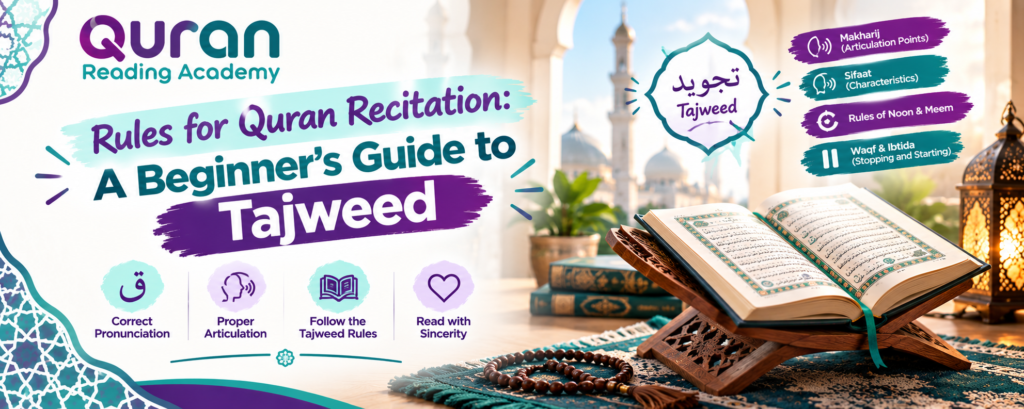
The rules for Quran recitation, also known as Tajweed, help Muslims pronounce the Quranic letters and words correctly while preserving their proper sounds and meanings. These rules of recitation of Quran include correct pronunciation, letter characteristics, elongation, nasal sounds, and appropriate stopping and pausing.
For beginners, learning Tajweed step by step makes Quran recitation more accurate, clear, and confident. In this guide, we will explain the essential Quran recitation rules simply and show how they apply while reading the Quran.
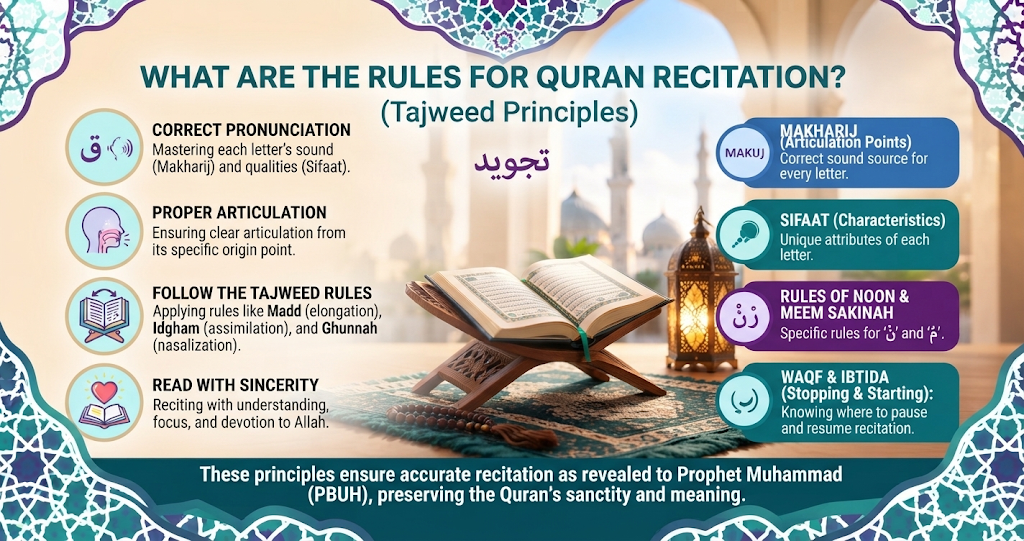
1. Makharij al-Huruf: Correct Pronunciation of Arabic Letters
Makharij al-Huruf refers to the points of articulation from which Arabic letters are pronounced. Learning these points is one of the most important rules for Quran recitation because changing the pronunciation of a letter can change the sound and, in some cases, the meaning of a word.
The main articulation areas include:
- Al-Jawf (الجوف): The space of the mouth and throat, used for the long vowel sounds of Madd.
- Al-Halq (الحلق): The throat, where letters such as ء, ه, ع, ح, غ, خ are produced.
- Al-Lisan (اللسان): The tongue, which produces many Arabic letters, including ق, ك, ج, ش, ي, ل, ن, ر.
- Ash-Shafatan (الشفتان): The two lips, used for letters such as ب, م, و, ف.
- Al-Khayshum (الخيشوم): The nasal passage, associated with the sound of Ghunna.
For beginners, practicing each letter slowly and listening to a qualified teacher can make it easier to identify and correct pronunciation mistakes.
2. Sifaat al-Huruf: Characteristics of Quranic Letters
Sifaat al-Huruf means the characteristics or qualities of Arabic letters. While Makharij explains where a letter is pronounced, Sifaat explains how that letter sounds as it comes from its articulation point.
These characteristics help distinguish letters that may have similar sounds. Important examples include:
- Hams: A flow of breath with certain letters, such as ف، ح، ث، ه، ش، خ، ص، س، ك، ت.
- Jahr: The opposite of Hams, where the breath is more restricted during pronunciation.
- Shiddah: A strong stopping of the sound when pronouncing certain letters.
- Rikhawah: A continuous flow of sound when pronouncing certain letters.
- Isti‘la: Raising the back of the tongue, giving certain letters a fuller or heavier sound.
Understanding these qualities helps learners pronounce Quranic letters more accurately and avoid confusing similar letters. It is especially useful when learning rules of recitation of Quran alongside proper articulation.
3. Rules of Noon Sakinah and Tanween
The rules of Noon Sakinah (نْ) and Tanween (ــًــٍــٌ) explain how the Noon sound should be pronounced when it is followed by another letter. There are four main rules:
a. Izhar
Izhar means making the Noon or Tanween sound clear. It occurs when Noon Sakinah or Tanween is followed by one of the six throat letters:
ء، ه، ع، ح، غ، خ
The Noon sound is pronounced clearly without merging it into the following letter.
b. Idgham
Idgham means merging the Noon or Tanween sound into the following letter. It occurs with the letters:
ي، ر، م، ل، و، ن
Some Idgham letters are pronounced with Ghunna, while others are pronounced without it.
c. Iqlab
Iqlab means changing the Noon sound into a hidden Meem sound. It occurs when Noon Sakinah or Tanween is followed by the letter ب. The sound is accompanied by Ghunna.
d. Ikhfaa
Ikhfaa means partially hiding the Noon or Tanween sound. It occurs when the following letter is one of the 15 Ikhfaa letters. The sound is kept between clear pronunciation and complete merging, with Ghunna.
Learning these four rules is essential for reading Quran correctly because Noon Sakinah and Tanween appear frequently throughout the Quran.
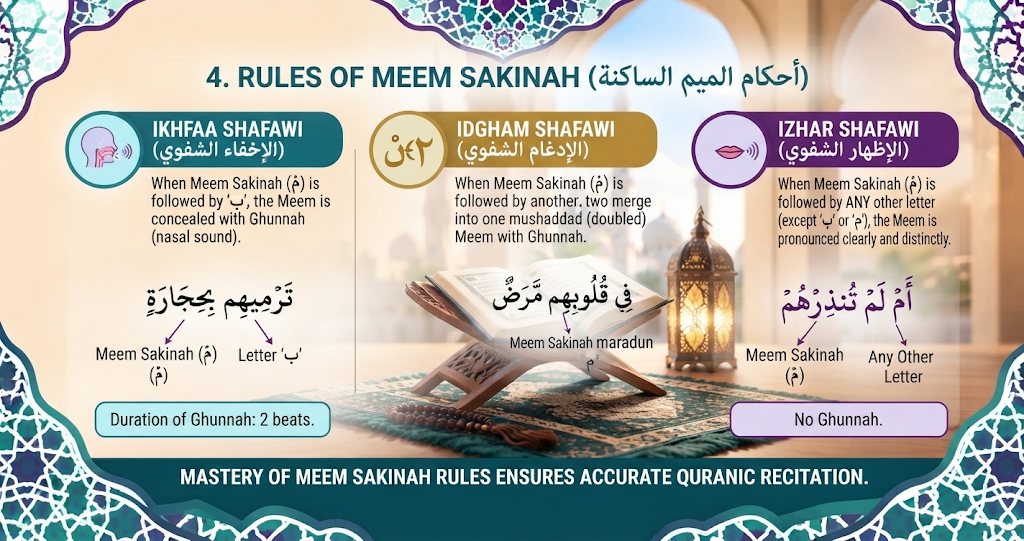
4. Rules of Meem Sakinah
Meem Sakinah (مْ) is a Meem with a Sukoon. Its pronunciation changes depending on the letter that follows it. There are three main rules of Meem Sakinah:
- Ikhfaa Shafawi: occurs when Meem Sakinah is followed by ب. The Meem is pronounced with a light concealment and Ghunna, while the lips remain prepared for the following Baa.
- Idgham Shafawi: occurs when Meem Sakinah is followed by another م. The two Meems merge into one emphasized Meem sound with Ghunna.
- Izhar Shafawi: occurs when Meem Sakinah is followed by any Arabic letter other than ب or م. The Meem is pronounced clearly without merging or hiding it.
These three rules help readers recognize how the Meem sound should flow from one word or letter to the next, making Quran recitation clearer and more accurate.
5. Ghunna: The Nasal Sound in Quran Recitation
Ghunna (الغنة) is a nasal sound that comes from the nasal passage, known as Al-Khayshum. It is an important part of the rules for Quran recitation, particularly when pronouncing Noon (ن) and Meem (م) in specific situations.
Ghunna is especially noticeable in:
- Noon and Meem with Shaddah: These are pronounced with a clear nasal sound.
- Ikhfaa: Noon Sakinah and Tanween are accompanied by Ghunna when the Ikhfaa rule applies.
- Idgham with Ghunna: The Noon or Tanween sound merges into ي، ن، م، و with a nasal sound.
- Ikhfaa Shafawi: Meem Sakinah before ب is pronounced with Ghunna.
For beginners, the key is to produce the nasal sound naturally without exaggerating it. Practicing with a qualified Quran teacher can help you develop the correct timing and pronunciation.
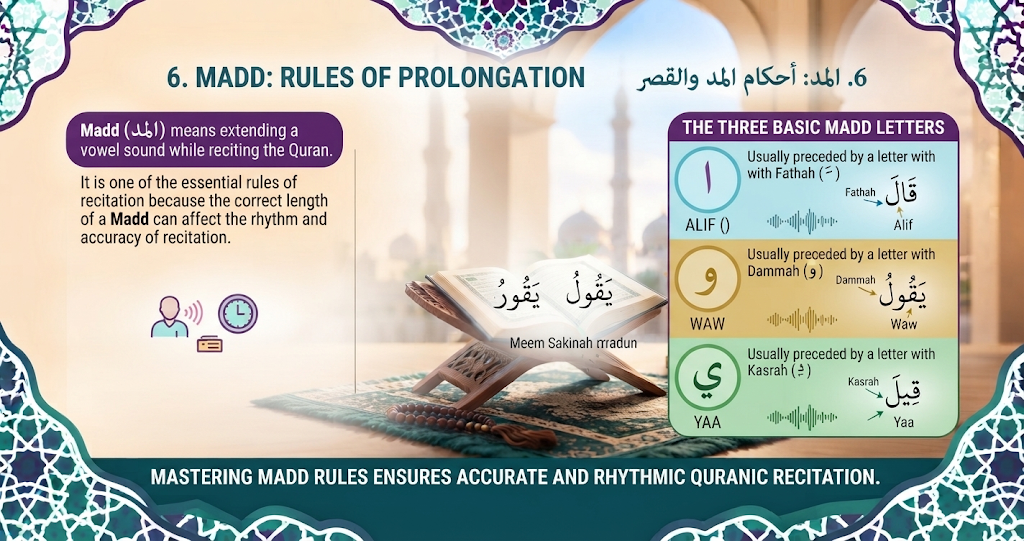
6. Madd: Rules of Prolongation
Madd (المد) means extending a vowel sound while reciting the Quran. It is one of the essential rules of recitation of Quran because the correct length of a Madd can affect the rhythm and accuracy of recitation.
The three basic Madd letters are:
- Alif (ا): Usually preceded by a letter with Fathah.
- Waw (و): Usually preceded by a letter with Dammah.
- Yaa (ي): Usually preceded by a letter with Kasrah.
Common Types of Madd
Madd Asli (Natural Madd): The basic type of Madd, normally extended for two counts.
Madd Muttasil: Occurs when a Madd letter is followed by a Hamzah within the same word.
Madd Munfasil: Occurs when a Madd letter appears at the end of one word and a Hamzah begins the next word.
Madd Laazim: Occurs when a Madd letter is followed by a permanent Sukoon or a Shaddah and requires a longer extension.
The exact duration of some Madd types depends on the method of recitation being learned. Beginners should first master the natural two-count Madd before moving to the more advanced forms.
Start Your Quran Learning Journey Today
Join Quran Reading Academy and begin structured, step-by-step Quran reading with expert guidance.
Try your first class for free6. Madd: Rules of Prolongation
Madd (المد) means extending a vowel sound while reciting the Quran. It is one of the essential rules of recitation of Quran because the correct length of a Madd can affect the rhythm and accuracy of recitation.
The three basic Madd letters are:
- Alif (ا): Usually preceded by a letter with Fathah.
- Waw (و): Usually preceded by a letter with Dammah.
- Yaa (ي): Usually preceded by a letter with Kasrah.
Common Types of Madd
Madd rules can feel abstract until you see how each type actually plays out in recitation — here are the four most common ones you’ll encounter:
- Madd Asli (Natural Madd): The basic type of Madd, normally extended for two counts.
- Madd Muttasil: Occurs when a Madd letter is followed by a Hamzah within the same word.
- Madd Munfasil: Occurs when a Madd letter appears at the end of one word and a Hamzah begins the next word.
- Madd Laazim: Occurs when a Madd letter is followed by a permanent Sukoon or a Shaddah and requires a longer extension.
The exact duration of some Madd types depends on the method of recitation being learned. Beginners should first master the natural two-count Madd before moving to the more advanced forms.
7. Qalqalah: The Echoing Sound
Qalqalah (القلقلة) is a slight echoing or bouncing sound that occurs when one of five specific Arabic letters has a Sukoon. These letters are commonly remembered through the phrase قُطْبُ جَدٍّ:
ق، ط، ب، ج، د
The sound should be clear and controlled without adding an extra vowel.
When Does Qalqalah Occur?
Qalqalah can occur when one of these letters has a permanent Sukoon within a word. It can also become more noticeable when stopping on a word where one of these letters becomes temporarily silent.
For beginners, the main goal is to avoid swallowing the letter or turning the Qalqalah into a full vowel sound. Listening to a qualified Quran teacher and practicing individual examples can help develop accurate pronunciation.
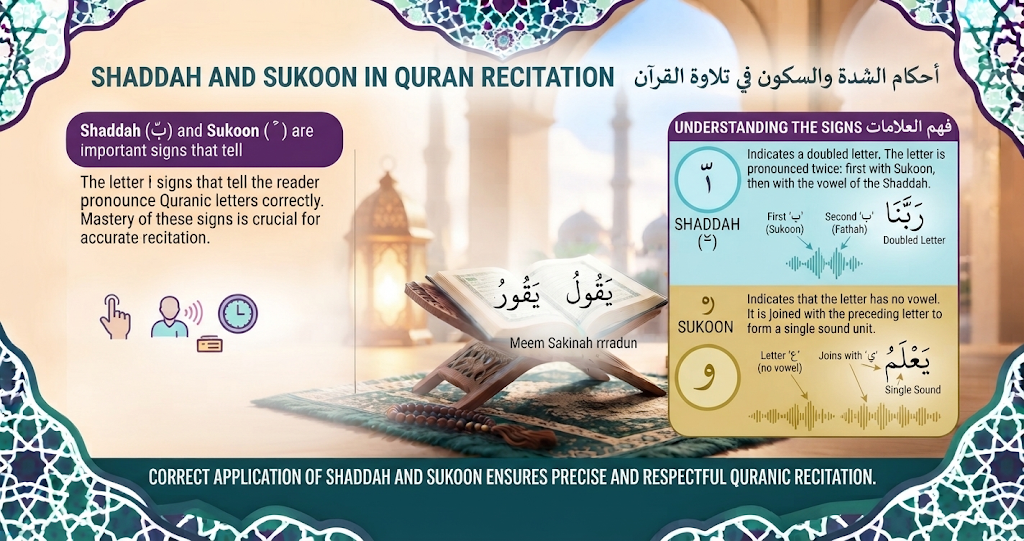
8. Shaddah and Sukoon in Quran Recitation
Shaddah (ّ) and Sukoon (ْ) are important signs that tell the reader how to pronounce Quranic letters correctly.
Shaddah
Shaddah indicates that a letter is doubled in pronunciation. The first part is treated as having Sukoon, while the second part carries the vowel sound. For example, when نّ or مّ appears with Shaddah, the letter is pronounced with a clear Ghunna.
Sukoon
Sukoon indicates that a letter has no vowel. The letter should be pronounced clearly and connected to the surrounding sounds without adding an extra vowel.
Recognizing these two signs helps beginners read Quranic words accurately and avoid changing the pronunciation of letters. They are especially important when applying other rules for Quran recitation, such as Ghunna, Qalqalah, and Idgham.
9. Waqf: Rules for Stopping During Quran Recitation
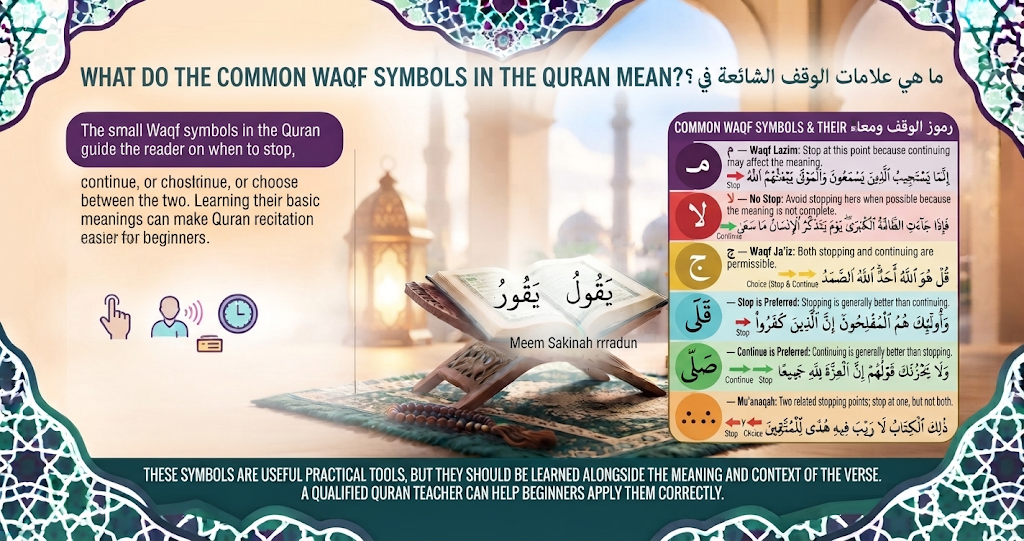
Waqf (الوقف) refers to stopping during Quran recitation. Knowing Waqf rules helps the reader pause at appropriate places without changing or confusing the intended meaning.
So The small Waqf symbols in the Quran guide the reader on when to stop, continue, or choose between the two. Learning their basic meanings can make Quran recitation easier for beginners.
- م – Waqf Lazim: Stop at this point because continuing may affect the meaning.
- لا – No Stop: Avoid stopping here when possible because the meaning is not complete.
- ج – Waqf Ja’iz: Both stopping and continuing are permissible.
- قلى – Stop is Preferred: Stopping is generally better than continuing.
- صلى – Continue is Preferred: Continuing is generally better than stopping.
- ∴ ∴ – Mu‘anaqah: Two related stopping points; stop at one, but not both.
These symbols are useful practical tools, but they should be learned alongside the meaning and context of the verse. A qualified Quran teacher can help beginners understand how to apply them correctly while reading.
How to Apply Quran Recitation Rules While Reading?
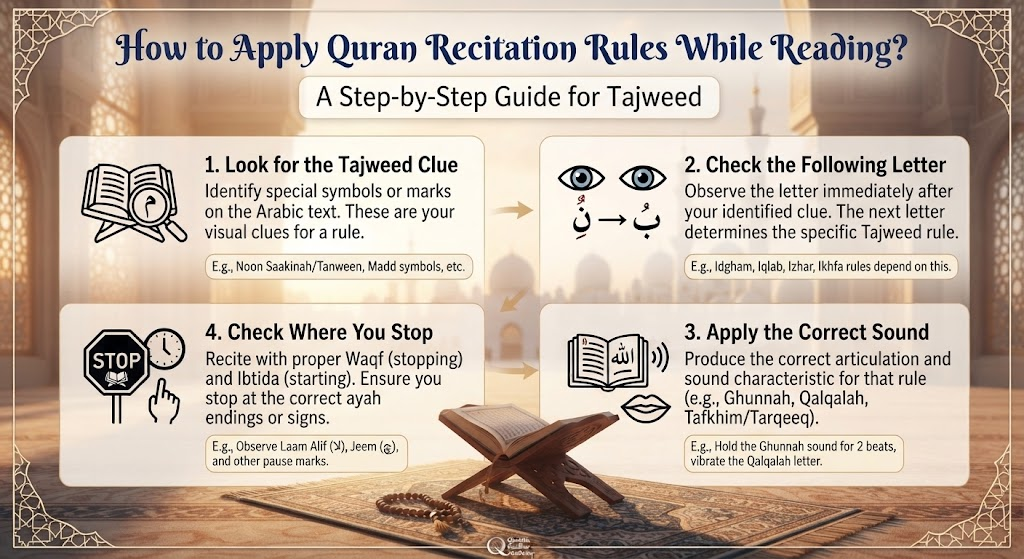
Knowing the rules for Quran recitation is only the first step. The real goal of Tajweed is to apply these rules naturally while reading the Quran. Beginners can use a simple process: observe the word, identify the Tajweed sign or letter combination, apply the rule, and then recite it carefully.
1. Look for the Tajweed Clue
Before reading a word, notice important signs such as Sukoon, Shaddah, Madd, or Tanween. These signs can tell you how a letter should be pronounced.
2. Check the Following Letter
This is especially important with Noon Sakinah, Tanween, and Meem Sakinah. The letter that follows determines whether you should use Izhar, Idgham, Iqlab, Ikhfaa, or another rule.
3. Apply the Correct Sound
Do not focus only on the written letters. Pay attention to Ghunna, Madd, Qalqalah, and the correct articulation point (Makharij). The aim is to give every letter its proper sound without exaggeration.
4. Check Where You Stop
When reaching the end of a phrase or verse, look at the Waqf symbol before stopping. A correct stop helps preserve the intended meaning and makes recitation clearer.
The Quran encourages careful and measured recitation:
أَوۡ زِدۡ عَلَيۡهِ وَرَتِّلِ ٱلۡقُرۡءَانَ تَرۡتِيلًا
“And recite the Quran with measured recitation.”
The Prophet ﷺ also said:
“الْمَاهِرُ بِالْقُرْآنِ مَعَ السَّفَرَةِ الْكِرَامِ الْبَرَرَةِ، وَالَّذِي يَقْرَأُ الْقُرْآنَ وَيَتَتَعْتَعُ فِيهِ، وَهُوَ عَلَيْهِ شَاقٌّ، لَهُ أَجْرَانِ”
“The one who is proficient in the Quran is with the noble and obedient angels.”
Sahih al-Bukhari and Sahih Muslim
Therefore, learning Tajweed is not simply about memorizing technical rules. It is about practicing them consistently until correct pronunciation becomes a natural part of Quran recitation.
What Are the Basic Etiquettes of Quran Recitation?
Alongside Tajweed rules, Muslims are encouraged to observe Adab, or proper etiquette, when reciting the Quran. These practices are not pronunciation rules, but they help create a respectful and focused environment for Quran reading.
Some basic etiquettes include:
- Purification: Performing Wudu is recommended before touching and reciting from a physical Mushaf.
- Cleanliness: Choose a clean and respectful place for Quran recitation.
- Seeking refuge: Begin by saying A‘udhu billahi min ash-shaytanir-rajim before recitation.
- Saying Bismillah: Say Bismillah ar-Rahman ar-Rahim when beginning a Surah, except for Surah At-Tawbah.
- Tarteel: Recite slowly and clearly, giving each letter and word its proper pronunciation.
- Reflection: Try to understand and reflect on the meanings of the verses rather than focusing only on speed.
These etiquettes complement the rules of recitation of Quran and help learners approach the Quran with greater respect, attention, and sincerity.
Shots Videos from Our Courses
Learn Quran Recitation Rules with Quran Reading Academy
Learning the rules for Quran recitation with a qualified teacher can help you build correct pronunciation and avoid mistakes that may become difficult to correct later. Quran Reading Academy provides online Quran learning designed to help students improve their recitation step by step.
Through personalized lessons, students can practice Tajweed, Makharij, Ghunna, Madd, Qalqalah, and Waqf while receiving direct feedback from a teacher. Lessons can be adapted to the learner’s level, whether they are beginning with Arabic letters or working on improving their existing Quran recitation skills.
With regular practice and guidance, you can develop greater accuracy, fluency, and confidence in reading the Quran.
Ready to improve your Quran recitation? Join Quran Reading Academy and start learning Tajweed with a qualified teacher today.
Start Your Quran Learning Journey Today
Join Quran Reading Academy and begin structured, step-by-step Quran reading with expert guidance.
Try your first class for freeStart Your Spiritual Journey with The Quran Reading Academy
Master Tajweed, memorize verses, and understand the deep meanings of the Quran from the comfort of your home. Whether you are an absolute beginner or looking to perfect your recitation, our expert tutors guide you every step of the way with personalized, one-on-one lessons. Join thousands of students globally and bring the light of the Quran into your daily life today.
Our Quran Courses
- Quran Reading Classes
- Quran Reading Classes for Kids
- Quran Reading Classes for Adults
- Quran Reading Classes for Female/Sisters
- Quran Reading Classes for New Muslims
- Quran Reading Course for Beginners
- Online Quran Reading Course with Tajweed
- Quran Recitation Course
- Quranic Arabic Course
- Arabic Reading Practice Course
Conclusion
Understanding the rules for Quran recitation is easier when you have a teacher who can listen to your reading, correct your pronunciation, and guide you through Tajweed step by step.
At Quran Reading Academy, you can learn Quran recitation online with qualified teachers and receive personalized guidance based on your current level. Whether you are a complete beginner or want to improve your Tajweed, regular one-on-one practice can help you recite the Quran with greater accuracy and confidence.
Start your Quran learning journey today. Book a trial class with Quran Reading Academy and take the first step toward better Quran recitation.
FAQs
What are the main rules for Quran recitation?
The main rules include Makharij, Sifaat, Noon Sakinah and Tanween, Meem Sakinah, Ghunna, Madd, Qalqalah, Shaddah, Sukoon, and Waqf.
Is Tajweed necessary for reading the Quran?
Learning Tajweed helps readers pronounce the Quran correctly and avoid pronunciation mistakes. Beginners should learn it gradually and practice with a qualified teacher whenever possible.
How long does it take to learn Quran recitation rules?
The time varies depending on your starting level, practice routine, and learning goals. Consistent practice with a qualified teacher can help you make steady progress.
Can beginners learn Tajweed online?
Yes. Beginners can learn Tajweed through online Quran classes with qualified teachers. Online lessons can provide structured practice, correction, and guidance from the comfort of home.
How can I improve my Quran recitation?
Practice regularly, listen carefully to skilled reciters, review Tajweed rules, and receive feedback from a qualified Quran teacher. Consistency is more important than trying to learn everything at once.








Leave a Reply