 Quran
If you are wondering what is a Surah in the Quran, a Surah is a chapter of the Holy Quran, and the Quran contains 114 Surahs in total. Each Surah is made up of verses called Ayahs, and the Surahs vary in length, themes, and purpose.
From Surah Al-Fatihah, the first Surah, to Surah An-Nas, the final Surah, each chapter carries important guidance and lessons for Muslims. In this guide, we’ll explore how many Surahs are in the Quran, their order, the longest and shortest Surahs, Makki and Madani Surahs, and answers to other common questions about the Quranic chapters.
What Is a Surah in the Quran?
A Surah is a chapter of the Quran. The Holy Quran contains 114 Surahs, and each Surah consists of individual verses known as Ayahs. Surahs differ in length, subject matter, and the themes they address, from faith and worship to stories of prophets, moral guidance, and laws.
Each Surah has its own name and number in the Quran. Some are very long, such as Surah Al-Baqarah, while others contain only a few verses, such as Surah Al-Kawthar.
The Surahs were revealed to Prophet Muhammad ﷺ over a period of approximately 23 years. They are traditionally classified as Makki or Madani based on their period of revelation.
Understanding what a Surah is provides a foundation for exploring the structure, order, and guidance of the Quran.
Quran Facts Every Beginner Should Know
If you are new to reading the Quran, a few basic terms can make its structure much easier to understand:
- Surah: A chapter of the Quran. There are 114 Surahs in the standard Mushaf.
- Ayah: An individual verse within a Surah. Each Surah contains a different number of Ayahs.
- Juz: One of 30 divisions of the Quran, created to make regular reading and completion of the Quran more manageable.
- Makki Surah: A Surah revealed before the Hijrah, regardless of the specific location of revelation.
- Madani Surah: A Surah revealed after the Hijrah, whether the revelation occurred in Medina or elsewhere.
- Mushaf: The written or compiled copy of the Quran containing all 114 Surahs in their standard order.
Understanding these terms helps beginners follow Quran lessons, reading plans, memorization programs, and discussions about the different Surahs more confidently.
How Are Surahs Named?
Each Surah in the Quran has a recognized name that helps identify it. Many Surah names come from a distinctive word, person, event, or subject mentioned in the Surah.
For example:
- Al-Baqarah means “The Cow” and refers to the story of the cow mentioned in the Surah.
- Al-Fil means “The Elephant” and refers to the event described at the beginning of the Surah.
- An-Nahl means “The Bee,” which is mentioned in the Surah.
- An-Nisa means “The Women” and includes important guidance concerning women and family matters.
- Al-Kahf means “The Cave,” referring to the story of the People of the Cave.
A Surah’s name does not necessarily describe its entire subject. It is often a distinctive identifier connected to something mentioned within the Surah.
Learning the meanings of Surah names can therefore help beginners recognize different chapters and remember some of the key themes associated with them.
How Many Surahs Are in the Quran?
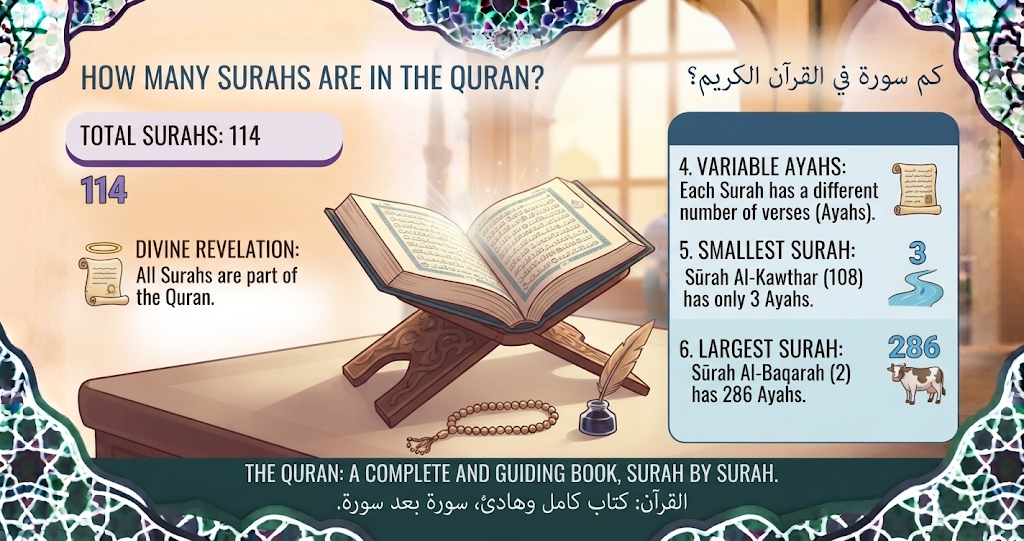
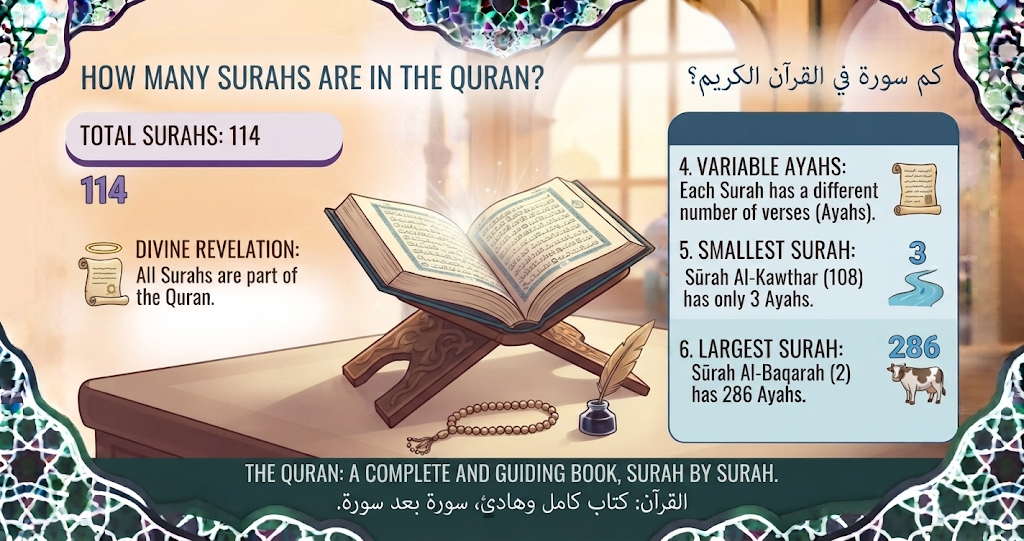
The Quran has 114 Surahs in total. Each Surah has a different number of Ayahs, ranging from just 3 verses in Surah Al-Kawthar to 286 verses in Surah Al-Baqarah, the longest Surah in the Quran.
The 114 Surahs cover a wide range of subjects, including faith, worship, morality, family life, history, and guidance for daily life. Some Surahs were revealed in Mecca before the Hijrah, while others were revealed in Medina after the migration of Prophet Muhammad ﷺ.
The Surahs are arranged in a specific order in the Quran, beginning with Surah Al-Fatihah and ending with Surah An-Nas.
What Is the Order of the Surahs in the Quran?
The order of Quranic Surahs refers to the arrangement of the 114 chapters in the Quran as it is read today. The Quran begins with starting with Al-Fatihah and ending with An-Nas.
The order of the Surahs is not simply based on the chronological order in which they were revealed. For example, Surah Al-Fatihah is the first Surah in the Quran, while some of the earliest revelations were from Surah Al-Alaq.
The Quranic Surahs are arranged as follows:
- Surah Al-Fatihah – the first Surah
- Surah Al-Baqarah – the second and longest Surah
- Surah Aal-Imran – the third Surah
- The remaining Surahs continue through the Quran until:
- Surah An-Nas – the 114th and final Surah
This arrangement allows Muslims to read and recite the Quran according to its established structure. The Surahs also vary greatly in length, with longer chapters generally appearing earlier and shorter Surahs appearing toward the end, particularly in Juz Amma.
It is important to distinguish the order of the Surahs in the Quran from the chronological order of revelation. Studying both can help readers of the Quran better understand the historical context and development of Quranic revelation.
List of Surahs in the Quran
The Quran contains 114 Surahs, each with its own name and number. Below is the complete list of Surahs in the Quran in their standard order:
- Al-Fatihah
- Al-Baqarah
- Aal-Imran
- An-Nisa
- Al-Ma’idah
- Al-An’am
- Al-A’raf
- Al-Anfal
- At-Tawbah
- Yunus
- Hud
- Yusuf
- Ar-Ra’d
- Ibrahim
- Al-Hijr
- An-Nahl
- Al-Isra
- Al-Kahf
- Maryam
- Ta-Ha
- Al-Anbiya
- Al-Hajj
- Al-Mu’minun
- An-Nur
- Al-Furqan
- Ash-Shu’ara
- An-Naml
- Al-Qasas
- Al-Ankabut
- Ar-Rum
- Luqman
- As-Sajdah
- Al-Ahzab
- Saba
- Fatir
- Ya-Sin
- As-Saffat
- Sad
- Az-Zumar
- Ghafir
- Fussilat
- Ash-Shura
- Az-Zukhruf
- Ad-Dukhan
- Al-Jathiyah
- Al-Ahqaf
- Muhammad
- Al-Fath
- Al-Hujurat
- Qaf
- Adh-Dhariyat
- At-Tur
- An-Najm
- Al-Qamar
- Ar-Rahman
- Al-Waqi’ah
- Al-Hadid
- Al-Mujadilah
- Al-Hashr
- Al-Mumtahanah
- As-Saff
- Al-Jumu’ah
- Al-Munafiqun
- At-Taghabun
- At-Talaq
- At-Tahrim
- Al-Mulk
- Al-Qalam
- Al-Haqqah
- Al-Ma’arij
- Nuh
- Al-Jinn
- Al-Muzzammil
- Al-Muddaththir
- Al-Qiyamah
- Al-Insan
- Al-Mursalat
- An-Naba
- An-Nazi’at
- Abasa
- At-Takwir
- Al-Infitar
- Al-Mutaffifin
- Al-Inshiqaq
- Al-Buruj
- At-Tariq
- Al-A’la
- Al-Ghashiyah
- Al-Fajr
- Al-Balad
- Ash-Shams
- Al-Layl
- Ad-Duha
- Ash-Sharh
- At-Tin
- Al-Alaq
- Al-Qadr
- Al-Bayyinah
- Az-Zalzalah
- Al-Adiyat
- Al-Qari’ah
- At-Takathur
- Al-Asr
- Al-Humazah
- Al-Fil
- Quraysh
- Al-Ma’un
- Al-Kawthar
- Al-Kafirun
- An-Nasr
- Al-Masad
- Al-Ikhlas
- Al-Falaq
- An-Nas
This list of Surahs in the Quran follows the standard order used in printed copies of the Mushaf. The Surahs range from very long chapters such as Al-Baqarah to short Surahs such as Al-Kawthar, Al-Ikhlas, Al-Falaq, and An-Nas.
What Is the Difference Between a Surah, Ayah, and Juz?
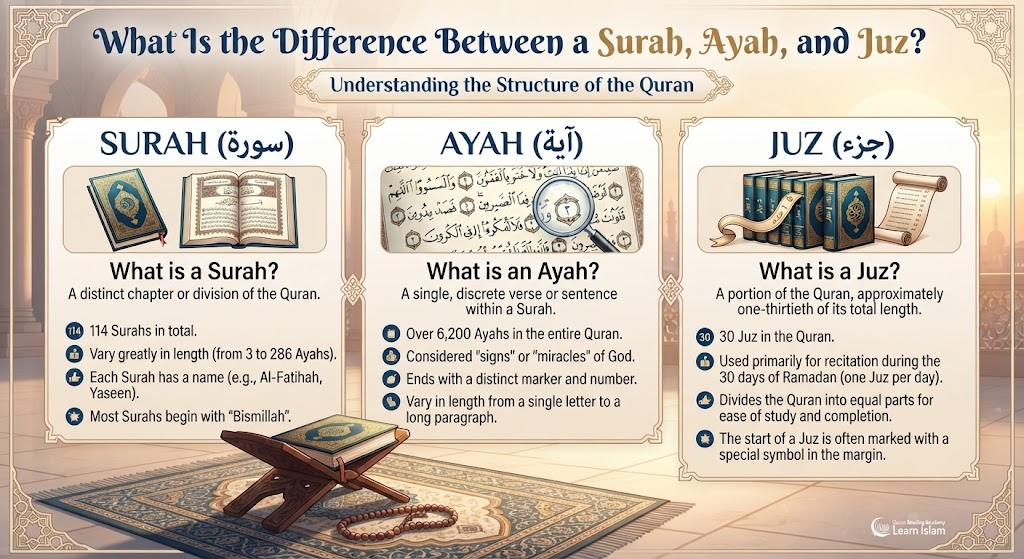
Beginners often see the terms Surah, Ayah, and Juz when reading or studying the Quran. They refer to different parts of the Quran:
| Term | What It Means | Example |
|---|---|---|
| Surah | A chapter of the Quran | Surah Al-Fatihah |
| Ayah | A verse within a Surah | Ayah 1 of Al-Fatihah |
| Juz | One of 30 divisions used to organize Quran reading | Juz Amma |
A Surah can contain many Ayahs, while a Juz may include parts of several Surahs. These divisions make it easier to reference, read, memorize, and organize the Quran.
Beginner takeaway: Think of a Surah as a chapter, an Ayah as a verse, and a Juz as a reading division of the Quran.
What Is the First Surah in the Quran?
The first Surah in the Quran is Surah Al-Fatihah, which means “The Opening.” It is Surah 1 and consists of 7 Ayahs. Al-Fatihah is one of the most important Surahs in Islam and is recited during every unit (Rak’ah) of the obligatory prayer. It praises Allah, asks for His guidance, and teaches Muslims to seek the straight path.
Although Al-Fatihah appears first in the Quran, it was not necessarily the first Surah to be revealed chronologically. The first verses revealed to Prophet Muhammad ﷺ were from Surah Al-Alaq.
Because of its central role in Salah and its concise message of worship and guidance, Surah Al-Fatihah is also known as Umm Al-Kitab (Mother of the Book).
What Is the Longest Surah in the Quran?
The longest Surah in the Quran is Surah Al-Baqarah, which is the second Surah in the Mushaf and contains 286 Ayahs. Surah Al-Baqarah covers a wide range of topics, including faith, worship, Islamic law, family matters, charity, fasting, and guidance for believers. It also contains important passages such as Ayat al-Kursi (2:255) and the final two verses of the Surah.
Its length reflects the variety of guidance and subjects it addresses. However, a Surah’s length does not determine its importance; every Surah of the Quran contains valuable guidance and lessons for Muslims.
What Is the Second-Longest Surah in the Quran?
The second-longest Surah in the Quran is Surah Al-A’raf, which contains 206 Ayahs. It is the seventh Surah in the Quran. Surah Al-A’raf discusses faith, accountability, the stories of several prophets and their peoples, and the consequences of accepting or rejecting divine guidance.
What Is the Shortest Surah in the Quran?
The shortest Surah in the Quran is Surah Al-Kawthar, which is Surah 108 and contains only 3 Ayahs. Despite its brevity, it carries a powerful message about Allah’s blessings and encourages sincere worship and gratitude.
Surah Al-Kawthar was revealed to Prophet Muhammad ﷺ and reminds believers of the abundant goodness Allah has granted. It concludes with a warning concerning those who oppose the Prophet.
Because of its short length and memorable verses, Surah Al-Kawthar is one of the short Surahs commonly learned and memorized by beginners when studying Quran reading and memorization.
What Are the Short Surahs From the Quran?
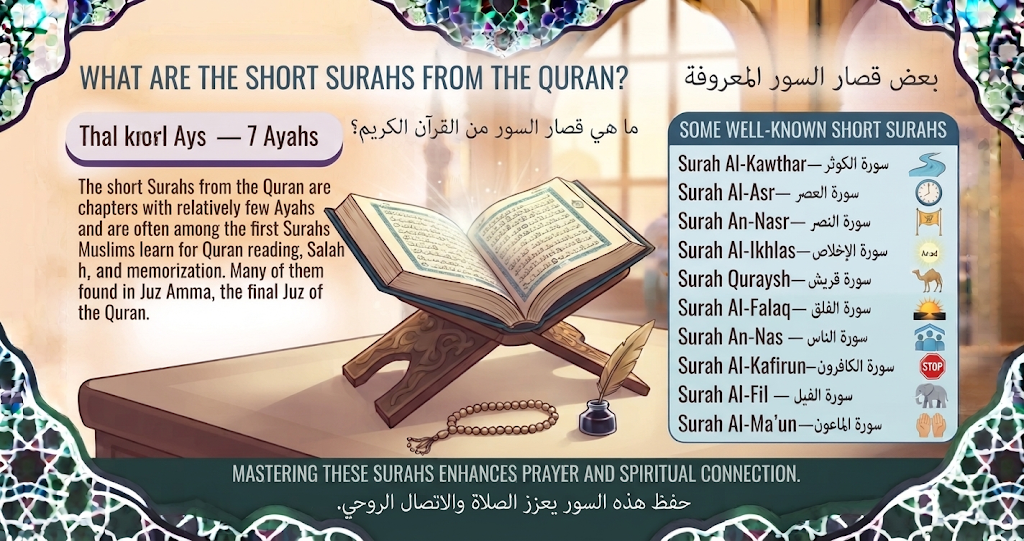
The short Surahs from the Quran are chapters with relatively few Ayahs and are often among the first Surahs Muslims learn for Quran reading, Salah, and memorization. Many of them are found in Juz Amma, the final Juz of the Quran.
Some well-known short Surahs include:
- Surah Al-Kawthar – 3 Ayahs
- Surah Al-Asr – 3 Ayahs
- Surah An-Nasr – 3 Ayahs
- Surah Al-Ikhlas – 4 Ayahs
- Surah Quraysh – 4 Ayahs
- Surah Al-Falaq – 5 Ayahs
- Surah An-Nas – 6 Ayahs
- Surah Al-Kafirun – 6 Ayahs
- Surah Al-Fil – 5 Ayahs
- Surah Al-Ma’un – 7 Ayahs
These Surahs are short in length but contain important lessons about faith, worship, reliance on Allah, morality, and seeking His protection. Learning them can be a useful starting point for beginners who are developing their Quran reading and memorization skills.
How Many Makki and Madani Surahs Are in the Quran?
The Quran is traditionally divided into Makki and Madani Surahs based on when they were revealed in relation to the Hijrah, the migration of Prophet Muhammad ﷺ from Mecca to Medina.
A commonly cited traditional classification is:
- 86 Makki Surahs – revealed before the Hijrah.
- 28 Madani Surahs – revealed after the Hijrah.
- 114 Surahs in total.
What Are Makki Surahs?
Makki Surahs are those revealed before the Hijrah, even if the revelation occurred outside Mecca. They often emphasize Tawhid, faith, the Hereafter, accountability, and stories of earlier prophets and nations.
What Are Madani Surahs?
Madani Surahs are those revealed after the Hijrah, even if the revelation occurred outside Medina. They frequently address worship, family matters, community life, laws, social responsibilities, and relations between Muslims and other communities.
The Makki and Madani classification helps readers understand the historical context and themes of Quranic revelation. However, scholars have discussed some classifications differently, so the 86/28 division is best understood as the commonly cited traditional count.
Start Your Quran Learning Journey Today
Join Quran Reading Academy and begin structured, step-by-step Quran reading with expert guidance.
Try your first class for freeWhich Surah Is the Heart of the Quran?
Surah Ya-Sin is popularly known as the “Heart of the Quran” (Qalb al-Quran) in Islamic tradition. It is the 36th Surah of the Quran and contains 83 Ayahs.
Surah Ya-Sin focuses on important themes such as belief in Allah, the message of the prophets, resurrection, accountability, and Allah’s signs in creation. Its powerful reminders encourage believers to reflect on faith and the Hereafter.
It is important to note that calling Ya-Sin the “Heart of the Quran” is a well-known traditional description, rather than a title explicitly given to the Surah in the Quran itself. Muslims can benefit from reading and reflecting on every Surah, as each chapter contains guidance and lessons.
Which Surah Is Equal to One-Third of the Quran?
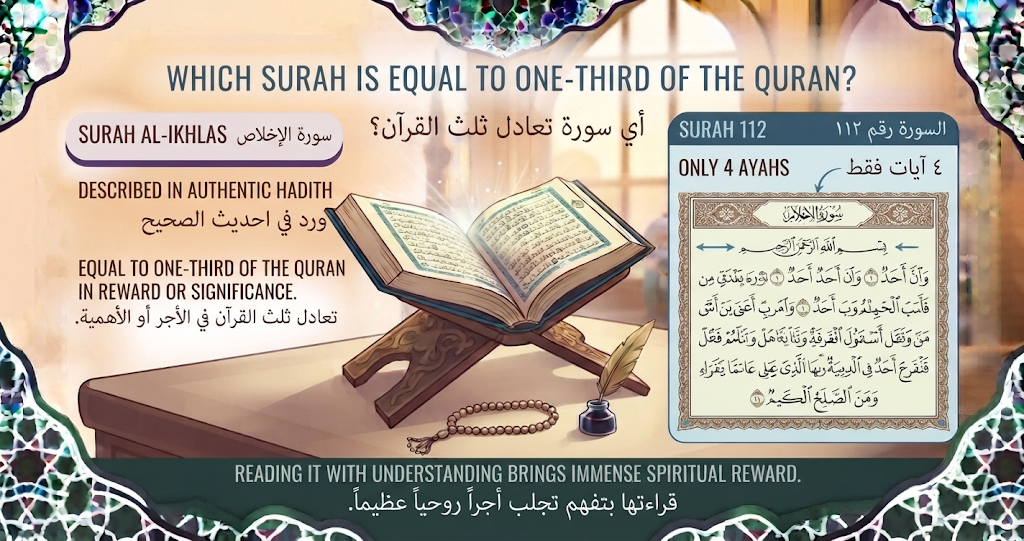
Surah Al-Ikhlas is the Surah described in authentic Hadith as being equal to one-third of the Quran in reward or significance. It is Surah 112 and contains only 4 Ayahs.
The Surah focuses on the oneness and uniqueness of Allah, emphasizing that Allah is One, self-sufficient, and unlike His creation.
The Prophet Muhammad ﷺ taught that Surah Al-Ikhlas is equivalent to one-third of the Quran. This does not mean that reciting it literally replaces reading one-third of the Quran; rather, the Hadith highlights its exceptional virtue and the importance of the Tawhid it expresses.
What Is the Greatest Surah in the Holy Quran?
Surah Al-Fatihah is described as the greatest Surah in the Quran in an authentic Hadith. It is the first Surah of the Quran and contains 7 Ayahs.
Al-Fatihah is also known as Umm Al-Kitab and Umm Al-Quran. It praises Allah, affirms His mercy and authority, and asks Him to guide believers to the straight path.
Its central role in Salah further highlights its importance. Muslims recite Al-Fatihah in every Rak’ah of their prayer, making it one of the most frequently recited passages of the Quran.
While Al-Fatihah has a special distinction as the greatest Surah, every Surah of the Quran is part of Allah’s revelation and contains valuable guidance for believers.
What Is the Most Important Surah in the Quran?
If by “most important Surah in the Quran” you mean the Surah specifically described as the greatest, the answer is Surah Al-Fatihah. It is the opening chapter of the Quran, contains 7 Ayahs, and has a central place in Muslim worship.
Al-Fatihah summarizes essential themes of the Quran, including praising Allah, worshipping Him alone, seeking His mercy, and asking for guidance to the straight path. It is also recited in every Rak’ah of Salah.
However, it is important not to treat the other Surahs as less valuable. Every Surah of the Quran has its own guidance, lessons, and wisdom, and Muslims are encouraged to read, understand, and reflect on the Quran as a whole.
Start Your Quran Learning Journey Today
Join Quran Reading Academy and begin structured, step-by-step Quran reading with expert guidance.
Try your first class for freeWhat Is the Most Beautiful Surah of the Quran?
There is no single Surah officially designated as the “most beautiful Surah” of the Quran. Beauty is partly a matter of personal reflection, and Muslims may connect deeply with different Surahs depending on their circumstances and the lessons they need.
Some Surahs are especially loved for their powerful themes and beautiful meanings. For example, Surah Ar-Rahman repeatedly reminds believers of Allah’s blessings, while Surah Yusuf presents the story of Prophet Yusuf and highlights patience, trust in Allah, forgiveness, and hope.
Surah Al-Fatihah, Surah Al-Ikhlas, and Surah Ya-Sin are also widely cherished for their profound messages and spiritual impact.
Rather than looking for one objectively “most beautiful” Surah, Muslims can benefit from reading different Surahs with understanding, reflection, and sincere devotion.
What Is the Last Surah of the Holy Quran?
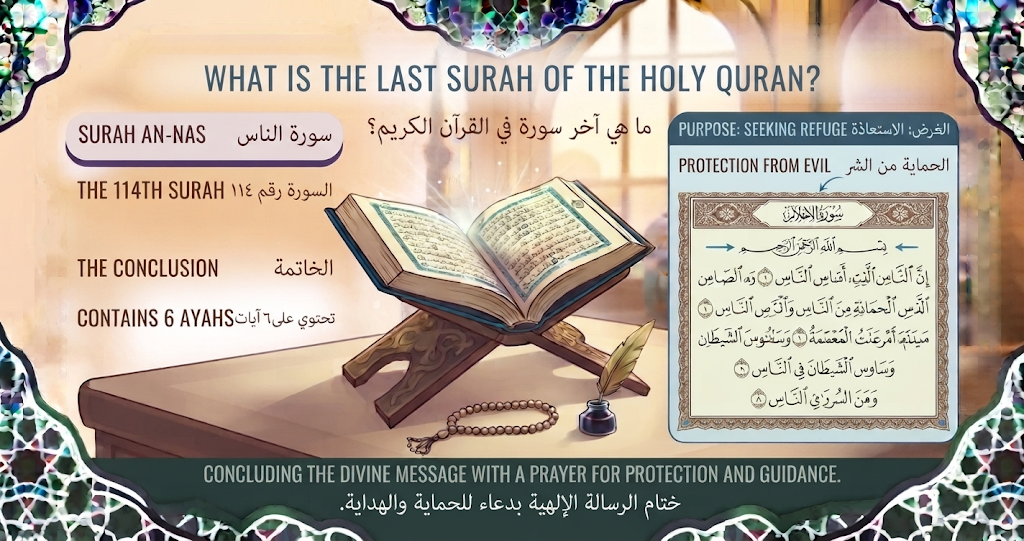
The last Surah of the Holy Quran is Surah An-Nas, which is Surah 114 and contains 6 Ayahs. It is the final chapter in the standard order of the Quran.
Surah An-Nas teaches believers to seek protection in Allah, the Lord, King, and God of humanity, from the evil of the whisperer who influences people’s hearts and minds.
It is important to distinguish the order of the Quran from the chronological order of revelation. An-Nas is the final Surah in the Mushaf, but this does not mean it was the last Surah revealed to Prophet Muhammad ﷺ.
Together with Surah Al-Falaq, it is one of the two protective Surahs known as Al-Mu’awwidhatayn, which Muslims commonly recite for seeking Allah’s protection.
Why Are the Surahs of the Quran Different in Length and Subject?
The Surahs of the Quran differ in length, subject, style, and structure because the Quran provides guidance for many different aspects of human life. Some Surahs focus on faith and the Hereafter, while others discuss worship, morality, laws, family matters, or the stories of prophets and earlier nations.
For example, Surah Al-Baqarah is the longest Surah and covers a wide range of guidance, including worship, fasting, charity, family matters, and community responsibilities. In contrast, short Surahs such as Al-Ikhlas, Al-Falaq, and An-Nas communicate powerful spiritual messages in only a few verses.
The difference in length does not mean that longer Surahs are more important than shorter ones. Every Surah is part of the Quran and carries its own lessons and guidance.
Reading different Surahs with understanding allows Muslims to explore the Quran’s diverse messages and apply its teachings to their faith and daily lives.
Short Videos from Our Courses
Learn to Read and Understand the Quran With Quran Reading Academy
Understanding what a Surah is is only the first step toward building a stronger connection with the Quran. At Quran Reading Academy, students can develop their Quran reading skills through structured online Quran classes designed to make learning accessible and engaging.
Whether you are a beginner learning how to read the Quran, looking to improve your Tajweed, or working toward Quran memorization, learning with a qualified teacher can help you progress with greater confidence.
With online Quran lessons, you can learn from home while receiving guidance tailored to your learning level and goals. Regular practice can help you improve your pronunciation, recitation, understanding, and relationship with the Quran.
Start your Quran learning journey with Quran Reading Academy and take the next step toward reading the Quran with confidence and understanding.
Start Your Quran Learning Journey Today
Join Quran Reading Academy and begin structured, step-by-step Quran reading with expert guidance.
Try your first class for freeConclusion
A Surah is a chapter of the Quran, and the Holy Quran contains 114 Surahs, each offering its own guidance, lessons, and spiritual meaning. From Al-Fatihah, the first Surah, to An-Nas, the final Surah, the Quran provides guidance on faith, worship, morality, and daily life.
Whether you are beginning with short Surahs such as Al-Kawthar and Al-Ikhlas or studying longer chapters such as Al-Baqarah, reading with understanding and reflection can deepen your connection with Allah.
If you want to improve your Quran reading, Tajweed, or memorization, Quran Reading Academy can help you learn with structured online Quran lessons and guidance from qualified teachers.
FAQs
What Is the Longest Surah in the Quran?
Surah Al-Baqarah is the longest Surah, with 286 Ayahs.
What Is the Shortest Surah in the Quran?
Surah Al-Kawthar is the shortest Surah, containing 3 Ayahs.
Which Surah Is Equal to One-Third of the Quran?
Surah Al-Ikhlas is described in authentic Hadith as being equivalent to one-third of the Quran in virtue.
Which Surah Is Considered the Greatest?
Surah Al-Fatihah is described as the greatest Surah in the Quran and holds a central role in Salah.
How Many Makki and Madani Surahs Are There?
The commonly cited traditional classification includes 86 Makki Surahs and 28 Madani Surahs, making 114 in total.
What Are Some Short Surahs to Memorize?
Popular short Surahs for learning and memorization include Al-Kawthar, Al-Ikhlas, Al-Falaq, An-Nas, Al-Asr, An-Nasr, Al-Kafirun, and Quraysh. Many are found in Juz Amma and are commonly taught to beginners.


Leave a Reply