 Quran

Learning to read the Yaseen Surah with Tajweed can seem challenging at first, especially if you are still building your Arabic pronunciation and Quran recitation skills. However, you can learn it gradually by focusing on correct letter pronunciation, basic Tajweed rules, listening to accurate recitation, and practicing a few verses at a time.
Surah Yaseen contains several Tajweed rules that are important to recognize and apply correctly. With consistent practice and guidance from a qualified Quran teacher, beginners can improve their recitation and read Surah Yaseen more accurately and confidently.
1. Listen to Surah Yaseen Before Reading
Start by listening carefully to Surah Yaseen from a qualified Quran reciter while following the verses in your Mushaf. Do not focus only on memorizing the words or following the general rhythm. Listen for how each Arabic letter is pronounced, where sounds are extended, where Ghunnah is applied, and where the reciter stops and continues.
Choose one reliable reciter and listen to the same passage several times. Consistency makes it easier to recognize the correct pronunciation and prevents you from copying different recitation patterns from multiple sources.
After listening, read the same verses yourself and try to reproduce what you heard. This listen-and-repeat approach can help train your ear before you begin working independently.
2. Start With a Small Number of Verses
Avoid trying to learn the entire Surah in one session. Instead, divide Surah Yaseen into small sections and concentrate on a few verses at a time.
For each section, first read the verses slowly from the Mushaf. Identify words that are difficult to pronounce and mark the places where specific Tajweed rules occur. Then repeat the same verses until you can read them without constantly stopping to think about every letter.
A short, focused practice session is often more effective than spending a long time reading while repeating the same mistakes. Once you become comfortable with one group of verses, move to the next and periodically review the previous section.
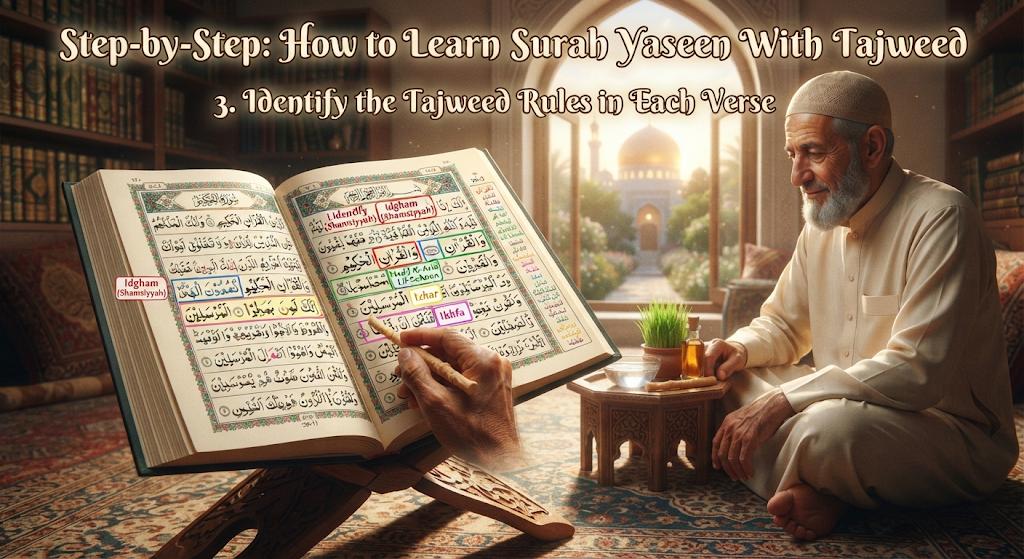
3. Identify the Tajweed Rules in Each Verse
learning to read the Yaseen Surah with tajweed rules rather than simply trying to imitate the sound. This will help you understand why a word is recited in a particular way.
Pay particular attention to rules such as:
- Noon Sakinah and Tanween, including Izhar, Idgham, Iqlab, and Ikhfa.
- Meem Sakinah, including the rules that affect its pronunciation before different letters.
- Madd, which determines when and how sounds are prolonged.
- Ghunnah, especially in places where nasalization is required.
- Qalqalah, where certain letters produce a characteristic echoing sound when the relevant conditions are present.
- Waqf and Ibtida, which help you understand appropriate stopping and starting points.
You do not need to memorize every Tajweed rule before beginning Surah Yaseen. Learn the rules progressively and immediately apply them to the verses you are practicing.
4. Practice Each Verse Slowly and Repeatedly
Once you know the relevant rules, practice each verse at a controlled pace. Begin by reading the verse carefully, giving attention to the articulation of every letter and the correct application of Tajweed.
If a particular word or phrase is difficult, isolate it and repeat it several times before returning to the complete verse. You can also divide a longer verse into smaller phrases, practice each phrase separately, and then connect them.
Do not increase your reading speed simply because you can pronounce the words. Your first goal should be accuracy and consistency. As your pronunciation improves, you can gradually make your recitation more fluent without sacrificing Tajweed.
5. Record Yourself and Compare Your Recitation
Recording your own recitation is a useful way to become aware of mistakes. When you are reading aloud, you may not notice that you are shortening a Madd, rushing a Ghunnah, mispronouncing an Arabic letter, or stopping at an unsuitable point.
Learning to read the Yaseen Surah with tajweed: After recording a passage, listen to it alongside the recitation of a qualified Qari. Compare specific details rather than judging your voice generally. Ask yourself:
- Are the Arabic letters pronounced correctly?
- Are the required sounds extended properly?
- Am I applying Ghunnah where it is required?
- Am I producing Qalqalah correctly without adding an extra vowel?
- Are my stops and continuations appropriate?
- Am I reading smoothly without rushing?
Write down the mistakes you notice and focus on correcting them during your next practice session. This turns recording from simple repetition into purposeful practice.
Start Your Quran Learning Journey Today
Join Quran Reading Academy and begin structured, step-by-step Quran reading with expert guidance.
Try your first class for free6. Get Your Recitation Corrected by a Qualified Teacher
Learning to read the Yaseen Surah with tajweed: Listening and self-practice can take you a long way, but they cannot always identify subtle pronunciation errors. A qualified Quran or Tajweed teacher can listen to your recitation and correct mistakes in Makharij, letter characteristics, Tajweed rules, elongation, and stopping points.
Teacher feedback is especially valuable when you are learning Surah Yaseen as a beginner because incorrect pronunciation can become a habit if it is repeated without correction.
Ideally, practice your assigned verses before each lesson and use the lesson to identify the areas that need improvement. Your teacher can then give you specific exercises and guide you toward more accurate recitation.
With this approach, learning Surah Yaseen with Tajweed becomes a gradual process: listen, understand, practice, record, receive correction, and review. Over time, these steps can help you develop a more accurate and confident Quran recitation.

A Practical Tajweed Practice Plan for Surah Yaseen
A structured practice routine can help you apply Tajweed rules more consistently while learning Surah Yaseen. Rather than reading without a specific goal, use each session to focus on pronunciation, recognize relevant rules, and correct mistakes.
Follow This Routine During Each Practice Session
- Listen first: Play a short passage from a qualified Quran reciter while following the Arabic text in your Mushaf.
- Review the Tajweed rules: Identify the rules you will focus on, such as Madd, Ghunnah, or Noon Sakinah and Tanween.
- Practice the passage: Recite the selected verses slowly, paying attention to letter articulation and the correct application of each rule.
- Check difficult words: Repeat challenging words or phrases and seek correction if you are unsure about their pronunciation.
- Review before finishing: Revisit the same passage and note which mistakes you corrected and which still need attention.
How Can You Tell If You Are Improving?
Do not measure progress only by how many verses you can read. Check whether your letter pronunciation is becoming more accurate, whether you can apply the rules more consistently, and whether you are recognizing mistakes that previously went unnoticed.
If possible, ask a qualified Quran teacher to assess your recitation regularly. This helps ensure that your progress reflects improved accuracy, not simply increased familiarity with the verses.

How to Practice Tajweed Using a Color-Coded Mushaf
A color-coded Tajweed Mushaf can help you recognize certain recitation rules while learning to read Surah Yaseen. The colors provide visual cues that make it easier to notice where specific rules may apply, but you still need to understand how each rule affects pronunciation.
1. Understand What the Colors Represent
Tajweed Mushafs may use different colors to highlight rules such as Ghunnah, Madd, and Noon Sakinah, or Tanween. However, color systems are not identical across all editions, so check the legend provided with your Mushaf before using it.
2. Identify the Rule Before Reciting
When you notice a highlighted word or letter, pause briefly to identify the rule it represents. For example, ask yourself whether the passage requires nasalization, elongation, or a particular pronunciation of Noon Sakinah or Tanween. This helps you connect the written text with the rule instead of relying on colors alone.
3. Listen and Apply the Rule
Listen to a qualified reciter reading the same passage, follow the Arabic text, and pay attention to how the highlighted rule sounds. Then recite the passage yourself, applying the rule as accurately as you can.
4. Use the Mushaf as a Learning Aid, Not a Replacement for Instruction
Color coding can help you notice Tajweed patterns, but it cannot teach you every detail of correct pronunciation. You may still need guidance with letter articulation, the length of Madd, and appropriate stopping points.
Choose a short passage from Surah Yaseen, identify two or three rules in it, and focus on applying them correctly before moving to a new passage. As your understanding improves, you will become better at recognizing Tajweed rules while reading.

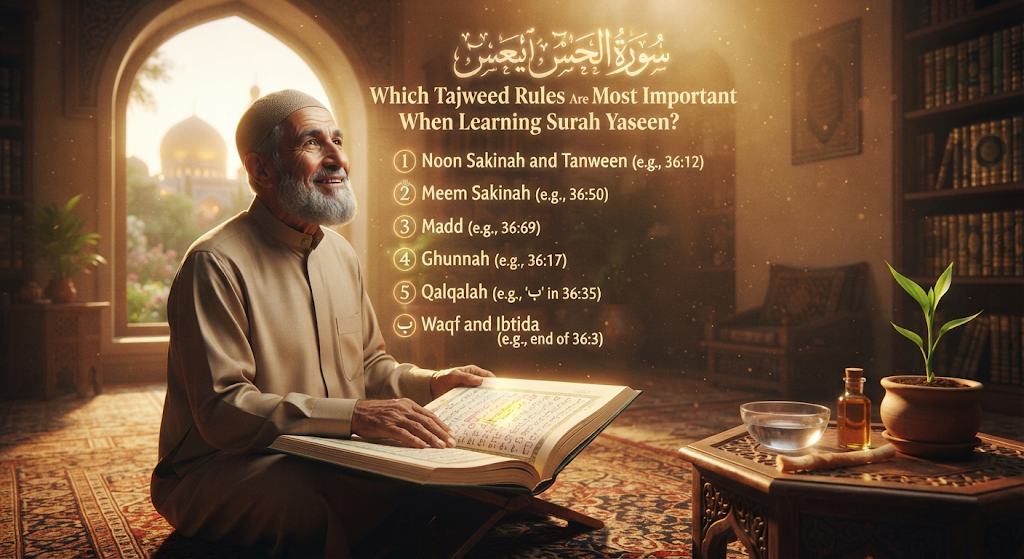
Which Tajweed Rules Are Most Important When Learning Surah Yaseen?
You do not need to master every Tajweed rule before starting Surah Yaseen. However, learning the rules that commonly appear while reciting the Surah will help you understand why certain letters are pronounced, merged, hidden, nasalized, or prolonged.
Here are some of the most important rules to focus on:
Noon Sakinah and Tanween
Noon Sakinah (نْ) and Tanween (ــًــٍــٌ) have different pronunciation rules depending on the letter that follows them. The main rules include Izhar, Idgham, Iqlab, and Ikhfa.
Learning to read the Yaseen Surah with tajweed: For a beginner, the important point is not simply memorizing their names. You should learn how each rule sounds and then identify examples while practicing Surah Yaseen. This will help you avoid reading every Noon Sakinah or Tanween in the same way.
Meem Sakinah
Meem Sakinah (مْ) also has specific rules depending on the following letter. These rules affect how clearly the Meem is pronounced and whether a nasal sound is involved.
Practice these rules directly from the verses of Surah Yaseen. Listening to a qualified reciter while following the Mushaf can make the differences much easier to hear.
Madd
Madd refers to elongating certain vowel sounds during Quranic recitation. Different types of Madd require different lengths of elongation, so learners should avoid treating every long sound in the same way.
When practicing Surah Yaseen, listen carefully to the length of the Madd and try to reproduce it consistently. A Tajweed teacher can help you distinguish between the different types and correct your timing.
Ghunnah
Ghunnah is a nasal sound that is an important part of several Tajweed rules. It should be produced correctly without rushing it or extending it beyond what the rule requires.
Beginners often focus heavily on the mouth movement while overlooking the nasal sound. Listening closely to an experienced Qari and practicing the relevant words repeatedly can help develop better control.
Qalqalah
Qalqalah is associated with the letters ق، ط، ب، ج، د when they occur with Sukoon under the applicable conditions. It produces a characteristic slight echoing or bouncing quality in the sound.
One common mistake is to turn Qalqalah into an additional vowel sound. Practice producing the required echo clearly while keeping the original letter sound intact.
Waqf and Ibtida
Learning to read the Yaseen Surah with tajweed is not limited to individual letters and sounds. Waqf refers to stopping during recitation, while Ibtida concerns beginning or resuming recitation appropriately.
Pay attention to the stopping signs in your Mushaf and avoid stopping randomly in a way that disrupts the meaning of the verse. As you progress, learning the basic rules of Waqf and Ibtida will make your recitation more accurate and natural.
The best way to master these rules is to learn them gradually and immediately apply them while reading Surah Yaseen. Instead of memorizing long theoretical explanations, connect each Tajweed rule to an actual word or verse and practice it repeatedly.
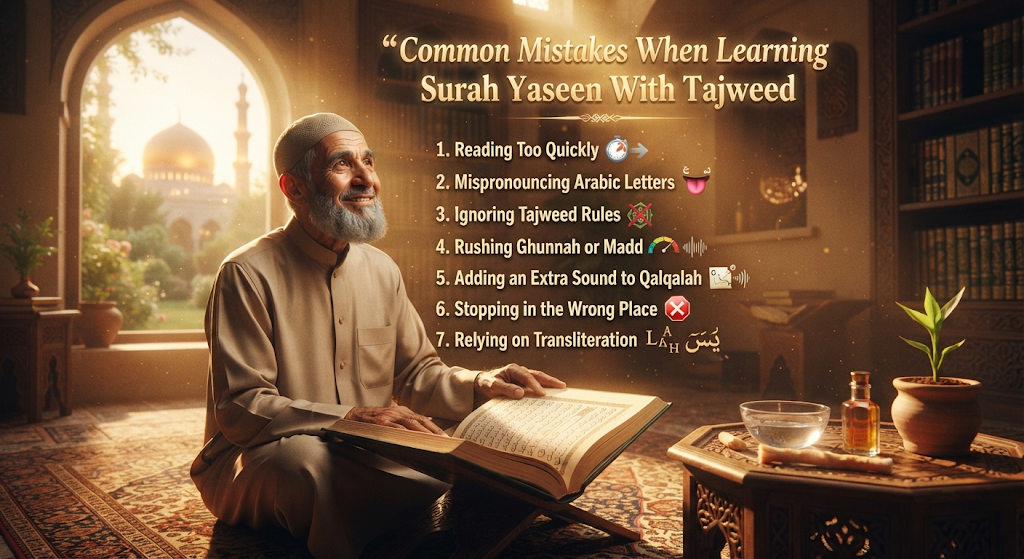
Common Mistakes When Learning Surah Yaseen With Tajweed
When learning to read the Yaseen Surah with tajweed, beginners can develop incorrect habits without realizing it. Recognizing these mistakes early can make your practice more effective and help you improve your recitation.
1. Reading Too Quickly
Trying to finish a large portion of Surah Yaseen quickly can cause you to overlook pronunciation, Madd, Ghunnah, and other Tajweed rules. Focus on accuracy first and increase your speed only when your recitation becomes consistent.
2. Mispronouncing Arabic Letters
Some Arabic letters have similar sounds but different articulation points and characteristics. Mispronouncing them can affect the accuracy of Quran recitation. Practice difficult letters separately and seek correction from a qualified teacher when necessary.
3. Ignoring Tajweed Rules
Simply reading the words correctly from the Mushaf does not mean that the recitation is being performed with Tajweed. Pay attention to the rules within each verse and practice applying them naturally rather than treating Tajweed as something separate from reading.
4. Rushing Ghunnah or Madd
Learners may shorten required sounds or extend them unnecessarily. Both can affect the quality and accuracy of recitation. Listen carefully to a qualified reciter and practice maintaining consistent timing.
5. Adding an Extra Sound to Qalqalah
Qalqalah should produce its characteristic sound without turning the letter into a new vowel sound. This is a common issue for beginners and is best corrected through repeated listening and teacher feedback.
6. Stopping in the Wrong Place
Stopping randomly can interrupt the meaning or structure of a verse. Pay attention to the Waqf signs in your Mushaf and gradually learn the basic principles of appropriate stopping and continuation.
7. Relying on Transliteration
Transliteration may help someone recognize a word temporarily, but it cannot accurately represent all Arabic pronunciation and Tajweed rules. Whenever possible, learn to read directly from the Arabic Mushaf and use a teacher to improve your pronunciation.
Avoiding these mistakes requires patience and consistent practice. The goal is not to recite Surah Yaseen quickly, but to build accurate pronunciation and Tajweed habits that you can carry into your wider Quran reading.
Can You Learn Surah Yaseen With Tajweed on Your Own?
Yes, you can begin learning to read the Yaseen Surah with Tajweed on your own, especially if you already know how to read Arabic and understand some basic Tajweed rules. Listening to qualified reciters, using a Tajweed Mushaf, and practicing verse by verse can give you a strong starting point.
However, self-study has an important limitation: you may not recognize your own pronunciation mistakes. Some errors in the articulation of Arabic letters, Ghunnah, Madd, or Qalqalah can sound correct to the learner even when they need correction.
For this reason, it is better to combine independent practice with guidance from a qualified Quran teacher. You can study the rules and practice between lessons, then have your teacher listen to your recitation and correct the areas that need improvement.
If you are a complete beginner, teacher guidance can be particularly helpful because it allows you to develop correct pronunciation habits from the beginning. If you already have a good foundation in Quran reading, self-study can complement your regular Tajweed lessons.
The goal is not simply to finish reading Surah Yaseen, but to develop accurate and consistent Quran recitation that you can continue applying to other Surahs.
Start Your Quran Learning Journey Today
Join Quran Reading Academy and begin structured, step-by-step Quran reading with expert guidance.
Try your first class for freeHow Long Does It Take to Learn Surah Yaseen With Tajweed?
There is no fixed amount of time needed to learn Surah Yaseen with Tajweed. The timeline depends on your current Quran reading ability, knowledge of Tajweed, Arabic pronunciation, practice routine, and whether you receive feedback from a qualified teacher.
If you already read Arabic confidently and understand basic Tajweed, you may progress relatively quickly. A beginner who is still working on Arabic letters and pronunciation will usually need more time to develop these foundational skills before achieving consistent recitation.
Instead of focusing on completing Surah Yaseen within a specific number of days, set smaller goals. For example, you can practice a few verses during each session, review previously learned verses, and gradually add new passages as your accuracy improves.
Consistent practice is more important than speed. Even a short, focused session each day can be valuable when you actively work on pronunciation, Tajweed rules, and teacher feedback. With regular practice and proper guidance, you can steadily improve your ability to read Surah Yaseen accurately and confidently.

Tips to Improve Your Surah Yaseen Recitation
Improving your Surah Yaseen recitation requires regular practice and attention to detail. The following habits can help you strengthen your Tajweed and make your recitation more fluent over time.
1. Practice Consistently
Try to practice Surah Yaseen regularly rather than relying on occasional long sessions. Consistency helps reinforce correct pronunciation and makes Tajweed rules easier to apply naturally.
2. Keep Your Practice Sessions Focused
You do not need to read a large number of verses every time. Choose a manageable passage and focus on correcting your pronunciation, Tajweed, and stopping points before moving to new verses.
3. Listen Before You Recite
Listen to a qualified reciter before practicing a new passage. This helps you hear the correct pronunciation, rhythm, elongations, and application of Tajweed rules before attempting the verses yourself.
4. Read Directly From the Arabic Mushaf
Whenever possible, practice from the Arabic Quran rather than depending on transliteration. A Tajweed Mushaf can also help you recognize certain rules visually while you read.
5. Record Your Recitation
Recording yourself allows you to review your pronunciation objectively. Compare difficult passages with a reliable recitation and identify specific areas that need more practice.
6. Review Difficult Verses Frequently
Some verses or words may require more practice than others. Keep a list of difficult passages and return to them regularly instead of moving on and forgetting them.
7. Practice With a Qualified Quran Teacher
Regular feedback can help you correct mistakes before they become habits. A teacher can also explain the Tajweed rules you encounter and adjust your practice according to your level.
Most importantly, focus on accuracy before speed. A slower, carefully corrected recitation is more beneficial for learning than rushing through the Surah without noticing mistakes.
How to Track Your Tajweed Progress While Learning Surah Yaseen?
Tracking your progress helps you identify which Tajweed rules you have learned and which still need attention. Instead of measuring improvement by the number of verses you finish, focus on the accuracy of your pronunciation and your ability to apply Tajweed consistently.
Create a Simple Surah Yaseen Practice Checklist
After each practice session, review the following points:
- Arabic pronunciation: Can you pronounce the letters correctly from their articulation points?
- Tajweed application: Can you recognize and apply the rules covered in your lesson?
- Madd and Ghunnah: Are you observing the required elongation and nasalization?
- Stopping and continuation: Are you following appropriate stopping points in the Mushaf?
- Teacher feedback: Have you corrected the mistakes identified during your last lesson?
Mark each skill as needs practice, improving, or ready for review. These labels help you decide what to focus on during your next session, but they do not replace an assessment by a qualified teacher.
Learn Surah Yaseen With Tajweed Online at Quran Reading Academy
If you are learning to read the yaseen surah with Tajweed but need personalized guidance, Quran Reading Academy provides online Quran learning with qualified teachers who can help you develop accurate and confident recitation skills.
Instead of trying to identify every pronunciation mistake on your own, you can practice directly with a teacher who listens to your recitation and provides personalized corrections. This is particularly useful for beginners who are still developing their Arabic pronunciation and learning the foundations of Tajweed.
With online Quran classes, you can work through Surah Yaseen step by step, review difficult verses, and receive guidance based on your individual level. You can also continue practicing between lessons to reinforce the rules and corrections covered during your sessions.
Whether you are beginning your Quran journey or want to improve your existing recitation, learning with a qualified online Quran teacher can give you the structured practice and feedback needed to progress.
Quran Reading Academy can help you:
- Learn Surah Yaseen with Tajweed step by step.
- Improve your Arabic letter pronunciation and articulation.
- Understand and apply important Tajweed rules.
- Receive personalized correction during recitation.
- Practice Quran reading from the comfort of your home.
- Build greater confidence and consistency in your Quran recitation.
With the right guidance and regular practice, learning Surah Yaseen with Tajweed can become a clear and manageable journey rather than an overwhelming one.
Our Quran Courses
- Quran Reading Classes
- Quran Reading Classes for Kids
- Quran Reading Classes for Adults
- Quran Reading Classes for Female/Sisters
- Quran Reading Classes for New Muslims
- Quran Reading Course for Beginners
- Online Quran Reading Course with Tajweed
- Reading and Memorizing the Quran Course
- Noorani Qaida Course
- Quran Course for Beginners
- Quran Tajweed Course
- Quran Recitation Course
- Quran Hifz Course
Start Your Quran Learning Journey Today
Join Quran Reading Academy and begin structured, step-by-step Quran reading with expert guidance.
Try your first class for freeConclusion
Learning to read the Yaseen Surah with Tajweed is a gradual process that requires correct pronunciation, knowledge of essential Tajweed rules, regular practice, and consistent correction. Start with a few verses, listen to qualified recitation, practice slowly, identify your mistakes, and review difficult passages until your recitation becomes more accurate.
While self-study can help you practice, guidance from a qualified Quran teacher can make it easier to identify and correct pronunciation and Tajweed mistakes. With structured online Quran lessons at Quran Reading Academy, you can learn Surah Yaseen step by step and build the confidence to recite it accurately.
Start your Quran learning journey today and take the next step toward reading Surah Yaseen with accurate Tajweed and confidence.
FAQs
Can I Learn Surah Yaseen With Tajweed Online?
Yes. Online Quran classes allow you to learn Surah Yaseen from home with a qualified Quran teacher. You can practice verse by verse and receive direct feedback on your pronunciation and Tajweed.
Do I Need a Teacher to Learn Surah Yaseen With Tajweed?
You can begin practicing independently, but a qualified teacher is highly beneficial. A teacher can identify pronunciation and Tajweed mistakes that may be difficult to notice on your own and help you correct them before they become habits.
Should I Use a Tajweed Mushaf When Learning Surah Yaseen?
A Tajweed Mushaf can be helpful, particularly for beginners. The color-coding can make certain Tajweed rules easier to identify while reading. However, visual markings should support your understanding rather than replace learning the actual rules.
Is Listening to a Quran Reciter Helpful for Learning Tajweed?
Yes. Listening carefully to a qualified reciter helps you hear correct pronunciation, elongation, Ghunnah, pauses, and other aspects of Quran recitation. Following the Mushaf while listening and then repeating the same passage can make practice more effective.
Can I Learn Surah Yaseen With Tajweed Without Knowing Arabic?
Yes, you can learn Quran recitation with Tajweed even if you do not speak Arabic. However, you will need to learn the correct pronunciation of Arabic letters and Quranic words. Working with a qualified teacher can be especially helpful for learners who are unfamiliar with Arabic sounds.









Leave a Reply