 Women
Women
| Key Takeaways |
| Women are permitted to read the Quran in all states except janabah, according to mainstream Islamic scholarship. |
| Menstruating women may recite the Quran from memory or a device but should avoid directly touching the mushaf. |
| Women do not need to cover their hair when reciting the Quran privately at home or in the presence of mahrams. |
| Raising the voice in melodious, alluring recitation before non-mahram men is disliked; normal recitation is fully permissible. |
| Women must be in a state of wudu to physically touch the mushaf but may recite freely without it. |
Many Muslim women — especially those learning Quran for the first time — carry quiet uncertainty about when, how, and whether they are even permitted to read. These questions deserve clear, grounded answers, not vague disclaimers.
Understanding exactly what those conditions are and what they are not frees Muslim women to build a consistent, confident relationship with the Book of Allah.
Are Women Allowed to Read the Quran?
Yes, women are fully permitted to read the Quran across most of their daily circumstances — with only narrow, well-defined exceptions.
The preponderant position among Islamic scholars holds that a woman may recite the Quran in the majority of her daily states — whether she has wudu or not, and whether her hair is covered or uncovered — with the sole absolute prohibition being recitation in a state of janabah (major ritual impurity). This ruling applies equally to men.
Outside of that single condition, a woman’s access to the Quran is open and encouraged. This clarity matters enormously for students I work with at The Quran Reading Academy.
New Muslim sisters, in particular, often arrive at their first session asking whether they are “even allowed” to open the Quran. Establishing this from day one (that the Quran is available to them, not withheld from them) transforms how they engage with the learning process.
Start Your Quran Learning Journey Today
Join Quran Reading Academy and begin structured, step-by-step Quran reading with expert guidance.
Try your first class for freeWhat Are the Conditions That Affect a Woman’s Quran Recitation?
Several conditions intersect with a woman’s recitation in Islam, and each carries its own specific ruling. Understanding them together, rather than in isolation, gives the clearest picture.
1- Reciting the Quran Without Wudu
A woman who does not have wudu may still recite the Quran from memory or from a screen. The requirement of wudu applies specifically to touching the physical mushaf, not to the act of recitation itself. This distinction is widely agreed upon among the four major schools of Islamic jurisprudence.
2- Reciting the Quran During Her Period
A menstruating woman can recite the Quran from memory or through an electronic device, according to the preponderant scholarly opinion.
She should avoid directly touching the physical mushaf but is not required to pause her recitation entirely. This ruling ensures her connection to the Quran remains uninterrupted throughout her cycle.
3- Reciting the Quran in a State of Janabah
The one state that prohibits recitation entirely (for both men and women) is janabah. This refers to major ritual impurity following intercourse or a nocturnal emission.
Recitation must pause until ghusl (full ritual bath) is performed. This is the only condition that suspends the permissibility of recitation itself.
This table summarizes the majority scholarly opinions concerning a woman’s recitation of the Quran in her various states.
| Condition | Ruling on Recitation | Ruling on Touching Mushaf |
| Wudu present | Permitted | Permitted |
| No wudu (minor impurity) | Permitted | Not permitted (direct touch) |
| Menstruation / Nifas | Permitted (preponderant view) | Not permitted (direct touch) |
| Janabah | Not permitted | Not permitted |
Are Women Allowed to Read the Quran During Her Period?
A menstruating woman may recite the Quran according to the preponderant opinion among contemporary Islamic scholars, particularly when there is a genuine need, such as a student keeping up with her lessons or a teacher fulfilling her professional responsibilities.
She should not touch the mushaf directly but may recite from memory, from a phone, tablet, or any electronic device, or while wearing gloves as a barrier.
This is not a concession to modernity, it reflects the reasoning of classical scholars who recognized that preventing a woman from all Quran recitation for seven to ten days each month would cause significant disruption to her religious education and practice.
At The Quran Reading Academy, our Quran Reading Classes for Sisters are structured with this reality in mind, ensuring continuity of learning throughout the month.
Book your FREE trial class to start reading Quran

Are Women Allowed to Read the Quran in Nifas?
Nifas (postpartum bleeding) carries the same rulings as menstruation regarding Quran recitation. A woman in this state may recite without touching the mushaf directly.
Given that nifas can last up to forty days, applying unnecessary prohibition here could cause a mother to lose weeks of her Quran connection, something the spirit of Islamic scholarship does not support.
Does a Woman Need to Cover Her Hair to Read the Quran?
A woman is not required to cover her hair when reciting the Quran if she is in a private setting, such as her own home, or in the presence of her husband or mahrams (unmarriageable male relatives). Hair covering during Quran recitation is not a condition for the validity or permissibility of the recitation itself.
The obligation of hijab relates to the presence of non-mahram men, not to acts of worship performed in private.
Many sisters I have taught were surprised to learn this, having assumed that reciting the Quran at home required the same standards as prayer. This is not the case. Recitation remains valid and rewarded in all such circumstances.
Shots Videos from Our Courses
Start Your Quran Learning Journey Today
Join Quran Reading Academy and begin structured, step-by-step Quran reading with expert guidance.
Try your first class for freeIs a Woman’s Voice Permissible When Reciting Quran Aloud?
A woman’s voice is not considered ‘awrah (something that must be concealed) in and of itself. She may recite aloud in the presence of her mahrams freely.
She may also recite in public settings, including recorded or broadcast programs, provided she avoids deliberate softening, elongation, or beautification of her voice in a manner intended to attract attention.
This specific form of vocal display, known in Arabic as khudhu’ bil-qawl (softness/submission in speech), is what scholars identify as problematic.
Normal, standard recitation, including proper Tajweed, is entirely permissible in front of non-mahram men.
A woman teaching the Quran, reciting in an online class, or participating in a group learning session is doing nothing impermissible. The prohibition is narrow and specific, not broad.
If you are a sister working toward confident, correct recitation, the Online Quran Reading Course with Tajweed at The Quran Reading Academy is designed with female students in mind — taught by qualified female instructors who understand both the rulings and the practical learning needs of women.
What Are the Etiquettes of Quran Recitation for Women?
The etiquettes of Quran recitation are shared between men and women, with a few considerations specific to women’s circumstances.
Seeking Refuge and Beginning with Bismillah
Before beginning recitation, it is Sunnah to say: A’udhu Billahi min ash-Shaytaan ir-Rajeem, followed by Bismillah ir-Rahman ir-Raheem at the start of each surah. These are not merely formalities — they establish the intention and orientation of the recitation.
1- Reciting with Tarteel
Allah commands measured, careful recitation in the Quran itself:
وَرَتِّلِ ٱلْقُرْءَانَ تَرْتِيلًا
Wa rattil il-Qur’āna tartīlā
“And recite the Quran with measured recitation.” (Al-Muzzammil 73:4)
Tarteel means reading each letter clearly, giving every letter its proper articulation point (makhraj) and characteristics (sifat).
This applies equally to women as to men. For sisters building this skill from the ground up, the Noorani Qaida Course provides the foundational letter-by-letter training that makes tarteel achievable for complete beginners.
Start Reading the Quran Today with a FREE Trial in Our Noorani Qaida Course

2- Maintaining Ritual Cleanliness When Touching the Mushaf
When a woman wishes to hold and read from a physical mushaf, wudu is required. This is the established position of the majority of scholars, based on the Quranic verse:
لَّا يَمَسُّهُۥٓ إِلَّا ٱلْمُطَهَّرُونَ
Lā yamassuhu illā l-muṭahharūn
“None touch it except the purified.” (Al-Waqi’ah 56:79)
This requirement does not restrict recitation from memory or from a digital device, which are both fully permissible without wudu.
Start Your Quran Learning Journey Today
Join Quran Reading Academy and begin structured, step-by-step Quran reading with expert guidance.
Try your first class for freeHow Can Women Build a Consistent Quran Reading Practice?
Building a daily recitation habit is both a spiritual discipline and a practical skill, and the two reinforce each other. For non-Arabic speaking women approaching the Quran for the first time, the foundational challenge is not motivation but mechanics: learning how to read Arabic script accurately before attempting full recitation.
In nearly every beginner session at The Quran Reading Academy, adult female students who have studied independently share a common pattern: they have memorized short surahs by ear but cannot yet decode written Arabic.
This means they are reciting from auditory memory, not genuine reading. Correcting this requires structured progression — from isolated letters, to harakāt (short vowels), to joined letters, to full words.
1- Starting with a Structured Reading Curriculum
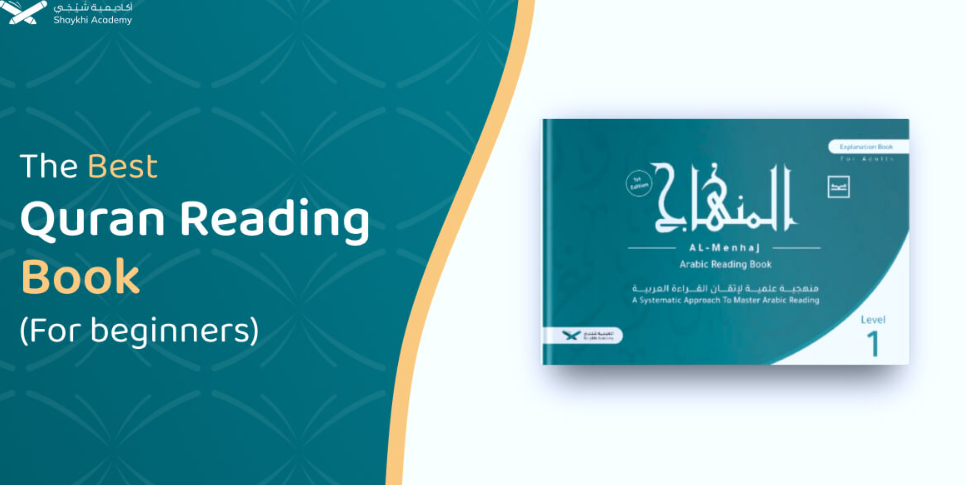
For sisters at the absolute beginning stage, the Al-Menhaj Book offers a carefully sequenced Arabic reading curriculum developed by experienced Quran teachers. It covers the Arabic alphabet, vowel markers, and reading mechanics in a format designed specifically for non-native Arabic speakers.
Explore The Best Quran Reading Book for FREE
2- Setting a Realistic Daily Target
Consistency outperforms intensity. Reading five to ten minutes daily produces better long-term outcomes than one long session per week.
A practical starting point is reciting one page of the Quran per day, which, over time, builds both fluency and confidence. For guidance on pacing, the Daily Quran Reading Plan on our blog offers structured schedules adaptable to different levels.
3- Addressing Common Recitation Errors
Among the common mistakes when reading the Quran for female students’ are:
- flattening the tafkheem (emphatic letters) into light sounds
- merging letters that carry qalqalah (bounce) without the required echo
- shortening Madd (elongation) vowels that require two full counts.
These are not minor issues; rather, they can alter the meaning of Quranic words. For this reason, these topics are completely covered through our Quran Reading Course for Beginners that helps you overcome these challenges and read the Quran correctly.
Our Students Reviews
Start Your Quran Learning Journey Today
Join Quran Reading Academy and begin structured, step-by-step Quran reading with expert guidance.
Try your first class for freeEnroll in Our Quran Reading Course for Beginners with a Free Trial

Begin Your Quran Reading Practice with The Quran Reading Academy
Women’s access to the Quran is clear, broad, and encouraged. The conditions that apply are narrow and manageable, and they should never be a barrier to consistent recitation and learning.
The Quran Reading Academy offers:
- Qualified female instructors for sisters preferring same-gender teaching
- Structured beginner programs including the Al-Menhaj Book and Noorani Qaida Course
- Flexible scheduling for busy mothers, students, and working women
- Specialized tracks: Quran Reading for New Muslims, beginners, and Tajweed development
Check out our top courses to help you read the Quran with confidence:
- Quran Reading Course With Tajweed
- Noorani Qaida Course
- Quran Reading Course for Beginners
- Quran Reading Classes for Adults
- Quran Reading Classes for Sisters
- Quran Reading Classes for Kids
- Quran Hifz Course
- Arabic Reading Practice Course
- Quranic Arabic Course
Book your free class today—it’s the perfect start to learning the Quran

Conclusion
A woman’s relationship with the Quran is not contingent on perfect circumstances. It is available to her in her home, during her daily routine, and across the full range of her life’s seasons, with only narrow, clearly defined exceptions that scholars have long reasoned through with care and compassion.
Understanding these rulings is not just a legal exercise. It is an act of empowerment. When a sister knows exactly where she stands, she stops hesitating and starts reciting. That confidence, grounded in authentic knowledge, is where real Quranic connection begins.
Alhamdulillah, the door is open. We hope that we have comprehensively answered the question: are women allowed to read the Quran? And the question now is simply: when will you walk through it?
Frequently Asked Questions
Can a woman read the Quran without wudu?
Yes. A woman may recite the Quran from memory or from a digital device without wudu. The requirement of wudu applies only to physically touching the mushaf. This ruling is based on the majority scholarly position and applies in all states of minor ritual impurity. Only janabah (major ritual impurity) prevents recitation entirely.
Is it permissible for a menstruating woman to read the Quran?
Yes, according to the preponderant scholarly opinion. A menstruating woman may recite the Quran, particularly when there is a genuine need such as ongoing study or teaching. She should avoid directly touching the mushaf and instead recite from memory or use an electronic device. This position is held by many contemporary scholars.
Do I need to cover my hair to recite the Quran?
No. Hair covering is not a condition for Quran recitation. If you are reciting in your home or in the presence of mahrams, it is not required to wear a hijab during your recitation. The obligation of covering applies in the presence of non-mahram men and is unrelated to the validity or reward of Quran recitation.
Can women recite Quran aloud in front of non-mahram men?
Normal recitation, including proper Tajweed, is permissible in front of non-mahram men. What scholars identify as disliked is deliberately softening or beautifying the voice in a manner that may attract inappropriate attention. Teaching, studying, or reciting in a standard manner does not fall under this restriction.
Can a woman teach the Quran while on her period?
Yes, she can teach the Quran through a pointer to indicate words, read from a phone/tablet, or use a barrier (gloves) to handle the mushaf without direct physical touch.
What is the best way for a woman to start learning Quran reading from scratch?
A structured Arabic reading course that covers letter recognition, harakāt, and joining rules before moving to full Quranic text is the most effective starting point. The Arabic Reading Practice Course The Quran Reading Academy follows exactly this sequence, with female instructors available for sisters who prefer that option.







Leave a Reply