 benefits of reading quran
| Key Takeaways |
| The Prophet ﷺ described Surah Al-Waqiah as the “Surah of wealth,” with authentic hadith narrations linking its regular recitation to protection from poverty. |
| Scholars of Tafsir identify this Surah’s primary benefit as deepening one’s awareness of the Hereafter, which directly shapes a believer’s worldly conduct and priorities. |
| Regular recitation of Surah Al-Waqiah is an established Sunnah practice, particularly recommended in the evening, based on verified hadith narrations. |
| Many reported benefits of this Surah circulate widely online but lack authentic hadith support — distinguishing verified from unverified narrations is essential for every Muslim. |
Surah Al-Waqiah strikes the heart differently from other chapters of the Quran. Its opening verses describe the Day of Judgment with unmistakable force — a cosmic shaking, a sorting of humanity — and something in those words reaches a believer in a way that is difficult to explain until you have sat with it long enough.
The benefits of reading Surah Al-Waqiah are real — but they must be understood honestly, grounded in authentic sources rather than circulated claims.
Surah Al-Waqiah carries verified spiritual significance confirmed by the Prophet ﷺ himself, and its deeper rewards are connected to understanding what it actually teaches, not merely to reciting it as a ritual habit.
What Are the Authentic Benefits of Reading Surah Al-Waqiah?
Reading Surah Al-Waqiah consistently carries authentic, narration-backed benefits rooted in prophetic guidance. The most verified of these is protection from poverty through the barakah of regular recitation, established in a hadith recorded by Ibn Mardawayh. Beyond this, the Surah cultivates deep awareness of the Hereafter — its real and lasting spiritual reward — that reshapes how a believer lives every day.
These benefits are not vague spiritual feelings. They are anchored in what this Surah contains: a vivid, precise description of resurrection, of the three categories of souls, and of what awaits each. Engaging with that content sincerely — understanding what you are reading — is where the genuine benefit lives.
Many students at The Quran Reading Academy first encounter this Surah in the context of searching for blessings or protection from financial hardship, which is a completely understandable starting point.
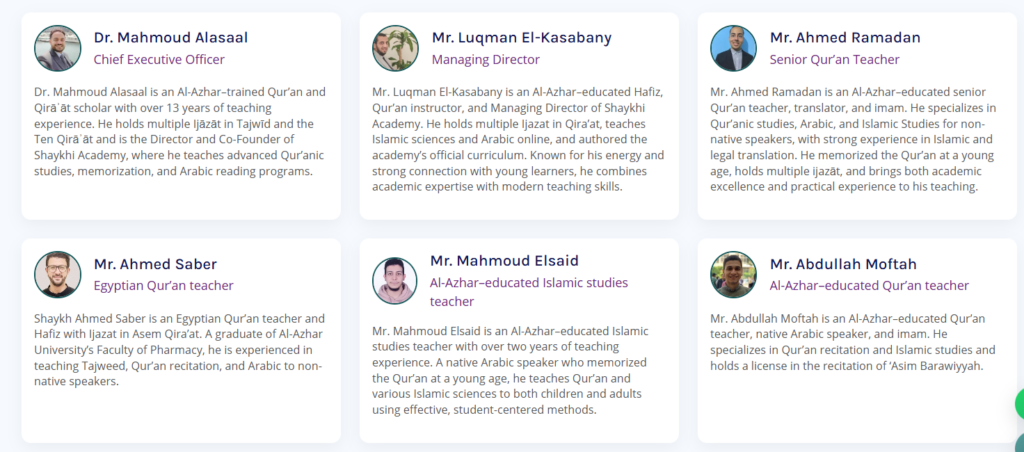
Meet our Quran teachers and find the perfect match for your trial session
1. Surah Al-Waqiah Protect from Poverty and Hardship
The most widely transmitted authentic benefit of Surah Al-Waqiah is its connection to sustenance and protection from financial difficulty. The Prophet ﷺ said, in a narration attributed to Ibn Mas’ud (may Allah be pleased with him), that whoever recites it every night will never be afflicted by poverty.
Ibn Mas’ūd reported God’s messenger as saying,
“He who recites sūra al-Waqi’a (Qur’ān, 56) every night will never be afflicted by want.” Ibn Mas’ūd used to order his daughters to recite it every night. (Transmitted by Baihaqī in Shu’ab al-īmān).
If you are looking to build a consistent recitation habit around this Surah, our daily Quran reading plan and schedule is a practical place to begin.
2. Reading Surah Al-Waqiah Strengthen Iman and Awareness of the Hereafter
Surah Al-Waqiah builds profound consciousness of the afterlife through its vivid, sequential description of the Day of Judgment — something no other chapter delivers with quite the same intensity.
Reading it regularly conditions a believer’s heart to remain attached to what is permanent rather than what is temporary, which is among the most valuable transformations a Muslim can experience.
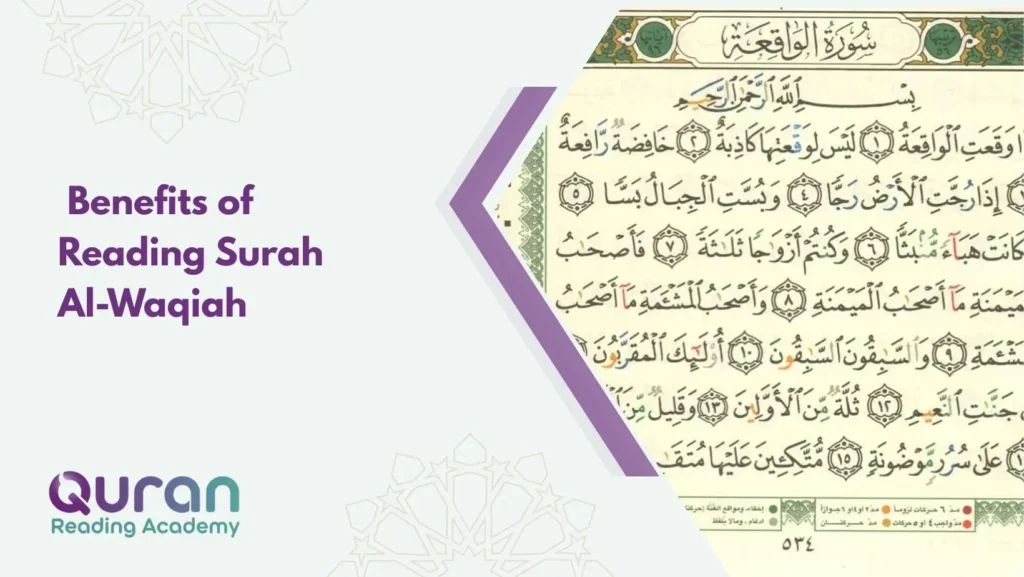
The Surah opens by describing the Day of Judgment as an inevitable event that cannot be denied or delayed:
إِذَا وَقَعَتِ ٱلْوَاقِعَةُ لَيْسَ لِوَقْعَتِهَا كَاذِبَةٌ
Idhā waqa’ati l-wāqi’ah. Laysa liwaq’atihā kādhibah.
“When the Occurrence occurs, there is, at its occurrence, no denial.” (Al-Waqiah 56:1–2)
These two verses alone, read with understanding, do something to the heart that no motivational content can replicate.
Students who work through the meaning of this Surah — even partially — consistently report that their relationship with prayer and with the Quran shifts. That is not coincidence. That is the intended effect of this chapter.
Shots Videos from Our Courses
Start Your Quran Learning Journey Today
Join Quran Reading Academy and begin structured, step-by-step Quran reading with expert guidance.
Try your first class for free3. Great Spiritual Reward of Reciting Surah Al-Waqiah Regularly
Regular recitation of Surah Al-Waqiah earns the general rewards of Quran recitation — multiplied by the letter, as the Prophet ﷺ confirmed in a widely authenticated hadith recorded in Sunan At-Tirmidhi:
“Whoever recites one letter of the Book of Allah will have one good deed recorded for him, and that good deed will be multiplied ten times.” This applies to every verse of Surah Al-Waqiah’s 96 verses.
Beyond the letter-by-letter reward, the Surah’s particular content — its descriptions of the people of the right hand, the people of the left hand, and the forerunners — invites the reciter into sustained reflection.
Reflection (tadabbur) during Quran recitation is itself an act of worship, encouraged throughout Islamic scholarship as among the highest forms of engagement with the Book of Allah.
If you are working toward consistent, meaningful recitation but struggle with reading fluency, exploring how to read the Quran as a structured skill — not just a ritual — will help you recite with far greater presence and understanding.
4. Surah Al-Waqiah is Recommended to Read Every Night
The recommendation to recite Surah Al-Waqiah every night traces back to the narration connected to Ibn Mas’ud (may Allah be pleased with him), in which the Prophet ﷺ is reported to have encouraged its nightly recitation.
Classical scholars including Ibn Hajar Al-Asqalani discussed this narration in their hadith commentary literature, acknowledging the practice while noting the chain’s transmission details.
Nighttime recitation holds additional significance in Islamic worship practice because of the natural quietness and focus the evening provides. The Quran itself describes the night as a time when recitation has greater weight and impression on the heart:
إِنَّ نَاشِئَةَ ٱلَّيْلِ هِىَ أَشَدُّ وَطْـًٔا وَأَقْوَمُ قِيلًا
Inna nāshi’ata l-layli hiya ashaddu waṭ’an wa-aqwamu qīlā
“Indeed, the hours of the night are more effective for concurrence and more suitable for words.” (Al-Muzzammil 73:6)
Building this evening habit takes consistency. At The Quran Reading Academy, students in our Quran Reading Classes for Adults are often guided to establish short, regular recitation sessions in the evening — a practical approach that develops both habit and quality of reading simultaneously.
Start Your Quran Reading Classes Today

5. Surah Al-Waqiah Encourages You to be One of the Forerunners (As-Sabiqun)
Surah Al-Waqiah uniquely categorizes all of humanity into three groups on the Day of Judgment, making it one of the Quran’s most powerful tools for self-reflection and spiritual assessment.
These three groups — the Forerunners (As-Sabiqun), the People of the Right (Ashabu l-Maymanah), and the People of the Left (Ashabu l-Mash’amah) — are described with specific, concrete detail about their rewards and consequences.
| Category | Arabic Term | Description | Outcome |
| The Forerunners | السَّابِقُونَ | Those nearest to Allah | The highest stations in Jannah |
| People of the Right | أَصْحَابُ الْيَمِينِ | The righteous believers | Jannah, in great comfort |
| People of the Left | أَصْحَابُ الشِّمَالِ | Those who rejected guidance | Severe punishment |
Reading these descriptions consistently places the reciter in a position of honest self-examination. Which category am I living toward? That question, when it becomes habitual, changes behavior in ways that purely motivational content never could.
This is why scholars across centuries have emphasized reading Surah Al-Waqiah not as a ritual for worldly gain alone, but as a Hereafter-focused discipline.
Our Quran Reading Course for Beginners builds the skills that make Surah Al-Waqiah recitation sound the way it is meant to sound.
Enroll in Our Quran Reading Course for Beginners with a Free Trial

6. Surah Al-Waqiah Teach About the Reality of Death and Resurrection
Surah Al-Waqiah addresses the reality of death and resurrection with direct, almost confrontational language — precisely because the human heart has a tendency to defer thinking about these realities.
Verses 83 through 87 challenge the reader: if you truly have power, why can you not return the soul of a dying person? This rhetorical argument against arrogance and heedlessness is one of the Surah’s most pedagogically powerful passages.
فَلَوْلَآ إِذَا بَلَغَتِ ٱلْحُلْقُومَ
Falawlā idhā balaghati l-ḥulqūm
“Then why, when it [the soul] reaches the throat…” (Al-Waqiah 56:83)
This passage is regularly cited in classical Tafsir literature — including in the works of Ibn Kathir and At-Tabari — as one of the most direct Quranic confrontations with human denial of death. Reading it with understanding is not morbid.
It is clarifying. It puts the temporary distractions of daily life into their proper, small proportions.
Which Benefits of Surah Al-Waqiah Are Not Supported by Authentic Hadith?
Many widely shared benefits of Surah Al-Waqiah circulate without authentic hadith support, and Muslim content consumers deserve clarity on this point. Fabricated or severely weak narrations claiming specific rewards for recitation — such as guaranteed entry to Jannah, protection from all diseases, or blessings equivalent to feeding a specific number of people — do not represent reliable Islamic scholarship.
The practice of circulating unverified narrations, even with good intentions, was a concern addressed by the scholars of hadith sciences from the earliest generations. Reading Surah Al-Waqiah sincerely and consistently, for the authenticated reasons described in this article, is more than enough. Adding invented rewards does not increase the Surah’s value — it risks eroding the trust that faith must be built on.
This matters practically. When students arrive at The Quran Reading Academy having been told they must recite a specific Surah in a specific way for a specific worldly result, and that result does not materialize, it can shake their relationship with Quran engagement altogether.
Grounded, accurate Islamic literacy protects against that kind of disappointment. Our guidance on Quran reading etiquettes and manners covers how to approach the Quran with the correct intentions from the beginning.
Our Students Reviews
Start Your Quran Learning Journey Today
Join Quran Reading Academy and begin structured, step-by-step Quran reading with expert guidance.
Try your first class for freeRead Also: Benefits of Reading Surah Mulk
How Can You Begin Reading Surah Al-Waqiah with Proper Recitation?
Reading Surah Al-Waqiah with correct pronunciation requires working through foundational Arabic reading skills — particularly because the Surah contains several Arabic letters that non-native speakers consistently struggle to produce correctly.
Letters like ع, خ, ق, and غ appear throughout the Surah, and mispronouncing them changes meaning in ways that matter.
In almost every beginner session at The Quran Reading Academy, adult students who attempt Surah Al-Waqiah before solidifying their foundational letter sounds encounter the same specific difficulty: they read the opening word وَقَعَتِ (waqa’at) without producing the ع correctly, softening it into a plain vowel sound. That single error alters the word’s phonetic character significantly.
Tackling these foundational mechanics before attempting independent recitation of longer Surahs is not a delay — it is the fastest path to genuinely correct reading.
Our Noorani Qaida Course and Quran Reading Course for Beginners are designed specifically to address exactly these foundational gaps, building the skills that make Surah Al-Waqiah recitation sound the way it is meant to sound.
You can also explore our guidance on common mistakes when reading the Quran to identify which errors to address first.
Start Reading the Quran Today with a FREE Trial in Our Noorani Qaida Course

Read Also: Benefits of Reading Surah Yaseen Everyday
Begin Your Recitation of Surah Al-Waqiah the Right Way with The Quran Reading Academy
Surah Al-Waqiah’s authentic benefits — from its connection to sustenance to its profound transformation of how a believer views the Hereafter — are best accessed through correct, consistent, and understanding-driven recitation.
The Quran Reading Academy offers:
- Certified, experienced instructors with up to 25 years of teaching experience
- Structured courses for beginners through advanced levels — kids, adults, new Muslims
- The Al-Menhaj Book — a foundational resource for learning Arabic reading from scratch
- Online Quran Reading Classes with Tajweed for accurate, beautiful recitation
- Flexible scheduling — learn from anywhere, at your own pace
Book your free trial class today and take your first step toward reciting Surah Al-Waqiah as it deserves to be recited.
Check out our top courses to help you read the Quran with confidence:
- Quran Reading Course With Tajweed
- Noorani Qaida Course
- Quran Reading Course for Beginners
- Quran Reading Classes for Adults
- Quran Reading Classes for Sisters
- Quran Reading Classes for Kids
- Quran Hifz Course
- Arabic Reading Practice Course
- Quranic Arabic Course
Book your free class today—it’s the perfect start to learning the Quran
Frequently Asked Questions About the Benefits of Reading Surah Al-Waqiah
What Is the Best Time to Recite Surah Al-Waqiah for Maximum Benefit?
The evening, specifically after Maghrib or before sleeping, is the most commonly cited time in Islamic tradition for reciting Surah Al-Waqiah, based on the narrations encouraging its nightly recitation. The Quran also affirms that nighttime recitation carries particular spiritual weight. Consistency of time, however, matters more than the specific hour — establishing a fixed, daily habit is the practical priority.
Can Beginners Recite Surah Al-Waqiah Even If They Cannot Read Arabic Yet?
Beginners can listen to and memorize Surah Al-Waqiah by sound while simultaneously working on their Arabic reading foundation. However, building proper reading skills — through a structured course like the Noorani Qaida Course — ensures that recitation is accurate and that the spiritual engagement is grounded in real comprehension. Learning to read Quran word by word is an excellent approach for early-stage students.
How Long Is Surah Al-Waqiah and How Long Does It Take to Recite?
Surah Al-Waqiah contains 96 verses and spans approximately 3 pages in the standard Mushaf. At a measured, Tajweed-correct pace appropriate for regular recitation, most readers complete it in 7 to 12 minutes, depending on their reading speed and fluency level. Beginners may take longer initially, and that is entirely normal — consistency and correctness take precedence over speed.
Does Reading Surah Al-Waqiah Without Understanding Arabic Still Carry Reward?
Yes. The reward for reciting the Quran applies to the recitation itself, letter by letter, regardless of whether the reader understands Arabic. This is established in authenticated hadith. Simultaneously, scholars universally encourage learning the meaning of what one recites, as the Quran’s transformative impact deepens substantially when its message is understood. Pursuing both — correct recitation and growing comprehension — is the most complete approach.
Related Articles
benefits of reading quran





Leave a Reply