 Quran
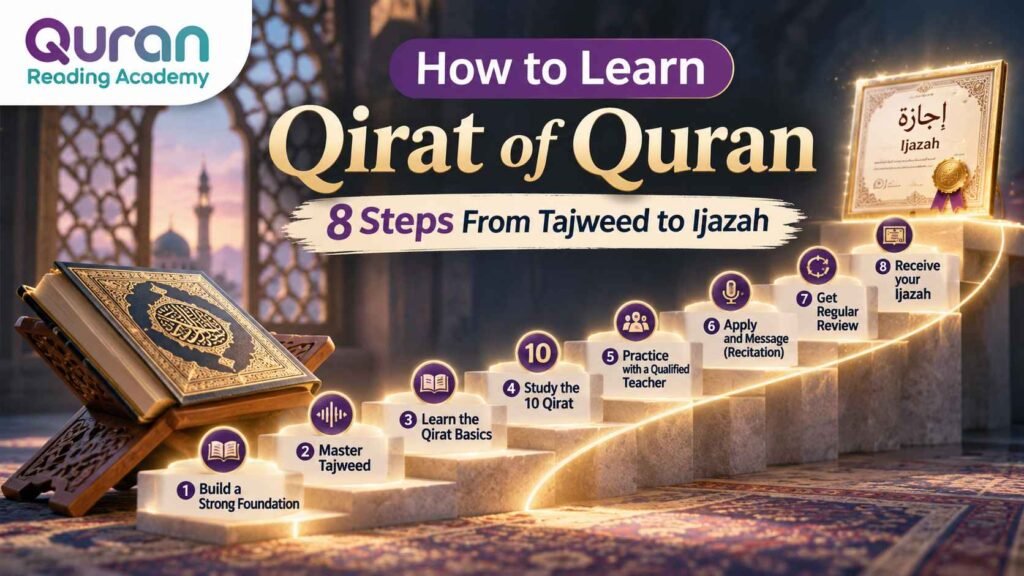
To learn Qirat of Quran, first master Quran reading and Tajweed in Hafs ‘an ‘Asim. Then choose one new Riwayah, study it with a Qari who holds Ijazah in it, learn its general rules (Usul) and word-specific differences (Farsh), and recite to your teacher until you earn Ijazah.
That is the short answer to how to learn Qirat of Quran. The longer answer is a path with clear stages, and most students get lost because nobody shows them the order.
This guide walks you through that order step by step: what the Qira’at are, what you need before you start, how Quran Qirat learning is structured, how long it takes, and the mistakes that slow students down.
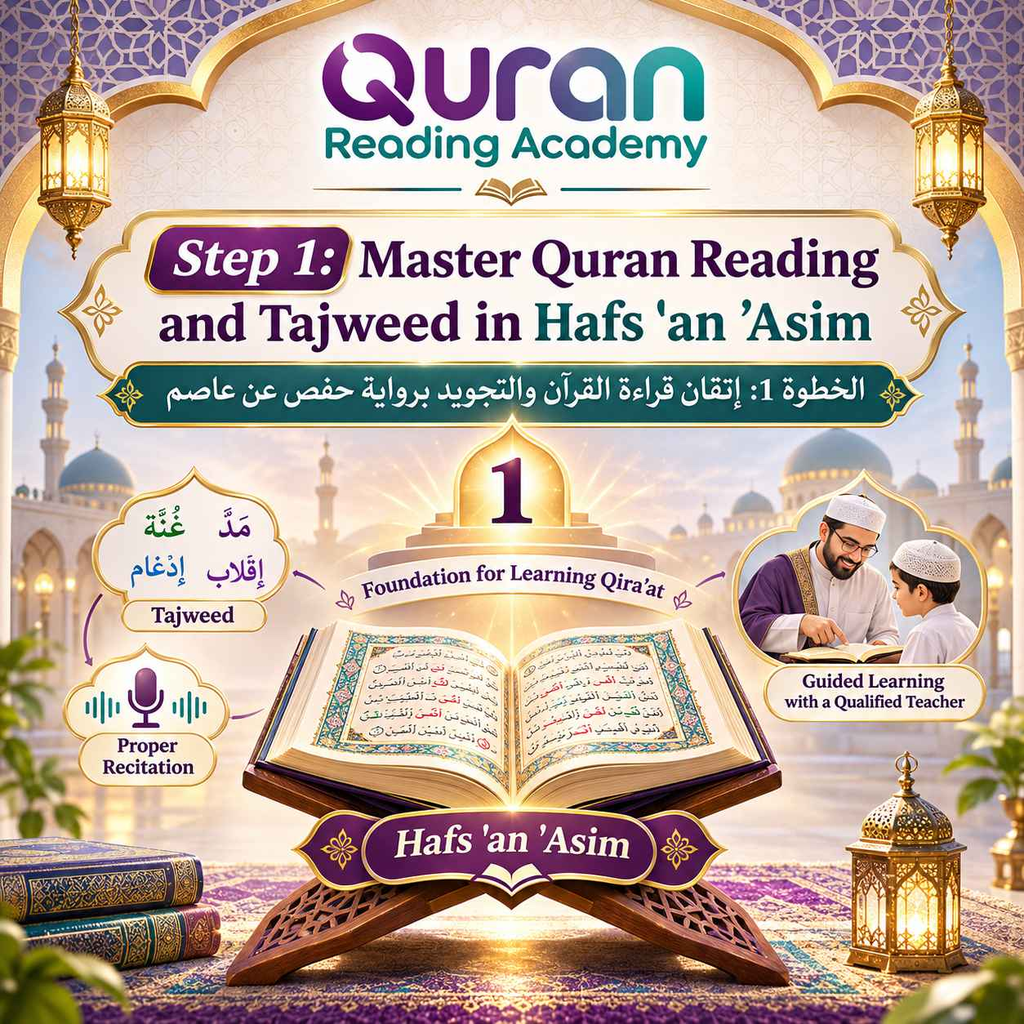
Step 1: Master Quran Reading and Tajweed in Hafs ‘an ‘Asim
Every new Riwayah is taught as a set of differences from the one you already know, and for most learners that base is Hafs ‘an ‘Asim. If your Hafs is shaky, you will not be able to tell which rule belongs to which Riwayah.
Make sure you can apply the full set of Tajweed rules without thinking: Makharij, Sifat, the types of Madd and their lengths, and the rules of stopping and starting.
If you need a structured refresher, our Quran Tajweed course covers these rules in depth, and our guide to the essential rules of Quran recitation is a good self-check.
Step 2: Strengthen Your Memorization
In Qira’at study, you recite to your teacher from memory. The teacher listens for each difference as it comes, so you must know the text well enough to focus on the Riwayah rather than on remembering the next verse.
If you have not memorized the full Quran, start with the surahs you know best and keep growing your Hifz alongside your Qirat lessons. Ask your teacher early whether they require complete Hifz for the Ijazah you are aiming for.
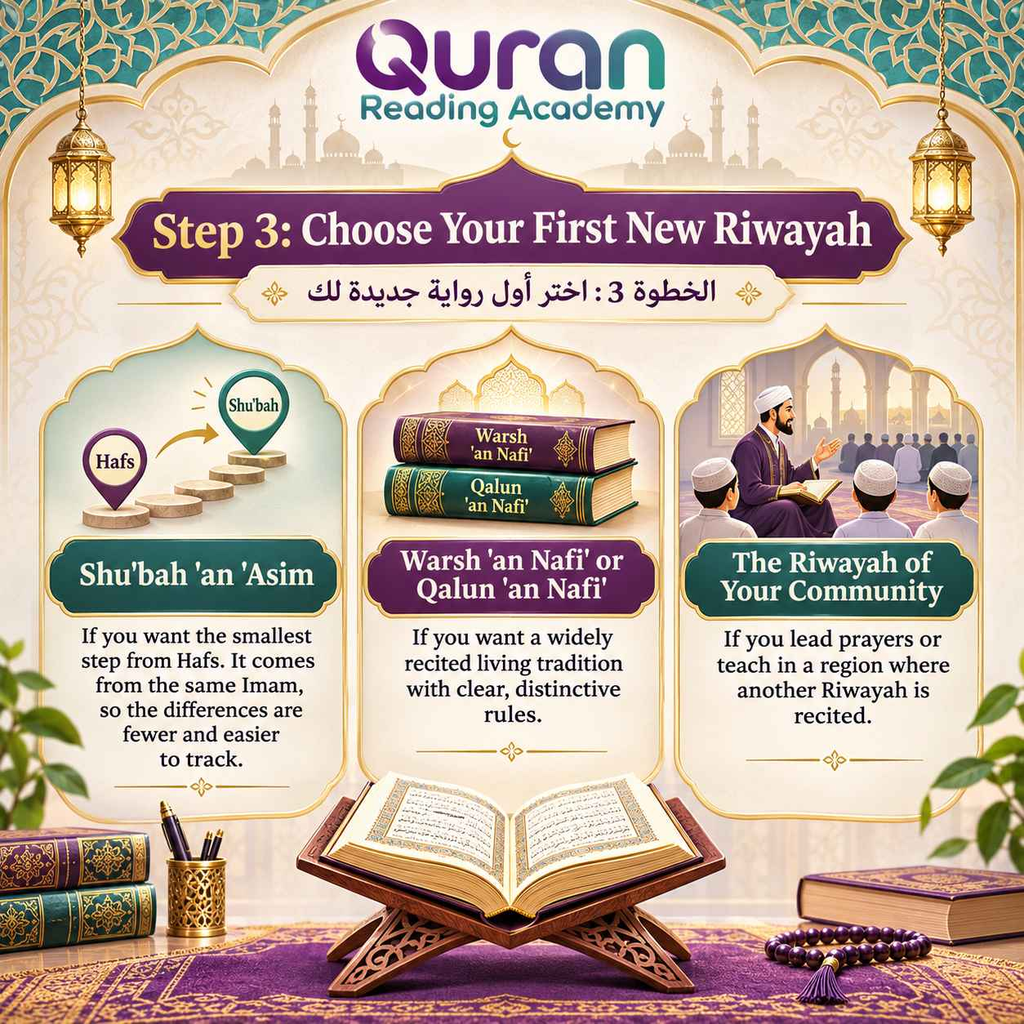
Step 3: Choose Your First New Riwayah
Learn one Riwayah at a time. Use this simple framework to choose:
- Shu’bah ‘an ‘Asim if you want the smallest step from Hafs. It comes from the same Imam, so the differences are fewer and easier to track.
- Warsh ‘an Nafi’ or Qalun ‘an Nafi’ if you want a widely recited living tradition with clear, distinctive rules.
- The Riwayah of your community if you lead prayers or teach in a region where another Riwayah is recited.
Step 4: Find a Qari With Verified Ijazah and Sanad in That Riwayah
Qira’at are an oral science. You cannot learn them reliably from books or recordings alone, because fine points such as Imalah, Taqlil, and the exact length of a Madd must be heard and corrected live.
Before you commit to a teacher, ask three questions:
- Which Riwayah or Riwayat does your Ijazah cover?
- Can I see your Sanad (chain of transmission)?
- Through which Tariq did you receive it, such as al-Shatibiyyah or al-Tayyibah?
A good teacher will answer all three happily. You can meet our Ijazah-certified teachers to see what this looks like in practice.
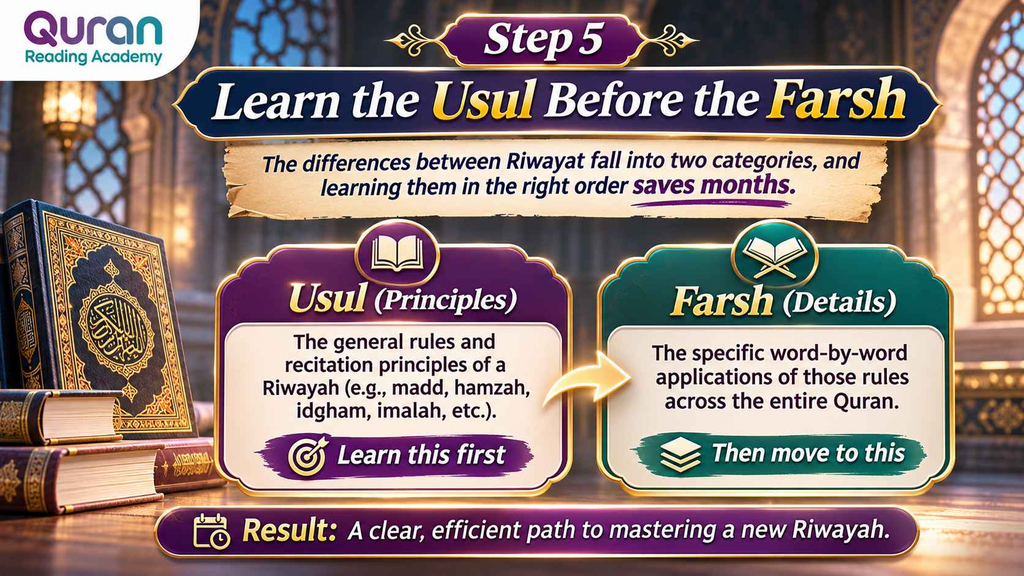
Step 5: Learn the Usul Before the Farsh
The differences between Riwayat fall into two categories, and learning them in the right order saves months.
Usul are general rules that repeat throughout the Quran, such as Madd lengths, how Hamzah is treated, Imalah, and the rules of Ra and Lam. In Warsh, for example, the separated Madd (Madd Munfasil) is lengthened to six counts wherever it appears.
Farsh al-Huruf are word-specific differences that occur in particular places. A well-known example is Al-Fatihah, verse 4, recited “Maliki” (King) in some Qira’at and “Maaliki” (Owner) in others. Both meanings are true and complement each other.
Master the Usul first, because they affect every page you recite. Then add the Farsh surah by surah.
Step 6: Study the Classical Texts in Order
Qira’at scholarship is built on a small number of foundational texts, usually studied with a teacher rather than alone:
- Hirz al-Amani (Al-Shatibiyyah) by Imam al-Shatibi, a didactic poem covering the seven Qira’at. It versifies Imam al-Dani’s book Al-Taysir.
- Al-Durrah al-Mudiyyah by Ibn al-Jazari, which covers the three Qira’at that complete the ten.
- Tayyibat al-Nashr by Ibn al-Jazari, the advanced text for the “major ten” with their many Turuq, based on his book Al-Nashr fi al-Qira’at al-‘Ashr.
Most students memorize the lines of the poem that relate to their Riwayah and learn how to read them with their teacher.
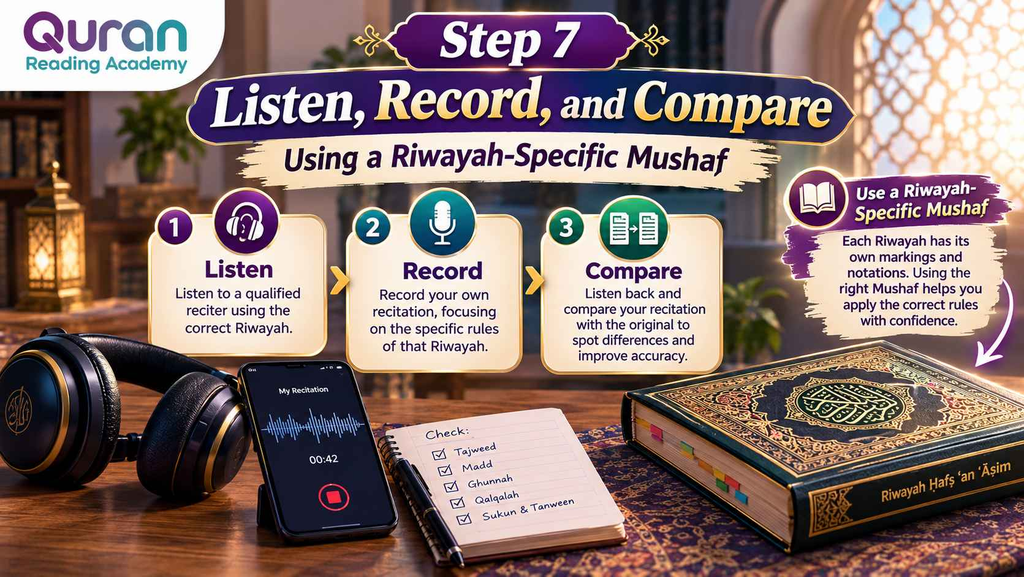
Step 7: Listen, Record, and Compare Using a Riwayah-Specific Mushaf
Recite from a Mushaf printed in the Riwayah you are learning. Warsh and Qalun Mushafs, for example, differ from a Hafs Mushaf in their vowel marks and some spellings, and reading from the wrong one trains the wrong habits. Stop signs can also differ between editions, which our guide to Quran stop signs explains.
Every day, listen to one page from a reciter who records in your Riwayah. Then record yourself reciting the same page and compare the two line by line. Note every difference in a notebook and take it to your next lesson.
Step 8: Complete a Full Recitation and Earn Your Ijazah
Qira’at are traditionally learned through Ifrad: reciting the whole Quran in a single Riwayah from start to finish. Only after completing one or more Riwayat this way do advanced students move to Jam’, combining several Riwayat in a single recitation.
When you complete a full recitation that meets your teacher’s standard, they grant you an Ijazah. It certifies that you recite that Riwayah correctly and authorizes you to teach it, adding your name to a chain that reaches back to the Prophet ﷺ.
If you want a guided path through all eight steps, our Online Quran Qirat Classes are built around exactly this progression.
What Is Qirat in the Quran?
Qirat (Qira’at, singular Qira’ah) are the canonical methods of reciting the Quran, each transmitted through unbroken, mass-narrated (mutawatir) chains back to the Prophet Muhammad ﷺ. Every Qira’ah is the same Quran. The differences lie in pronunciation, vowelling, elongation, and some word forms, all taught by the Prophet ﷺ himself.
The clearest evidence is the incident between Umar ibn al-Khattab and Hisham ibn Hakim. Umar heard Hisham reciting Surah Al-Furqan differently from how he had learned it and brought him to the Prophet ﷺ. The Prophet ﷺ approved both recitations and said:
“The Qur’an has been revealed in seven different ways, so recite it in the way that is easier for you.” (Sahih al-Bukhari 2419)
Qira’at vs. Ahruf: What’s the Difference?
The “seven ways” in this hadith are the seven Ahruf, and they are not the same as the seven Qira’at. The Ahruf are the modes of revelation mentioned by the Prophet ﷺ.
The seven Qira’at are seven recitation methods selected centuries later by the scholar Ibn Mujahid (d. 324 AH) because of the strength of their chains. Mixing up the two is one of the most common errors in articles about Qirat.
Qira’ah, Riwayah, and Tariq Explained
When you start Quran Qirat learning, you will hear three terms constantly. Each one is a level of the chain:
| Term | Meaning | Example |
|---|---|---|
| Qira’ah | The method attributed to one of the ten Imams | Qira’ah of ‘Asim |
| Riwayah | A transmission of that method by one of the Imam’s two main narrators | Riwayah of Hafs from ‘Asim |
| Tariq | A later path of transmission from the narrator | Tariq al-Shatibiyyah for Hafs |
So when someone says they recite “Hafs ‘an ‘Asim,” they mean the Riwayah of Hafs from the Qira’ah of Imam ‘Asim. Learning a new Qirat in practice usually means learning a new Riwayah.
Inside Our Live Classroom
We believe in complete transparency. Take a look inside our virtual classrooms to experience our premium teaching tools and engaging learning environment firsthand.
Start Your Quran Learning Journey Today
Join Quran Reading Academy and begin structured, step-by-step Quran reading with expert guidance.
Try your first class for freeThe 10 Qira’at of the Quran and Their Narrators
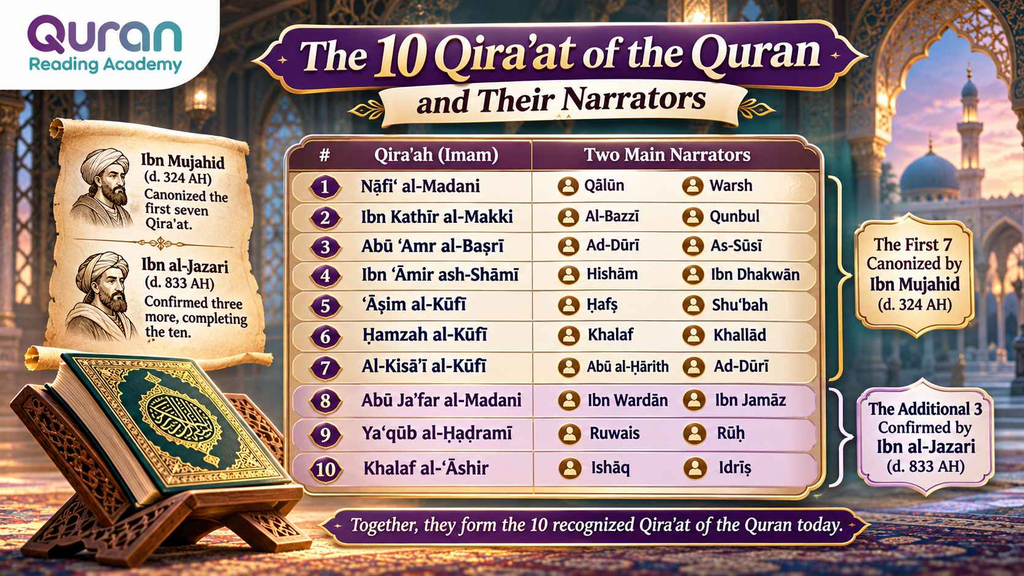
There are ten canonical Qira’at, each named after an Imam and transmitted by two main narrators. Ibn Mujahid canonized the first seven, and Imam Ibn al-Jazari (d. 833 AH) later confirmed the authenticity of three more, completing the ten recognized today.
| # | Imam | City | Narrators |
|---|---|---|---|
| 1 | Nafi’ | Madinah | Qalun, Warsh |
| 2 | Ibn Kathir | Makkah | Al-Bazzi, Qunbul |
| 3 | Abu ‘Amr | Basra | Al-Duri, Al-Susi |
| 4 | Ibn ‘Amir | Damascus | Hisham, Ibn Dhakwan |
| 5 | ‘Asim | Kufa | Shu’bah, Hafs |
| 6 | Hamzah | Kufa | Khalaf, Khallad |
| 7 | Al-Kisa’i | Kufa | Abu al-Harith, Al-Duri |
| 8 | Abu Ja’far | Madinah | Ibn Wardan, Ibn Jammaz |
| 9 | Ya’qub | Basra | Ruways, Rawh |
| 10 | Khalaf al-‘Ashir | Baghdad | Ishaq, Idris |
That gives 20 main Riwayat in total. Each one is a complete, authentic way to recite the entire Quran.
Which Riwayat Are Recited Most Today?
Only a few Riwayat are in everyday use, and knowing which ones helps you choose what to learn:
- Hafs ‘an ‘Asim is recited across most of the Muslim world, including the Middle East, South Asia, and Turkey. It is the Riwayah printed in most Mushafs.
- Warsh ‘an Nafi’ is recited across North and West Africa, including Morocco, Algeria, and Mauritania.
- Qalun ‘an Nafi’ is recited in Libya and parts of Tunisia.
- Al-Duri ‘an Abi ‘Amr is recited in Sudan and parts of West Africa.
The others are studied and recited by specialists, and you will hear them in competitions and advanced recitation gatherings.
Before You Start: Prerequisites for Quran Qirat Learning
Quran Qirat learning is an advanced stage of Quranic study, so be honest with yourself about where you stand before you begin. Check yourself against these five prerequisites:
- Fluent Quran reading. You should read any page of the Mushaf smoothly, without spelling out words. If you are not there yet, start with a Noorani Qaida course to build the foundation.
- Solid Tajweed in Hafs ‘an ‘Asim. You need a working command of Makharij (articulation points), Sifat (letter characteristics), and the core Ahkam such as Noon Sakinah, Meem Sakinah, and Madd.
- Substantial memorization. Qira’at are recited to the teacher from memory, and many traditional teachers require the full Quran memorized before granting a complete Ijazah. A Quran Hifz course is often the step before Qirat.
- A realistic time commitment. Plan for regular lessons every week plus daily revision. Qira’at reward consistency far more than intensity.
- Access to a qualified teacher. You need a Qari who holds Ijazah in the specific Riwayah you want to learn. Without one, you cannot learn Qirat authentically.
The Qirat Learning Path: Levels and Timeline
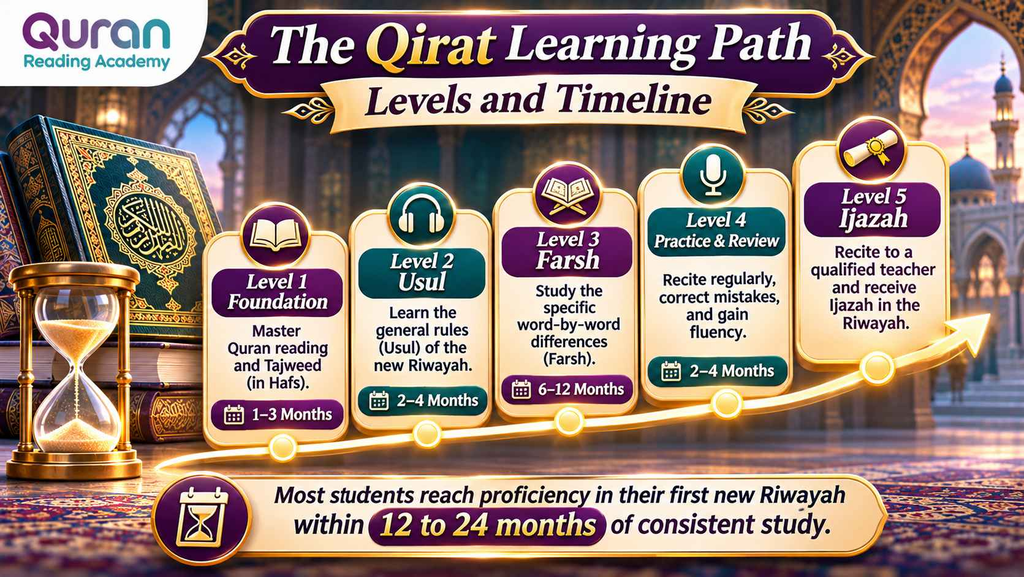
Most students reach proficiency in their first new Riwayah within 12 to 24 months of consistent study. The earlier stages vary widely depending on your starting point, so treat this as a map rather than a schedule:
| Stage | What you learn | Typical duration |
|---|---|---|
| 1. Reading foundation | Arabic letters, vowel marks, fluent reading | Varies by starting level |
| 2. Tajweed in Hafs | Makharij, Sifat, Ahkam, Madd, Waqf | Varies by starting level |
| 3. Hifz | Memorizing the Quran with correct Tajweed | Varies by pace and daily hours |
| 4. First new Riwayah (Ifrad) | Usul and Farsh of one Riwayah, full recitation | 12–24 months |
| 5. Further Riwayat | Additional Riwayat, often within the seven | Shorter for each new one |
| 6. Jam’ and the ten | Combining Riwayat, Al-Durrah, Tayyibat al-Nashr | Several years of advanced study |
Four things change these timelines the most: how solid your Hafs Tajweed already is, how much of the Quran you have memorized, how many lessons you take each week, and whether you revise daily between lessons.
Can You Learn Qirat Online?
Yes, you can learn Qirat online, provided the lessons are live, one-on-one, and taught by a Qari with a verified Sanad in your Riwayah. Recorded courses can support your study, but they cannot replace a teacher who hears you and corrects you in real time.
A good online Qirat class has four features:
- Live one-on-one sessions, so the teacher can stop you at the exact word where a rule was missed.
- Clear audio on both sides. A decent microphone matters more than a fast computer, because subtle differences in Madd and Imalah are easy to lose.
- A shared Mushaf on screen in the Riwayah you are studying, so you and your teacher are looking at the same page.
- A documented path to Ijazah, with a clear record of what you have completed and what remains.
Many students also keep their general recitation sharp alongside Qira’at study with a Quran recitation course.
Common Mistakes to Avoid When Learning Qirat
Most students who stall make one of these six mistakes:
- Starting several Riwayat at once. The rules blur together. Finish one Riwayah through Ifrad before adding another.
- Mixing rules between Riwayat while reciting. Applying a Warsh rule in one verse and a Hafs rule in the next (Talfiq) is a recognized error. Stay inside one Riwayah per recitation.
- Learning from YouTube or apps without a teacher. Recordings are excellent for listening, but nobody is checking your mistakes.
- Jumping to the Farsh before the Usul. Word-specific differences make little sense until the general rules are automatic.
- Reading from a Hafs Mushaf while studying another Riwayah. Your eyes keep pulling you back to Hafs. Use a Mushaf printed in your Riwayah.
- Confusing Qira’at with melody. Qira’at are a science of transmission, not musical styles (Maqamat). A beautiful voice does not make a Riwayah correct.
See Our Academy in Action
Discover what a typical session looks like! Watch these brief highlights from our live, interactive classes to see how our instructors engage with students of all ages.
Start Your Quran Learning Journey Today
Join Quran Reading Academy and begin structured, step-by-step Quran reading with expert guidance.
Try your first class for freeLearn Qirat of Quran With The Quran Reading Academy
The Quran Reading Academy’s Online Quran Qirat Classes take you through every step in this guide with one Ijazah-certified Azhari Qari by your side. You start by perfecting Hafs ‘an ‘Asim, progress to Warsh ‘an Nafi’ and Qalun, and prepare for a formal Ijazah with a documented chain of transmission.
Here is what makes it a strong choice for serious Quran Qirat learning:
- Ijazah-certified Azhari Qurra with verified Sanad. Every teacher holds an authenticated chain of transmission in the Riwayat they teach.
- A curriculum built on Usul and Farsh. You learn the general rules first, then the word-specific differences, exactly as described in Step 5.
- Live one-on-one lessons. Your teacher corrects every Madd, Imalah, and Hamzah the moment you recite it.
- Flexible scheduling across time zones, with morning, afternoon, and evening slots for students worldwide.
- Female Qaris for sisters. Sisters can study with Ijazah-certified female teachers in a private, comfortable setting through our Quran classes for sisters.
- Transparent, affordable tuition. You can review the options on our pricing page.
Not sure whether you are ready for Qira’at yet? Your free trial lesson includes an assessment of your reading, Tajweed, and memorization, so your teacher can tell you exactly where to start.
Our Quran Courses
- Quran Reading Course for Beginners
- Online Quran Reading Course with Tajweed
- Reading and Memorizing the Quran Course
- Noorani Qaida Course
- Quran Course for Beginners
- Quran Tajweed Course
- Quran Recitation Course
- Quran Hifz Course
- Online Quran Qirat Classes
Conclusion
Now you know how to learn Qirat of Quran: build strong Tajweed in Hafs, strengthen your memorization, choose one Riwayah, study it with a Qari who holds Ijazah, and recite until you earn your own place in the chain.
The path is long, but every lesson connects you more closely to how the Quran was revealed and recited.The Prophet ﷺ said: “The best among you are those who learn the Qur’an and teach it.” (Sahih al-Bukhari 5027)
Take your first step with a teacher who can guide you all the way to Ijazah. Book your free trial lesson with The Quran Reading Academy today.
FAQs
How long does it take to learn Qirat of Quran?
Most students reach proficiency in one new Riwayah within 12 to 24 months of consistent study. The time depends on how strong your Tajweed in Hafs already is, how much of the Quran you have memorized, and how often you study. Each additional Riwayah usually takes less time than the first.
Can I learn Qirat without memorizing the whole Quran?
Yes, you can start learning a Riwayah and recite it from the Mushaf or from the surahs you know. However, many teachers require full memorization before granting a complete Ijazah, because Qira’at are traditionally recited to the teacher from memory.
Do the different Qira’at change the meaning of the Quran?
The Qira’at never contradict each other. Some differences are only in pronunciation, while others give complementary meanings, such as “Maliki” (King) and “Maaliki” (Owner) in Al-Fatihah. Scholars see these variations as adding depth to the meaning. A Quranic Arabic course helps you appreciate these layers.
Can I learn Qirat online and get an Ijazah?
Yes. Ijazah is granted based on your recitation to a qualified teacher, and that can take place in live online sessions. Make sure your teacher holds a verified Sanad in the Riwayah and that the lessons are live and one-on-one.
What is the difference between Tajweed and Qirat?
Tajweed is the set of rules for pronouncing the Quran correctly within one Riwayah. Qirat are the different canonical Riwayat themselves, each with its own application of those rules. You need Tajweed first, because every Qira’ah is built on it.



Leave a Reply