 Surahs to Read
| Key Takeaways |
| No single fixed list of daily morning surahs exists in the Sunnah; specific guidance varies by day and occasion. |
| The Prophet ﷺ instructed reciting Surah Al-Ikhlas, Al-Falaq, and An-Nas three times each morning for full protection. |
| Ayat al-Kursi recited in the morning provides protection from harm until the evening. |
| Surah Al-Kahf carries a specific authenticated reward on Fridays only, not as a general daily morning practice. |
| Morning recitation after Fajr is among the most spiritually potent times for Quran reading according to Islamic tradition. |
The morning hours — especially the blessed stretch after Fajr — hold a spiritual weight that no other time of day can match. Many Muslims want to fill this time with meaningful Quran recitation but genuinely don’t know what the Prophet ﷺ actually prescribed, versus what is culturally assumed or passed on without verification.
The authentic Sunnah provides clear, specific guidance on certain surahs and verses to recite in the morning. These are not arbitrary selections; they are practices tied directly to the Prophet’s ﷺ instruction and carry verified spiritual benefits.
Are There Specific Surahs Prescribed for Every Morning?
There is no single fixed list of daily morning surahs established in the authenticated Sunnah. What the Prophet ﷺ did prescribe are specific recitations — certain verses and short surahs — as part of the morning adhkar (remembrances), along with general encouragement to recite the Quran at Fajr time.
This distinction matters deeply. Attributing specific virtues to morning recitation of a surah when the relevant hadith is weak (da’eef) or fabricated is a religious inaccuracy that scholars consistently warn against.
At The Quran Reading Academy, our instructors are trained to teach with precision — which means teaching only what is verified.
Meet our Quran teachers and find the perfect match for your trial session
That said, there are indeed several specific recitations with sahih (authentic) or hasan (good) hadith support for the morning. These form a meaningful, spiritually rich morning Quran reading practice. Below, we explore each of them in detail.
If you are building a daily Quran reading plan and schedule, the morning recitations below provide an excellent authenticated foundation.
1. Reciting Al-Ikhlas, Al-Falaq, and An-Nas Three Times Each Morning
The most clearly established morning recitation in the Sunnah is the three Quls — Surah Al-Ikhlas (112), Surah Al-Falaq (113), and Surah An-Nas (114).
The Prophet ﷺ instructed a companion to recite all three surahs three times in the morning and three times in the evening, with the assurance that this practice would suffice him as protection against everything. This hadith is reported in Sunan at-Tirmidhi 3575 and is graded as authentic.
Why These Three Surahs Together
Each surah in this trio addresses a different dimension of divine protection. Surah Al-Ikhlas affirms the absolute Oneness of Allah — it is the declaration of Tawhid in its purest form.
The Prophet ﷺ described it as equivalent in reward to reciting one-third of the entire Quran (Sahih al-Bukhari 5013).
Al-Falaq and An-Nas together are called Al-Mu’awwidhatan — the two surahs of seeking refuge — and they collectively cover protection from external harm (Al-Falaq) and internal whispering and doubt (An-Nas).
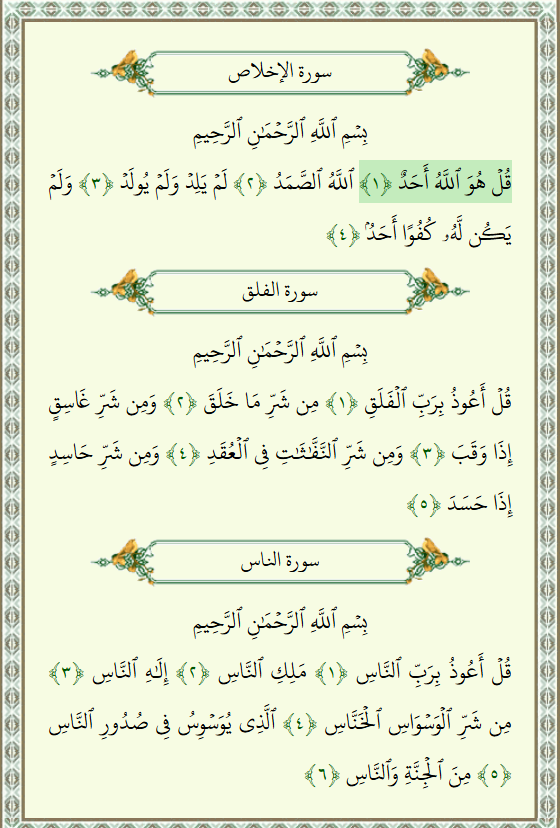
Recite each surah individually three times, not the sequence of three surahs once. This is the established manner supported by the wording of the hadith.
The Correct Practice for Morning Recitation
After the Fajr prayer is the recommended time to recite the three Quls. Blow gently into your cupped palms after reciting and wipe over your face and body — this is the practice recorded in Sahih al-Bukhari 5017, narrated by Aisha (may Allah be pleased with her), describing the Prophet’s ﷺ practice before sleep.
Scholars extend the blowing-and-wiping practice to morning recitation as well, as it is part of the same Sunnah of seeking protection through these three surahs.
In my experience working with non-Arabic students at The Quran Reading Academy, many beginners who start with these three surahs find they are genuinely achievable to memorize early on — Al-Ikhlas especially tends to be one of the first surahs new students commit to memory.
Our Quran Reading Classes for Beginners often use the three Quls as an early memorization milestone precisely because they are short, authenticated, and immediately meaningful.
Enroll in Our Quran Reading Course for Beginners with a Free Trial
2. Ayat al-Kursi in the Morning Provides Authenticated Protection Until Evening
Ayat al-Kursi — the 255th verse of Surah Al-Baqarah — is among the most powerful single recitations a Muslim can make in the morning.
ٱللَّهُ لَآ إِلَٰهَ إِلَّا هُوَ ٱلْحَىُّ ٱلْقَيُّومُ ۚ لَا تَأْخُذُهُۥ سِنَةٌ وَلَا نَوْمٌ ۚ لَّهُۥ مَا فِى ٱلسَّمَٰوَٰتِ وَمَا فِى ٱلْأَرْضِ ۗ مَن ذَا ٱلَّذِى يَشْفَعُ عِندَهُۥٓ إِلَّا بِإِذْنِهِۦ ۚ يَعْلَمُ مَا بَيْنَ أَيْدِيهِمْ وَمَا خَلْفَهُمْ ۖ وَلَا يُحِيطُونَ بِشَىْءٍ مِّنْ عِلْمِهِۦٓ إِلَّا بِمَا شَآءَ ۚ وَسِعَ كُرْسِيُّهُ ٱلسَّمَٰوَٰتِ وَٱلْأَرْضَ ۖ وَلَا يَـُٔودُهُۥ حِفْظُهُمَا ۚ وَهُوَ ٱلْعَلِىُّ ٱلْعَظِيمُ ﴿٢٥٥﴾
“Allah – there is no deity except Him, the Ever-Living, the Sustainer of [all] existence. Neither drowsiness overtakes Him nor sleep. To Him belongs whatever is in the heavens and whatever is on the earth. Who is it that can intercede with Him except by His permission? He knows what is [presently] before them and what will be after them, and they encompass not a thing of His knowledge except for what He wills. His Kursi extends over the heavens and the earth, and their preservation tires Him not. And He is the Most High, the Most Great. (255)” (Al-Baqarah 2:255)
Why Ayat al-Kursi Belongs in Your Morning Practice
This single verse describes more of Allah’s Names and Attributes than almost any other verse in the Quran.
Scholars have noted that it contains over twenty references to Allah’s attributes — from His eternal Living existence to His absolute knowledge and encompassing sovereignty.
Beginning the day by reciting it anchors the heart in Tawhid and renews one’s trust (tawakkul) in Allah.
After every obligatory (fard) prayer, reciting Ayat al-Kursi holds a specific and enormous reward. Abu Umamah (may Allah be pleased with him) reported that the Prophet ﷺ said: “Whoever recites the Verse of the Throne after every obligatory prayer, there will be nothing standing between him and entry into Paradise except death.”
For students working through how to read the Quran for the first time, Ayat al-Kursi is an ideal early recitation goal — long enough to be a meaningful challenge, short enough to be achievable within weeks of consistent practice.
Shots Videos from Our Courses
Start Your Quran Learning Journey Today
Join Quran Reading Academy and begin structured, step-by-step Quran reading with expert guidance.
Try your first class for free3. Surah Al-Kahf on Friday Morning Carries a Specifically Established Reward
Surah Al-Kahf (Chapter 18) has an authenticated virtue for Fridays — not for every morning of the week.
Abu Sa’id al-Khudri (may Allah be pleased with him) reported that the Prophet ﷺ said: “Whoever recites Surah Al-Kahf on the day of Jumu’ah, a light will shine for him between the two Fridays.”
The time for reciting Surah Al-Kahf begins at Maghrib on Thursday evening and extends until Maghrib on Friday. Reciting it in the Friday morning hours — after Fajr through noon — falls within this authenticated window and is considered among the better times by scholars.
It is important to clarify here: the virtue of Surah Al-Kahf is specific to Friday, not to every morning.
This is a distinction that matters for proper Islamic practice. Some Muslims recite Al-Kahf daily, which is permissible as general Quran recitation, but the specific reward described in the hadith is attached to Friday recitation only.
The first ten verses of Surah Al-Kahf carry an additional authenticated benefit: protection from the trial of the Dajjal, as recorded in Sahih Muslim. This makes the Friday morning recitation of Al-Kahf particularly comprehensive in its spiritual value.
If you are not yet able to read Surah Al-Kahf with proper Tajweed, our Online Quran Reading Course with Tajweed provides a structured path to reciting longer surahs with accuracy and confidence.
Start Reading the Quran with Tajweed with a FREE Trial Today

4. General Fajr Recitation Is Specifically Praised
Beyond specific surahs, the time of Fajr itself carries a general virtue for Quran recitation that the Quran directly affirms. Allah says:
أَقِمِ الصَّلَاةَ لِدُلُوكِ الشَّمْسِ إِلَىٰ غَسَقِ اللَّيْلِ وَقُرْآنَ الْفَجْرِ ۖ إِنَّ قُرْآنَ الْفَجْرِ كَانَ مَشْهُودًا
Aqimi as-salata li-duluki ash-shamsi ila ghasaqi al-layli wa qur’ana al-fajri inna qur’ana al-fajri kana mashhuda
“Establish prayer at the decline of the sun until the darkness of the night and the Quran of dawn. Indeed, the recitation of dawn is ever witnessed.” (Al-Isra 17:78)
“Witnessed” (mashhud) — the scholars of Tafsir explain that the angels of the night and the angels of the day gather at Fajr time and both witness the recitation of the Quran at that hour.
This makes the early morning one of the most spiritually charged moments for any Quran recitation — whether it is the three Quls, Ayat al-Kursi, Al-Kahf on Fridays, or simply working through your regular Quran reading portion (Hizb).
If you are working to develop fluency and speed in reading, check out our guidance on how to read the Quran faster — building consistent Fajr reading habits is one of the most effective ways to progress.
Read Also: Quran To Read On Friday
Our Students Reviews
Start Your Quran Learning Journey Today
Join Quran Reading Academy and begin structured, step-by-step Quran reading with expert guidance.
Try your first class for freeRead Also: Quran To Read Before Sleeping
Start Your Morning Quran Practice with The Quran Reading Academy
You now have a clear, authentic foundation for morning Quran reading — grounded in verified hadiths, not assumptions. The next step is building the skills to read these passages with proper Tajweed and confidence.
The Quran Reading Academy offers:
- Expert certified instructors with up to 25 years of teaching experience
- Structured beginner courses starting with the Al-Menhaj Book — purpose-built for non-Arabic speakers
- Flexible online classes for kids, adults, and new Muslims
- Free trial class — no commitment required
Begin your Quran reading practice with guidance you can trust. Book your free trial today.
Check out our top courses to help you read the Quran with confidence:
- Quran Reading Course With Tajweed
- Noorani Qaida Course
- Quran Reading Course for Beginners
- Quran Reading Classes for Adults
- Quran Reading Classes for Sisters
- Quran Reading Classes for Kids
- Quran Hifz Course
- Arabic Reading Practice Course
- Quranic Arabic Course
Book your free class today—it’s the perfect start to learning the Quran

Conclusion
Morning recitation of the Quran is one of the most spiritually rewarding habits a Muslim can build — and doing it correctly, grounded in authentic guidance, makes it even more meaningful. The Sunnah is clear on specific recitations: the three Quls three times each morning, Ayat al-Kursi for daily protection, and Surah Al-Kahf on Friday mornings for its promised light.
What makes these practices valuable is not just what you recite, but the sincerity you bring and the accuracy with which you read. Insha’Allah, consistent morning recitation with verified Sunnah guidance will bring barakah to your entire day.
Start Your Quran Learning Journey Today
Join Quran Reading Academy and begin structured, step-by-step Quran reading with expert guidance.
Try your first class for freeRead Also: Quran To Read To Ease The Pain
Frequently Asked Questions About Surahs to Read in the Morning
Can I Recite Surah Yasin Every Morning for Its Blessings?
Many hadiths about Surah Yasin’s specific morning rewards are graded as weak (da’eef) or fabricated by hadith scholars, including scholars like Shaykh al-Albani. While reciting Surah Yasin as general Quran recitation is rewarding, claiming specific morning virtues for it as established Sunnah would not be accurate.
How Do I Learn to Recite These Surahs With Proper Tajweed?
Start with short, memorizable surahs like the three Quls, then gradually build up. Structured courses — beginning with foundational Arabic reading through the Noorani Qaida Course or the Al-Menhaj Book — give non-Arabic speakers the phonetic and Tajweed foundation to read with accuracy. Our common mistakes when reading the Quran guide is also a useful starting point.
Does Reading the Quran in the Morning Need to Be in Arabic?
Yes — for recitation to count as Quranic recitation with its full spiritual rewards, the Arabic text must be used. Non-Arabic speakers benefit enormously from reading translations alongside their Arabic recitation for understanding, but the recitation itself should be in Arabic. Our Quran Reading Course for Beginners is specifically designed to help non-Arabic speakers reach this goal, even from absolute zero.
Related Articles
Surahs to Read







Leave a Reply