 How to read Quran
Millions of Muslims worldwide recite the Quran daily with errors they cannot even identify, because no one ever corrected them at the foundational level. Learning how to improve recitation of the Quran is not reserved for scholars or those raised in Arabic-speaking households.
It is a structured skill that any Muslim can develop with the right steps, consistent practice, and a teacher who corrects rather than discourages. This guide gives you ten steps drawn from established recitation methodology and practical learning principles that produce real, measurable results.
1. Understanding Tajweed Rules Protects Every Word You Recite
Allah says in the Quran:
“وَرَتِّلِ الْقُرْآنَ تَرْتِيلًا ”
Wa rattil il-Qur’aana tarteelaa
“and recite the Qur’an with measured recitation.”
Tajweed rules determine how each letter is articulated, when vowels are lengthened, when nasal sounds apply, and where pauses must fall. Many learners treat these rules as optional refinements, when in reality they are the difference between recitation that preserves meaning and recitation that distorts it.
The practical approach is to master one rule fully before moving to the next. Attempting multiple rules simultaneously leads to confusion and eventual abandonment of the entire effort.
The following table shows the four foundational Tajweed categories every learner must prioritize first, along with what each one governs and the specific error it prevents:
| Tajweed Rule | What It Governs | Error It Prevents |
| Makharij al-Huruf | Precise articulation point of each letter | Confusing similar letters like ح and ه or س and ص |
| Madd | Duration of vowel lengthening | Cutting vowels short and changing word meaning |
| Ghunnah | Nasal resonance in Noon and Meem | Flat pronunciation that removes a required sound |
| Waqf | Rules for pausing and stopping | Pausing mid-meaning and distorting the verse |
Learners who attempt to self-teach Tajweed without live correction consistently develop errors that harden into permanent habits. The Quran Tajweed Course at The Quran Reading Academy pairs every student with a certified tutor who corrects Makharij in real time using audio-visual feedback during every single session.

Register now and build recitation that honors every word.
2. Mastering Arabic Letter Pronunciation Removes the Root Cause of Most Errors
For non-native speakers, mispronouncing Arabic letters is the single most common and most damaging problem in Quranic recitation. The Arabic language has specific articulation points, known as Makharij, distributed across the throat, the tongue, the lips, and the nasal passage.
Some letters, such as Qaf and Ghayn, originate deep in the throat and require muscular engagement that speakers of most languages have never developed. Others, such as Dhad and Dhaa, require precise tongue placement that must be physically practiced rather than simply learned theoretically.
The most effective method for correcting pronunciation is deliberate overemphasis during early practice. When a learner struggles with a specific letter, exaggerating the articulation point at first trains the muscle memory needed for correct production.
Once the correct sound becomes accessible, the exaggeration is gradually reduced until natural delivery is achieved. This technique works for adults and children alike, and it is significantly more effective than passive listening alone.
See Our Academy in Action
Discover what a typical session looks like! Watch these brief highlights from our live, interactive classes to see how our instructors engage with students of all ages.
Start Your Quran Learning Journey Today
Join Quran Reading Academy and begin structured, step-by-step Quran reading with expert guidance.
Try your first class for free3. Listening to Expert Reciters Daily Trains Ear and Tongue Together
Allah says in the Quran:
“وَإِذَا قُرِئَ الْقُرْآنُ فَاسْتَمِعُوا لَهُ وَأَنصِتُوا لَعَلَّكُمْ تُرْحَمُونَ ﴿٢٠٤﴾”
Wa idhaa quri’a al-Qur’aanu fastami’oo lahu wa ansitoo la’allakum turhamoon
“So when the Qur’an is recited, then listen to it and pay attention that you may receive mercy. (204) .”
Passive listening while doing other tasks produces minimal improvement. Active listening, where the learner follows along in the Mushaf and pauses after each verse to attempt imitation, is what produces measurable results.
Choosing one Surah and listening to the same reciter for three to five consecutive days before moving on allows the correct sounds to settle into memory rather than passing through as background noise.
The following table shows the most recommended reciters for learners at different stages, with the specific quality each one offers for improving recitation:
| Reciter | Recitation Style | Best For |
| Sheikh Mahmoud Khalil Al-Husary | Slow and exceptionally precise | Absolute beginners learning letter sounds |
| Sheikh Abdul Basit Abdul Samad | Measured with full Tajweed application | Intermediate learners building rhythm |
| Sheikh Mishary Rashid Al-Afasy | Clear and melodious | Learners working on intonation and flow |
| Sheikh Maher Al-Muaiqly | Steady pace with strong Makharij | Learners focusing on articulation precision |
4. Controlling Your Breath Determines How Smoothly You Can Recite
Many learners run out of breath mid-verse and pause at grammatically and spiritually incorrect positions, which distorts the meaning of what they are reciting. The Quran contains built-in pause markers, known as Waqf signs, which indicate exactly where a reciter may stop to breathe without interrupting the meaning of the verse.
Learning to recognize and use these markers solves most breath-related recitation problems without requiring any special vocal training.
The practical approach is to take a deep, controlled breath at the beginning of each verse, use the natural Waqf positions within longer verses to replenish air, and never force a continuation when breath is depleted.
Reciters who struggle with longer verses should begin by practicing shorter Surahs and gradually build the lung capacity and breath management needed for extended recitation. Recording your own recitation and identifying exactly where breaks occur is the most efficient way to locate and correct these specific problems.
The Quran Recitation Course at The Quran Reading Academy teaches Tarteel with live feedback from certified tutors who identify breath-control errors and correct them during every session.
Let every verse flow without interruption
5. Reciting with Understanding Transforms Reading Into Genuine Worship
Ibn al-Qayyim described the Prophet ﷺ’s recitation as deliberate and deeply felt, with each letter given its full right and each verse recited with complete presence. This quality of recitation is impossible to achieve when the reciter has no idea what they are saying.
When a learner understands that a verse is a command, they recite it with resolve. When they understand it is a promise of mercy, they recite it with tenderness. When they understand it is a warning, they recite it with gravity. These emotional responses emerge naturally from comprehension and produce a recitation that feels alive rather than mechanical.
The practical method is to study the translation of any Surah before practicing its recitation. Reading the Tafsir of frequently recited Surahs, particularly those used in Salah, builds a layer of personal connection that gradually transforms how those verses feel in the mouth and the heart.
Start Your Quran Learning Journey Today
Join Quran Reading Academy and begin structured, step-by-step Quran reading with expert guidance.
Try your first class for free6. Focusing on Intonation and Rhythm Gives Your Recitation Its Beauty
Intonation refers to the rise and fall of the voice, the modulation of pitch across a verse, and the rhythmic patterns that give Quranic recitation its distinctive and captivating quality. Many learners mistakenly believe that beautiful recitation requires a naturally gifted voice.
In reality, it requires correct Tajweed, proper breath control, and meaningful engagement with the text. A person with an average voice who applies these three elements will produce recitation that is far more beautiful than a person with a strong voice who ignores them.
The specific habits that build correct intonation are:
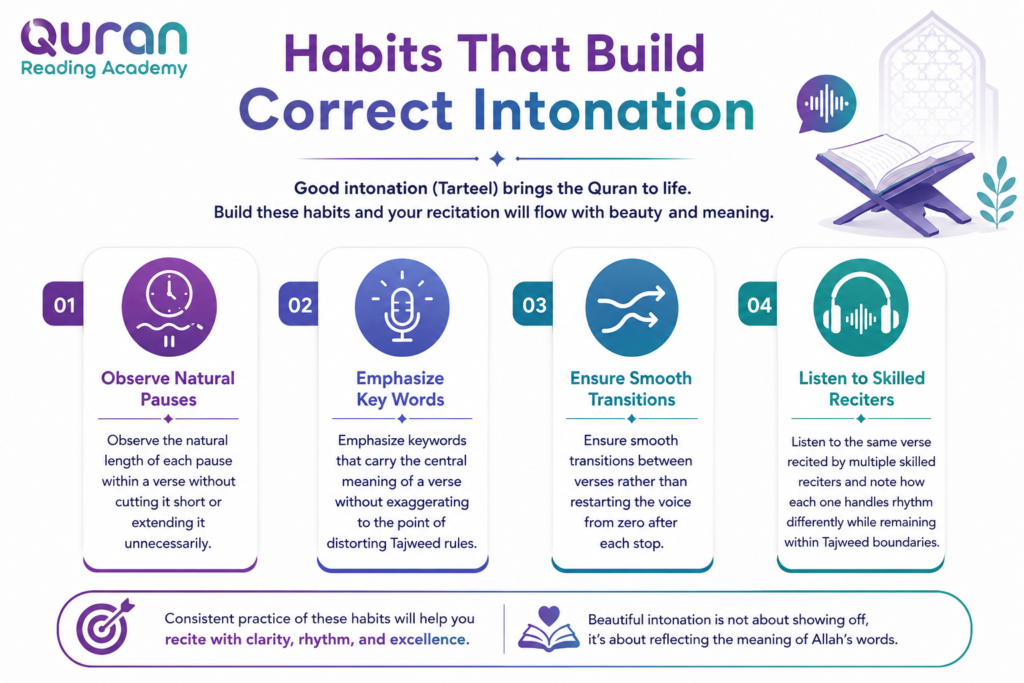
- Observing the natural length of each pause within a verse without cutting it short or extending it unnecessarily.
- Emphasizing keywords that carry the central meaning of a verse without exaggerating to the point of distorting Tajweed rules.
- Ensuring smooth transitions between verses rather than restarting the voice from zero after each stop.
- Listening to the same verse recited by multiple skilled reciters and noting how each one handles rhythm differently while remaining within Tajweed boundaries.
7. Recording Your Own Recitation Reveals Errors No Mirror Can Show
Most learners who hear their own recorded recitation for the first time are surprised by what they discover. Errors in pronunciation, breaks in rhythm, and missed Tajweed rules that felt correct during recitation become clearly audible in playback.
This gap between perception and reality is the primary reason why self-assessment without recording produces very slow improvement, while consistent recording produces rapid and measurable progress.
The practical recording habit involves three steps. Record a short passage of five to ten verses. Listen back and note every point where pronunciation, rhythm, or Tajweed application felt incorrect.
Compare the identified errors against a recording of the same passage by a skilled reciter, listening specifically to the points where your version and theirs diverge. Repeating this cycle weekly provides the clearest possible picture of genuine progress and the most targeted direction for continued practice.
8. Seeking Correction from a Qualified Teacher Accelerates Every Other Step
The Prophet ﷺ said:
“الَّذِي يَقْرَأُ الْقُرْآنَ وَيَتَتَعْتَعُ فِيهِ وَهُوَ عَلَيْهِ شَاقٌّ لَهُ أَجْرَانِ”
Man qara’a al-Qur’aana wa huwa yatata’ta’u feehi wa huwa ‘alayhi shaqqun lahu ajraan
“he who falters in it, and finds it difficult for him, will have two rewards.”
This hadith confirms that the struggling learner is rewarded, but it does not mean that struggling without correction is the intended path.
A qualified teacher with Ijazah in recitation identifies whether a student’s error is a Makharij problem, a Tajweed rule misunderstanding, or a breath control issue, and addresses each one with a targeted correction rather than a general instruction to practice more.
One session of live, targeted correction produces more improvement than weeks of solo practice spent reinforcing the same undetected error.
The Online Quran Reading Course with Tajweed at The Quran Reading Academy delivers exactly this. Certified Arab tutors with Ijazah provide one-on-one live correction tailored to each student’s specific errors, with real-time audio-visual feedback in every class.
Read Also: How to Read Quran If You Don’t Know Arabic: 7 Proven Ways

Enroll today and stop practicing your mistakes
9. Practicing Daily at a Fixed Time Builds the Habit That Sustains Everything Else
Research on habit formation consistently shows that a behavior repeated at the same time each day requires approximately sixty-six days to become automatic.
For Quranic recitation, this means that a learner who sits down after Fajr every single day for two months will find by the end of that period that missing the session feels wrong, while sitting down for it requires no conscious effort at all.
The time after Fajr is specifically recommended because the mind is clear, distractions are minimal, and the spiritual environment of the early morning supports focused recitation.
The daily practice session does not need to be long to be effective. Fifteen focused minutes of deliberate practice, where the learner applies Tajweed consciously, corrects known errors actively, and records progress weekly, produces more improvement than an hour of passive reading. The following practice structure works effectively for most learners:
- Five minutes of warming up with a short, familiar Surah to prepare the voice and settle the mind.
- Ten minutes of focused work on a new passage, applying specific Tajweed rules to each verse before moving forward.
- Five minutes of listening to the same passage recited by a skilled reciter to close the gap between current level and target level.
Read Also: How to Make Reading Quran More Interesting?
10. Embracing Mistakes as Part of the Process Keeps You Moving Forward
Allah says in the Quran:
“فَاتَّقُوا اللَّهَ مَا اسْتَطَعْتُمْ “
Fattaqoo Allaaha mastata’tum
“So fear Allah as much as you are able.”
This verse establishes the foundational Islamic principle that Allah asks of each person their genuine capacity, not perfection. A non-Arab Muslim who recites with errors while sincerely trying is fulfilling their obligation and earning reward.
The problem is not making mistakes. The problem is making the same mistakes repeatedly without seeking correction. A learner who approaches each error as specific information about what needs to be fixed, rather than as evidence of failure, makes steady progress. A learner who avoids recitation out of embarrassment makes none at all.
Read Also: How to Read and Understand Quran in 8 Proven Steps
Inside Our Live Classroom
We believe in complete transparency. Take a look inside our virtual classrooms to experience our premium teaching tools and engaging learning environment firsthand.
Start Your Quran Learning Journey Today
Join Quran Reading Academy and begin structured, step-by-step Quran reading with expert guidance.
Try your first class for freeBegin Improving Your Recitation at The Quran Reading Academy Today
The Quran Reading Academy provides everything needed to genuinely improve Quran recitation at any level. Certified Arab tutors holding Ijazah in recitation deliver one-on-one live sessions with real-time Makharij correction using audio-visual feedback in every class.
Flexible scheduling covers all global time zones including EST, PST, GMT, CET, IST, and MYT, ensuring no learner is left without access regardless of their location. Monthly progress reports and written feedback after every session make your development measurable and your direction clear.
Our Quran Courses
- Quran Reading Classes
- Quran Reading Classes for Kids
- Quran Reading Classes for Adults
- Quran Reading Classes for Female/Sisters
- Quran Reading Classes for New Muslims
- Quran Reading Course for Beginners
- Online Quran Reading Course with Tajweed
- Reading and Memorizing the Quran Course
- Noorani Qaida Course
- Quran Course for Beginners
- Quran Tajweed Course
- Quran Recitation Course
- Quran Hifz Course
- Online Quran Qirat Classes
- Quranic Arabic Course
- Arabic Reading Practice Course

Register at The Quran Reading Academy and start improving your recitation
Conclusion
Learning how to improve recitation of the Quran is a structured journey built on ten interconnected steps. Tajweed rules protect meaning. Correct pronunciation removes the root cause of most errors. Active listening trains the ear. Breath control ensures smooth delivery. Understanding transforms reading into worship. Intonation emerges naturally from all of these combined. Recording provides honest self-assessment.
A qualified teacher corrects what self-study cannot reach. Daily practice builds the habit that sustains everything. And embracing mistakes keeps the learner moving forward rather than standing still. Every step you take toward better recitation is an act of worship that Allah rewards, and every correction you make honors the Book that was revealed to be recited with precision and presence.
Frequently Asked Questions
How long does it take to noticeably improve Quran recitation?
Most learners notice measurable improvement within four to six weeks of daily focused practice combined with live teacher correction.
Is it sinful to recite the Quran with mistakes while learning?
No. The Prophet ﷺ confirmed that the learner who recites with difficulty while sincerely trying receives a double reward from Allah.
What is the most common recitation error among non-Arab learners?
Substituting familiar sounds for unfamiliar Arabic letters, particularly throat letters like Qaf, Ain, and Kha, is the most widespread error.
Can adults learn how to improve Quran recitation from scratch?
Absolutely. Adults learn effectively with structured one-on-one instruction and consistent daily practice regardless of their starting level.
Does the quality of my voice affect recitation beauty?
No. Beautiful recitation results from correct Tajweed, breath control, and understanding, not from a naturally strong or melodious voice.
How many minutes of daily practice are needed for real progress?
Fifteen focused minutes of deliberate daily practice consistently outperforms longer but irregular sessions in producing measurable results.



Leave a Reply