 Quran
Quran
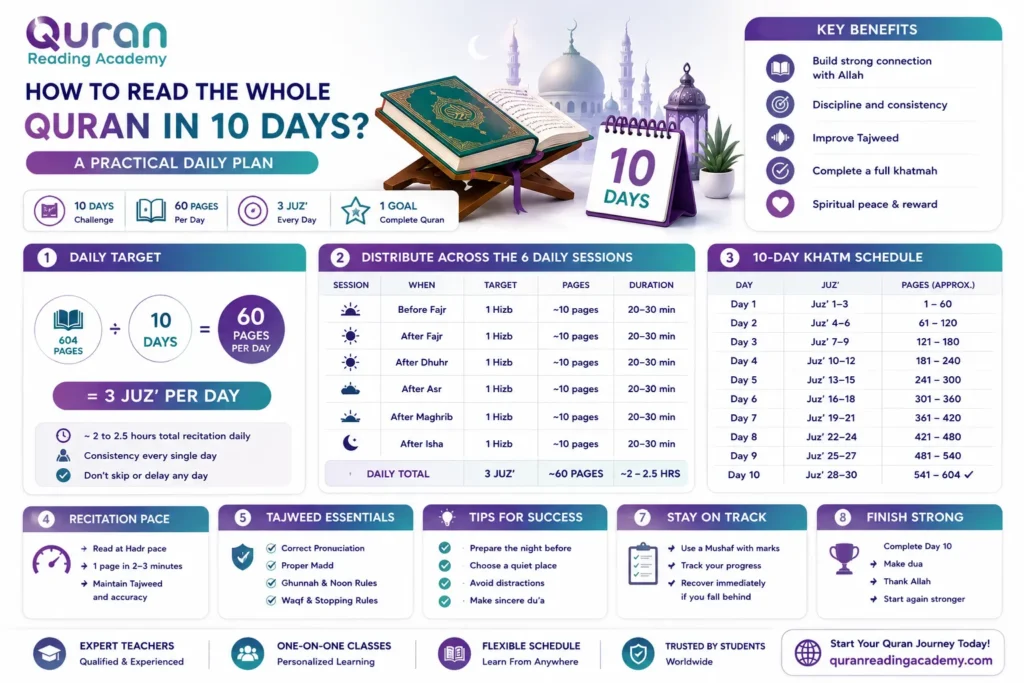
Sixty pages a day. Three Juz’ every twenty-four hours. That is the exact commitment behind completing the Quran in 10 days — a goal that sounds extreme until you see how it breaks down across your five daily prayers.
The math is simple: the standard Mushaf contains 604 pages across 30 Juz’, and dividing that by 10 gives you roughly 60 pages per day, or about 10 pages per sitting if you spread it across six sessions.
Most 10-day plans fail not because the reader lacks motivation, but because the daily target is treated as one massive block instead of being distributed intelligently.
This guide from Quran Reading Academy gives you the exact page targets, the prayer-by-prayer distribution, the recitation speed that keeps your Tajweed intact, and the specific mistakes that cause most plans to collapse by day four.
1. Knowing How Many Pages Per Day To Read The Whole Quran In 10 Days
To finish reading the Quran in 10 days, you need to recite approximately 60 pages — or 3 complete Juz’ — every single day without exception. Missing even one day means covering 6 Juz’ the next, a strain that collapses most plans entirely. The table below maps out exactly where you should be at any point in the plan.
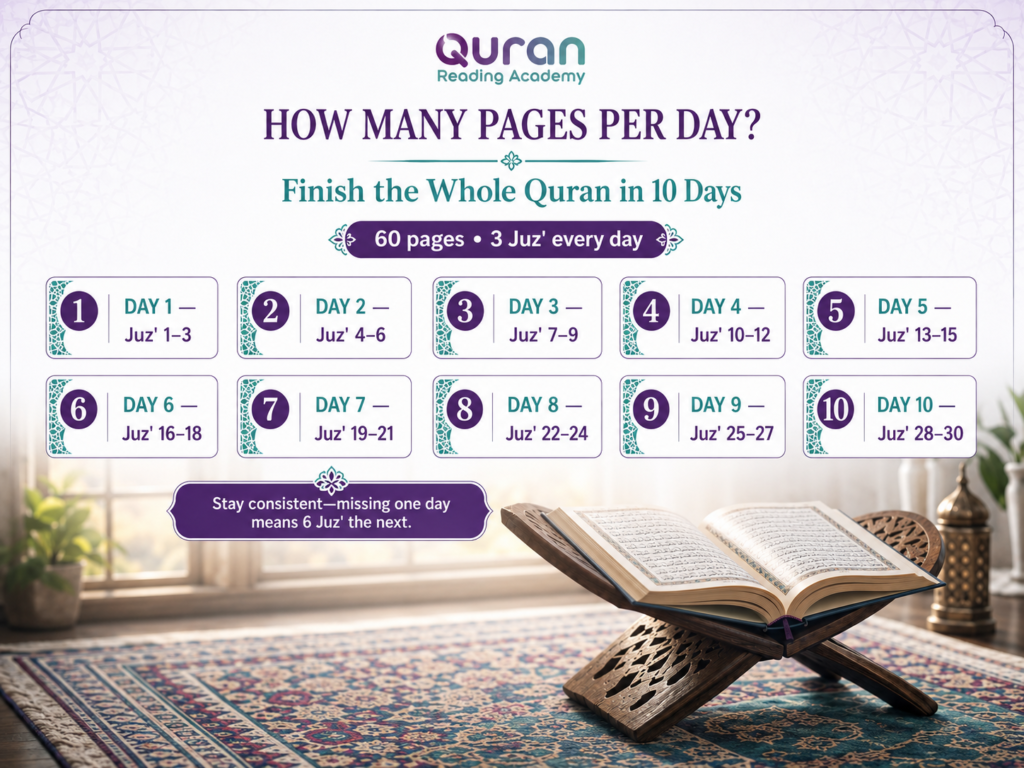
| Day | Juz’ to Complete | Approximate Pages | Cumulative Juz’ |
| Day 1 | Juz’ 1–3 | Pages 1–60 | 3 |
| Day 2 | Juz’ 4–6 | Pages 61–120 | 6 |
| Day 3 | Juz’ 7–9 | Pages 121–180 | 9 |
| Day 4 | Juz’ 10–12 | Pages 181–240 | 12 |
| Day 5 | Juz’ 13–15 | Pages 241–300 | 15 |
| Day 6 | Juz’ 16–18 | Pages 301–360 | 18 |
| Day 7 | Juz’ 19–21 | Pages 361–420 | 21 |
| Day 8 | Juz’ 22–24 | Pages 421–480 | 24 |
| Day 9 | Juz’ 25–27 | Pages 481–540 | 27 |
| Day 10 | Juz’ 28–30 | Pages 541–604 | 30 ✓ |
Each day’s 3 Juz’ is your non-negotiable minimum. This same schedule can be repeated three times during Ramadan to complete the Quran three times in 30 days — simply restart the table on day 11 and again on day 21.
Read also: How To Read The Quran In 15 Days?
2. Distribute Recitation Across The Five Daily Prayers
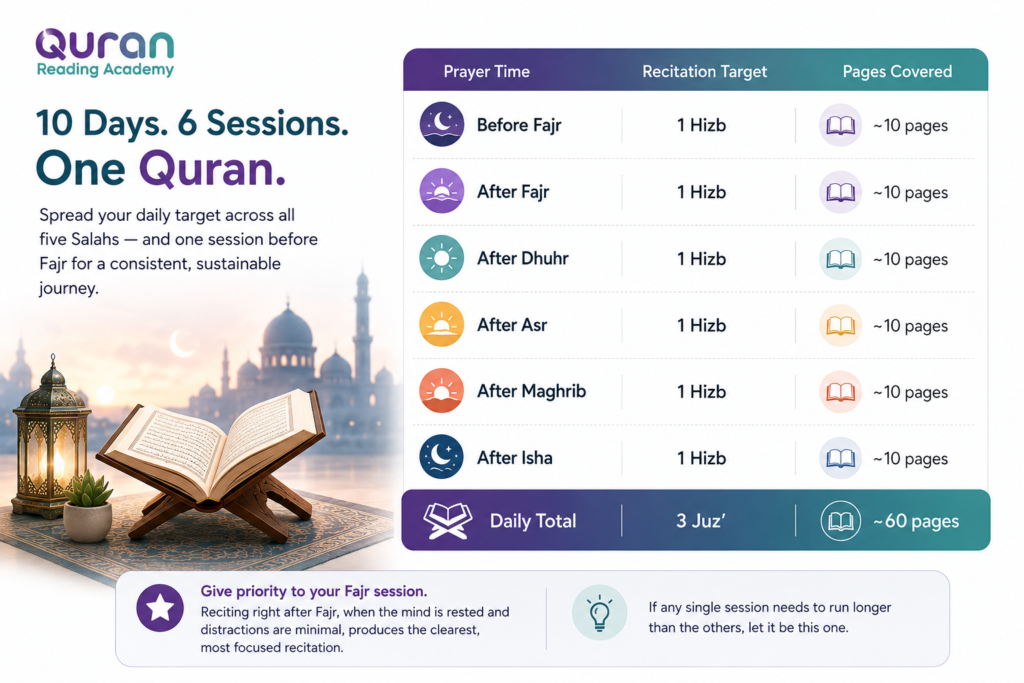
The most sustainable way to read the whole Quran in 10 days is spreading your daily target across all five Salahs — reciting one Hizb (half a Juz’, roughly 10 pages) after each prayer, plus one session before Fajr.
This avoids the exhaustion of marathon sessions and keeps your connection to the Quran constant throughout the day.
| Prayer Time | Recitation Target | Pages Covered |
| Before Fajr | 1 Hizb | ~10 pages |
| After Fajr | 1 Hizb | ~10 pages |
| After Dhuhr | 1 Hizb | ~10 pages |
| After Asr | 1 Hizb | ~10 pages |
| After Maghrib | 1 Hizb | ~10 pages |
| After Isha | 1 Hizb | ~10 pages |
| Daily Total | 3 Juz’ | ~60 pages |
The Fajr session deserves particular attention. Reciting right after Fajr, when the mind is rested and distractions are minimal, consistently produces the clearest, most focused recitation. If any single session needs to run longer than the others, let it be this one.
An alternative split that some readers prefer: complete one full Juz’ (20 pages) after each of three prayers — Fajr, Dhuhr, and Maghrib. This means fewer but longer sessions, which suits readers who find it easier to enter a flow state once rather than restarting six times.
Read Also: How To Read Quran In 2 Weeks
3. Choose The Right Recitation Pace
For anyone learning how to finish reading the Quran in 10 days, Hadr — the fastest of the three accepted recitation speeds — is the appropriate pace. Hadr is faster than Tarteel and Tadwir, but it still requires correct pronunciation, proper Madd lengths, and essential Ghunnah. It is not reckless rushing.
At Hadr pace, a proficient reader covers roughly one page every two to three minutes. That means each 10-page Hizb session takes 20–30 minutes — entirely manageable after each prayer. The Prophet ﷺ tied the merit of recitation to effort as much as proficiency:
“The one who is proficient in reciting the Quran is with the honorable, obedient scribes (angels), and the one who recites it while finding it difficult, stumbling through it, will have a double reward.” (Sahih Muslim 798)
This hadith confirms that even a student reciting at Hadr pace while genuinely working at it earns real reward. Sincere effort, not flawless delivery, is the condition.
Read also: How To Complete The Quran In 30 Days?
The Four Tajweed Minimums You Must Maintain At Speed
Mispronouncing letters due to excessive speed can distort meaning, so maintain at minimum:
- Correct Makhraj (articulation point) for every letter — this is what separates Hadr from simply reading fast.
- Madd lengths of at least two counts where required — a shortened Madd changes the rhythm of the verse.
- Ghunnah on Noon and Meem with Shaddah — this nasal sound is easy to drop entirely under time pressure.
- Qalqalah on the five echoing letters (ق ط ب ج د) when they carry Sukoon — the bounce is often the first thing lost at speed.
If you need to build this Tajweed foundation before attempting Hadr pace, Quran Reading Academy offers a structured Quran Tajweed Course with one-on-one sessions that prepare you for faster, accurate recitation.
See Our Academy in Action
Discover what a typical session looks like! Watch these brief highlights from our live, interactive classes to see how our instructors engage with students of all ages.
Start Your Quran Learning Journey Today
Join Quran Reading Academy and begin structured, step-by-step Quran reading with expert guidance.
Try your first class for free4. Design A Detailed Daily Routine
A vague intention to “read more Quran today” fails by day two. You need a schedule locked to specific times, tied to prayers you already perform, and treated as non-negotiable.
Start by choosing your primary session — the one you protect above all others. For most readers, this is after Fajr. Then build outward: assign a Hizb to each remaining prayer, write the schedule where you can see it, and track completion with a simple tick sheet per Hizb.
Here is a practical daily structure that works for working adults:
- 5:00 AM (before Fajr): Hizb 1 — recite while the house is quiet.
- 5:30 AM (after Fajr): Hizb 2 — your sharpest mental window of the day.
- 1:00 PM (after Dhuhr): Hizb 3 — use your lunch break if working.
- 4:30 PM (after Asr): Hizb 4 — a lighter session after the day’s main work.
- 7:00 PM (after Maghrib): Hizb 5 — transition into the evening.
- 9:00 PM (after Isha): Hizb 6 — your final session, then rest.
The secret is not finding extra time — it is attaching recitation to prayers you already perform. The prayer becomes the trigger; the Hizb becomes the habit.
Read Also: 10 Benefits Of Reading The Quran In Arabic
5. Prepare Your Recitation Environment
How to read the whole Quran in 10 days without losing focus? Your environment matters more than willpower. A few practical steps make the difference between finishing and stalling around day four.
Use one fixed Mushaf throughout. Familiarity with the page layout genuinely speeds up reading over the ten days. Your eyes learn where lines break, where pages turn, and this reduces cognitive load with each passing day.
Mark your daily checkpoints. Place a light pencil mark at the start of each Juz’ you need to cover that day, so progress stays visually trackable. Visible progress provides real psychological motivation to continue.
Remove phone notifications during sessions. Even brief interruptions during a 10-page session break your flow and extend how long each Hizb takes. A 25-minute session can stretch to 45 minutes with just three phone checks.
Recite in wudu, in a clean and quiet space. Treating the setting with reverence sharpens focus noticeably. Designate a specific spot in your home — the same chair, the same corner — so your body associates that space with focused recitation.
6. Take Strategic Breaks Between Each Juz’
Breaks between sessions are not pauses — they are part of the strategy. Reading 60 pages straight causes mental fatigue that degrades your Tajweed by page 30 and your comprehension by page 40.
After each Hizb, step away for 5–10 minutes. Hydrate, stretch, or take a brief walk. This small reset preserves recitation quality across all six sessions.
Some readers use the break to quickly review the meaning of a passage that struck them — not a full Tafseer session, but a moment of reflection that keeps the recitation from becoming mechanical.
For parents and homemakers: use the natural gaps between prayers for household responsibilities. Cook between Dhuhr and Asr, handle children’s needs between Asr and Maghrib. The prayer-based distribution builds these breaks into your day automatically.
Quran Reading Academy recommends treating each Hizb session as a self-contained unit — start it, finish it, close the Mushaf, and walk away until the next prayer. This mental framing prevents the overwhelming feeling of “I still have 40 pages left today.”
The Virtues That Make This Effort Worthwhile
Every letter you recite carries its own multiplied reward. The Prophet ﷺ said:
“Whoever recites a letter from the Book of Allah will be credited with a good deed, and the good deed is multiplied by ten.” (Jami’ at-Tirmidhi 2910)
The reward is counted letter by letter, not word by word. A full 604-page Khatm represents a substantial cumulative act of worship — not because of the achievement of finishing, but because of what every single page along the way quietly accumulates.
Correct Tajweed matters directly here: giving each letter its full articulation is what ensures the reward described in this hadith is actually earned as intended.
The Tajweed minimums covered earlier are not a separate concern from reward — they are the mechanism that delivers it in full.
If you want to strengthen your recitation quality before or during your 10-day plan, Quran Reading Academy’s Quran Recitation Course helps you build the fluency needed for sustained, accurate reading.
How Non-Arabic Speakers Can Maintain Quality Over 10 Days?
Non-Arabic speakers face two specific challenges during intensive recitation: letter confusion under time pressure, and fatigue-driven loss of proper Makhraj by the later sessions of the day.
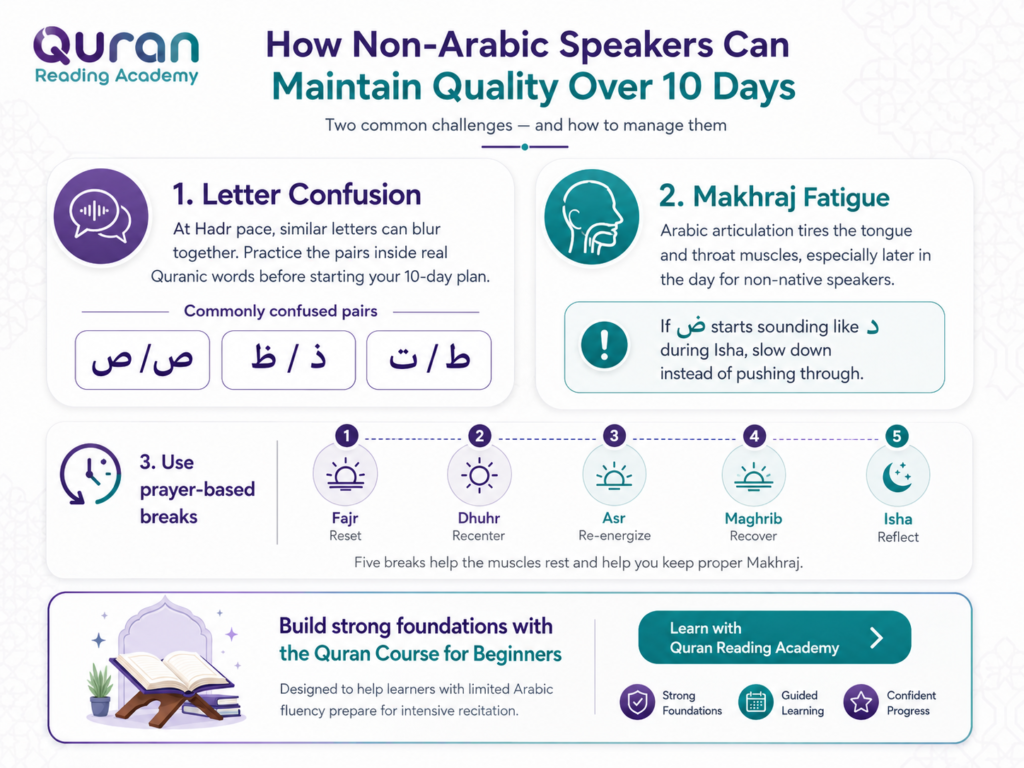
Letter confusion happens most often between similar-sounding pairs — سين/صاد, ذال/ظاء, تاء/طاء. At Hadr pace, the instinct is to blur distinctions. Before starting your 10-day plan, spend one session practicing these pairs specifically, not in isolation but within actual Quranic words.
Makhraj fatigue is physical. The tongue and throat muscles used for Arabic articulation tire after extended use, especially for non-native speakers.
The prayer-based distribution helps here — five breaks across the day allow these muscles to rest. If you notice your ض starting to sound like your د in the Isha session, that is a signal to slow down rather than push through.
Quran Reading Academy offers a Quran Course for Beginners specifically designed to build the foundational skills that make intensive recitation plans achievable, even for readers starting with limited Arabic fluency.
Inside Our Live Classroom
We believe in complete transparency. Take a look inside our virtual classrooms to experience our premium teaching tools and engaging learning environment firsthand.
Start Your Quran Learning Journey Today
Join Quran Reading Academy and begin structured, step-by-step Quran reading with expert guidance.
Try your first class for freeStart Your 10-Day Quran Reading Journey With Quran Reading Academy
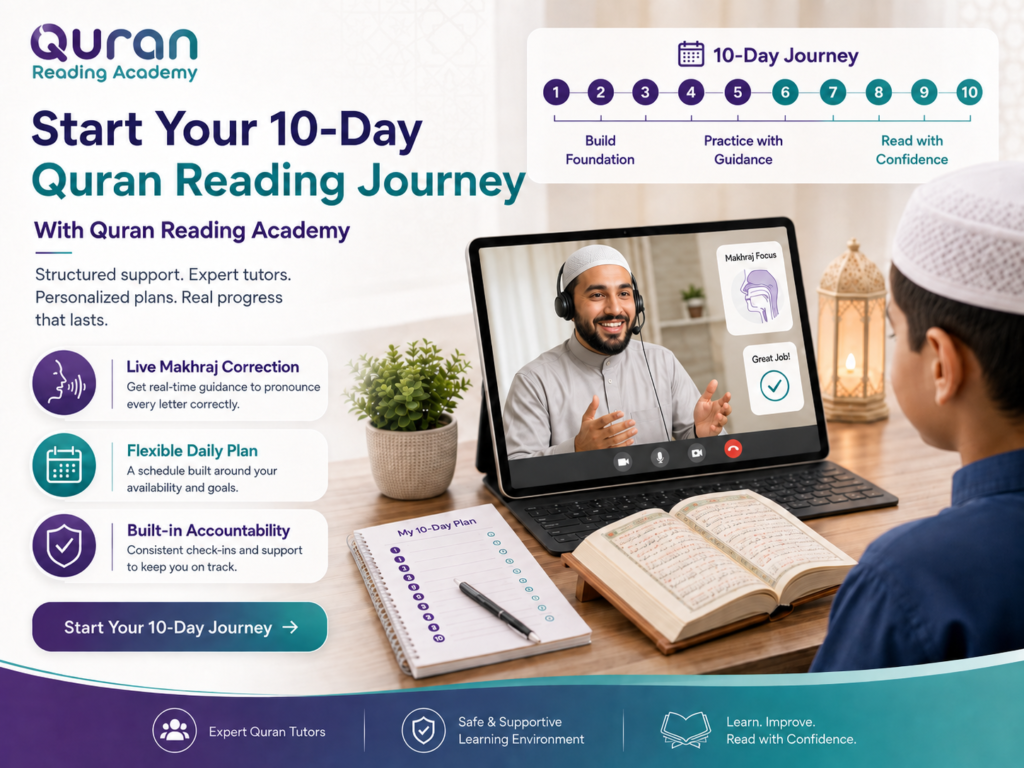
You now have the schedule, the distribution method, and the Tajweed standards. What separates readers who finish from those who stop at day four is structured support — a tutor who corrects your Makhraj in real time, a plan built around your actual daily availability, and accountability that keeps you going when motivation dips.
Quran Reading Academy provides one-on-one sessions with qualified instructors who can build a personalized recitation plan around your schedule, correct your Tajweed at Hadr pace, and guide you through your first complete 10-day Khatm.
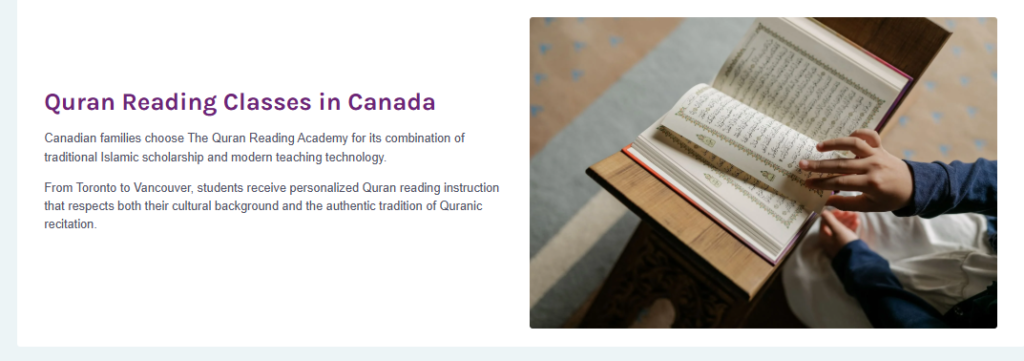
Whether you are preparing for Ramadan or setting a personal goal, expert guidance turns a challenging target into a realistic one.
Our Quran Courses:
- Quran Reading Classes
- Quran Reading Classes for Kids
- Quran Reading Classes for Adults
- Quran Reading Classes for Female/Sisters
- Quran Reading Classes for New Muslims
- Quran Reading Course for Beginners
- Online Quran Reading Course with Tajweed
- Reading and Memorizing the Quran Course
- Noorani Qaida Course
- Quran Course for Beginners
- Quran Tajweed Course
- Quran Recitation Course
- Quran Hifz Course
- Online Quran Qirat Classes
- Quranic Arabic Course
- Arabic Reading Practice Course
Start Your Quran Learning Journey Today
Join Quran Reading Academy and begin structured, step-by-step Quran reading with expert guidance.
Try your first class for freeConclusion
How to finish reading the Quran in 10 days comes down to three non-negotiable elements: a daily target of exactly 3 Juz’ (60 pages), distribution across your five daily prayers so no single session overwhelms you, and Hadr-pace recitation that stays within the four Tajweed minimums — correct Makhraj, proper Madd lengths, Ghunnah, and Qalqalah.
The plan is demanding but sits comfortably within the boundaries Islamic scholarship has established — above the three-day minimum the Prophet ﷺ set, and structured to preserve both recitation quality and genuine engagement with the text.
Every letter you recite carries multiplied reward, and that reward is earned fully only when each letter receives its proper articulation.
Treat this as a periodic commitment — Ramadan, a personal milestone, a spiritual reset — rather than a permanent pace. Use the Juz’ table to track daily progress, protect your Fajr session above all others, and remember that the readers who finish are not the ones with the most free time, but the ones with the most consistent routine.
Quran Reading Academy is here to help you build that routine with expert guidance from day one through your Quran Hifz Course and recitation programs.

Frequently Asked Questions
Below are the most common questions readers ask when planning to finish reading the Quran in 10 days, answered directly so you can resolve any hesitations before starting.
1. How long does each recitation session take if I split 3 Juz’ across six sittings?
Each session covers roughly 10 pages (one Hizb). At Hadr pace, a proficient reader finishes one Hizb in 20–30 minutes. Non-native Arabic speakers may need 30–40 minutes per session initially, which decreases as familiarity with the pages builds over the ten days.
2. Can I listen to a reciter instead of reading myself to save time?
Listening counts as engaging with the Quran and carries its own reward, but it does not replace personal recitation in terms of the letter-by-letter reward described in the hadith of Tirmidhi 2910. You can use listening to familiarize yourself with upcoming pages during commutes or chores, then recite those pages yourself during your scheduled session.
3. What should I do if I miss a full day?
Missing one day means 6 Juz’ the next — an extremely difficult catch-up that usually causes the entire plan to collapse. If you genuinely cannot recite on a given day, reduce the damage by completing at least 1 Juz’ (20 pages), then spread the remaining deficit across the following three days rather than attempting a full 6 Juz’ recovery in one shot.
4. Do I need to understand every verse to get the full reward?
The letter-by-letter reward applies to recitation itself, regardless of whether you understand every word. However, pausing briefly to reflect on verses you do understand adds the separate reward of tadabbur (reflection). For a 10-day plan, prioritize completing the daily target, and use breaks between sessions for brief reflection rather than stopping mid-flow for extended Tafseer study.
5. Is it better to read from a physical Mushaf or a Quran app?
A physical Mushaf is generally recommended for a 10-day plan because your visual memory of the page layout develops faster, and there are no notifications or app-switching temptations. If you must use a digital device, enable airplane mode during each session and use an app that replicates the standard Madinah Mushaf layout page for page.
6. How can Quran Reading Academy help me prepare for a 10-day Khatm?
Quran Reading Academy offers structured Tajweed and Recitation courses that build the fluency and accuracy needed for sustained Hadr-pace reading. Tutors assess your current level, identify specific pronunciation weaknesses, and create a practice plan that prepares you for intensive recitation before you begin your 10-day commitment.






Leave a Reply