 Quran
Quran
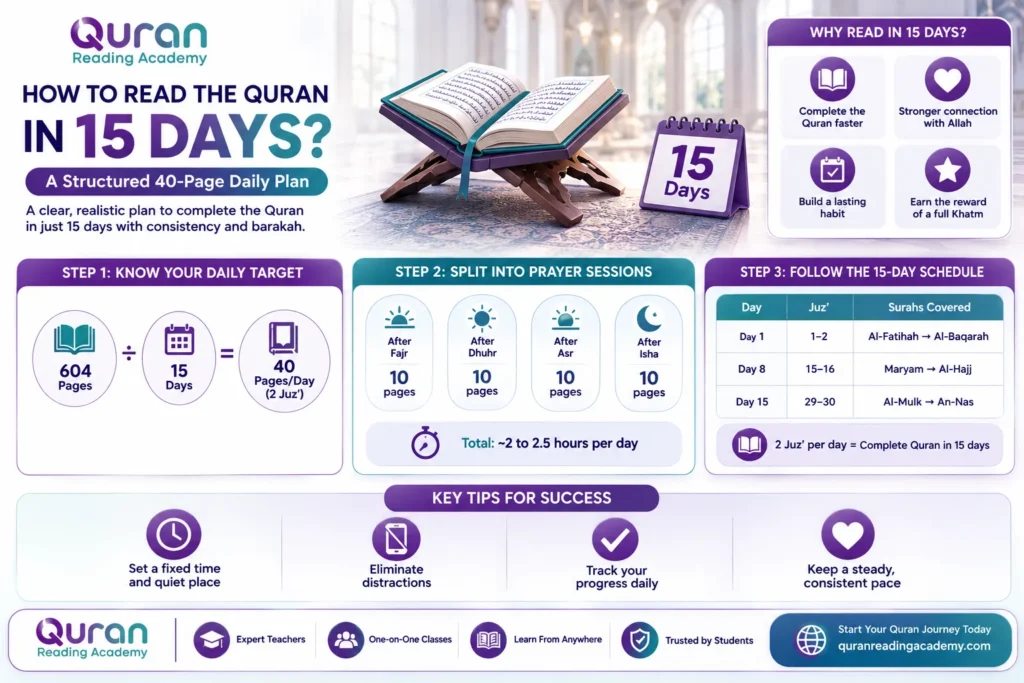
Reading the entire Quran in 15 days is not reserved for scholars or lifelong huffaz. It is a concrete, repeatable goal that any committed Muslim can reach — provided you follow a structured daily plan.
The math is simple: 604 pages divided by 15 days equals roughly 40 pages per day, or exactly 2 Juz’ per session day.
What makes this challenge realistic is not speed — it is structure. When you break 40 pages into smaller blocks anchored to your existing prayer schedule, the daily target shifts from overwhelming to manageable. Around 2 to 2.5 hours of total recitation, spread across four sessions, is all it takes.
This step-by-step guide from Quran Reading Academy walks you through exactly how to read the Quran in 15 days — from calculating your daily target to crossing the finish line on Day 15 with your Tajweed intact.
Step 1: Calculate Your Daily Reading Target Based On Juz’ And Page Count
The first step in learning how to read the Quran in 15 days 40 pages daily is knowing your exact daily number. The standard Madinah Mushaf contains 604 pages and 30 Juz’. Dividing 604 by 15 gives 40.27 pages — rounded practically to 40 pages per day, which equals exactly 2 Juz’.
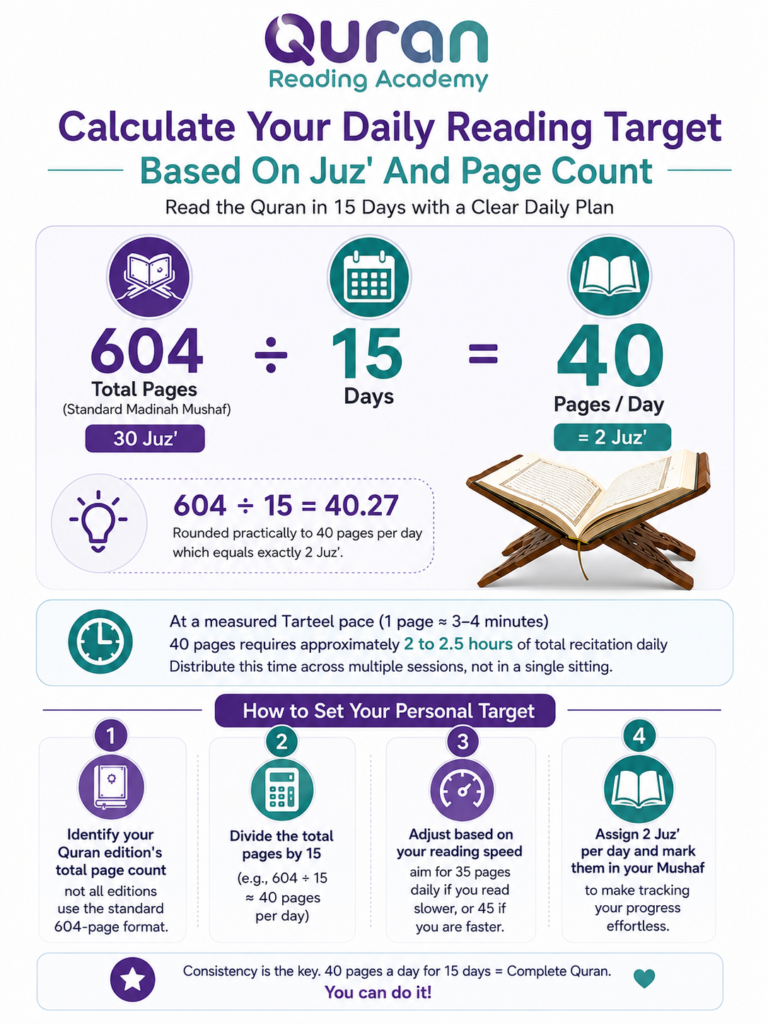
This daily target is demanding but manageable when you understand the time commitment. An average reader reciting at a measured Tarteel pace covers roughly 1 page every 3 to 4 minutes.
That means 40 pages requires approximately 2 to 2.5 hours of total recitation daily — time that must be distributed across multiple sessions, not attempted in a single sitting.
How to Set Your Personal Target:
- Identify your Quran edition’s total page count — not all editions use the standard 604-page format
- Divide the total pages by 15 (e.g., 604 ÷ 15 ≈ 40 pages per day)
- Adjust based on your reading speed — aim for 35 pages daily if you read slower, or 45 if you are faster
- Assign 2 Juz’ per day and mark them in your Mushaf to make tracking your progress effortless
At Quran Reading Academy, our Quran Recitation Course trains students in paced recitation techniques that allow them to maintain both speed and accuracy — the two qualities this 15-day plan demands simultaneously.
Read also: How To Complete The Quran In 30 Days?
Step 2: Break Your Daily 40 Pages Into Prayer
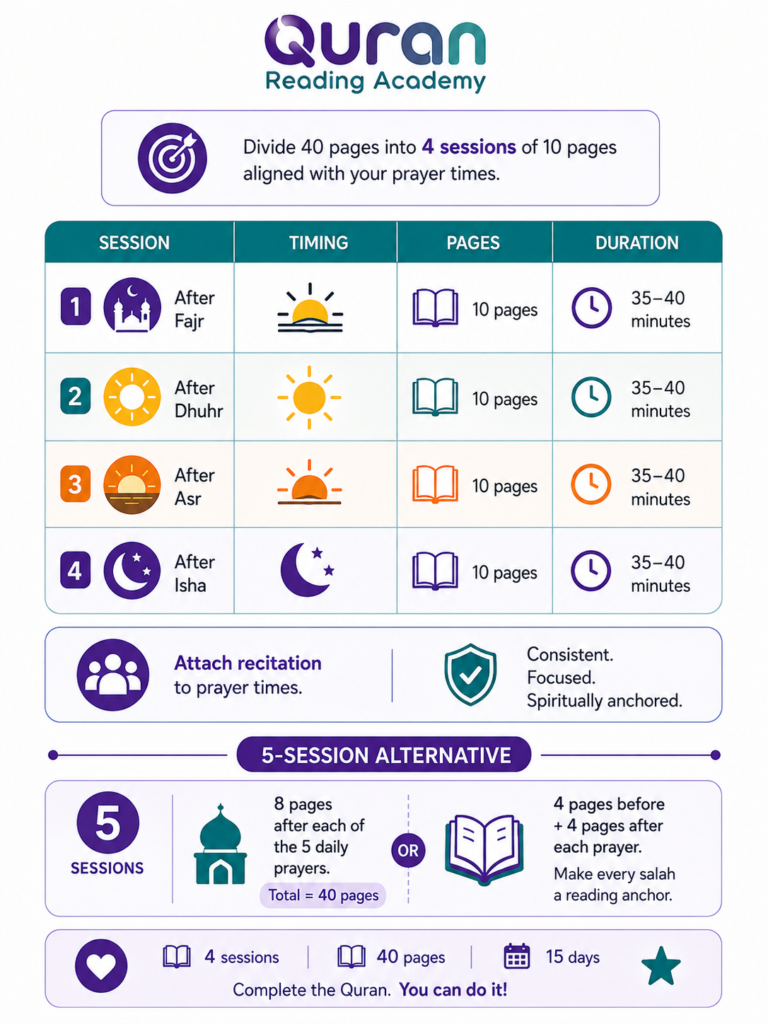
Reading 40 pages in one sitting is a guaranteed path to burnout. The most effective structure divides the daily target into 4 sessions of 10 pages each, distributed across the day’s natural prayer intervals.
This prevents vocal fatigue, maintains concentration, and anchors recitation to acts of worship already in your routine.
| Session | Timing | Pages | Approximate Duration |
| Session 1 | After Fajr | 10 pages | 35–40 minutes |
| Session 2 | After Dhuhr | 10 pages | 35–40 minutes |
| Session 3 | After Asr | 10 pages | 35–40 minutes |
| Session 4 | After Isha | 10 pages | 35–40 minutes |
Students at Quran Reading Academy who attach recitation to prayer times miss sessions far less frequently than those who schedule recitation independently — this is one of the most consistent patterns our instructors have observed.
The 5-Session Alternative For Slower Readers
If 10 pages per session feels heavy, switch to 8 pages after each of the five daily prayers. The total still reaches 40, but no single sitting exceeds 30 minutes.
You can also split it further — 4 pages before each prayer and 4 pages after — turning every salah into a natural reading anchor.
Read Also: How To Read Quran In 2 Weeks
Step 3: Map Each Day To Specific Surahs
Having a fixed daily schedule eliminates the daily question of “where do I start today?” The table below outlines the exact targets based on the standard 15-line Madinah Mushaf. Each Juz’ contains approximately 20 pages in this edition.
Read Also: 10 Benefits Of Reading The Quran In Arabic
Your 15-Day Khatm Schedule
| Day | Juz’ | Surahs Covered |
| Day 1 | 1–2 | Al-Fatihah → Al-Baqarah (most) |
| Day 2 | 3–4 | Al-Baqarah (end) → Al-Imran |
| Day 3 | 5–6 | Al-Nisa → Al-Ma’idah |
| Day 4 | 7–8 | Al-An’am → Al-A’raf |
| Day 5 | 9–10 | Al-Anfal → Yunus |
| Day 6 | 11–12 | Hud → Yusuf → Ibrahim |
| Day 7 | 13–14 | Al-Hijr → Al-Kahf |
| Day 8 | 15–16 | Maryam → Al-Anbiya → Al-Hajj |
| Day 9 | 17–18 | Al-Mu’minun → Al-Qasas |
| Day 10 | 19–20 | Al-Ankabut → Ya-Sin |
| Day 11 | 21–22 | Al-Saffat → Al-Zukhruf |
| Day 12 | 23–24 | Al-Dukhan → Al-Fath |
| Day 13 | 25–26 | Al-Hujurat → Al-Hadid |
| Day 14 | 27–28 | Al-Mujadila → Al-Tahrim |
| Day 15 | 29–30 | Al-Mulk → Al-Nas |
Day 15 covers 44 pages — plan for a slightly longer final session. Once you see the full map laid out, how to read the Quran in 15 days 40 pages daily shifts from abstract goal to a concrete, trackable routine.
See Our Academy in Action
Discover what a typical session looks like! Watch these brief highlights from our live, interactive classes to see how our instructors engage with students of all ages.
Start Your Quran Learning Journey Today
Join Quran Reading Academy and begin structured, step-by-step Quran reading with expert guidance.
Try your first class for freeStep 4: Choose The Right Recitation Pace, Hadr With Essential Tajweed
Speed without rules is not recitation — it is error. During a 15-day plan, recite at the Hadr pace, the fastest of the three recognized recitation speeds in classical Tajweed science, while maintaining all obligatory rules.
The Three Recognized Recitation Paces:
- Tahqiq — the slowest pace, used for learning and correction
- Tadwir — moderate, used for regular recitation
- Hadr — fast, still requiring essential Tajweed rules
Even at Hadr pace, rules such as Ghunnah on Noon Mushaddadah and Meem Mushaddadah, correct Madd lengths, and proper Waqf (stopping) remain obligatory. Skipping them does not constitute speed — it constitutes error.
If you can hear yourself clearly pronouncing each letter from its correct articulation point (Makhraj), your Hadr pace is valid. If letters are merging or disappearing, slow down slightly — saving 5 minutes per session is not worth accumulating errors across 604 pages.
Quran Reading Academy’s Quran Recitation Course and Online Quran Qirat Classes build exactly this skill: fluent, fast recitation that never drops below the Tajweed floor.
Allah says: “And recite the Quran with measured recitation.” (Surah Al-Muzzammil 73:4)
Read Also: One Year Quran Reading Plan
Step 5: Complete Three Preparation Tasks Before Day 1
Effective preparation before Day 1 directly determines whether your plan to read the Quran in 15 days survives past Day 3. Three preparation tasks make the most measurable difference in completion rates.
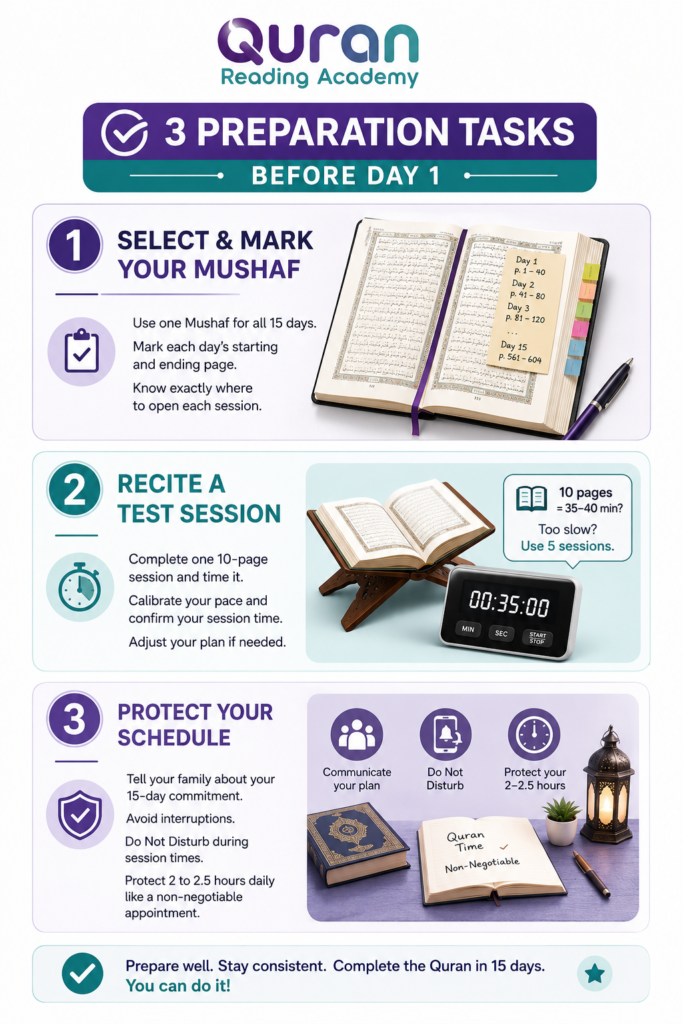
Task 1 — Select And Mark Your Mushaf
Use a single physical or digital Mushaf throughout all 15 days. Mark each day’s starting and ending page before the plan begins. Knowing exactly where to open each session removes daily decision-making — a small friction that compounds into missed sessions when left unresolved.
Task 2 — Recite A Test Session
On the day before starting, complete one 10-page session and time it accurately. This calibrates your realistic pace and confirms whether your session time allocations are sound.
If 10 pages takes you 50 minutes instead of 35, you know immediately that you need the 5-session split rather than the 4-session plan.
Task 3 — Protect Your Schedule
Communicate your 15-day commitment to household members. Interrupted sessions are the primary reason structured plans collapse midway through. Set your phone to Do Not Disturb during each session block.
Treat these 2 to 2.5 daily hours with the same non-negotiability you would give to a work appointment.
Step 6: Maintain Consistency And Combine Recitation With Reflection
Reading 40 pages daily for 15 days straight requires more than a schedule — it requires habits that keep you engaged spiritually, not just mechanically.
- Start Session 1 immediately after Fajr — your mind is freshest and distractions are fewest
- Use phone reminders set 5 minutes before each session block
- If you must shorten one session, reduce it by 2–3 pages rather than skipping entirely — momentum matters more than perfection
- Consider joining a reading partner or accountability group; shared commitment reduces dropout significantly
Add Brief Reflection Without Slowing Down
Understanding does not require stopping after every verse. A practical approach for a 15-day plan:
- Use a Mushaf with a side-by-side translation and glance at meanings during natural pauses
- After completing each day’s 2 Juz’, spend 5 minutes noting one theme or lesson that stood out
- This reflection habit turns a speed-focused exercise into genuine spiritual engagement — the difference between finishing the Quran and truly reading it
The Prophet Muhammad ﷺ said:
“The most beloved deeds to Allah are those that are done consistently, even if they are few.” (Sahih Muslim)
Quran Reading Academy’s Quranic Arabic Course and Arabic Reading Practice Course strengthen the foundation that makes comprehension during fast recitation possible.
Step 7: Avoid The Five Mistakes That Derail Most 15-Day Plans
The most common reasons structured Quran completion plans fail are predictable and preventable. Understanding them before Day 1 gives you a clear advantage when reading the Quran in 15 days with 40 pages daily.
| Common Mistake | Why It Happens | Practical Fix |
| Attempting all 40 pages in one sitting | Underestimating fatigue | Commit strictly to 4 or 5 separate sessions |
| Skipping a session and “catching up later” | Poor time protection | Never defer — reduce pages in the current session if needed, not the next |
| Reciting too slowly due to Tajweed anxiety | Fear of making errors | Adopt Hadr pace; Hadr with core rules is valid and rewarded |
| Losing track of daily position | No pre-marking | Pre-mark all 15 starting points before Day 1 |
| Abandoning the plan after Day 4–5 | Unrealistic expectations | Anticipate mid-plan fatigue; schedule a 15-minute rest before Session 4 |
The Day 4–5 fatigue pattern is one of the most consistent observations instructors at Quran Reading Academy have noted over years of guiding students through intensive recitation plans. It is not a sign of failure — it is a physiological response to new cognitive and vocal demands.
Your throat, focus, and discipline are adapting to a workload they are not accustomed to. Expecting this dip prevents discouragement. Push through Days 4 and 5, and Days 6 onward feel noticeably lighter.
Step 8: Understand How A 15-Day Plan Compares To Other Timelines
Knowing where a 15-day Khatm falls on the spectrum of Quran completion schedules helps you set realistic expectations — and shows you what to build toward next.
The Prophet ﷺ directly addressed the responsible pace for Quran completion. As recorded in Sahih Bukhari 5054, he ﷺ said:
“Recite the Quran in a month.” (Sahih al-Bukhari)
He also discouraged completing it in fewer than three days, noting that one who does so does not truly understand it.
| Timeline | Daily Pages | Recommended For |
| 30 days (1 Juz’/day) | 20 pages | Regular monthly cycle |
| 15 days (2 Juz’/day) | 40 pages | Ramadan / dedicated breaks |
| 10 days (3 Juz’/day) | 60 pages | Advanced reciters with strong prior habit |
| 7 days (Khatm in a week) | ~86 pages | Scholars; requires exceptional prior conditioning |
The 15-day plan sits within the range that combines meaningful engagement with manageable daily volume — appropriate for dedicated Muslims who are not yet habituated to 60+ pages daily. It is also the most natural fit for each half of Ramadan.
For those building a longer-term structured plan beyond these 15 days, Quran Reading Academy’s Quran Hifz Course provides frameworks adaptable to any memorization or reading timeline.
Read Also: Motivation To Read Quran
Inside Our Live Classroom
We believe in complete transparency. Take a look inside our virtual classrooms to experience our premium teaching tools and engaging learning environment firsthand.
Start Your Quran Learning Journey Today
Join Quran Reading Academy and begin structured, step-by-step Quran reading with expert guidance.
Try your first class for freeStart Your Structured Quran Practice with Quran Reading Academy
A 15-day completion plan is a powerful act of dedication — and the right guidance makes it sustainable beyond a single intensive effort.
At Quran Reading Academy, our expert instructors help students build the recitation habits, Tajweed foundations, and structured reading discipline that make every future Khatm stronger and faster.

Our Quran Courses
- Quran Reading Classes
- Quran Reading Classes for Kids
- Quran Reading Classes for Adults
- Quran Reading Classes for Female/Sisters
- Quran Reading Classes for New Muslims
- Quran Reading Course for Beginners
- Online Quran Reading Course with Tajweed
- Reading and Memorizing the Quran Course
- Noorani Qaida Course
- Quran Course for Beginners
- Quran Tajweed Course
- Quran Recitation Course
- Quran Hifz Course
- Online Quran Qirat Classes
- Quranic Arabic Course
- Arabic Reading Practice Course

Start Your Quran Learning Journey Today
Join Quran Reading Academy and begin structured, step-by-step Quran reading with expert guidance.
Try your first class for freeConclusion
Completing the Quran in 15 days comes down to eight clear steps: calculate your 40-page daily target, break it into prayer-anchored sessions, follow a fixed day-by-day Surah map, recite at Hadr pace with essential Tajweed.
Prepare your Mushaf and schedule before Day 1, maintain consistency with brief reflection, avoid the five predictable mistakes, and understand where this plan fits in the broader spectrum of completion timelines.
How to read the Quran in 15 days is ultimately a question of discipline and structure, not talent or speed.
The total daily commitment is 2 to 2.5 hours — less time than most people spend on their phones. Fifteen days from Al-Fatiha to An-Nas. Structure gives you the path. Intention gives it meaning.

Frequently Asked Questions
Below are the most common questions readers ask when planning to read the Quran in 15 days. Each answer addresses a specific concern to help you stay on track throughout your Khatm journey.
How many pages of the Quran should I read daily to complete it in 15 days?
You need to read approximately 40 pages per day, which equals 2 Juz’. For a standard 604-page Madinah Mushaf, this means covering 40 pages on Days 1 through 13, with slight increases on Days 14 and 15 to account for the remaining pages.
Is it permissible to complete the Quran in 15 days?
Yes, completing the Quran in 15 days is permissible and falls well within the range the Prophet ﷺ endorsed. He discouraged finishing in fewer than three days but encouraged regular completion. A 15-day Khatm is a common practice during Ramadan and is supported by classical scholarship.
What is the best time of day to read large portions of the Quran?
The period immediately after Fajr prayer is the most effective — fewer distractions, a fresh mind, and the spiritual momentum of having just prayed. The post-Isha period is the second-best slot. Distributing sessions after each prayer ensures no single block becomes too long.
Can I use a digital Quran app instead of a physical Mushaf?
Yes, a digital Mushaf is fully acceptable. Many apps track your daily progress automatically, which eliminates the need for manual page marking. The key is consistency — choose one format and stick with it for all 15 days.
What should I do if I fall behind schedule?
Distribute the missed pages across the remaining sessions that same day — never push them to tomorrow. If you fall a full day behind, extend your plan to 16 days rather than doubling the next day’s load to 80 pages. A realistic recovery keeps you going; an impossible catch-up target causes you to quit.
How long does it take to memorize 40 pages of the Quran?
Memorizing 40 pages (2 Juz’) is a different goal from reading them. At a steady memorization pace, most students complete 2 Juz’ in 1 to 2 months, depending on prior familiarity and daily revision time. Quran Reading Academy’s Quran Hifz Course provides structured memorization schedules tailored to individual learning speeds.







Leave a Reply