 Quran
Quran
Every Ramadan, millions of Muslims set the same goal: finish reading the entire Quran before Eid. Yet many start strong, lose momentum by the second week, and end the month feeling they fell short. The problem is rarely motivation — it is the absence of a realistic, day-by-day structure that fits around fasting, work, and family life.
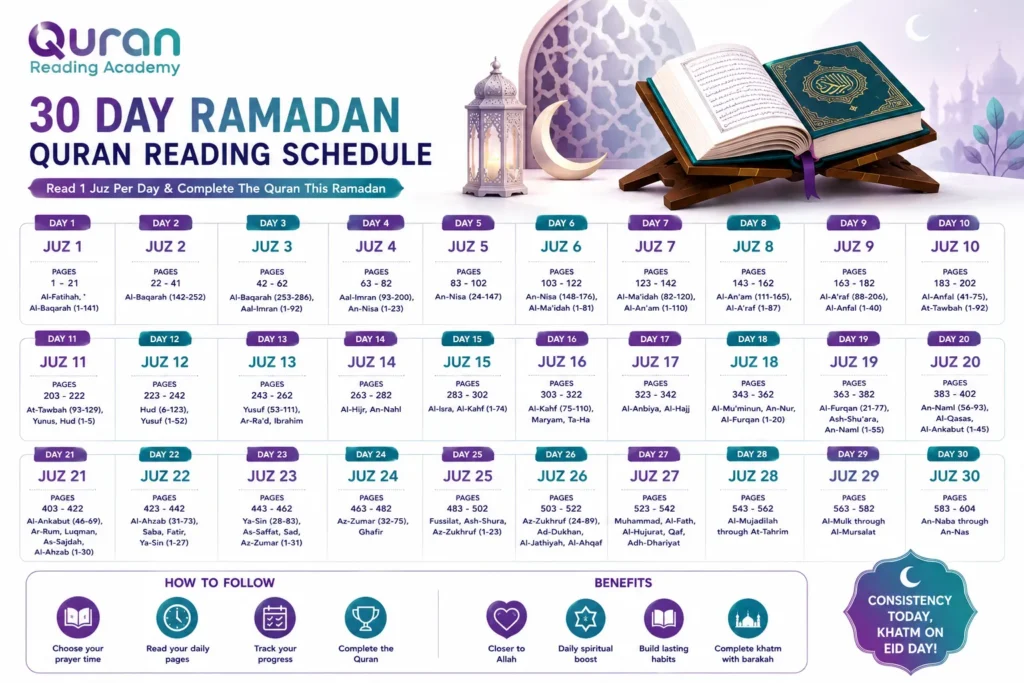
This 30 day Ramadan Quran reading schedule solves that. It breaks the Quran’s 604 pages into daily portions you can split across your five prayers, so no single session feels heavy.
Whether you are a fluent reciter or someone reading alongside a translation, this plan from Quran Reading Academy gives you the clarity and structure to reach Juz 30 before Ramadan ends.
30 Day Ramadan Quran Reading Schedule
Follow this complete Ramadan Quran schedule to read one Juz per day and finish the entire Quran by the end of the month.
| Ramadan Day | Juz to Read | Pages | Key Surahs Covered |
| Day 1 | Juz 1 | 1–21 | Al-Fatihah, Al-Baqarah (1–141) |
| Day 2 | Juz 2 | 22–41 | Al-Baqarah (142–252) |
| Day 3 | Juz 3 | 42–62 | Al-Baqarah (253–286), Aal-Imran (1–92) |
| Day 4 | Juz 4 | 63–82 | Aal-Imran (93–200), An-Nisa (1–23) |
| Day 5 | Juz 5 | 83–102 | An-Nisa (24–147) |
| Day 6 | Juz 6 | 103–122 | An-Nisa (148–176), Al-Ma’idah (1–81) |
| Day 7 | Juz 7 | 123–142 | Al-Ma’idah (82–120), Al-An’am (1–110) |
| Day 8 | Juz 8 | 143–162 | Al-An’am (111–165), Al-A’raf (1–87) |
| Day 9 | Juz 9 | 163–182 | Al-A’raf (88–206), Al-Anfal (1–40) |
| Day 10 | Juz 10 | 183–202 | Al-Anfal (41–75), At-Tawbah (1–92) |
| Day 11 | Juz 11 | 203–222 | At-Tawbah (93–129), Yunus, Hud (1–5) |
| Day 12 | Juz 12 | 223–242 | Hud (6–123), Yusuf (1–52) |
| Day 13 | Juz 13 | 243–262 | Yusuf (53–111), Ar-Ra’d, Ibrahim |
| Day 14 | Juz 14 | 263–282 | Al-Hijr, An-Nahl |
| Day 15 | Juz 15 | 283–302 | Al-Isra, Al-Kahf (1–74) |
| Day 16 | Juz 16 | 303–322 | Al-Kahf (75–110), Maryam, Ta-Ha |
| Day 17 | Juz 17 | 323–342 | Al-Anbiya, Al-Hajj |
| Day 18 | Juz 18 | 343–362 | Al-Mu’minun, An-Nur, Al-Furqan (1–20) |
| Day 19 | Juz 19 | 363–382 | Al-Furqan (21–77), Ash-Shu’ara, An-Naml (1–55) |
| Day 20 | Juz 20 | 383–402 | An-Naml (56–93), Al-Qasas, Al-Ankabut (1–45) |
| Day 21 | Juz 21 | 403–422 | Al-Ankabut (46–69), Ar-Rum, Luqman, As-Sajdah, Al-Ahzab (1–30) |
| Day 22 | Juz 22 | 423–442 | Al-Ahzab (31–73), Saba, Fatir, Ya-Sin (1–27) |
| Day 23 | Juz 23 | 443–462 | Ya-Sin (28–83), As-Saffat, Sad, Az-Zumar (1–31) |
| Day 24 | Juz 24 | 463–482 | Az-Zumar (32–75), Ghafir |
| Day 25 | Juz 25 | 483–502 | Fussilat, Ash-Shura, Az-Zukhruf (1–23) |
| Day 26 | Juz 26 | 503–522 | Az-Zukhruf (24–89), Ad-Dukhan, Al-Jathiyah, Al-Ahqaf |
| Day 27 | Juz 27 | 523–542 | Muhammad, Al-Fath, Al-Hujurat, Qaf, Adh-Dhariyat |
| Day 28 | Juz 28 | 543–562 | Al-Mujadilah through At-Tahrim |
| Day 29 | Juz 29 | 563–582 | Al-Mulk through Al-Mursalat |
| Day 30 | Juz 30 | 583–604 | An-Naba through An-Nas |
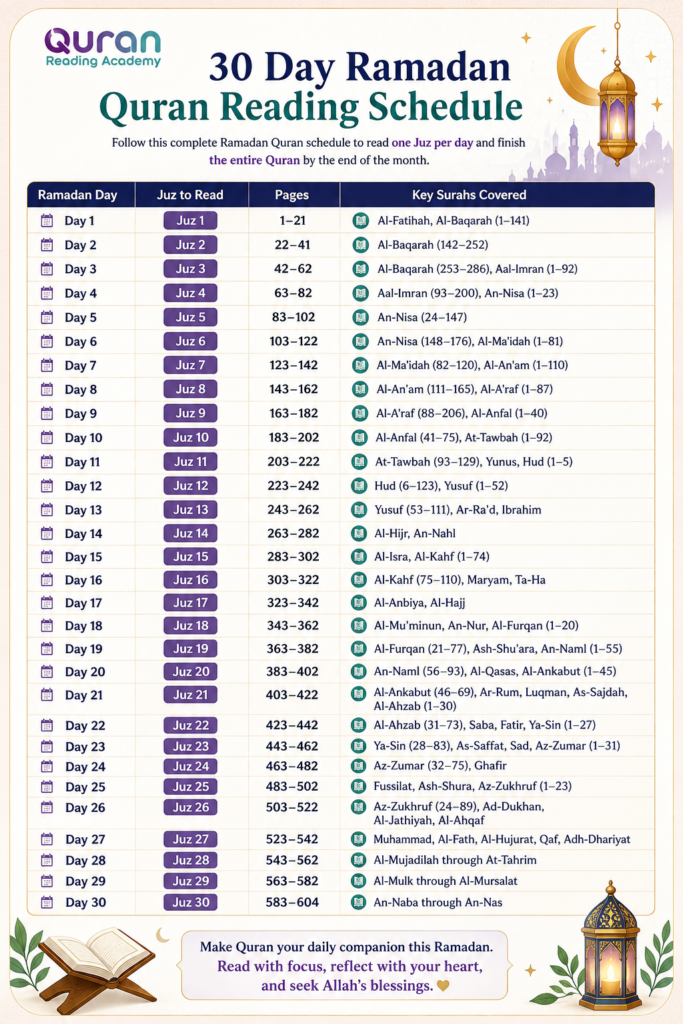
This 30 day Ramadan Quran reading schedule follows the standard Juz divisions, making it easy to track your progress using any Mushaf or Quran app.
Read Also: Quran Reading Tracker
Read Also: How Long Does It Take To Read 20 Pages Of Quran
Page-Based 29-Day Schedule For Extra Safety
If you prefer the security of finishing one day early, use this page-based alternative. Read 21 pages per day to complete all 604 pages by Day 29.
| Ramadan Day | Pages to Read | Cumulative Pages |
| Day 1 | Pages 1–21 | 21 |
| Day 2 | Pages 22–42 | 42 |
| Day 3 | Pages 43–63 | 63 |
| Day 4 | Pages 64–84 | 84 |
| Day 5 | Pages 85–105 | 105 |
| Day 6 | Pages 106–126 | 126 |
| Day 7 | Pages 127–147 | 147 |
| Day 8 | Pages 148–168 | 168 |
| Day 9 | Pages 169–189 | 189 |
| Day 10 | Pages 190–210 | 210 |
| Day 11 | Pages 211–231 | 231 |
| Day 12 | Pages 232–252 | 252 |
| Day 13 | Pages 253–273 | 273 |
| Day 14 | Pages 274–294 | 294 |
| Day 15 | Pages 295–315 | 315 |
| Day 16 | Pages 316–336 | 336 |
| Day 17 | Pages 337–357 | 357 |
| Day 18 | Pages 358–378 | 378 |
| Day 19 | Pages 379–399 | 399 |
| Day 20 | Pages 400–420 | 420 |
| Day 21 | Pages 421–441 | 441 |
| Day 22 | Pages 442–462 | 462 |
| Day 23 | Pages 463–483 | 483 |
| Day 24 | Pages 484–504 | 504 |
| Day 25 | Pages 505–525 | 525 |
| Day 26 | Pages 526–546 | 546 |
| Day 27 | Pages 547–567 | 567 |
| Day 28 | Pages 568–588 | 588 |
| Day 29 | Pages 589–604 | 604 ✓ |
Day 30, if it occurs, becomes your day for du’a of khatm al-Quran, revision of favorite passages, or beginning a second reading.
Why Experienced Reciters Plan for 29 Days, Not 30?
Islamic months are lunar. Ramadan can end on day 29 with no warning. If your entire plan depends on having 30 full days and Ramadan ends on the 29th, you miss your goal by a single day.
The smarter approach: target completing the Quran by Day 29. If Day 30 arrives, treat it as a bonus day for revision, reflection, or a second reading of your favorite surahs. This requires reading approximately 21 pages per day instead of 20 — just one extra page, but it removes all uncertainty.
Quran Reading Academy recommends this 29-day safety margin to every student, whether they are in a Quran Reading Course for Beginners or an advanced Tajweed program.
See Our Academy in Action
Discover what a typical session looks like! Watch these brief highlights from our live, interactive classes to see how our instructors engage with students of all ages.
Start Your Quran Learning Journey Today
Join Quran Reading Academy and begin structured, step-by-step Quran reading with expert guidance.
Try your first class for freeRead also: How To Read The Whole Quran In 10 Days?
How Many Verses Per Day to Finish the Quran in Ramadan?
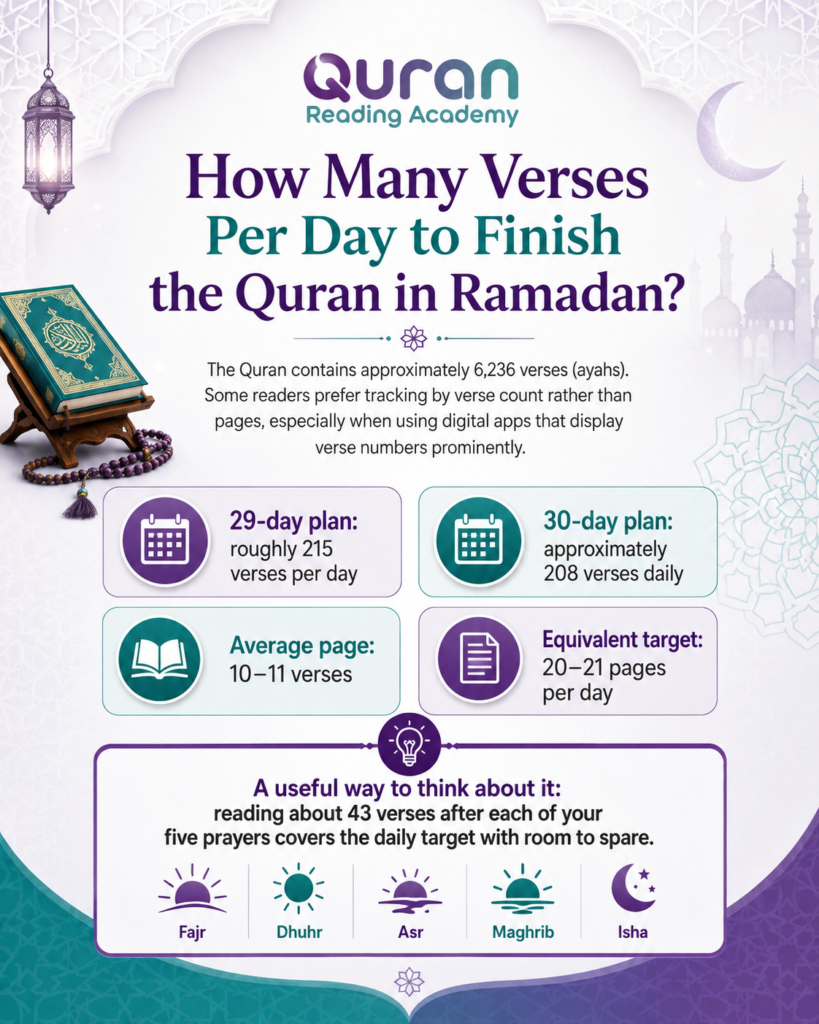
The Quran contains approximately 6,236 verses (ayahs). Some readers prefer tracking by verse count rather than pages, especially when using digital apps that display verse numbers prominently.
For a 29-day plan, that means roughly 215 verses per day. For 30 days, approximately 208 verses daily. Since the average page holds 10–11 verses, these numbers align perfectly with the 20–21 pages-per-day targets above.
A useful way to think about it: reading about 43 verses after each of your five prayers covers the daily target with room to spare.
Best Quran Reading Schedules For Busy Ramadan Days
Not everyone has the same daily rhythm during Ramadan. Fasting, work, family obligations, and Taraweeh prayers all compete for your time and energy. The key is choosing a reading pattern that fits your life — not forcing your life around a rigid schedule.
Option 1: The Five-Prayer Split
This is the approach Quran Reading Academy recommends to all students, from beginners in the Quran Reading Course for Beginners to advanced learners in the Online Quran Reading Course with Tajweed.
- 4 pages after Fajr
- 4 pages after Dhuhr
- 4 pages after Asr
- 4 pages after Maghrib
- 4 pages after Isha
Each session takes under 15 minutes. You finish a full Juz without any single session feeling heavy.
Read also: How To Read The Quran In 15 Days?
Option 2: Morning And Night
If your workday makes mid-day reading impossible, consolidate into two sessions:
- 10 pages after Fajr (before your day begins)
- 10 pages after Taraweeh (when the spiritual atmosphere is strongest)
This works particularly well for professionals who cannot open a Mushaf at the office.
Option 3: Reading And Listening Combined
For commuters or parents with small children, combining recitation with listening is practical and still rewarding:
- Listen to one Juz during your commute or household routine
- Read 10 pages with focused reflection later in the day
Scholars permit listening to the Quran as a form of engagement with it, and pairing listening with reading deepens retention.
Choose the Ramadan Quran reading schedule that matches your reality and stay consistent. A plan you follow imperfectly beats a perfect plan you abandon.
How to Catch Up If You Fall Behind?
Missing a day does not mean the plan has failed. It means you need a small adjustment, not a restart. A single missed session creates guilt, the backlog feels intimidating, and the internal narrative shifts from “I’m on track” to “I’ve already failed.” But this mindset misunderstands the goal.
The purpose of a Quran reading plan for Ramadan is steady, sincere effort across the month — not a flawless streak where one break ruins everything.
The companions of the Prophet ﷺ varied in their daily recitation based on travel, illness, and obligations, and none of them treated a missed day as a reason to stop. What matters is how quickly you return, not whether you stumbled.
A. If You Miss One Day
Add 2 extra pages after each prayer for the next two days. That is 10 extra pages per day, which clears the backlog in two days without any marathon sessions.
B. If You Miss Two or More Days
Read an additional 10 pages over the weekend — one extra session of focused reading. Alternatively, dedicate one evening entirely to catching up. Many people find that a longer session on Friday evening, when the spiritual energy of Jumu’ah carries over, helps them regain momentum.
For every day you miss, add just one extra page to each of your five prayer sessions. Missing one day means 5 pages after each prayer instead of 4 for two days.
Missing two days means the same adjustment for four days. This gradual approach prevents the overwhelm that causes people to quit entirely.
The goal of a 30 day Ramadan Quran reading schedule is steady effort, not perfection. Even the Prophet ﷺ’s companions varied in their daily recitation based on circumstances.
How to Make Your Quran Reading in Ramadan More Meaningful?
Finishing the Quran is a blessing. Understanding and reflecting on it is transformation. Quran Reading Academy encourages every student to pair recitation with reflection — the Quran itself commands this in Surah Sad (38:29):
“A blessed Book which We have revealed to you, so that they may contemplate its verses.”
1. Pause At Verses Of Mercy And Accountability
When you encounter a verse about Allah’s mercy, stop and make du’a asking for that mercy. When you read about accountability, pause and examine your own actions. This practice, called tadabbur, turns mechanical reading into a conversation with the Creator.
2. Read A Short Tafsir For One Passage Daily
You do not need to study tafsir for every verse. Pick one ayah per day — the one that strikes you most — and read a brief explanation. Ibn Kathir’s tafsir is widely available in English, and even a two-minute reading deepens your understanding dramatically.
3. Write One Reflection Each Day
Keep a small notebook beside your Mushaf. After your reading, write one sentence: what you learned, felt, or want to act on. By the end of Ramadan, you have 30 personal reflections — a spiritual journal unique to your experience.
4. Make Du’a Using The Verses You Read
When the Quran mentions provision, ask Allah for provision. When it mentions forgiveness, seek forgiveness. When it mentions guidance, ask to be guided. This practice connects your recitation directly to your life.
Students at Quran Reading Academy who follow the Reading and Memorizing the Quran Course are taught this reflection-based approach because it dramatically improves both retention and spiritual connection.
Start Your Quran Learning Journey Today
Join Quran Reading Academy and begin structured, step-by-step Quran reading with expert guidance.
Try your first class for freeTips To Overcome Common Quran Recitation Challenges In Ramadan
Ramadan brings unique demands — long fasting hours, disrupted sleep, family responsibilities, and packed evening schedules.
These pressures can make even a well-structured 30 day Ramadan Quran reading schedule feel difficult to maintain. The good news is that every common obstacle has a practical solution, and recognizing the challenge before it derails your progress is half the battle.
1. Time Management
If you struggle to find reading time, anchor your Quran sessions to prayers — they are already fixed in your day.
Keeping a Quran app on your phone also creates micro-opportunities: waiting rooms, commutes, lunch breaks. Even 5 minutes of unplanned reading adds up across the month.
2. Fatigue from Fasting
Fasting can affect concentration, especially in the afternoon. Schedule your most focused reading for after Fajr (when you have just eaten suhoor) and after Isha (when you have broken your fast and prayed).
The afternoon sessions can be lighter — listening to a reciter or reading a familiar surah.
3. Reading Speed and Fluency
If you read Arabic slowly, do not let that discourage you. The Prophet ﷺ said:
“The one who recites the Quran and struggles with it, having difficulty, will have two rewards.” (Sahih Muslim)
If your fluency needs development, Quran Reading Academy offers structured programs including Quran Reading Classes for New Muslims and Quran Reading Classes for Sisters designed to build reading confidence at your own pace.
4. Distractions and Inconsistency
Set a specific reading time and communicate it to your household. Treat it like an appointment you cannot reschedule. Turning off phone notifications during your reading sessions — even for just 10 minutes — eliminates the most common source of broken concentration.
Read Also: How Long Does It Take To Read 1 Page Of Quran
Inside Our Live Classroom
We believe in complete transparency. Take a look inside our virtual classrooms to experience our premium teaching tools and engaging learning environment firsthand.
Start Your Quran Learning Journey Today
Join Quran Reading Academy and begin structured, step-by-step Quran reading with expert guidance.
Try your first class for freeStart Your Ramadan Quran Journey With Quran Reading Academy
Make this the Ramadan you finally complete the Quran with confidence, correct recitation, and deep understanding. Quran Reading Academy offers expert-led online courses in Quran reading, Tajweed, and memorization — taught by qualified instructors who guide you step by step.

Whether you are a beginner learning to read Arabic for the first time or an experienced reciter refining your Tajweed, there is a course designed for you. Join thousands of students worldwide who have transformed their Quran recitation through structured, supportive learning.
Our Quran Courses:
- Quran Reading Classes
- Quran Reading Classes for Kids
- Quran Reading Classes for Adults
- Quran Reading Classes for Female/Sisters
- Quran Reading Classes for New Muslims
- Quran Reading Course for Beginners
- Online Quran Reading Course with Tajweed
- Reading and Memorizing the Quran Course
- Noorani Qaida Course
- Quran Course for Beginners
- Quran Tajweed Course
- Quran Recitation Course
- Quran Hifz Course
- Online Quran Qirat Classes
- Quranic Arabic Course
- Arabic Reading Practice Course

Start Your Quran Learning Journey Today
Join Quran Reading Academy and begin structured, step-by-step Quran reading with expert guidance.
Try your first class for freeConclusion
A 30 day Ramadan Quran reading schedule turns an ambitious goal into a series of small, manageable daily sessions. The entire method rests on one principle: split 20 pages across five prayers, and each session takes under 15 minutes.
Plan for 29 days to protect yourself against a shorter Ramadan, use the five-prayer split to avoid marathon reading sessions, and pair your recitation with even brief moments of reflection.
The Quran was revealed in Ramadan, and the Prophet ﷺ gave it special attention during this month. Following a structured reading plan is not about pressure — it is about giving yourself the clarity to succeed at something deeply rewarding. Consistency matters more than speed, and sincerity matters more than perfection.
Quran Reading Academy supports learners at every stage of this journey. Whether you need to build fluency, learn Tajweed rules, or develop a memorization habit that lasts beyond Ramadan, their courses provide the structure and guidance to help you grow.
Frequently Asked Questions About the 30 Day Ramadan Quran Reading Schedule
Below are the most common questions readers ask when planning their Quran recitation for Ramadan, answered directly to help you start with confidence.
1. How many pages should I read each day to finish the Quran in Ramadan?
Read approximately 20 pages per day to finish in 30 days, or 21 pages per day to finish safely in 29 days. The standard Madani Mushaf has 604 pages total, and splitting your daily portion across the five daily prayers makes this target comfortable for most readers.
2. Can I follow a Quran reading schedule on my phone?
Yes. Reading from a digital Mushaf or Quran app is permissible and widely practiced. Many apps include Juz markers, page counts, and daily progress tracking that align perfectly with this 30 day Ramadan Quran reading schedule.
3. What if I miss a day of reading?
Add 2 extra pages after each prayer for the next two days to catch up, or read an additional 10 pages over the weekend. Missing one day is a small adjustment, not a reason to abandon the plan. Steady effort throughout Ramadan matters far more than an unbroken streak.
4. What if I cannot read Arabic fluently?
You can read a translation, listen to a reciter daily, and reflect on the meaning. Allah rewards sincere effort regardless of fluency level. Over time, consider enrolling in a structured reading program like those offered by Quran Reading Academy to gradually build your Arabic reading ability.
5. Is it discouraged to finish the Quran in less than 3 days?
The Prophet ﷺ advised against habitually completing the Quran in fewer than three days, as rushing may reduce comprehension. Scholars explain this as a recommendation for regular practice outside Ramadan, not a prohibition. During Ramadan, many companions and scholars completed the Quran multiple times
6. Is it obligatory to complete the Quran in Ramadan?
No. Completing the Quran in Ramadan is highly recommended and carries great reward, but it is not a religious obligation. Even partial daily recitation with sincerity earns immense reward, and any amount of engagement with the Quran is better than none.
.







Leave a Reply