 Quran
Quran
The Prophet Muhammad (peace be upon him) gave direct instructions on how the Quran should be recited. Multiple authentic hadiths about reading Quran with Tajweed confirm that precise pronunciation, measured pacing, and deliberate articulation are acts of worship, not optional refinements.
These prophetic narrations establish a clear standard for every Muslim who opens the Quran. They reveal the spiritual weight behind each tajweed rule and connect letter-level accuracy to elevated ranks in the hereafter.
The following guide presents the strongest hadith evidence, the Quranic verses that command proper recitation, and the practical obligations these texts place on every reciter.
1. Hadith on Skilled and Struggling Quran Reciters
The most frequently cited hadith about reading Quran with Tajweed addresses two categories of reciters.
It provides motivation for both advanced students and absolute beginners by assigning spiritual reward to each group.
Sahih Muslim 798 on Skilled Recitation and Double Reward
Aisha (may Allah be pleased with her) reported that the Prophet (peace be upon him) said:
الْمَاهِرُ بِالْقُرْآنِ مَعَ السَّفَرَةِ الْكِرَامِ الْبَرَرَةِ وَالَّذِي يَقْرَأُ الْقُرْآنَ وَيَتَتَعْتَعُ فِيهِ وَهُوَ عَلَيْهِ شَاقٌّ لَهُ أَجْرَانِ
(Al-maahiru bil-Qur’aani ma’a as-safaratil-kiraami al-bararah, walladhi yaqra’ul-Qur’aana wa yatata’ta’u feehi wa huwa ‘alayhi shaqqun lahu ajraan)
(“The one who is proficient in the Quran will be with the honorable and obedient scribes [angels], and the one who recites the Quran and finds it difficult, doing his best to recite it in the best way possible, will have a double reward.”)
This hadith carries a critical distinction that many reciters overlook. The word “al-maahir” (الماهر) refers specifically to someone who has achieved mastery in recitation.
Classical scholars including Imam An-Nawawi explained that this mastery means correct articulation of letters from their proper points of origin (makharij) and accurate application of tajweed rules.
The second category addresses the struggling reciter directly. The double reward is not given merely for reading slowly. It is given for the combination of sincere effort and persistent practice despite difficulty.
One reward is for the recitation itself, and the second is for the hardship endured while striving toward accuracy.
Read also: Hadith About Reading Quran in 3 Days
Understanding Lahn Jali and Lahn Khafi in Quran Recitation
A common mistake among self-taught reciters is assuming that “struggling” means tajweed rules do not apply to them. Scholars of Quranic recitation divide errors into two categories that every student should understand.
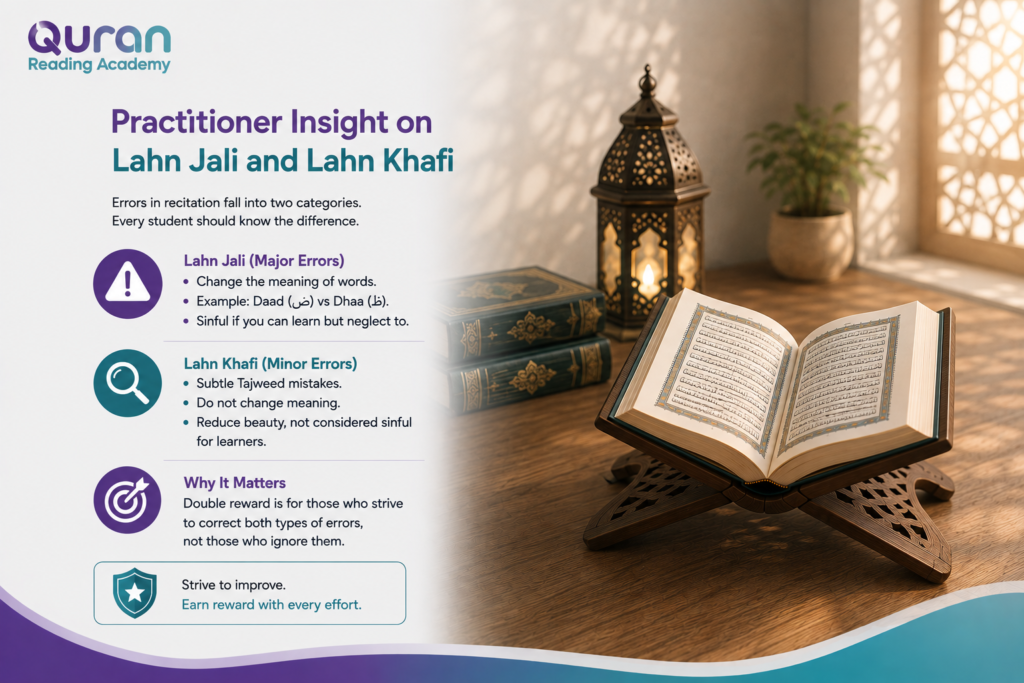
Lahn Jali (major errors) includes mispronouncing a letter in a way that changes the word’s meaning.
For example, pronouncing the letter ض (Daad) as ظ (Dhaa) in certain words can alter the entire meaning of a verse. These errors are considered sinful when a person has the ability to learn but neglects to do so.
Lahn Khafi (minor errors) involves subtle mistakes in tajweed application, such as shortening a required elongation (madd) or omitting a light nasalization (ghunnah).
These errors do not change meaning but reduce the beauty and precision of recitation. Scholars encourage correcting them but do not classify them as sinful for learners.
This distinction matters because it connects directly to the hadith. The struggling reciter who earns double reward is someone actively working to eliminate both categories of error, not someone who remains comfortable with mistakes.
Read also: Hadith About Reading Quran
The Prophetic Command to Beautify Quran Recitation
The Prophet (peace be upon him) did not leave recitation style to personal preference. He issued a direct command that carries weight in Islamic jurisprudence.
Sunan Abu Dawud 1468 on Beautifying the Quran With Your Voice
Al-Bara ibn Azib (may Allah be pleased with him) reported that the Messenger of Allah (peace be upon him) said:
زَيِّنُوا الْقُرْآنَ بِأَصْوَاتِكُمْ
(Zayyinul-Qur’aana bi-aswaatikum)
(“Beautify the Quran with your voices.”)
The Arabic verb “zayyinu” (زَيِّنُوا) is an imperative form, making this a direct prophetic order, not a suggestion. Scholars including Imam Ibn Hajar Al-Asqalani explained that “beautifying” here refers to improving pronunciation precision through proper articulation, not to theatrical vocal performance or melodic singing.
This command is the foundational hadith evidence for tajweed as a practice rooted in the Sunnah.
When a reciter applies the rules of noon sakinah and tanween (ikhfa, idgham, iqlab, izhar), elongates madd letters according to their required counts, and articulates heavy letters (tafkheem) distinctly from light letters (tarqeeq), the recitation becomes beautiful in the way this hadith demands.
Distinction Between Beautiful Recitation and Melodic Performance
A frequent question among students is whether “beautify” means adopting a singing style. The scholarly consensus clarifies this firmly.
Beautification means correct tajweed application, including proper stops (waqf), starts (ibtida), and rhythm (tarteel). It does not mean stretching vowels beyond their prescribed counts or adding vocal embellishments that distort letter sounds.
The Prophet’s own recitation, as described by his wife Umm Salamah (may Allah be pleased with her), was letter-by-letter, clear and distinct.
This narration, recorded in Sunan Abu Dawud 1466, describes precisely what the science of makharij (articulation points) ensures. Each letter pronounced from its correct origin is “distinct.” A letter recited from the wrong articulation point merges into adjacent sounds, which is the core problem tajweed corrects.
Quran Reading Academy offers an Online Quran Reading Course with Tajweed that trains students to apply this prophetic command through structured, one-on-one sessions with certified instructors who correct articulation in real time.
Start Your Tajweed Training with Expert Instructors
2. Hadith on the Reward for Every Letter of the Quran
The Prophet (peace be upon him) quantified the reward for Quran recitation at the individual letter level, which directly reinforces the importance of knowing how each letter should be pronounced.
Jami At-Tirmidhi 2910 on Ten Rewards for Every Quranic Letter
Abdullah ibn Masud (may Allah be pleased with him) reported that the Messenger of Allah (peace be upon him) said:
مَنْ قَرَأَ حَرْفًا مِنْ كِتَابِ اللَّهِ فَلَهُ بِهِ حَسَنَةٌ وَالْحَسَنَةُ بِعَشْرِ أَمْثَالِهَا لاَ أَقُولُ الم حَرْفٌ وَلَكِنْ أَلِفٌ حَرْفٌ وَلاَمٌ حَرْفٌ وَمِيمٌ حَرْفٌ
(Man qara’a harfan min kitaabillahi falahu bihi hasanah, wal-hasanatu bi-‘ashri amthaalihaa. Laa aqoolu Alif-Laam-Meem harfun, wa laakin Alifun harfun, wa Laamun harfun, wa Meemun harfun.)
(“Whoever recites a letter from the Book of Allah, he will be credited with a good deed, and a good deed gets a tenfold reward. I do not say that Alif-Lam-Mim is one letter, but Alif is a letter, Lam is a letter, and Mim is a letter.”)
This hadith transforms the way a student approaches tajweed study. Every single letter carries its own reward, multiplied tenfold at minimum. When a reciter mispronounces a letter or merges two letters together due to incorrect articulation, those individual rewards are affected.
The hadith specifically mentions the Huroof Muqatta’at (disjointed letters) that appear at the beginning of certain surahs, such as Alif-Lam-Mim in Surah Al-Baqarah. These letters are recited individually, each with its own pronunciation rules.
A student who does not know tajweed may rush through them or pronounce them incorrectly, missing the distinct reward attached to each one.
How Makharij Helps Preserve Every Quranic Letter
The Arabic alphabet contains 28 letters, each with a specific articulation point (makhraj) in the throat, tongue, or lips.
Tajweed science identifies 17 primary articulation points. When a student confuses the makhraj of one letter with another, the recited letter changes entirely in the ears of a trained listener.
For example, the letters ح (Haa) and هـ (Ha) both originate from the throat but from different depths. Pronouncing one as the other changes words and potentially meanings.
The letter-level reward structure in this hadith makes learning these distinctions a matter of spiritual investment, not academic exercise.
See Our Academy in Action
Discover what a typical session looks like! Watch these brief highlights from our live, interactive classes to see how our instructors engage with students of all ages.
Start Your Quran Learning Journey Today
Join Quran Reading Academy and begin structured, step-by-step Quran reading with expert guidance.
Try your first class for freeQuranic Verses Commanding Tarteel and Proper Recitation
The Quran itself contains direct commands regarding how it should be recited. These verses use specific Arabic grammatical structures that emphasize the obligation.
Surah Al-Muzzammil 73:4 on Measured Quran Recitation
Allah says in the Quran:
وَرَتِّلِ ٱلۡقُرۡءَانَ تَرۡتِيلًا
(Wa rattilil-Qur’aana tarteelaa)
(“And recite the Quran with measured recitation.”)
The Arabic grammatical structure here is significant. The verb “rattil” (رَتِّلِ) is followed by its maf’ul mutlaq (absolute object) “tarteelaa” (تَرۡتِيلًا), which is derived from the same root. In Arabic grammar, this construction intensifies and emphasizes the command. It is equivalent to saying “recite with true, deliberate, precise recitation” rather than simply “recite.”
Imam Ibn Al-Jazari, the foremost authority on Quranic recitation sciences, stated that this verse is the primary Quranic evidence for the obligation of tajweed.
Tarteel cannot be achieved without applying tajweed rules because tarteel requires giving each letter its right (haqq) in terms of articulation and its due (mustahaqq) in terms of characteristics like elongation, nasalization, and emphasis.
Surah Al-Baqarah Verse 121 on Correct Recitation
Allah also says:
ٱلَّذِينَ ءَاتَيۡنَـٰهُمُ ٱلۡكِتَـٰبَ يَتۡلُونَهُۥ حَقَّ تِلَاوَتِهِۦٓ أُوْلَـٰٓئِكَ يُؤۡمِنُونَ بِهِۦ
(Alladheena aataynaahum-ul-kitaaba yatluunahu haqqa tilaawatih, ulaa’ika yu’minoona bih)
(“Those to whom We have given the Book recite it with its true recital. Those are the ones who believe in it.”)
The phrase “haqqa tilaawatih” (حَقَّ تِلَاوَتِهِ) means “as it truly deserves to be recited.” Scholars of tafseer including Ibn Kathir explained that this includes pronouncing every letter correctly, observing the rules of stopping and starting, and reflecting on the meanings. The verse links correct recitation directly to genuine belief in the Quran.
Quran Reading Academy provides a dedicated Quran Tajweed Course where students systematically learn every rule referenced in these verses, from basic letter articulation through advanced elongation and assimilation rules.
Enroll in the Quran Tajweed Course Today
3. Hadith on Learning Quran from Qualified Teachers
The Prophet (peace be upon him) specified certain companions as authoritative sources for Quran learning, establishing the principle that recitation must be received from qualified individuals through oral transmission.
Sahih Bukhari 4999 on Four Designated Quran Teachers
Abdullah ibn Amr (may Allah be pleased with him) reported that the Prophet (peace be upon him) said:
خُذُوا الْقُرْآنَ مِنْ أَرْبَعَةٍ مِنْ عَبْدِ اللَّهِ بْنِ مَسْعُودٍ وَسَالِمٍ وَمُعَاذٍ وَأُبَىِّ بْنِ كَعْبٍ
(Khudhul-Qur’aana min arba’ah: min Abdillahi ibn Mas’ud, wa Saalim, wa Mu’aadh, wa Ubayyi ibn Ka’b.)
(“Take [learn] the Quran from four: Abdullah ibn Masud, Salim, Muadh, and Ubayy ibn Ka’b.”)
This hadith establishes a principle that remains central to tajweed education today. The Quran is learned through direct oral transmission from a qualified teacher, not through self-study alone.
These four companions were recognized for their mastery of recitation, their accuracy in pronunciation, and their complete knowledge of the Quran’s content.
The modern equivalent of this principle is the ijazah system, where a student recites the entire Quran to a certified teacher who holds an unbroken chain of transmission (sanad) going back to the Prophet (peace be upon him).
This chain ensures that the exact pronunciation, elongation counts, and articulation methods have been preserved across generations.
Read also: Hadith About Reading Quran With Difficulty
Why Tajweed Cannot Be Fully Learned Through Self-Study
A common error among English-speaking Muslims is attempting to learn tajweed entirely from books or apps. While these resources are valuable supplements, they cannot replace a live teacher for one critical reason.
Tajweed is an oral science. The articulation points of letters like ع (Ain), غ (Ghain), and خ (Khaa) require a teacher to listen to the student’s pronunciation and correct it in real time.
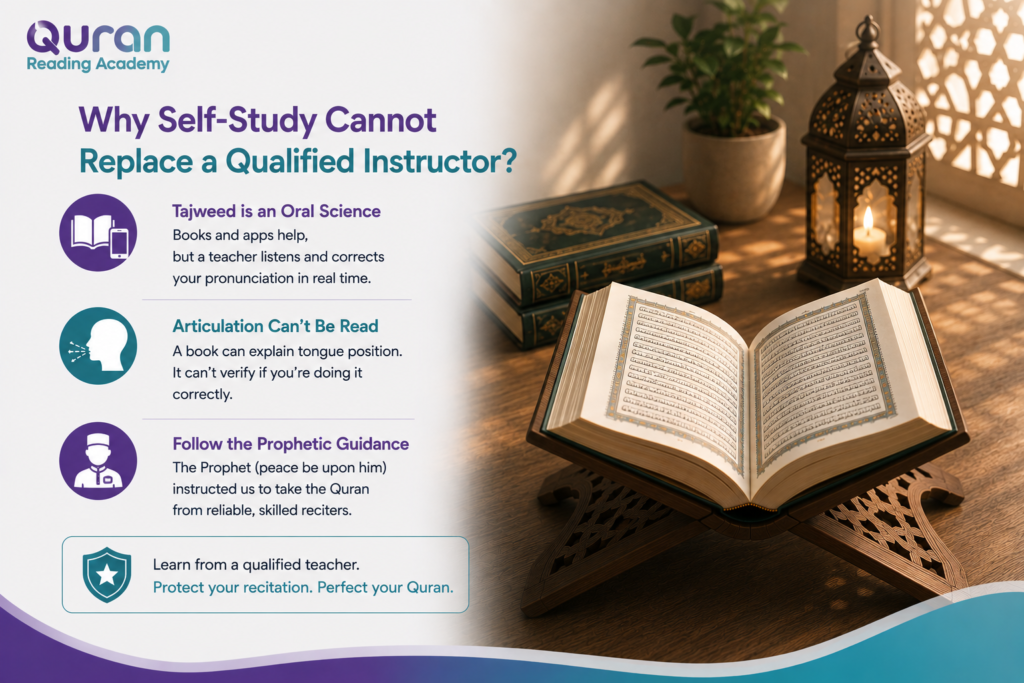
A book can describe where the tongue should be placed. It cannot tell the student whether their tongue is actually in the correct position. This is why the Prophet (peace be upon him) did not say “read the Quran from a book” but “take the Quran from” specific individuals known for their recitation accuracy.
4. Hadith on Quran Recitation and Higher Ranks in Paradise
Multiple narrations connect Quran recitation quality to a person’s rank both in this life and the hereafter.
Abu Dawud 1464 on Reciting and Ascending Through Paradise
Abdullah ibn Amr ibn Al-As (may Allah be pleased with them both) reported that the Prophet (peace be upon him) said:
يُقَالُ لِصَاحِبِ الْقُرْآنِ اقْرَأْ وَارْتَقِ وَرَتِّلْ كَمَا كُنْتَ تُرَتِّلُ فِي الدُّنْيَا فَإِنَّ مَنْزِلَتَكَ عِنْدَ آخِرِ آيَةٍ تَقْرَؤُهَا
(Yuqaalu li-saahib-il-Qur’aan: Iqra’ warta qi wa rattil kamaa kunta turattilu fid-dunya, fa inna manzilataka ‘inda aakhiri aayatin taqra’uhaa.)
(“It will be said to the companion of the Quran: Read and ascend, and recite with measured recitation as you used to recite in the world. Your rank will be at the last verse you recite.”)
This hadith uses the word “rattil” (رَتِّلْ) directly, the same root word used in Surah Al-Muzzammil 73:4. The connection is unmistakable. The reciter’s rank in paradise is tied to how they recited in this life, specifically with tarteel, which requires tajweed.
The phrase “as you used to recite in the world” makes this deeply personal. Every tajweed lesson, every correction from a teacher, every hour spent practicing the difference between similar letters builds toward a higher station.
The hadith does not say “at the last surah you memorized” but “at the last verse you recite,” meaning the quality and extent of recitation both matter.
Quran Reading Academy offers a Quran Recitation Course focused on developing the tarteel style of recitation this hadith describes, with personalized feedback from experienced instructors.
Improve Your Tarteel Recitation Now
5. Hadith on the Rewards of Studying Quran Together
The Prophet (peace be upon him) described specific blessings that descend upon groups who gather to recite and study the Quran together, reinforcing that recitation is both an individual and communal act.
Sahih Muslim 2699 on Gatherings of Recitation
Abu Hurairah (may Allah be pleased with him) reported that the Prophet (peace be upon him) said:
مَا اجْتَمَعَ قَوْمٌ فِي بَيْتٍ مِنْ بُيُوتِ اللَّهِ يَتْلُونَ كِتَابَ اللَّهِ وَيَتَدَارَسُونَهُ بَيْنَهُمْ إِلاَّ نَزَلَتْ عَلَيْهِمُ السَّكِينَةُ وَغَشِيَتْهُمُ الرَّحْمَةُ وَحَفَّتْهُمُ الْمَلاَئِكَةُ وَذَكَرَهُمُ اللَّهُ فِيمَنْ عِنْدَهُ
(Maa ijtama’a qawmun fee baytin min buyootillaahi yatloona kitaaballaahi wa yatadaarasoonahu baynahum illaa nazalat ‘alayhim-us-sakeenah, wa ghashiyat-hum-ur-rahmah, wa haffat-hum-ul-malaa’ikah, wa dhakarahum-ullaahu feeman ‘indah.)
(“No people gather in one of the houses of Allah, reciting the Book of Allah and studying it together among themselves, except that tranquility (sakinah) descends upon them, mercy covers them, the angels surround them, and Allah mentions them among those who are with Him.”)
This hadith uses two distinct verbs. “Yatloona” (يَتْلُونَ) means they recite aloud, and “yatadaarasoonahu” (يَتَدَارَسُونَهُ) means they study and review it with each other. Traditional tajweed education operates exactly on this model.
A student recites while a teacher listens, corrects, and explains the rules. Fellow students observe and learn from each other’s corrections.
The four blessings mentioned in this hadith (tranquility, mercy, angelic presence, and divine mention) are specifically tied to this communal recitation and study format.
This is the prophetic model that online tajweed classes replicate when a qualified instructor listens to a student recite and provides real-time correction.
6. Hadith on the Virtue of Learning and Teaching the Quran
The Prophet (peace be upon him) used the superlative form to describe those who engage with the Quran as both students and teachers.
Sahih Bukhari 5027 on Learning and Teaching Quran
Uthman ibn Affan (may Allah be pleased with him) reported that the Prophet (peace be upon him) said:
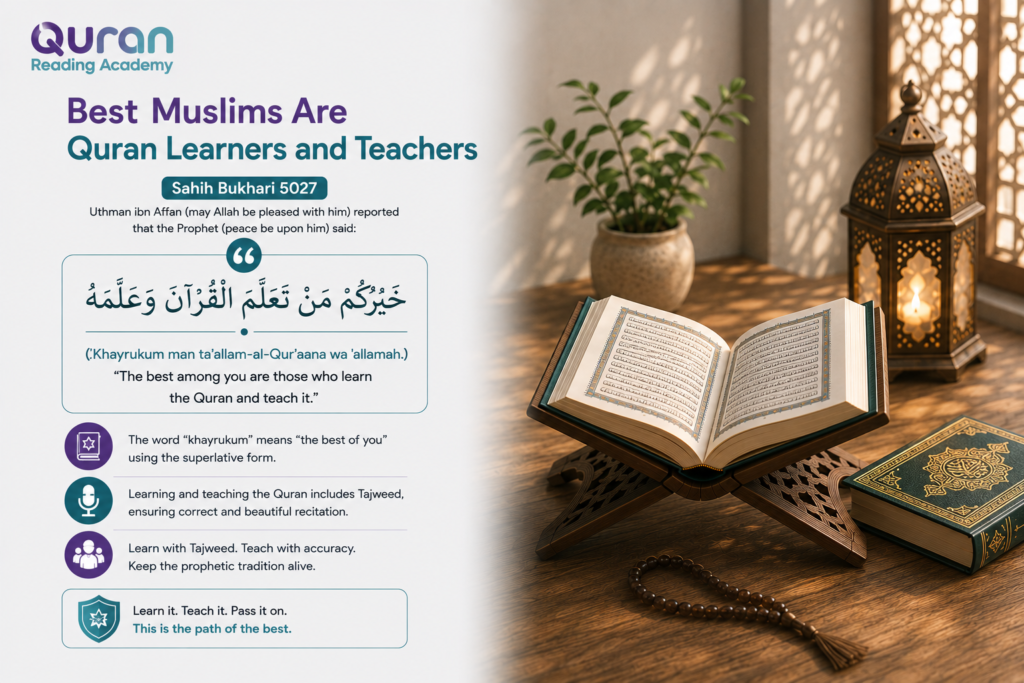
خَيْرُكُمْ مَنْ تَعَلَّمَ الْقُرْآنَ وَعَلَّمَهُ
(Khayrukum man ta’allam-al-Qur’aana wa ‘allamah.)
(“The best among you are those who learn the Quran and teach it.”)
The word “khayrukum” (خَيْرُكُمْ) means “the best of you,” using the superlative form. Learning and teaching the Quran inherently includes tajweed, because teaching someone to recite incorrectly would contradict the prophetic command to beautify the Quran and recite with tarteel.
This hadith motivates not only personal study but also the responsibility to pass accurate recitation to others.
A parent who learns tajweed and then teaches their children correct pronunciation fulfills both sides of this hadith. The cycle of precise oral transmission that began with the Prophet (peace be upon him) continues through every generation of Quran teachers.
The Scholarly Ruling on Applying Tajweed in Quran Recitation
The hadiths and verses presented above form the evidentiary basis for the scholarly ruling on tajweed. Understanding this ruling clarifies why tajweed is treated as a religious obligation rather than an optional skill.
Ibn Al-Jazari on the Obligation of Tajweed
Imam Ibn Al-Jazari, the most authoritative scholar of Quranic recitation sciences in Islamic history, stated in his famous poem Al-Muqaddimah Al-Jazariyyah:
وَالأَخْذُ بِالتَّجْوِيدِ حَتْمٌ لَازِمُ *** مَنْ لَمْ يُجَوِّدِ الْقُرْآنَ آثِمُ
(Wal-akhdhu bit-tajweedi hatmun laazimun, man lam yujawwid-il-Qur’aana aathimu.)
(“Applying tajweed is an absolute obligation. Whoever does not recite the Quran with tajweed is sinful.”)
He based this ruling on the Quranic command in Surah Al-Muzzammil 73:4 and the collective evidence from prophetic hadiths.
The majority of scholars agree that tajweed is Fard Ayn (individual obligation) in its practical application during recitation, while learning its theoretical rules in detail is Fard Kifayah (communal obligation).
Which Tajweed Rules Are Most Important to Apply Correctly?
The obligation applies specifically to recitation that affects letter identity and word meaning. A reciter who cannot distinguish between ص (Saad) and س (Seen) or between ط (Taa) and ت (Ta) must learn the difference because these distinctions change Quranic words and meanings.
Minor refinements, such as the precise duration of a two-count versus four-count elongation, are strongly encouraged but carry a lesser ruling. This graduated approach means every Muslim can begin learning tajweed immediately without feeling overwhelmed by its full scope.
Quran Reading Academy provides a structured Noorani Qaida Course that builds letter recognition and basic tajweed rules from zero, making it the ideal starting point for beginners who want to fulfill this obligation step by step.
Begin with Noorani Qaida Fundamentals
Inside Our Live Classroom
We believe in complete transparency. Take a look inside our virtual classrooms to experience our premium teaching tools and engaging learning environment firsthand.
Start Your Quran Learning Journey Today
Join Quran Reading Academy and begin structured, step-by-step Quran reading with expert guidance.
Try your first class for freeStart Your Free Evaluation Session with Quran Reading Academy
Every hadith and verse in this article points to one conclusion. Correct Quran recitation is a prophetic command backed by divine reward. The struggling reciter who makes sincere effort earns double reward. The proficient reciter joins the company of noble angels. Every letter recited correctly multiplies into tenfold good deeds.
The first step is knowing where your recitation stands right now. Quran Reading Academy offers a free trial session where a qualified instructor evaluates your current recitation level, identifies specific areas for improvement, and recommends a personalized learning path.
You do not need any prior tajweed knowledge to begin. Whether you are a complete beginner who has never read Arabic or an experienced reciter refining advanced rules, this free evaluation places you at the exact starting point that matches your ability.
Our Quran Courses
- Quran Reading Classes
- Quran Reading Classes for Kids
- Quran Reading Classes for Adults
- Quran Reading Classes for Female/Sisters
- Quran Reading Classes for New Muslims
- Quran Reading Course for Beginners
- Online Quran Reading Course with Tajweed
- Reading and Memorizing the Quran Course
- Noorani Qaida Course
- Quran Course for Beginners
- Quran Tajweed Course
- Quran Recitation Course
- Quran Hifz Course
- Online Quran Qirat Classes
Book Your Free Trial Session Now
Conclusion
The authentic hadiths about reading Quran with tajweed leave no ambiguity about the standard Allah and His Messenger set for recitation. Sahih Muslim 798 promises elevated rank for the proficient reciter and double reward for the one who persists through difficulty. Sunan Abu Dawud 1468 issues a direct command to beautify the Quran through precise pronunciation. Jami At-Tirmidhi 2910 attaches tenfold reward to every correctly recited letter.
The Quran itself reinforces these hadiths. Surah Al-Muzzammil 73:4 commands tarteel with an emphatic grammatical structure, and Surah Al-Baqarah 2:121 connects correct recitation to genuine faith. Scholars from Ibn Al-Jazari to contemporary authorities have ruled that applying tajweed during recitation is an individual obligation on every Muslim who has the ability to learn.
The path forward is clear. Learn tajweed from a qualified teacher, practice consistently, and approach every recitation session with the awareness that each letter carries its own reward and each rule fulfills a prophetic command.
Frequently Asked Questions
Is There a Hadith That Directly Uses the Word Tajweed?
No hadith uses the Arabic term “tajweed” as a codified science because the formal terminology developed after the prophetic era. However, multiple authentic narrations command tarteel (measured recitation), beautiful pronunciation, and letter-level precision, which are exactly what tajweed rules produce. The science of tajweed is the scholarly codification of how the Prophet (peace be upon him) actually recited.
Does a Muslim Sin for Reciting Quran Without Tajweed?
The dominant scholarly position distinguishes between major and minor errors. A Muslim who deliberately neglects tajweed to the degree that letters change identity or word meanings shift is considered sinful when they had the ability and opportunity to learn. A Muslim who is actively learning and making sincere effort earns double reward according to Sahih Muslim 798. Intention and consistent effort determine the ruling.
What Single Hadith Best Motivates Beginners to Start Tajweed?
The hadith in Sahih Muslim 798 is the most powerful motivator because it directly addresses the discouragement beginners feel. The struggling reciter who persists with sincere effort receives two rewards, one for the recitation and one for the difficulty endured. This means every difficult practice session, every tongue exercise, and every corrected mistake carries double spiritual weight.
Can Tajweed Be Learned Without a Teacher?
Books, apps, and videos are valuable supplementary resources, but they cannot replace a qualified teacher. Tajweed is an oral science transmitted through direct listening and correction. The Prophet (peace be upon him) instructed his companions to “take the Quran from” specific individuals (Sahih Bukhari 4999), establishing the principle that recitation must be received from a live, qualified source who can hear and correct the student’s pronunciation in real time.
Which Tajweed Rules Carry the Highest Priority for New Learners?
The articulation points of letters (makharij al-huroof) carry the highest priority because incorrect letter pronunciation can change word meanings entirely. After mastering letter distinctions, the rules of noon sakinah and tanween (ikhfa, idgham, iqlab, izhar) and the basic madd (elongation) rules form the essential foundation. These rules appear most frequently in Quranic text and have the greatest impact on recitation accuracy.
How Long Does It Typically Take to Learn Basic Tajweed?
A student who practices consistently with a qualified teacher can expect to learn fundamental tajweed rules within three to six months. This includes letter articulation, basic noon and meem rules, and standard elongation rules. Full proficiency, including advanced rules like sakt, tafkheem and tarqeeq of the letter Raa, and the various types of madd, typically requires one to two years of regular study depending on the student’s starting level and practice frequency.
Related Articles
Quran






Leave a Reply