 Quran
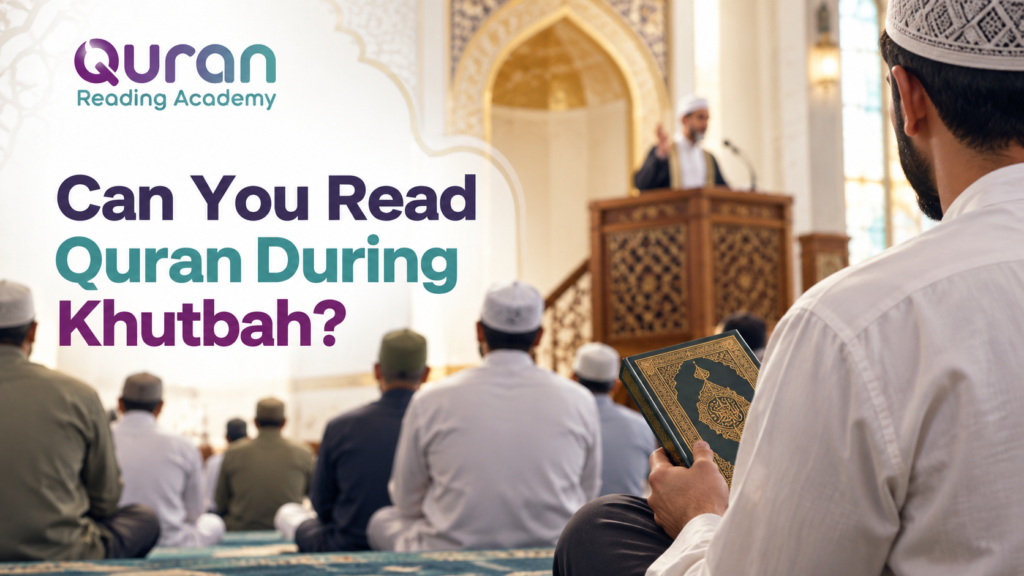
| Key Takeaways |
| The majority of Islamic scholars, including all four major Madhabs, hold that listening to the Friday Khutbah is obligatory for everyone present, including those who do not understand Arabic. |
| Reading the Quran or performing silent dhikr during the Friday sermon is considered impermissible by the dominant scholarly position because it diverts attention from the Khutbah and may distract other worshippers. |
| A minority scholarly opinion permits completely silent dhikr for those who genuinely cannot understand the language of the Khutbah, provided no sound or visible lip movement disturbs surrounding worshippers. |
| Between the two Khutbahs, during the brief seated pause, scholars differ on permissibility, with some allowing quiet personal supplication during this short interval only. |
Friday prayer has a unique place in Islam, as Muslims leave work, pause trade, and gather in response to Allah’s call. The Khutbah is itself an act of worship with specific rules and etiquette detailed by scholars.
The question of whether you can read Quran during Khutbah becomes especially important for Muslims who do not understand the Khutbah’s language. The rulings below explain the scholarly views, their reasoning, and practical guidance for non-Arabic speakers attending Jumu‘ah.
Is It Permissible to Read Quran During Khutbah?
No, reading Quran during the Friday Khutbah is not permissible according to the majority of scholars, including for those who do not understand Arabic.
Silence and attentive presence are required from the moment the Khateeb begins speaking until the prayer begins.
Why You Must Listen Silently During the Friday Khutbah
The following Quranic verses form part of the textual basis scholars use when explaining the required conduct during the Friday sermon.
وَإِذَا قُرِئَ الْقُرْآنُ فَاسْتَمِعُوا لَهُ وَأَنصِتُوا لَعَلَّكُمْ تُرْحَمُونَ
(Wa idhā quri’al-Qur’ānu fastami’ū lahu wa anṣitū la’allakum turḥamūn)
(“And when the Quran is recited, listen to it attentively and remain silent so that you may receive mercy.”)
While this verse addresses Quranic recitation specifically, classical scholars extended its principle to the Khutbah itself. The Friday sermon is categorized as a form of dhikr, remembrance of Allah.
Competing with that dhikr through personal recitation, even of the Quran, conflicts with the purpose of the gathering.
A second verse reinforces that Jumu’ah demands a dedicated state of focus, not partial attention divided between the sermon and private worship.
يَا أَيُّهَا الَّذِينَ آمَنُوا إِذَا نُودِيَ لِلصَّلَاةِ مِن يَوْمِ الْجُمُعَةِ فَاسْعَوْا إِلَىٰ ذِكْرِ اللَّهِ وَذَرُوا الْبَيْعَ ذَٰلِكُمْ خَيْرٌ لَّكُمْ إِن كُنتُمْ تَعْلَمُونَ
(Yā ayyuhā alladhīna āmanū idhā nūdiya liṣ-ṣalāti min yawmi al-Jumu’ati fas’aw ilā dhikri Allāhi wa dharū al-bay’a dhālikum khayrun lakum in kuntum ta’lamūn)
(“O you who believe, when the call to prayer is made on Friday, hasten to the remembrance of Allah and leave your trading. That is better for you, if you only knew.”)
Scholars read this verse as establishing that everything else stops at the sound of the Friday call. Trade stops. Personal tasks stop. Private devotional acts that compete with the communal focus of Jumu’ah also stop.
Read also: Can You Listen to Quran While Reading Quran?
Scholarly Rulings on Reading Quran During the Friday Khutbah
The majority of scholars prohibit Quran recitation during the Friday Khutbah, while a recognized minority permits only completely internal dhikr for a person who cannot understand the sermon.
The following views explain the scope of that disagreement:
Four Madhabs Require Listening to the Friday Khutbah
All four major Madhabs, Hanafi, Maliki, Shafi’i, and Hanbali, hold that listening to the Friday Khutbah is obligatory for those present.
The jurist Ibn Rushd recorded in his work Bidayat al-Mujtahid that this is the view of the majority of scholars, including the renowned jurists across the early Islamic world.
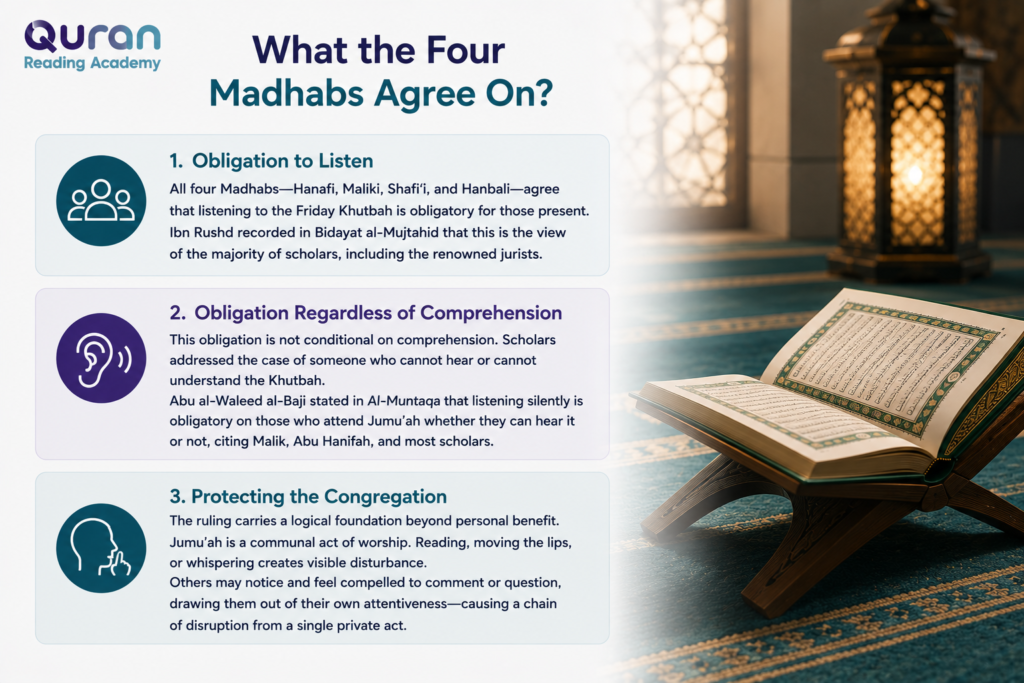
This obligation is not conditional on comprehension. Scholars specifically addressed the case of someone who cannot hear or cannot understand the Khutbah.
Abu al-Waleed al-Baji stated in Al-Muntaqa that listening silently is obligatory on those who attend Jumu’ah whether they can hear it or not, citing Malik, Abu Hanifah, and most scholars as holding this position.
The ruling carries a logical foundation that extends beyond personal benefit from the sermon. Jumu’ah is a communal act of worship.
A person who reads the Quran, moves their lips visibly, or whispers creates a visible disturbance. Others nearby may notice and feel compelled to comment or question, which draws them out of their own attentiveness, creating a chain of disruption from a single private act.
Minority View on Silent Dhikr for Non-Arabic Speakers
A recognized minority of scholars permitted silent dhikr for individuals with no means of benefiting from the Khutbah linguistically. Their reasoning centers on purpose: if the sermon exists to build the listener’s faith, a person entirely cut off by language should still have a way to engage spiritually during the time allotted.
Scholars who held this view placed firm conditions on it. Any dhikr must remain entirely internal, with no lip movement visible to others and no sound audible to anyone nearby.
Even within this minority position, Quran recitation is generally treated with more restriction than simple dhikr, because recitation involves moving the lips according to Arabic phonetics and cannot realistically be performed without visible mouth movement.
Quran Reading Academy offers a Quranic Arabic Course that builds the vocabulary and grammatical understanding needed to follow Quranic language directly, making Friday sermon attendance a more active spiritual experience.
Start understanding Quranic Arabic with a free trial lesson
Read also: Can You Read from the Quran During Tahajjud?
Why the Khutbah Requires Attention Even Without Arabic Comprehension
Listening silently remains required even when a person does not understand the Khutbah because Jumu’ah is a communal act of worship, not only a private lesson. The ruling considers both personal devotion and the congregation’s shared attentiveness.
Friday Silence Protects the Congregation’s Focus
Jumu’ah is not a private act. Every person in that congregation shares a communal space of devotion. A single person reading, moving their lips, or appearing visibly disengaged affects the overall environment of the gathering. Scholars recognized this dynamic and built it into the ruling.
The prohibition classical scholars mentioned on even saying “be quiet” to a neighbor during the Khutbah reflects how seriously Islam treats Friday prayer etiquette.
If advising someone to listen is itself an error, then reading Quran during that same period also falls short of the proper conduct Jumu’ah requires.
Jumu’ah Attendance Is Worship Even Without Full Understanding
Jumu’ah attendance itself carries reward independent of what a person intellectually absorbs from the sermon.
A Muslim who sits with proper adab, faces the Khateeb, maintains silence, and directs the heart toward Allah is participating in an act of worship. That act holds value even when the language creates a barrier to content comprehension.
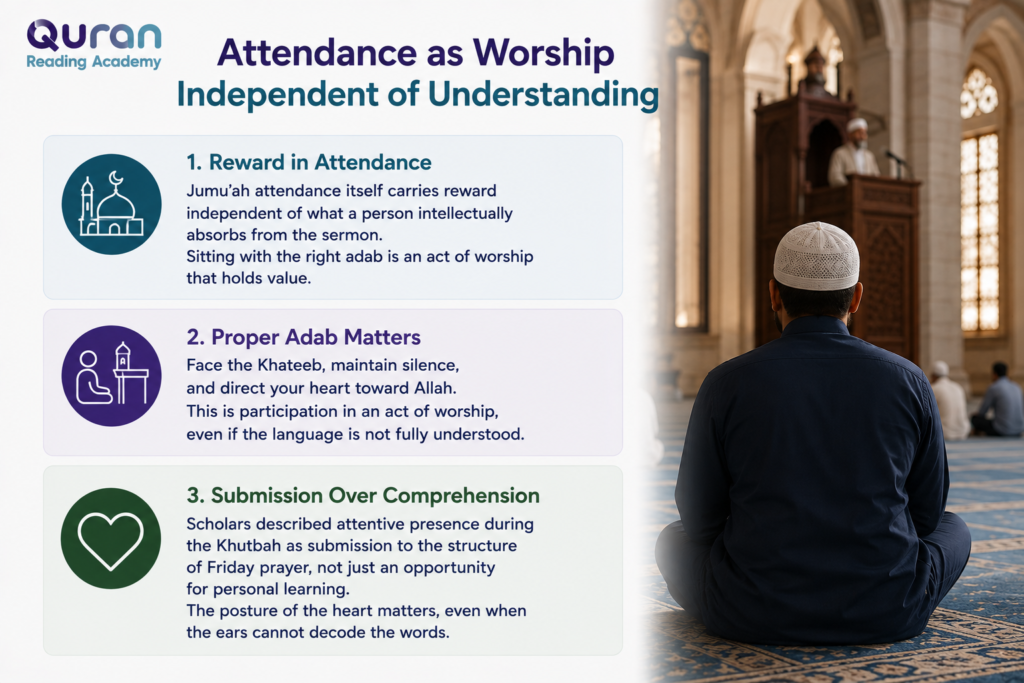
Scholars described attentive presence during the Khutbah as a form of submission to the structure of Friday prayer rather than merely an opportunity for personal learning. The posture of the heart matters even when the ears cannot decode the words.
Read also: Can You Read Quran with Tayammum?
What Is Permitted During the Jumu’ah Khutbah?
The following table summarizes the majority ruling on common actions during the Friday sermon and the limited areas of scholarly disagreement.
| Action | Ruling | Reasoning |
| Listening silently to the Khutbah | Obligatory | Required by majority scholarly consensus across all Madhabs |
| Reading the Quran | Forbidden (majority view) | Diverts attention and may disturb surrounding worshippers |
| Silent dhikr without lip movement | Scholarly disagreement | Majority forbid it; minority permit it for those without language access |
| Talking to a neighbor | Forbidden | Even correcting a neighbor’s behavior is an error during the sermon |
| Using a phone or reading a book | Forbidden | Falls under distraction from the Friday sermon |
| Personal dua between the two Khutbahs | Scholarly disagreement | Some permit silent supplication during the brief seated pause only |
Quran Reading Academy offers an Arabic Reading Practice Course that strengthens letter recognition and reading fluency, giving students the foundation needed to follow Quranic recitation during Friday prayer and in personal study.
Build your Arabic reading skills with a free trial
See Our Academy in Action
Discover what a typical session looks like! Watch these brief highlights from our live, interactive classes to see how our instructors engage with students of all ages.
Start Your Quran Learning Journey Today
Join Quran Reading Academy and begin structured, step-by-step Quran reading with expert guidance.
Try your first class for freeCan You Make Personal Dua Between the Two Khutbahs?
The majority view is that Quran recitation remains impermissible during the brief seated pause between the two Khutbahs, while some scholars allow quiet personal dua during that interval. The pause is short and remains closely connected to the sermon.
The majority position holds that the break is so brief and so connected to both portions of the Khutbah that it does not create an opening for personal recitation or independent religious activity. Both parts of the sermon are treated as a single act of worship, beginning when the Khateeb ascends the pulpit and concluding only when the prayer begins.
A smaller number of scholars allowed quiet personal supplication during this seated interval, viewing it as a momentary pause rather than an active period of the sermon itself.
Even this opinion comes with strict conditions: absolute silence, no lip movement visible to surrounding worshippers, and no disruption to the congregation in any form.
Conducting any organized ceremony, lesson, or event during this interval, such as having a student recite Quran memorization before the congregation or adorning a teacher with garlands, is considered impermissible by every school of thought.
Activities of that kind belong after the Jumu’ah prayer has concluded, when attendees are free to stay or leave as they choose.
Read also: Can You Read Quran Without Covering Awrah?
How Should Non-Arabic Speakers Attend Jumu’ah?
Non-Arabic speakers should remain silent and attentive during the Khutbah, then prepare beforehand to gain more benefit from its topic. These steps preserve Friday prayer etiquette while making the experience more meaningful.
Arriving early and reading a translation or summary of the week’s Khutbah topic in your own language is one of the most effective approaches.
Many mosques announce their Friday topic in advance through newsletters, websites, or community groups. Spending ten minutes before Jumu’ah reading about that topic orients your mind before the Khateeb begins.
Focusing the eyes on the Khateeb and the heart on the occasion itself also helps. Even without linguistic access, observing the posture of the speaker, the seriousness of the congregation, and the general emotional tone of the sermon contributes to the spiritual atmosphere of Friday prayer. Attentiveness of the heart is not blocked by a language barrier.
Quran Reading Academy offers a Quran Recitation Course that helps students improve Tarteel and build familiarity with Quranic language patterns, supporting their ability to follow Quranic verses recited during Friday worship.
Start your Quran recitation journey with a free trial lesson
Building Arabic Comprehension for a More Meaningful Friday Khutbah
Studying Quranic Arabic is a lasting way to reduce the language barrier at Friday prayer. Even a foundational vocabulary of 500 to 800 common Quranic words covers a substantial portion of what appears in most Friday sermons.
Quran educators consistently note that even partial comprehension fundamentally changes the experience of sitting through a Khutbah.
Consistent weekly attendance at Jumu’ah also has a cumulative effect for students of Arabic. Over months of exposure to the Friday sermon, listeners who know even basic Arabic begin catching repeated phrases, recognizing Quranic verses as they are recited, and identifying the emotional arc of the Khutbah.
Partial engagement of this kind grows steadily with study and is far more rewarding than private recitation that violates Friday prayer conduct.
Quran Reading Academy offers an Online Quran Reading Course with Tajweed that develops recitation precision and Quranic language exposure, equipping students to approach the Friday sermon with growing familiarity and genuine spiritual engagement over time.
Begin your Tajweed and Quran reading journey today
Inside Our Live Classroom
We believe in complete transparency. Take a look inside our virtual classrooms to experience our premium teaching tools and engaging learning environment firsthand.
Start Your Quran Learning Journey Today
Join Quran Reading Academy and begin structured, step-by-step Quran reading with expert guidance.
Try your first class for freeLearn Quran and Arabic With Quran Reading Academy
Improving your relationship with the Quran and with Friday prayer starts with structured, qualified instruction suited to your current level.
Quran Reading Academy connects students with certified instructors who understand the challenges faced by non-native Arabic speakers and design lessons that build real, lasting comprehension rather than superficial familiarity.
What sets Quran Reading Academy apart:
- One-on-one live sessions with Ijazah-certified instructors who provide personalized correction at every level.
- Structured Quranic Arabic and recitation courses for non-Arabic speakers.
- Flexible scheduling that fits around work, family, and weekly Friday prayer commitments.
Our Quran Courses
- Quran Reading Classes
- Quran Reading Classes for Kids
- Quran Reading Classes for Adults
- Quran Reading Classes for Female/Sisters
- Quran Reading Classes for New Muslims
- Quran Reading Course for Beginners
- Online Quran Reading Course with Tajweed
- Reading and Memorizing the Quran Course
- Noorani Qaida Course
- Quran Course for Beginners
- Quran Tajweed Course
- Quran Recitation Course
- Quran Hifz Course
- Online Quran Qirat Classes
Book your FREE trial lesson with Quran Reading Academy
Conclusion
Reading Quran during the Friday Khutbah is not permitted according to the dominant view of the four major Madhabs. This applies even to those who do not speak Arabic, because listening preserves the sanctity of the communal worship, avoids distraction, and honors the Khutbah as an act of devotion.
A minority view permits completely silent dhikr for someone with a genuine language barrier, without lip movement or sound. However, this remains the weaker view. The safer practice is to sit attentively, face the Khateeb, and keep the heart focused on Allah throughout the sermon.
For non-Arabic speakers, learning basic Quranic Arabic can make Jumu‘ah more meaningful. Even a modest vocabulary helps the Khutbah become a direct source of spiritual benefit.
Frequently Asked Questions About Reading Quran During Khutbah
Is it permissible to read Quran silently during the Friday Khutbah?
No, silent Quran recitation during the Khutbah is not permissible according to the majority of scholars. The ruling applies whether recitation is audible or silent because the obligation to listen is understood to require full attentive presence, not merely the absence of audible sound.
What should I do during Friday Khutbah if I cannot understand Arabic?
Remain completely silent, face the Khateeb, and orient your heart toward the occasion of Jumu’ah. Some scholars permit fully internalized dhikr as an exception for non-speakers, but this is a minority view with strict conditions. Working toward Quranic Arabic comprehension is the recommended long-term solution.
Can you read Quran during the break between the two Khutbahs?
No, the majority position holds that the brief interval between the two Khutbahs remains part of the Friday sermon and does not permit personal Quran recitation. Some scholars allowed quiet personal supplication during this moment, but no recognized scholarly position permits organized activity or Quran reading during it.
What is the ruling on talking or making dhikr aloud during the Khutbah?
Talking or making audible dhikr during the Friday Khutbah is forbidden. Classical scholars ruled that even advising a neighbor to be quiet is an error that diminishes the reward of Jumu’ah. Audible dhikr falls under the same prohibition because it creates noise and distracts surrounding worshippers from the sermon.
Does not understanding the Khutbah language excuse me from the listening requirement?
No, not understanding the language does not remove the obligation to remain silent and attentive. Classical jurists specifically addressed this scenario and upheld the listening requirement for non-speakers, citing both the communal nature of Jumu’ah and the spiritual merit of attentive presence independent of content comprehension.







Leave a Reply