 Fatawa
| Key Takeaways |
| Covering the ‘awrah is not a required condition for Quran recitation outside of salah, according to the agreement of classical scholars including Ibn Uthaymeen and Al-Azhar’s fatwa council. |
| The obligation to cover the ‘awrah is tied to the validity of salah itself, not to Quran recitation as a standalone act of worship. |
| Being in a state of major ritual impurity (janabah) is the one absolute barrier to Quran recitation, entirely separate from the question of dress. |
| Covering the body modestly when reciting Quran is a strongly recommended act of adab (etiquette) that increases spiritual focus but does not affect the validity or reward of the recitation. |
Questions about dress and purity arise for any Muslim who approaches the Quran with sincerity. The ‘awrah, the parts of the body Islamic law requires to be concealed, carries rulings that vary across different contexts and acts of worship.
Where those rulings apply depends on the specific act of worship in question. Scholars across the four major schools of Sunni jurisprudence address this distinction directly in their fatawa, and their answer on covering the ‘awrah during standalone Quran recitation is consistent. This article examines that ruling alongside what proper adab for recitation looks like in practice.
Is Quran Recitation Valid Without Covering Awrah?
Yes, a Muslim may read Quran without covering the ‘awrah when reciting outside of salah. Covering the ‘awrah is not listed among the required conditions (shurut) of Quran recitation in any of the four major schools of Islamic jurisprudence.
Ibn Uthaymeen, Al-Azhar, and the Islamweb fatwa panel all confirm this ruling explicitly. A person reciting Quran at home while casually dressed, or reciting before sleep without formal covering, performs fully valid and rewarded worship.
Awrah in Islamic Jurisprudence
Awrah refers to the parts of the body Islamic law requires to be concealed. Its rulings vary based on the person, the setting, and the act of worship being performed.
Classical jurisprudence addresses each context on its own terms, not through a single definition applied uniformly.
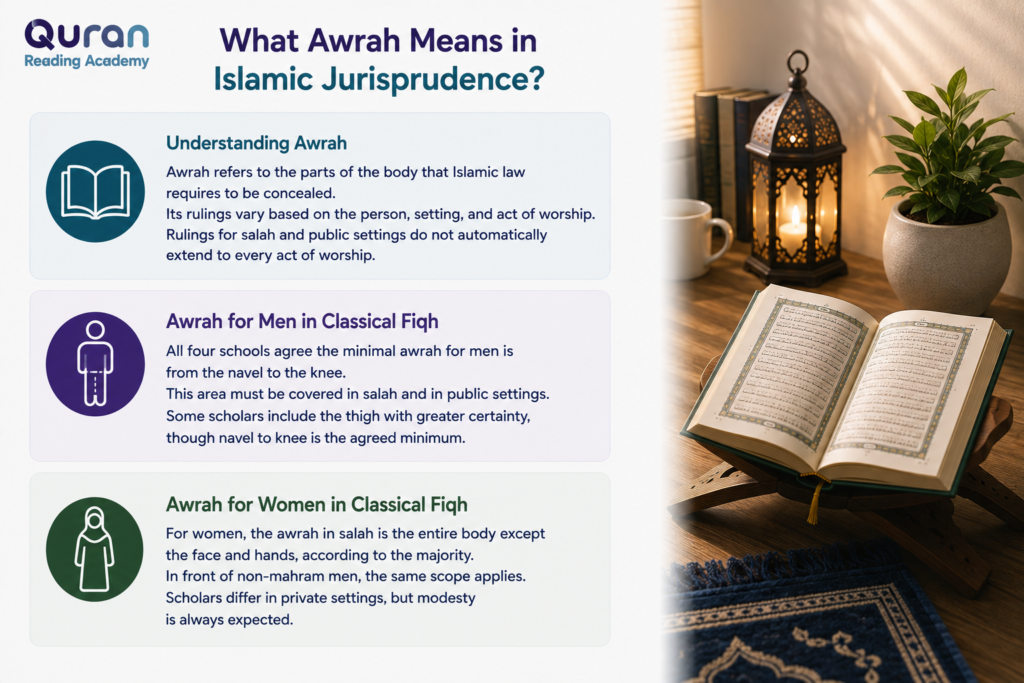
Most Muslims know the ‘awrah rulings for salah and for public settings. Fewer realize those rulings do not automatically extend to every act of worship, and understanding this difference shapes how a Muslim approaches Quran recitation during ordinary moments of daily life.
a. Awrah for Men in Islamic Law
All four schools agree that the minimal ‘awrah for men is the area from the navel to the knee. This region must be covered in salah and in public settings.
Some scholars include the thigh with greater certainty within this range, though the navel-to-knee scope is the agreed minimum.
b. Awrah for Women in Islamic Law
For women, the ‘awrah in salah covers the entire body except the face and hands, according to the majority position. In front of non-mahram men, the same scope applies.
Scholars differ on the extent of obligatory coverage in fully private settings, but general modesty is consistently expected.
Read also: Can You Listen to Quran While Reading Quran?
Awrah Requirements in Salah and Quran Recitation
Covering the ‘awrah is a required condition of salah, while it is not a condition of standalone Quran recitation. A prayer performed with the ‘awrah exposed is invalid across all four schools. This ruling applies to any salah, whether obligatory or voluntary.
Quran recitation as a standalone act outside of salah operates under a different set of conditions.
Those conditions center on the state of ritual purity, not on what the person is wearing. This structural separation is the key answer to the question of awrah during Quran recitation.
| Context | Covering Awrah Required? | Wudu Required? |
| Salah (fard or nafl) | Yes, condition of validity | Yes, condition of validity |
| Quran recitation at home without covering | No | Strongly recommended |
| Reading Quran from a smartphone | No | Recommended |
| Reciting Quran from memory | No | Recommended |
| Reciting Quran near non-mahram men | Yes (setting rule, not a recitation rule) | Recommended |
The table clarifies a distinction many Muslims conflate: covering the ‘awrah in salah is a condition of salah itself, not a universal condition attached to any engagement with the Quran.
Quran Reading Academy offers a Quran Recitation Course that builds correct recitation technique while giving students a clear grounding in what Islamic jurisprudence actually requires for valid and rewarded Quran reading.
Start Quran Recitation Training with Certified Instructors
Read also: Can You Read Quran During Khutbah?
How Scholars Rule on Dress During Quran Recitation
Covering the ‘awrah is not a required condition of standalone Quran recitation in classical Islamic jurisprudence. Multiple major scholarly authorities state this explicitly, making it one of the clearest answers in Fiqh on matters related to Quran recitation.
Ibn Uthaymeen stated in Fatawa Nur ‘ala al-Darb: “Covering the head is not required for Quran recitation, because covering the ‘awrah is not a condition for reading Quran.” This fatwa addresses the question directly for both men and women.
Al-Azhar’s Global Center for Electronic Fatwa confirmed the same ruling. Reading Quran while wearing shorts is permissible, for example, if those shorts cover the area from the navel to the knee.
Any restriction that exists concerns the separate general obligation not to expose the ‘awrah, not a condition specific to the act of Quran recitation itself.
Ibn Baz, in Majmu’ Fatawa Ibn Baz, drew the same distinction. The condition most closely tied to recitation is the absence of major ritual impurity, not the state of the person’s clothing. Scholars representing different traditions within Sunni Islam consistently arrive at this same conclusion.
Purity and Quran Recitation in the Quran and Sunnah
Major ritual impurity (janabah) prevents Quran recitation until ghusl is performed, while minor impurity (hadath) does not carry the same absolute prohibition.
Scholars draw a sharp distinction between these two ritual states when discussing Quran recitation.
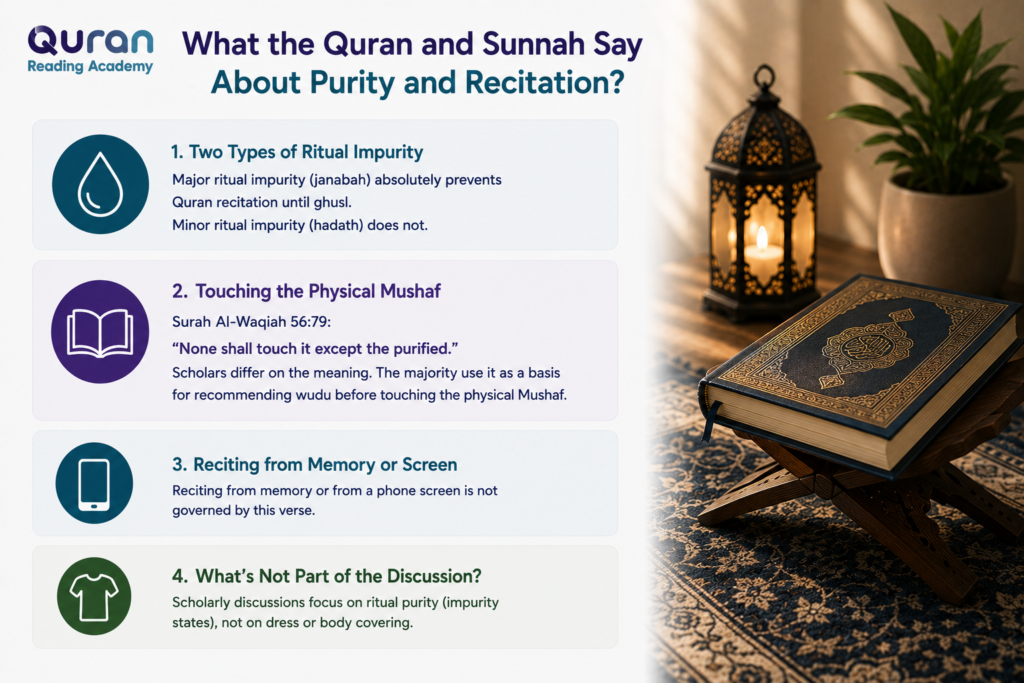
On the question of touching the physical Mushaf, scholars frequently cite this verse from Surah Al-Waqiah:
لَّا يَمَسُّهُ إِلَّا الْمُطَهَّرُونَ
(Laa yamassuhu illa al-mutahharun)
Scholars differ on whether “the purified” refers to the angels who carry the heavenly Mushaf or to human beings handling the earthly Mushaf.
The majority use this verse as a basis for recommending wudu before touching the physical Mushaf. Reciting from memory or from a phone screen is not governed by this verse.
Notice what is entirely absent from these scholarly discussions: dress. The purity conditions debated for Quran recitation center on ritual states, not on whether the body is covered or uncovered.
See Our Academy in Action
Discover what a typical session looks like! Watch these brief highlights from our live, interactive classes to see how our instructors engage with students of all ages.
Start Your Quran Learning Journey Today
Join Quran Reading Academy and begin structured, step-by-step Quran reading with expert guidance.
Try your first class for freeRead also: Can You Read from the Quran During Tahajjud?
Recommended Etiquette for Quran Recitation
Modest dress, wudu, and a respectful setting are recommended etiquette for Quran recitation, not conditions of validity outside of salah. Islamic tradition draws a clear line between what is obligatory (fard) and what is recommended (mustahabb) for Quran recitation.
Al-Hakim al-Tirmidhi writes in Nawadir al-Usul: “Among the honors due to the Quran is that you dress for its recitation as you would dress for entering upon a prince, because you are conversing with Him.” This description shaped how early Muslims prepared for recitation.
a. Prepare for Quran Recitation with Recommended Adab
Scholars list wudu as the most important recommended act before Quran recitation outside of salah.
Using siwak to clean the mouth is mentioned in multiple narrations, since the mouth is the passage through which the Words of Allah are recited. Wearing clean, modest clothing reflects the spirit of genuine reverence for the Quran.
b. Choose a Respectful Position and Setting for Quran Recitation
Sitting upright rather than reclining is recommended when reciting outside of salah. Facing the qiblah, when possible, adds another layer of reverence.
None of these practices are conditions that affect validity or reward. All of them increase the depth and focus of the worship.
Quran Reading Academy offers an Online Quran Reading Course with Tajweed that trains students to recite correctly while building genuine awareness of the etiquette classical scholars recommend for every recitation session.
Begin Proper Quran Reading with Quran Reading Academy Expert Instructors
Read also: Can You Read Quran with Tayammum?
Can Women Read Quran Without Covering Their Hair?
Yes, women do not need to cover their hair before reading Quran privately at home. Ibn Uthaymeen’s fatawa state that covering the head is not a condition of Quran recitation.
In Majmu’ Fatawa al-Mar’a al-Muslimah (vol. 1/249), Ibn Uthaymeen states that Quran recitation does not require covering the head, because covering the ‘awrah is not a condition for reading Quran. The Islamweb fatwa panel and multiple Al-Azhar scholars reaffirm this position independently.
A woman reading Quran at home without a headscarf performs fully valid and rewarded worship. Covering the hair is obligatory in salah and obligatory in the presence of non-mahram men. Standalone private Quran recitation falls outside both of those obligations.
Some scholars recommend that a woman cover herself out of reverence when reciting Quran, even alone. That recommendation reflects taqwa and adab. Scholars consistently frame it as a spiritual quality, not a ruling that affects the validity or reward of her recitation in any way.
Quran Reading Academy’s Quran Reading Classes for Sisters offers a private environment taught by qualified women instructors, giving sisters both scholarly clarity on these practical rulings and expert guidance on correct Tajweed technique in each session.
Book Your Free Trial Lesson for Sisters Quran Classes Today
Reading Quran From a Phone Without Covering Awrah
Reading Quran from a smartphone without covering the ‘awrah carries the same ruling as reciting from memory: permissible, with modest dress and wudu recommended as acts of adab. The phone does not hold the legal status of a physical Mushaf in Islamic jurisprudence.
Classical scholars defined the sanctity of the Mushaf around it being a physical object with the Words of Allah inscribed on its pages.
A phone screen displaying Quranic text uses digital signals rendered electronically, which scholars classify differently from a fixed physical inscription. The conditions linked to touching the Mushaf therefore do not transfer to the phone screen.
A Muslim reading Quran from a phone before sleep, between tasks during the day, or in informal clothing at home, recites in a permissible manner. Dress and wudu state are recommended considerations, not binding conditions. Being in a state of janabah remains the one absolute barrier regardless of the medium used.
The practical benefit of this ruling is meaningful. Quran recitation without covering awrah in a private setting, whether from a phone or from memory, is valid worship. That accessibility reflects the Quran’s nature as a daily companion across every moment of a Muslim’s life, not only a formal recitation reserved for specific dressed conditions.
Quran Reading Academy’s Quran Reading Course for Beginners takes students from absolute zero to confident Quran reading through structured, one-on-one sessions covering letter recognition, correct pronunciation, and the practical habits that build consistent, accurate recitation over time.
Inside Our Live Classroom
We believe in complete transparency. Take a look inside our virtual classrooms to experience our premium teaching tools and engaging learning environment firsthand.
Start Your Quran Learning Journey Today
Join Quran Reading Academy and begin structured, step-by-step Quran reading with expert guidance.
Try your first class for freeLearn Accurate Quran Recitation with Quran Reading Academy
Understanding what Islamic jurisprudence actually requires for Quran recitation clears the path to a consistent, confident practice. When the rulings around dress, purity, and etiquette are clear, a Muslim can recite with ease and genuine presence of heart throughout every part of the day.
At Quran Reading Academy, our instructors are Al-Azhar-trained and Ijazah-certified, with verified chains of recitation transmission and years of experience teaching non-Arabic speaking students at every level.
Every session is one-on-one, personalized to the student’s level, and scheduled flexibly across any time zone.
Why Students Choose Quran Reading Academy
- Al-Azhar-trained instructors with Ijazah-certified chains of recitation transmission
- One-on-one personalized sessions with flexible scheduling for students in any time zone
- A structured curriculum covering correct pronunciation, Tajweed rules, and recitation etiquette from the first lesson
Our Quran Courses
- Quran Reading Classes
- Quran Reading Classes for Kids
- Quran Reading Classes for Adults
- Quran Reading Classes for Female/Sisters
- Quran Reading Classes for New Muslims
- Quran Reading Course for Beginners
- Online Quran Reading Course with Tajweed
- Reading and Memorizing the Quran Course
- Noorani Qaida Course
- Quran Course for Beginners
- Quran Tajweed Course
- Quran Recitation Course
- Quran Hifz Course
- Online Quran Qirat Classes
Conclusion
Covering the ‘awrah is not a condition for reading Quran outside of salah. Ibn Uthaymeen, Ibn Baz, Al-Azhar, and classical scholars in all four schools confirm this ruling without disagreement.
The one absolute condition tied to Quran recitation is the absence of major ritual impurity (janabah), which requires ghusl before the person may recite in any form.
Wudu is strongly recommended before touching a physical Mushaf and advisable before any recitation, but not a condition that affects validity when reciting from memory or from a phone.
Covering the body modestly reflects genuine reverence for the Words of Allah and is a recommended act of adab that deepens the spiritual quality of each recitation.
Reading Quran without covering awrah, in a private setting and free of janabah, is valid and fully rewarded worship. Recognizing this ruling removes unnecessary barriers and allows every Muslim to build the consistent Quran practice the classical scholars always considered the highest daily priority.
Frequently Asked Questions
Is It Haram to Read Quran with Awrah Uncovered?
No. Reading Quran without covering the ‘awrah in a private setting is not haram. Scholars classify covering the body during Quran recitation as mustahabb (recommended), not obligatory. The one absolute prohibition is reciting while in a state of janabah, which is entirely unrelated to the question of dress.
Does a Woman Need to Wear Hijab to Read Quran at Home?
No. Ibn Uthaymeen explicitly confirmed that covering the head is not a condition of Quran recitation. A woman reading Quran at home without a headscarf performs fully valid and rewarded worship. The obligation to cover the hair applies in salah and in front of non-mahram men, not during private recitation.
Can You Read Quran From a Phone Without Covering Awrah?
Yes. Scholars classify the phone as distinct from the physical Mushaf, meaning conditions linked to touching the Mushaf do not apply to a phone screen. Reading Quran from a smartphone without covering the ‘awrah is fully permissible. Modest dress and wudu remain recommended as acts of adab.
Does Covering Up When Reading Quran Increase the Reward?
Covering modestly and being in wudu are recommended acts of adab that reflect reverence for the Quran, but they do not change the fundamental validity or the core reward attached to each letter recited. They may deepen spiritual focus without becoming conditions of Quran recitation.
Can You Read Quran Lying Down Without Covering Awrah?
Yes. Body position and clothing are not conditions of Quran recitation outside of salah. Classical scholars confirm that the Quran describes the believers as those who remember Allah while standing, sitting, and lying on their sides (Surah Al-Imran 3:191). The one binding condition remains the absence of janabah.








Leave a Reply