 Quran
| Key Takeaways |
| Islamic law draws a firm distinction between compelling a non-Muslim to engage with the Quran and a Muslim parent’s duty to educate their children, as these carry entirely different rulings. |
| Surah Al-Baqarah 2:256 explicitly prohibits compulsion in religion, making it forbidden to force a non-Muslim to read, listen to, or recite the Quran against their will. |
| Classical scholars in all four major madhabs affirm that Muslim parents have both the right and the religious obligation to require their children to learn Quran recitation. |
| Wisdom, patience, and consistent encouragement as modeled by the Prophet ﷺ produce stronger and more lasting Quranic commitment than any form of coercive pressure. |
Few questions in Islamic family life carry the practical weight this one does. Parents face it when a child resists Quran lessons, and adults face it when a spouse or sibling shows no interest in connecting with Allah’s Book.
This article examines whether it is haram to force someone to read Quran, drawing on both the explicit Quranic texts and the classical scholarly record in multiple legal schools.
Is It Haram to Force Someone to Read Quran?
The answer depends entirely on who is being required. Forcing a non-Muslim to read or recite the Quran is haram; the Quran itself prohibits compulsion in all matters of religion.
Muslim parents requiring their children to engage with Quranic education operate within an entirely different juristic category. Classical scholars in multiple legal schools recognize this as a legitimate parental religious obligation, not an overreach of parental authority.
Why Compelling a Non-Muslim to Read the Quran Is Forbidden
The Quran addresses the question of religious compulsion directly in a verse that scholars in every legal school have treated as the foundational ruling on this matter.
No Muslim may force a person who has not embraced Islam to engage with Quranic recitation, listen to Quranic audio they have rejected, or perform any act of Islamic worship against their will.
لَا إِكْرَاهَ فِي الدِّينِ ۖ قَد تَّبَيَّنَ الرُّشْدُ مِنَ الْغَيِّ
(La ikraha fid-deeni, qad tabayyanar-rushdu minal-ghayy)
(“There is no compulsion in religion. The right course has become clear from the wrong.”) Surah Al-Baqarah 2:256
Scholars in all four legal schools have treated this ruling as settled. Worship, including Quran recitation, is only valid and spiritually meaningful when performed by one who has chosen to perform it.
Compelling a non-Muslim neighbor, colleague, or family member to read the Quran, attend Quran sessions, or listen to recitation they have expressly refused is a direct violation of this command. The ruling applies to any adult who has clearly declined the invitation.
Read also: When Can You Not Read Quran?
Why Parental Quran Education Is Different from Religious Coercion
Where this question becomes more nuanced is in the parent-child relationship. Islamic jurisprudence draws a clear line between compelling someone into a faith they do not hold and a parent fulfilling their duty to raise a Muslim child within that faith.
A Muslim parent requiring a Muslim child to learn and recite the Quran operates within an entirely different legal category. The child is already Muslim, and Quranic education falls within the parent’s established religious guardianship obligations.
Scholars who affirmed parental authority over children’s Quran education were not contradicting the principle in Surah Al-Baqarah. They were applying a separate and well-established body of Islamic family jurisprudence with its own Quranic and prophetic foundations.
What Classical Islamic Scholars Said About Compelling Children to Learn Quran?
The classical position throughout the major legal schools on this question is both clear and consistent. Scholars addressed it directly in foundational texts, and their conclusions leave little ambiguity for parents navigating this situation today.
These positions come from recognized classical sources in the major legal traditions:
1. Hanafi View on Parental Requiring Quran Education
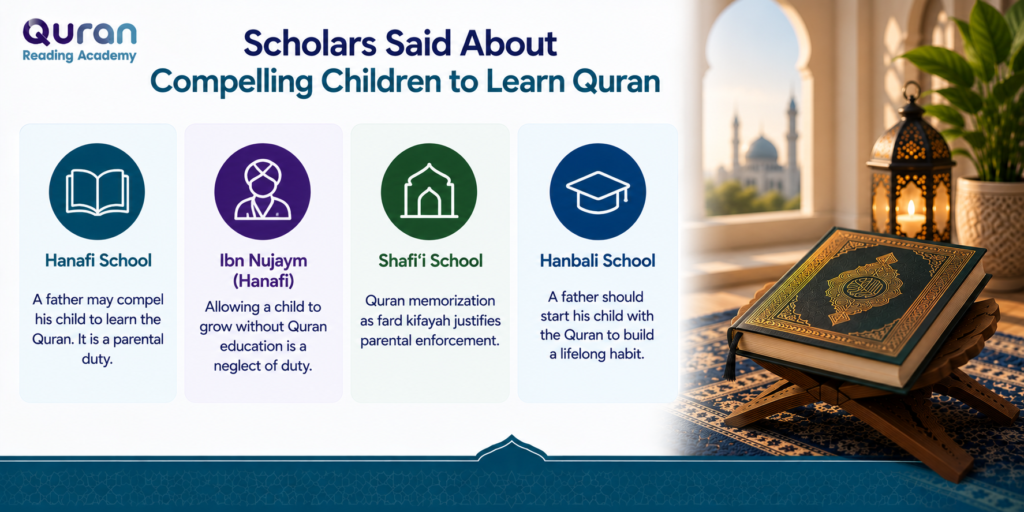
Al-Hamawi stated in Ghamz ‘Uyun al-Basa’ir that a father may compel his young child to learn the Quran, proper Islamic conduct, and religious knowledge. The grounds cited are that doing so is a parental obligation, not a recommendation alone.
Ibn Nujaym in Al-Bahr al-Ra’iq and Ibn ‘Abidin in his Hashiyah record identical positions. A parent who allows a child to grow without Quran education has neglected a recognized religious duty within the Hanafi legal framework.
2. Shafi’i and Hanbali Views on Children Learning Quran
Ibn Hajar al-Haytami from the Shafi’i school addressed whether parental enforcement of Quran memorization is justified. He concluded that Quran memorization as a fard kifayah provides strong legitimate grounds for parental requirement.
Al-Buhuti from the Hanbali school stated that a father should begin his son with the Quran so the child becomes accustomed to recitation and maintains it throughout life.
Habit formation and lasting connection are the core aim in this classical framework, not compliance produced through punishment or pressure.
| Scholar | School | Source | Position |
| Al-Hamawi | Hanafi | Ghamz ‘Uyun al-Basa’ir | Father may compel child to learn Quran and Islamic conduct |
| Ibn Nujaym | Hanafi | Al-Bahr al-Ra’iq | Quran education is an established parental obligation |
| Ibn Hajar al-Haytami | Shafi’i | Tuhfat al-Muhtaj | Quran memorization as fard kifayah justifies parental enforcement |
| Al-Buhuti | Hanbali | Daqa’iq Uli al-Nuha | Father begins son with Quran to build a lifelong recitation habit |
Quran Reading Academy offers Quran Reading Classes for Kids that provide children with structured, expert-led Quranic education in a nurturing environment designed to build accurate recitation skills from the earliest age.
Start your child’s Quran journey with a free lesson
Read also: Can You Go to Heaven Without Reading the Quran?
How Surah At-Tahrim Defines Parents’ Spiritual Responsibility
The Quranic basis for parental religious education obligations is stated explicitly in Surah At-Tahrim. Scholars consistently cited this verse as the doctrinal foundation for parental duties toward their children’s spiritual formation.
يَا أَيُّهَا الَّذِينَ آمَنُوا قُوا أَنفُسَكُمْ وَأَهْلِيكُمْ نَارًا وَقُودُهَا النَّاسُ وَالْحِجَارَةُ
(Ya ayyuhal-latheena amanoo qoo anfusakum wa ahleekum naran waquduha an-naasu wal-hijarah)
(“O you who have believed, protect yourselves and your families from a Fire whose fuel is people and stones.”)
Scholars read this verse as establishing the parent’s active role as the primary spiritual guardian of their household. Protecting a child from spiritual harm requires proactively ensuring they receive the religious knowledge that builds their relationship with Allah.
Allowing a child to grow without Quranic knowledge, under this reading, is not a neutral parenting decision. Failing to ensure Quran education is a failure to fulfill the guardianship that this verse directly commands believing parents to carry out.
Why Wisdom and Encouragement Are the Prophetic Approach for Adults
The distinction between compelling children and encouraging adults matters significantly for how Muslims relate to non-practicing family members. Regarding adults, the prophetic approach was unambiguous in its method and its spirit.
ادْعُ إِلَىٰ سَبِيلِ رَبِّكَ بِالْحِكْمَةِ وَالْمَوْعِظَةِ الْحَسَنَةِ ۖ وَجَادِلْهُم بِالَّتِي هِيَ أَحْسَنُ
(Id’u ila sabeeli rabbika bil-hikmati wal-maw’izatil-hasanah, wa jadilhum billati hiya ahsan)
(“Invite to the way of your Lord with wisdom and good instruction, and argue with them in a way that is best.”)
Adults who are not engaging with the Quran are appropriately met with encouragement, personal example, and patient reminders. Persistent pressure that overrides an adult’s expressed choice crosses into territory classical scholars would not endorse.
Forcing an adult Muslim — a spouse, sibling, or parent — to read the Quran builds resentment, not connection. Building a household where Quran recitation is a joyful, daily, visible practice invites others into participation far more effectively than pressure or ultimatums ever achieve.
Quran Reading Academy offers a Quran Course for Beginners that welcomes adults at any level, providing a supportive, judgment-free path to building a genuine and lasting connection with the Quran at their own pace.
Begin your Quran journey with a free trial lesson today
What Does “Force” Mean in Islamic Religious Education?
Classical scholars were not endorsing cruelty or psychological harm when they affirmed parental authority to require Quran learning. Their use of terms like “compel” operated within a specific juristic framework with clearly defined limits.
Legitimate parental enforcement covers requiring attendance at Quran sessions, establishing daily recitation practice, and applying graduated consequences for persistent avoidance.
Al-Khadimi’s Bariqa Mahmudiyya advises praising children of good character in front of a resistant child, using positive modeling before any stricter measures are introduced.
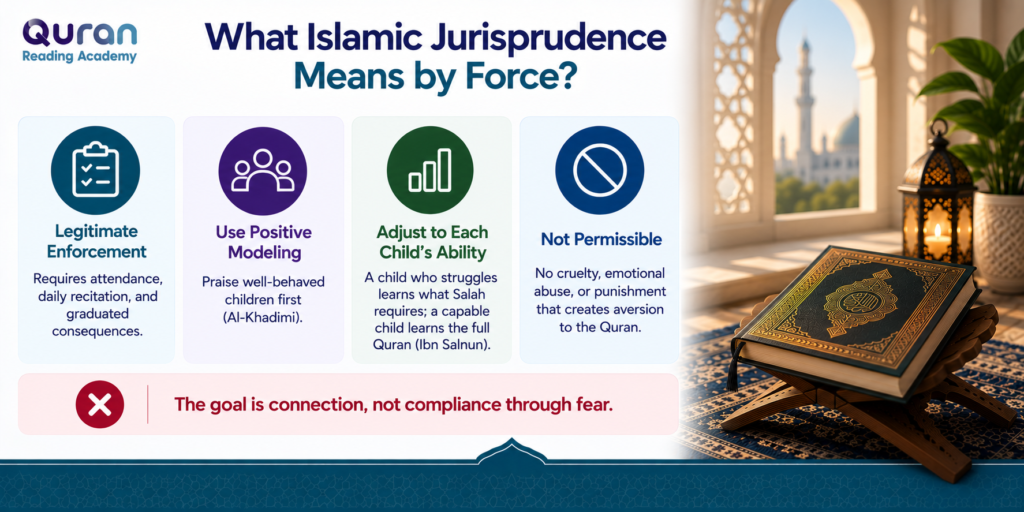
Ibn Salnun’s Adab al-‘Alim wal-Muta’allim adds an important qualification to classical enforcement limits. A child slow in comprehension should learn at minimum what Salah requires, while a capable child receives the full Quran.
Classical scholars built individual capacity into their rulings from the start. Graduated expectation prevents parents from demanding identical outcomes regardless of each child’s pace and ability.
What falls outside legitimate enforcement is equally clear throughout the classical texts. Treatment that creates deep and lasting aversion to the Quran, punishment disproportionate to the educational goal, and emotional abuse find no sanction among the scholars who affirmed parental authority.
Read also: Can You Read Quran on a Computer Without Wudhu?
See Our Academy in Action
Discover what a typical session looks like! Watch these brief highlights from our live, interactive classes to see how our instructors engage with students of all ages.
Start Your Quran Learning Journey Today
Join Quran Reading Academy and begin structured, step-by-step Quran reading with expert guidance.
Try your first class for freeHow Teaching Quran to Children Relates to Teaching Salah
The comparison that classical scholars return to most consistently is the ruling on requiring children to pray. This parallel clarifies the juristic logic that underlies parental authority over Quran reading and education.
مُرُوا أَوْلَادَكُمْ بِالصَّلَاةِ وَهُمْ أَبْنَاءُ سَبْعِ سِنِينَ وَاضْرِبُوهُمْ عَلَيْهَا وَهُمْ أَبْنَاءُ عَشْرٍ
(Muroo awladakum bis-salati wa hum abna’u sab’i sineena, wadriboohum ‘alayha wa hum abna’u ‘ashr)
(“Command your children to pray when they are seven years old, and discipline them for it when they are ten.”)
If parents are explicitly instructed to require prayer from children and to apply graduated discipline when they persistently refuse at age ten, then requiring Quran recitation stands on equally firm juristic ground.
Ibn Hajar al-Haytami made precisely this point in addressing critics of Quran enforcement. Within the household, parents carry the community’s collective fard kifayah obligation on behalf of their children.
A child’s initial reluctance does not remove the parent’s duty to ensure Quran learning takes place. Ibn Hajar’s reasoning applies the same juristic logic from prayer directly to Quranic recitation.
Quran Reading Academy offers a Quran Recitation Course that trains students of all ages to recite Allah’s words with the measured cadence the Prophet ﷺ commanded, building pronunciation accuracy and the spiritual quality of every recitation.
Reserve your free recitation trial lesson today
Building a Love for Quran Through Structure and Encouragement
Scholarly permission to require Quran education does not mean that pressure alone is the best strategy. Effective parents combine consistent structure with genuine encouragement, building environments where obligation gradually becomes love.
Children who begin their Quran journey through parental requirement often become the most motivated learners within months. The shift happens when they experience the satisfaction of completing a surah they once considered impossible or too difficult to attempt.
Negative associations with Quran that some adults carry from childhood come not from learning itself but from environments where pressure arrived without any celebration of progress.
Consistent recognition of small achievements shifts the emotional climate of Quran education entirely. When progress is marked, obligation gradually becomes genuine connection.
Adults who are reluctant to engage with regular Quran reading respond far better to being shown the beauty of what they are missing than to being lectured about neglect.
Inviting them gently, reading Quran aloud in shared spaces, and discussing what a given verse means creates natural opportunities for participation without any compulsion at all.
Quran Reading Academy offers an Online Quran Reading Course with Tajweed that moves students beyond simple letter recognition toward the acoustic precision that makes every recitation both correct and spiritually resonant.
Claim your free Tajweed trial session today
Read also: Can I Recite Quran From Memory On My Period?
Inside Our Live Classroom
We believe in complete transparency. Take a look inside our virtual classrooms to experience our premium teaching tools and engaging learning environment firsthand.
Start Your Quran Learning Journey Today
Join Quran Reading Academy and begin structured, step-by-step Quran reading with expert guidance.
Try your first class for freeStart Learning Quran with Quran Reading Academy Certified Instructors
Whether you are a parent establishing your child’s Quranic foundation or an adult ready to build your own connection to Allah’s Book, Quran Reading Academy provides structured, expert-led instruction suited to any level and age.
Quran Reading Academy’s key advantages:
- Certified instructors trained in age-appropriate Quran pedagogy for children and dedicated adult learning pathways
- One-on-one live sessions that adapt fully to each student’s current level, pace, and individual learning needs
- A structured curriculum that progresses from foundational letter recognition through complete Tajweed mastery
Our Quran Courses
- Quran Reading Classes
- Quran Reading Classes for Kids
- Quran Reading Classes for Adults
- Quran Reading Classes for Female/Sisters
- Quran Reading Classes for New Muslims
- Quran Reading Course for Beginners
- Online Quran Reading Course with Tajweed
- Reading and Memorizing the Quran Course
- Noorani Qaida Course
- Quran Course for Beginners
- Quran Tajweed Course
- Quran Recitation Course
- Quran Hifz Course
- Online Quran Qirat Classes
Conclusion
Forcing someone to read the Quran is haram when that person is a non-Muslim or a non-consenting adult. Surah Al-Baqarah 2:256 makes the prohibition clear, and scholars have applied it consistently throughout every generation of Islamic jurisprudence.
Muslim parents who require their children to learn Quran recitation operate within an entirely different juristic framework. This framework rests on established parental guardianship duties recognized in the Hanafi, Shafi’i, and Hanbali schools.
Classical scholars affirmed this as a parental religious duty with foundations in both Quranic command and prophetic instruction, not as an extension of the no-compulsion principle.
What matters alongside the right to require Quran education is how that requirement is applied. Whether it is haram to force someone to read Quran hinges on who they are, what relationship exists, and whether the method reflects the wisdom and mercy Islam teaches.
Frequently Asked Questions About Is It Haram to Force Someone to Read Quran
Is it haram to force a non-Muslim to read the Quran?
Yes, forcing a non-Muslim to read or recite the Quran is haram. Surah Al-Baqarah 2:256 explicitly prohibits compulsion in religion, and scholars have applied this ruling consistently to non-Muslims in all major legal schools.
Can Muslim parents require their children to learn Quran?
Yes, Muslim parents may and should require their children to engage with Quran education. Classical scholars in all major madhabs categorize this as a parental religious obligation, comparable in juristic structure to the prophetic instruction to require prayer from children beginning at age seven.
At what age should children begin structured Quran education?
Most scholars and educators recommend introducing Quran recitation between ages four and six, with consistent structured learning beginning by age seven. This aligns with the prophetic instruction on prayer and normalizes Quran time before resistance patterns develop.
Is encouraging an adult Muslim to read Quran the same as forcing them?
No, encouragement and force are entirely distinct in Islamic jurisprudence. Adults who are not reading Quran should be invited with wisdom, patience, and good example as Surah An-Nahl 16:125 instructs. Persistent pressure that overrides an adult’s expressed refusal crosses a line scholars would not sanction.
Does requiring children to read Quran cause them to dislike it in adulthood?
Negative associations arise from how Quran is taught, not from requiring it. Consistent structure paired with positive reinforcement, visible milestone celebrations, and qualified instruction produces children who develop genuine love for Quran over time.



Leave a Reply