 Women
Women
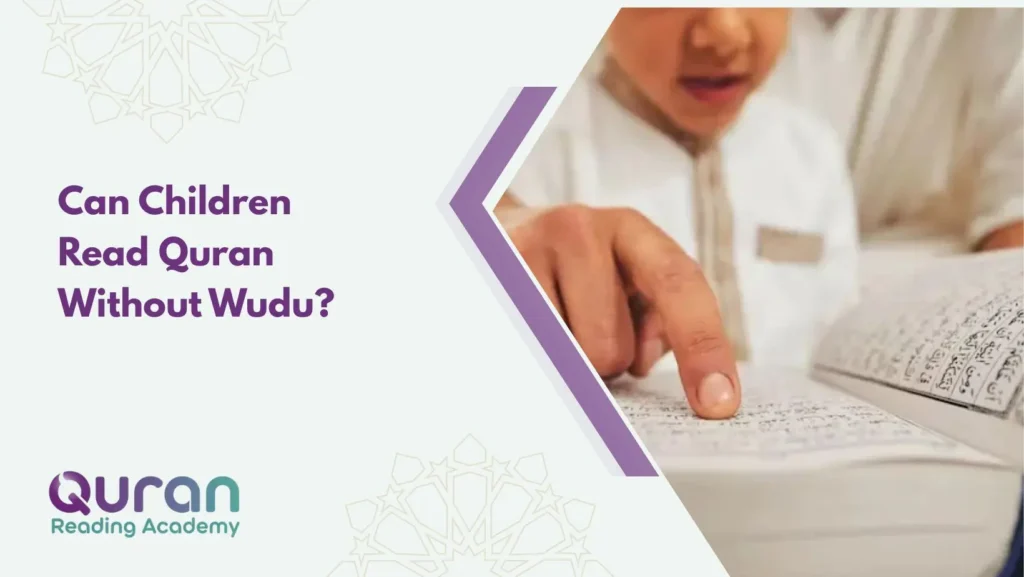
As a parent, you want to encourage your child’s connection with the Quran without placing unnecessary burdens on them, yet you also want to raise them with the correct Islamic etiquette from the start.
This guide covers the scholarly ruling on wudu for children, the difference between reciting and touching the Mushaf, how digital devices factor in, and how to build lasting habits of reverence in your child.
Can Children Read Quran Without Wudu?
Yes — children are permitted to recite the Quran without wudu, whether from memory or from a digital device such as a phone or tablet.
This ruling is not exclusive to children. Adults too may recite the Quran from memory without being in a state of wudu, according to the majority of scholars.
The Prophet ﷺ would mention Allah in all circumstances, which scholars have used as a basis for permitting dhikr and recitation without wudu.
The Leniency Position for Young Students
When a child is actively learning, tracing letters, following along during a lesson, or building reading fluency, requiring full wudu before every page creates a barrier that can interrupt learning continuity.
Scholars who permit this leniency include it under the broader principle that hardship lifts restriction (al-mashaqqah tajlib al-tayseer).
At The Quran Reading Academy, our Quran Reading Classes for Kids are designed with exactly this kind of juristic awareness, our certified instructors guide families on how to balance proper etiquette with realistic learning conditions.
Book your kid a FREE trial in the best Quran reading classes

Can Children Read Quran Without Wudu from the Physical Mushaf?
Scholars have differed on whether it is permissible for someone without wudu to touch the Mushaf. One group holds that it is permissible, on the basis that no clear and authentic evidence explicitly prohibits it, and the default ruling in Islamic jurisprudence is the absence of obligation.
The majority, however, hold that touching the Mushaf requires ritual purity, supported by this verse:
لَّا يَمَسُّهُۥٓ إِلَّا ٱلْمُطَهَّرُونَ
Lā yamassuhū illā al-muṭahharūn
“None touch it except the purified.” (Al-Waqi’ah: 79)
The Quranic prohibition on touching the Mushaf without purification based upon this verse applies specifically to the physical Mushaf, not to oral recitation or digital displays.
However, scholars of Tafseer explain that this verse refers to the protected Tablet (al-Lawh al-Mahfuz) in its primary meaning. The ruling applied to the Mushaf is derived through juristic inference, which is why the recitation itself (from memory or digitally) does not fall under this restriction.
Our Students Reviews
Start Your Quran Learning Journey Today
Join Quran Reading Academy and begin structured, step-by-step Quran reading with expert guidance.
Try your first class for freeWhat Do Scholars Say About Children Reading the Quran Without Wudu?
When it comes to young children touching the Mushaf for the purpose of learning and memorization, the majority of scholars permit it.
The Hanafi, Maliki, and one narration within the Hanbali school allow it without restriction — for both the discerning child (mumayyiz) and the young child who has not yet reached the age of discernment (7 years old). The Shafi’i school specifically permits it for the discerning child.
The Nihayah fi Sharh al-Hidayah states that there is no harm in children touching the Mushaf or writing boards in the learning environment, because children are not legally addressed by the obligation of purity — though they are encouraged to practise it as a matter of character and habit.
Al-Haskafi (رحمه الله) of the Hanafi school wrote that it is not disliked for a child to touch the Mushaf or a writing board, and there is no harm in giving it to them or receiving it from them — due to necessity, since memorization in childhood is like engraving on stone.
Imam Malik stated in al-Mukhtassar: “I hope it is permissible for children to touch the Mushaf for teaching purposes without wudu.” The Maliki scholar al-Kharashi further noted that the relied-upon position in the madhhab is that the student may touch the complete Mushaf, citing Ibn Bashir’s report of scholarly agreement on this point.
Al-Ghazali (رحمه الله) stated that it is most correct that a teacher is not obligated to require a discerning child to maintain purity when touching the Mushaf or writing board, as this would impose hardship upon them. Imam al-Nawawi similarly recorded that the stronger of the two well-known positions in the Shafi’i school is that it is not obligatory — due to the difficulty it would entail.
The Hanbali position, notes that permitting children to touch their writing boards is the sounder view, since imposing a strict purity requirement could lead to children being deterred from memorising the Quran.
The Conclusion of the Majority:
The majority of scholars thus permit children — whether discerning or not — to touch the Mushaf without wudu for the purpose of learning and memorisation.
This position is the most accommodating for people, the most conducive to connecting new generations with the Quran, and the position of the majority of the fuqaha.
Can Children Read Quran Without Wudu From a Digital Mushaf?
Yes, the overwhelming position among contemporary scholars is that there is no prohibition on touching a digital Mushaf without wudu for children or adults. The screen of a phone or tablet is not considered a Mushaf in the traditional legal sense, as the Quranic text is not physically inscribed on it in the same way.
This makes digital devices a highly practical tool for young learners.
Children can read, follow along, and practise their recitation freely without the barrier of wudu being a concern. Help your children read the Quran correctly by applying Tajweed rules and let them know the beauty of their recitation.
Start Reading the Quran with Tajweed with a FREE Trial Today

Why Should Parents Encourage Wudu for Children?
While leniency exists, Islamic scholars and educators consistently recommend that parents accustom children to making wudu before Quran recitation from an early age, even when it is not strictly required.
Although children can read Quran without Wudu, There are several important reasons to encourage them and make wudu a fixed habit for many reasons.
1. Cultivating Reverence for the Quran
Teaching children to prepare themselves before sitting with the Quran instills a sense of the Quran’s sacredness. This ta’dheem (reverence) is one of the most valuable gifts a parent can give their child in their relationship with Allah’s words.
2. Building Lifelong Habits
Habits formed in childhood tend to persist into adulthood. A child who grows up associating Quran recitation with wudu will naturally carry this practice forward without it feeling like a burden.
3. Aligning With the Spirit of Worship
Wudu is not merely a physical act, it is a spiritual preparation. Encouraging it before Quran time helps children understand that reading the Quran is an act of worship, deserving the same preparation as salah.
4. Developing Islamic Identity
Small rituals like wudu help children develop a conscious Islamic identity. They begin to understand that being Muslim shapes how they approach even daily activities.
Our Students Reviews
Start Your Quran Learning Journey Today
Join Quran Reading Academy and begin structured, step-by-step Quran reading with expert guidance.
Try your first class for freeHow Can Parents Train Children to Make Wudu Before Quran Reading?
Training children to make wudu before Quran recitation is a recommended practice rooted in reverence for the Quran, even where it is not strictly obligatory. Parents who instil this habit early raise children with a deep, embodied respect for the Book of Allah.
At The Quran Reading Academy, instructors consistently observe a meaningful pattern in student development: children who are trained to make wudu before their recitation sessions tend to approach the lesson with greater focus and intentionality. It is not merely a ritual — it becomes a mental signal that something sacred is about to begin.
Meet our Quran teachers and find the perfect match for your trial session

Start Your Child’s Quran Reading With Qualified Guidance
Whether your child is just beginning or is ready to build consistent Tajweed habits, structured guidance makes all the difference.
The Quran Reading Academy offers:
Certified instructors with extensive experience teaching children from non-Arabic backgrounds
- A structured Quran Reading Classes for Kids built around correct pronunciation from lesson one
- The Al-Menhaj Book — a proven foundational text for non-Arabic speaking beginners
- Flexible scheduling for families across different time zones
- A free trial lesson so your child can experience the methodology firsthand
Check out our top courses to help you read the Quran with confidence:
- Quran Reading Course With Tajweed
- Noorani Qaida Course
- Quran Reading Course for Beginners
- Quran Reading Classes for Adults
- Quran Reading Classes for Sisters
- Quran Reading Classes for Kids
- Quran Hifz Course
- Arabic Reading Practice Course
- Quranic Arabic Course
Book your free class today—it’s the perfect start to learning the Quran

Conclusion
The question: can children read Quran without wudu has a clear, practical answer rooted in authentic Islamic scholarship. Recitation from memory and digital Quran reading are freely permitted. Touching the physical Mushaf requires purification in principle, but established scholarly leniency supports young learners during active study.
The most important step parents can take is not anxiety over every ritual condition — it is consistency. Keep your child reciting daily, train them gradually in wudu as a habit of reverence, and invest in qualified instruction early. The Quran is meant to be accessible, and Allah ﷻ has made this Deen easy for those who seek it sincerely.
Start Your Quran Learning Journey Today
Join Quran Reading Academy and begin structured, step-by-step Quran reading with expert guidance.
Try your first class for freeRead Also: Do You Have to Wear a Scarf When Reading Quran?
Frequently Asked Questions
Can children read Quran without wudu from a phone or tablet?
Yes, children may read Quran from a phone or tablet without wudu. Digital devices are not classified as a Mushaf in Islamic legal terminology, so the condition of purification for touching the Quran does not apply. This is the consistent position of contemporary scholars and makes digital tools highly practical for young learners.
Is it sinful if a child touches the Mushaf without wudu?
Pre-pubescent children are not legally accountable (mukallaf) in Islamic law, so the concept of sin does not apply to them in this context. However, parents should guide children toward proper purification as a habit of reverence. Scholars permit educational necessity as grounds for leniency when wudu is not possible during lessons.
Can a child recite Quran without wudu before sleeping?
Yes. Reciting Quran from memory before sleeping is permitted without wudu, provided the child is not in a state of janabah. Many short Surahs, such as Al-Ikhlas, Al-Falaq, and An-Naas, are commonly recited at bedtime, and this practice is fully supported regardless of wudu status.








Leave a Reply