 Women
Women
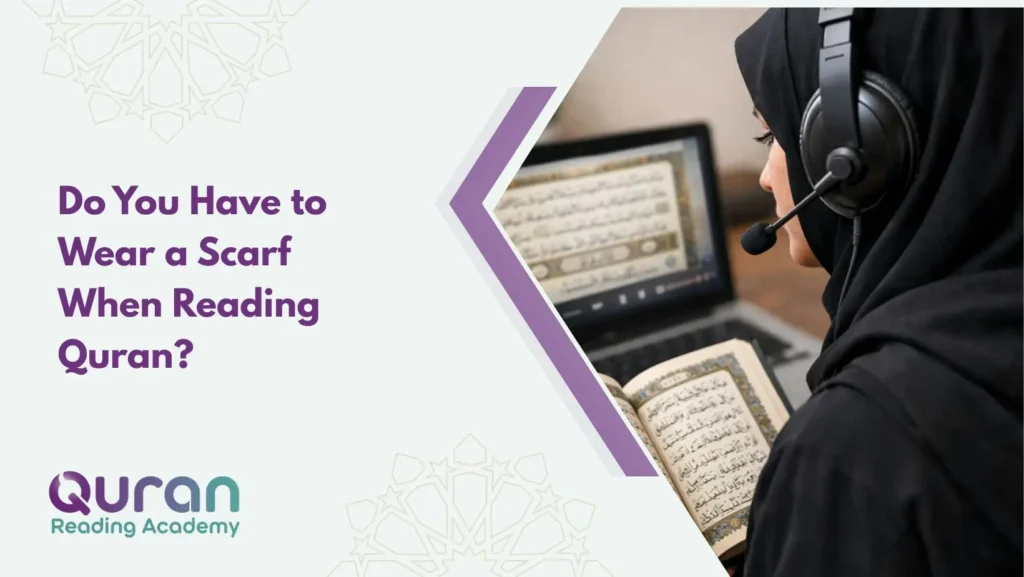
A question many new Muslim sisters — and even lifelong Muslims — quietly wonder about: does reading Quran require covering your hair? It comes up in nearly every beginner session at The Quran Reading Academy, and the uncertainty is completely understandable. Islamic rulings on etiquette and worship can feel overwhelming when you are still finding your footing.
The answer, based on authentic scholarly positions, is that wearing a scarf or hijab is not obligatory when reading the Quran. However, it is genuinely recommended as an act of reverence — and understanding why scholars say this will help you build the right mindset for approaching the Quran from the very beginning.
Do You Have to Wear a Scarf When Reading Quran?
No, women are not obligated to wear a scarf or hijab specifically for Quran recitation when reading in private. The scholarly consensus — across all four major Sunni schools of Islamic jurisprudence — holds that hijab is obligatory in the presence of non-Mahram men, not as a prerequisite for reading Quran. Reading Quran at home, uncovered, is therefore permitted without scholarly disagreement.
This is an important distinction that many students miss. The obligation of hijab is tied to public presence and social interaction, not to acts of personal worship performed in private. Scholars across the Hanafi, Maliki, Shafi’i, and Hanbali schools agree on this point.
What Does Scholars Recommend Even If Wearing a Scarf is not Obligatory?
While not obligatory, covering the head for women during Quran recitation is described by many scholars as mustahabb — meaning recommended and praiseworthy. The reasoning is straightforward: approaching the Quran is an act of great reverence, and presenting oneself in a dignified, modest manner reflects the proper adab (etiquette) of interacting with the Words of Allah.
Shots Videos from Our Courses
Start Your Quran Learning Journey Today
Join Quran Reading Academy and begin structured, step-by-step Quran reading with expert guidance.
Try your first class for freeDo You Have to Cover Your Hair When Reading Quran From a Physical Mushaf?
No, holding and reading from a physical Mushaf (printed Quran) does not add an additional obligation to cover the hair. The conditions most scholars discuss for handling the Mushaf relate to ritual purity (Wudu), not attire. Being in a state of Wudu is the more pressing scholarly discussion for those who touch the physical pages of the Quran.
Why Does Wudu Matter More Than Head Covering for the Mushaf?
The Quran states:
لَّا يَمَسُّهُۥٓ إِلَّا ٱلْمُطَهَّرُونَ
Lā yamassuhū illā al-muṭahharūn
“None touch it except the purified.” (Al-Waqi’ah 56:79)
Scholars of Tafsir differ on whether this verse refers to the angels or to human beings handling the Mushaf.
However, many jurists have used this verse as a basis for requiring Wudu before touching the physical Quran. The point is: scholarly attention centers on purity, not head covering, when it comes to the Mushaf.
Do You Have to Wear Hijab When Reading Quran if You Are in a Mixed Setting?
Yes — if non-Mahram men are present, the obligation of hijab applies as it would in any other setting. This is not a Quran-specific ruling; it is the standard hijab obligation. Reading Quran in that context does not create a separate ruling — the pre-existing obligation of hijab covers it automatically.
In a classroom setting — including online Quran classes where a male teacher can see the student — the normal hijab ruling applies for women who follow the majority scholarly position.
At The Quran Reading Academy, our Quran Reading Classes for Adults accommodate sisters through female instructors and appropriate session arrangements, so this is never a barrier to learning.
Book your FREE trial class to start reading Quran

Praying Versus Reading Quran — an Important Distinction
One reason this question arises is that covering the hair is obligatory for women during Salah (prayer). Many sisters naturally assume the same applies to Quran reading. But scholars distinguish between Salah — which has specific conditions of validity (shurut al-salah) including covering the awrah — and Quran recitation, which is a separate act of worship with its own etiquette rulings.
The conditions for Salah do not automatically transfer to Quran reading. This is a key piece of fiqh knowledge that clarifies the question immediately.
What Are the Proper Etiquettes of Reading Quran That Scholars Do Emphasize?
The proper etiquettes of Quran reading that scholars across all schools consistently emphasize include being in a state of Wudu, facing the Qiblah when possible, sitting in a clean and quiet place, reciting with focused presence of heart, and beginning with Ta’awwudh and Basmala. These are the adab of recitation that students should prioritize before concerning themselves with head covering.
Our guide on Quran reading etiquettes and manners covers these foundational practices in detail. Getting these right from day one shapes your entire relationship with the Quran.
A Table of Key Quran Reading Etiquettes and Their Ruling Status
| Etiquette | Scholarly Ruling | Priority Level |
| Wudu before touching Mushaf | Obligatory (majority) | Highest |
| Reciting Ta’awwudh before starting | Recommended (Sunnah) | High |
| Sitting in a clean place | Recommended | High |
| Facing the Qiblah | Recommended | Moderate |
| Head covering for women | Recommended (not obligatory) | Moderate |
| Head covering for men | Not mentioned as required |
In my years of working with beginner sisters at The Quran Reading Academy, the students who thrive are those who focus on Wudu, a clean environment, and consistent practice — not those who let questions about attire stop them from opening the Quran altogether.
The Spiritual Foundation Behind All Quran Etiquette
The Prophet ﷺ described the Quran’s elevation in his teachings on its recitation:
“The best of you are those who learn the Quran and teach it.” (Sahih al-Bukhari 5027)
This hadith emphasizes engagement with the Quran — learning and teaching it. Etiquette supports that engagement; it should never become a reason to delay it.
Our Students Reviews
Start Your Quran Learning Journey Today
Join Quran Reading Academy and begin structured, step-by-step Quran reading with expert guidance.
Try your first class for freeShould Beginners Worry About Scarf Requirements Before Starting to Read Quran?
No — beginners should not allow uncertainty about dress requirements to delay their Quran reading. The obligation is clear: covering hair during private Quran recitation is not required. What matters far more at the beginning is establishing the habit of reading with correct pronunciation, proper breath control, and letter articulation.
At The Quran Reading Academy, we regularly onboard sisters who have spent years hesitating to begin because they felt they needed to have every rule figured out first. The ruling on scarf-wearing is now clear — start reading.
For sisters just beginning, our Quran Reading Course for Beginners is designed precisely for this stage. It covers everything from Arabic letter recognition through the Al-Menhaj Book to building the reading fluency needed for independent recitation.
Enroll in Our Quran Reading Course for Beginners with a Free Trial

A practical learning plan also helps — our daily Quran reading plan and schedule gives you a structured framework that keeps practice consistent without overwhelm.
What Additional Recommendations Help Women Approach Quran Reading With Proper Reverence?
Beyond the head covering question, sisters approaching Quran reading can enrich their practice with these scholarly-grounded recommendations. They reflect the spirit of tazkim — venerating and honoring the words of Allah — which is the deeper purpose behind all Quran etiquette.
Choose a Clean, Dedicated Space for Your Reading Sessions
Scholars recommend that the place of recitation be clean, quiet, and free of impurity. This creates the mental clarity needed for focused recitation. Many of our students at The Quran Reading Academy set aside a specific corner of their home — even just a prayer mat in a quiet room — and report that the physical space cues their focus immediately.
Begin Every Session With Sincere Intention (Niyyah)
Setting a clear intention before reading — even a mental statement that you are reciting to draw closer to Allah — is a practice the scholars of Quran recitation uniformly emphasize. It shifts the act from routine to worship. This is adab that costs nothing and transforms the experience entirely.
Use Correct Tajweed From the Earliest Possible Stage
One of the most consistent observations from teaching is this: students who learn even basic Tajweed rules from the beginning develop far better reading habits than those who correct errors later. Our Online Quran Reading Course with Tajweed integrates pronunciation correction from lesson one — because fixing deeply ingrained errors later is significantly harder than building correctly from the start.
Start Reading the Quran with Tajweed with a FREE Trial Today

For those wondering whether reading without Tajweed is sinful, our article on whether reading Quran without Tajweed is wrong gives a nuanced, scholarly grounded answer.
Start Your Quran Learning Journey Today
Join Quran Reading Academy and begin structured, step-by-step Quran reading with expert guidance.
Try your first class for freeRead Also: Can Children Read Quran Without Wudu?
Start Your Quran Reading Journey With The Quran Reading Academy
The ruling is clear: no scarf obligation stands between you and the Quran. Now is the time to read.
The Quran Reading Academy offers:
- Certified female instructors for sisters who prefer same-gender teaching
- Structured beginner pathways starting with the Al-Menhaj Book
- Quran Reading Classes for New Muslims with patient, specialist teachers
- Flexible scheduling across all time zones
- One free trial class — no commitment required
Book your free trial class today and begin reading the Quran with confidence, correct pronunciation, and proper guidance — Insha’Allah.
Check out our top courses to help you read the Quran with confidence:
- Quran Reading Course With Tajweed
- Noorani Qaida Course
- Quran Reading Course for Beginners
- Quran Reading Classes for Adults
- Quran Reading Classes for Sisters
- Quran Reading Classes for Kids
- Quran Hifz Course
- Arabic Reading Practice Course
- Quranic Arabic Course
Book your free class today—it’s the perfect start to learning the Quran

Frequently Asked Questions About Wearing Hijab When Reading Quran
Do You Have to Wear the Hijab When Reading Quran at Home Alone?
No, wearing hijab is not required when reading Quran at home alone. The obligation of hijab in Islamic jurisprudence relates to the presence of non-Mahram men, not to acts of personal worship. Reading Quran privately without a head covering is permitted across all four major Sunni schools of jurisprudence, though covering is considered praiseworthy.
Is It Disrespectful to Read Quran Without a Scarf?
Reading Quran without a scarf is not considered disrespectful by mainstream Islamic scholarship. It is a permitted act. However, many scholars recommend covering as part of the broader adab of Quran recitation, treating it as an expression of reverence rather than a legal requirement. Omitting it does not constitute disrespect; doing it earns additional reward.
Do Men Have to Cover Their Heads When Reading Quran?
No — there is no scholarly requirement for men to cover their heads during Quran recitation. Some scholars consider it a general mark of respect in worship contexts, and covering the head during prayer is a recommended Sunnah for men. However, this is not extended as a condition or even a strong recommendation specifically for Quran reading.
Does the Ruling Change if a Woman Is Leading a Quran Study Circle?
The ruling on head covering does not change based on the role of teacher or student in an all-female setting. Among women alone (with no non-Mahram men present), the hijab obligation does not apply, and the Quran recitation ruling remains the same: covering is recommended but not obligatory. In a mixed-gender setting, the standard hijab obligation applies regardless of role.
What Is More Important — Wearing a Scarf or Being in a State of Wudu Before Reading Quran?
Wudu is significantly more emphasized in Islamic scholarship than head covering for Quran reading. The majority of scholars hold that being in a state of Wudu is required before touching the physical Mushaf, while head covering is recommended but not obligatory. If you can only fulfill one condition, Wudu takes clear precedence in terms of scholarly weight.







Leave a Reply