 Times for Reading
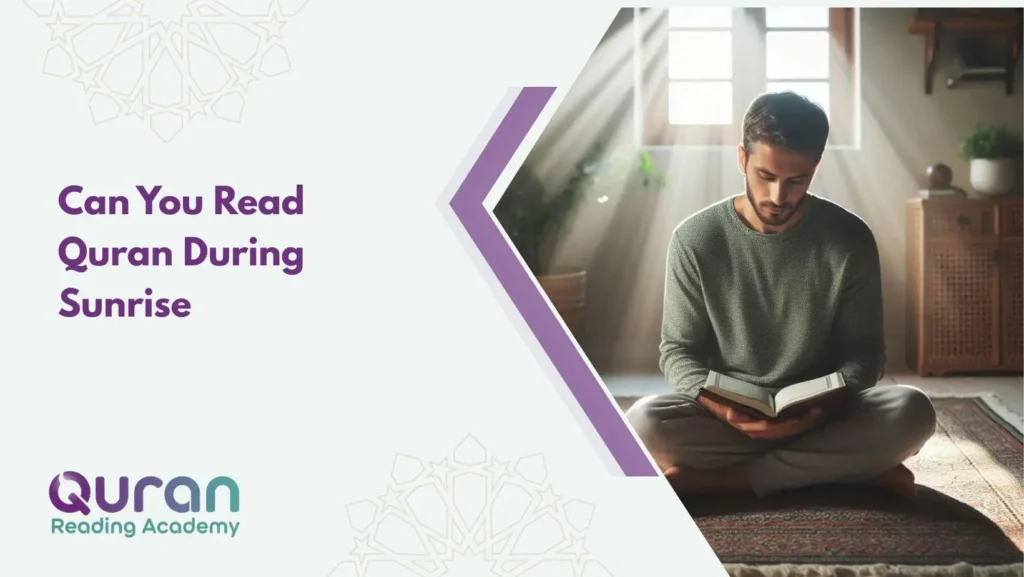
Many Muslims carry an honest but mistaken worry: they finish Fajr prayer, open the Mushaf, and then hesitate — is this allowed while the sun is rising?
This confusion is understandable, especially for non-Arabic speakers who have heard about forbidden times for prayer but never received a clear, detailed explanation of what exactly those restrictions cover.
Can You Read Quran During Sunrise Without Any Restriction?
Yes, you can read the Quran during sunrise, reading Quran during sunrise carries no restriction whatsoever according to Islamic scholarship.
The three times when certain acts are discouraged — sunrise, solar noon, and sunset — relate specifically to voluntary prayer, not to recitation of the Quran. Quran reading is a form of dhikr (remembrance of Allah), and dhikr is permitted and encouraged at all times without exception.
This is a point where many sincere students at The Quran Reading Academy arrive confused — they’ve absorbed a general sense that “sunrise is a forbidden time” and applied it too broadly.
The Islamic ruling is precise: the prohibition targets voluntary prayer during these brief windows because the Prophet ﷺ forbade praying at those specific moments. Quran recitation sits in an entirely different category.
If you’ve enrolled in our Quran Reading Classes for Adults, your certified instructor will confirm this clearly: keep your Mushaf open after Fajr. That morning window is precious, and the ruling supports using every minute of it.
Book your FREE trial class to start reading Quran

What the Prohibition During Sunrise Actually Covers
The prohibited acts during sunrise, solar noon, and sunset are specifically voluntary (nafl) prayers. Scholars from all four major madhabs agree on this. The restriction does not extend to obligatory prayers in most scholarly opinions when there is a valid reason, and it certainly does not extend to recitation.
Reading, memorizing, listening to, and studying the Quran remain fully permissible during these times. So does making du’a, performing dhikr, or engaging in Islamic study.
Shots Videos from Our Courses
Start Your Quran Learning Journey Today
Join Quran Reading Academy and begin structured, step-by-step Quran reading with expert guidance.
Try your first class for freeWhy This Confusion About Read Quran During Sunrise Is Common Among Beginners?
In our experience teaching hundreds of non-Arabic speaking students, this misconception spreads because the phrase “forbidden times” gets passed down informally without context.
Someone hears that praying at sunrise is forbidden, repeats it as “doing Islamic acts at sunrise is forbidden,” and the misunderstanding travels.
This is exactly the kind of precision that structured Quran education provides. Our Quran Reading Course for Beginners addresses not just how to read, but the foundational knowledge surrounding proper recitation practice.
Enroll in Our Quran Reading Course for Beginners with a Free Trial
When Is the Best Time to Read Quran Each Day?
The best time to read Quran is whichever part of your day brings the most stillness, focus, and presence of heart. Scholars consistently emphasize that Quran reading is valid and rewarded at any hour — day or night — but the most virtuous time is the one where your khushu’ (humility and focus) is highest and your mind is most free from distraction.
This is not a vague answer — it’s the actual scholarly guidance. The goal is not to chase a specific clock time but to find your personal window of clarity.
1. After Fajr Is Among the Most Praised Times for Recitation
The time after Fajr prayer and before sunrise is praised in Islamic tradition for its spiritual weight. This is a moment of quiet, when the world has not yet filled with noise and the heart is fresh from prayer and sleep. Many scholars and pious predecessors specifically recommended this window for Quran recitation and memorization.
The Quran itself references the recitation of Fajr:
إِنَّ قُرْآنَ ٱلْفَجْرِ كَانَ مَشْهُودًا
Inna qur’ānal-fajri kāna mashhūdā
“Indeed, the recitation of dawn is ever witnessed.” (Al-Isra’ 17:78)
This verse is understood by scholars of Tafsir to indicate that the angels witness the Fajr recitation — a mark of its special status. It is a strong encouragement to read Quran in the early morning, including during and after the sunrise period.
Read Also: Forbidden and Makrooh Times to Read Quran
2. Reading Quran at Night Carries Particular Spiritual Weight
Night recitation — especially in the final third of the night — holds a distinguished place in Islamic spirituality. This is when the soul is most attuned, the environment is silent, and concentration comes more naturally. Many Quran memorization students find their retention is strongest during late-night review sessions.
If your schedule allows any portion of night reading, even ten focused minutes, the quality of that engagement often surpasses a distracted hour during the day.
Read Also: Can You Read Quran After Asr?
Our Students Reviews
Start Your Quran Learning Journey Today
Join Quran Reading Academy and begin structured, step-by-step Quran reading with expert guidance.
Try your first class for freeStart Your Quran Reading Practice with The Quran Reading Academy
Reading Quran at sunrise, after Fajr, or at any hour of your day is fully supported by Islamic scholarship. What matters most now is building the structured practice that turns good intentions into real recitation skill.
The Quran Reading Academy offers:
- Certified Qari instructors with verified Tajweed credentials
- Flexible scheduling across all time zones
- Beginner-friendly programs including the Al-Menhaj Book and Noorani Qaida Course
- Dedicated courses for kids,adults, and new Muslims
- Book your free trial lesson today — no commitment required
Check out our top courses to help you read the Quran with confidence:
- Quran Reading Course With Tajweed
- Noorani Qaida Course
- Quran Reading Course for Beginners
- Quran Reading Classes for Adults
- Quran Reading Classes for Sisters
- Quran Reading Classes for Kids
- Quran Hifz Course
- Arabic Reading Practice Course
- Quranic Arabic Course
Book your free class today—it’s the perfect start to learning the Quran

Conclusion
The question of whether you can read Quran during sunrise has a clear, confident answer rooted in over a millennium of Islamic scholarship: yes, fully and without hesitation. The prohibition during sunrise applies to voluntary prayer — a precise, limited ruling that has no bearing on recitation, dhikr, or study.
What this ruling ultimately invites is something more valuable than a simple yes or no — it invites you to stop waiting for the “right” moment and start reading. Your Mushaf is open to you at every hour Allah has given you.
Use the time that brings your heart the most presence, build your practice around consistency, and trust that every letter recited with sincerity carries its reward — sunrise or otherwise.
Start Your Quran Learning Journey Today
Join Quran Reading Academy and begin structured, step-by-step Quran reading with expert guidance.
Try your first class for freeRead Also: Reading Quran While Traveling
Frequently Asked Questions About Reading Quran During Sunrise
Can I read Quran while the sun is rising without it being disliked?
Yes, reading Quran while the sun is rising is neither forbidden nor disliked (makruh) in Islamic scholarship. The restriction during sunrise applies exclusively to voluntary prayers. Quran recitation is a form of dhikr and remains fully permitted and rewarded throughout the sunrise period without any scholarly disagreement.
Is there any time in the day when Quran reading is actually forbidden?
No. time is forbidden for Quran reading. Scholars unanimously permit recitation at all hours — day and night. The prohibited times for voluntary prayer (sunrise, solar noon, sunset) do not extend to Quran reading, dhikr, or Islamic study. A Muslim may open the Mushaf at any moment.
Does reading Quran without wudu at sunrise affect its permissibility?
Reading Quran from memory or listening to recitation does not require wudu according to many scholars. Touching the physical Mushaf while in a state of minor impurity is a matter of scholarly difference, with many scholars permitting it for the purpose of learning. The sunrise timing has no additional impact on this ruling.
How do I know how to read quran properly if I am a complete beginner?
Start with foundational letter recognition before attempting full recitation. Resources like the Al-Menhaj Book and structured programs like our Quran Reading Course for Beginners are designed specifically for non-Arabic speakers with no prior reading ability. Working with a certified instructor accelerates progress significantly compared to self-study alone. Explore our how to read the Quran guide for a complete overview.
Related Articles
Times for Reading







Leave a Reply