 How to read Quran
Learning Quran reading with Tajweed in Juz 30 is the most practical starting point for any Muslim who wants to recite correctly. Juz 30 — known as Juz Amma — contains 37 short surahs from Surah An-Naba to Surah An-Nas, and it concentrates nearly every foundational Tajweed rule in verses short enough to drill, repeat, and master within a realistic timeframe.
If you want to know how to learn Quran reading with Tajweed Juz 30 correctly, the answer begins not with named rules but with a fixed skill sequence that every qualified teacher follows. The following eight steps take you from your first Arabic letter to your first correctly recited surah — with every rule applied, every error caught, and every surah built on a solid foundation.
Step 1. Build Arabic Letter Reading Fluency as Your Non-Negotiable Base
Before a single named Tajweed rule is introduced, you must read Arabic script without hesitation. Students who attempt Tajweed while still decoding letters cannot simultaneously monitor pronunciation quality — the cognitive load is too high and both skills suffer as a result.
Reading Readiness Criteria Before Tajweed Instruction Begins
You are ready for formal Tajweed when you can identify all 28 Arabic letters in isolated and connected forms, read short voweled words without pausing, and recognize the six core diacritical markers: fathah, kasrah, dammah, tanwin, shaddah, and sukoon.
Noorani Qaida as the Structured Path to Letter Fluency
The Noorani Qaida is the standard primer used across the Muslim world for exactly this stage. It introduces letters in order, then in combinations, then with diacritical marks, before the student ever touches continuous Quranic text. Students who complete this foundation progress through Tajweed rules significantly faster than those who attempt both skills at once.
Quran Reading Academy’s Noorani Qaida Course builds letter recognition and basic sound production simultaneously, creating the reading fluency that every Tajweed step that follows depends on.
Start your free lesson today and let an expert assess exactly where you stand
Step 2. Master Makharij Before Memorizing Any Named Tajweed Rule
Makharij al-Huruf — the articulation points of Arabic letters — is where genuine Tajweed instruction begins. Classical scholars identify 17 specific points grouped across five vocal regions. Non-Arabic speakers consistently conflate letters that sound similar in English but come from entirely different physical positions in Arabic.
Five Articulation Regions and Their Key Letters
| Region | Arabic Term | Key Letters |
| Empty air cavity | Al-Jawf | Long vowels: ا، و، ي |
| Throat | Al-Halq | ء، ه، ع، ح، غ، خ |
| Tongue | Al-Lisan | ق، ك، ج، ض، ل، ن، ر، ط، د، ت، ص، ز، س |
| Lips | Al-Shafatan | ف، و، ب، م |
| Nasal passage | Al-Khayshum | Ghunnah (nasal resonance) |
Three Makhraj Errors Most Common in Juz 30 Recitation
Three letter confusions appear most frequently in beginner recitations of Juz 30. First: producing ق as a standard “k” from the front of the mouth instead of its deep uvular position. Second: confusing ح with ه because both approximate an English “h” sound, despite completely different throat depths. Third: producing ض from the wrong tongue position, which alters every word containing it throughout Juz 30.
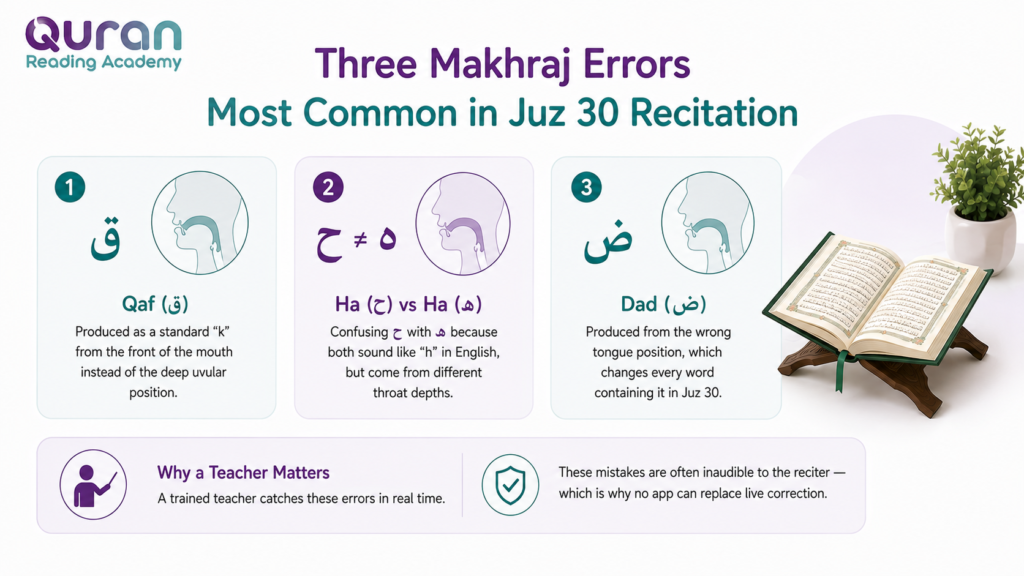
A trained teacher catches these errors in real time. They are often inaudible to the reciter themselves — which is why no app substitutes for live correction at this stage.
Step 3. Learn Sifat al-Huruf for Accurate Juz 30 Recitation
Once you know where each letter originates, you must learn how it sounds. Sifat al-Huruf are the specific qualities that distinguish letters sharing the same articulation point. For example, ت and ط both involve the tongue touching the upper front teeth, yet they are phonetically opposite in weight — and confusing them changes meaning.
Tafkhim and Tarqiq Letter Weight in Juz 30 Verses
Tafkhim (heaviness) and Tarqiq (lightness) are the most impactful Sifat qualities for recitation accuracy. Seven letters are always heavy: خ، ص، ض، غ، ط، ق، ظ. They are pronounced with the back of the tongue raised toward the palate, producing a full, rounded acoustic quality.
All other letters carry Tarqiq — a light, forward sound — and should never take on that heavy quality. Juz 30 contains dozens of these distinctions per page, making it ideal for drilling heavy and light letters in authentic Quranic context.
Qalqalah Bounce Sound Across Juz 30 Surahs
Qalqalah is a bouncing echo sound applied to five letters — ق، ط، ب، ج، د — when they carry a Sukoon. Surah Al-Ikhlas contains ق twice with Sukoon. Surah Al-Masad contains ب with Sukoon. Surah At-Tariq takes its very name from a Qalqalah letter. Juz 30 is filled with Qalqalah opportunities ideal for drilling this quality immediately in real Quranic context.
See Our Academy in Action
Discover what a typical session looks like! Watch these brief highlights from our live, interactive classes to see how our instructors engage with students of all ages.
Start Your Quran Learning Journey Today
Join Quran Reading Academy and begin structured, step-by-step Quran reading with expert guidance.
Try your first class for freeStep 4. Apply Four Noon Sakinah Rules Across Juz 30 Verses
The rules of Noon Sakinah (نْ) and Tanween (ـً ـٍ ـٌ) are the most frequently encountered Tajweed rules in the Quran, and Juz 30 alone contains hundreds of examples. Each rule is triggered by a different letter or letter group that follows the Noon Sakinah or Tanween:
- Izhar Halqi — clear pronunciation with no nasal hum, occurring before the six throat letters ء، ه، ع، ح، غ، خ.
- Idgham — merging of the Noon into the following letter, applying to the six Yarmaloon letters ي، ر، م، ل، و، ن with or without Ghunnah.
- Iqlab — conversion of the Noon into a light Meem with two-count Ghunnah, occurring only before ب.
- Ikhfa Haqiqi — concealment with two-count Ghunnah before the remaining 15 letters, the most frequently occurring rule across all of Juz 30.
Quran Reading Academy’s Quran Tajweed Course trains students through live application of all four rules in actual Juz 30 surahs — not isolated drills — so the rules become instinctive through real recitation rather than memorized definitions.

Enroll in the Quran Tajweed Course and apply every rule correctly from your first session
Step 5. Learn Madd Elongation Rules to Achieve Correct Tarteel Rhythm
Madd — vowel elongation — is what separates flat, mechanical reading from correct Tarteel recitation. Allah commands in Surah Al-Muzzammil:
وَرَتِّلِ الْقُرْآنَ تَرْتِيلًا
(Wa rattili l-Qur’āna tartīlā)
Ignoring Madd is the single most common reason beginner recitation sounds flat — and Juz 30 contains every major Madd type in short, accessible verses. The four primary Madd types every Juz 30 reader must know:
- Madd Asli — two counts, applied to every long vowel throughout all 37 surahs of Juz 30.
- Madd Muttasil — four or five counts, obligatory when a long vowel and Hamzah appear together in the same word.
- Madd Munfasil — four counts, occurring when a long vowel ends one word and Hamzah begins the next.
- Madd Lazim — six full counts, compulsory with no reduction permitted under any recitation circumstance.
Step 6. Apply Meem Sakinah Rules in Juz 30 Short Surahs
Meem Sakinah (مْ) has its own three-rule system that operates independently from Noon Sakinah rules. Many beginners assume Meem follows the same pattern — it does not, and confusing the two produces consistent errors throughout Juz 30 recitation.
Idgham Shafawi and Ikhfa Shafawi Rule Application
Idgham Shafawi occurs when Meem Sakinah is followed by another Meem — the two merge into one extended Meem with a two-count nasal hum. Ikhfa Shafawi occurs only before ب — the Meem is hidden with a light two-count Ghunnah while the lips prepare for the ب without fully closing. This is the most commonly mispronounced of the three Meem rules.
Izhar Shafawi Clear Pronunciation Rule
Izhar Shafawi applies when Meem Sakinah is followed by any letter other than Meem or Ba. The Meem is pronounced clearly with no nasal hum whatsoever. Despite being the “clear” rule, many learners incorrectly add Ghunnah here — a habit a qualified teacher eliminates in the first corrected session.
Step 7. Build a Daily Routine for Real Juz 30 Tajweed Fluency
Tajweed fluency is built through regularity, not intensity. Students who practice 20 minutes daily consistently outperform students who practice 90 minutes once or twice a week — in rule retention, naturalness of recitation, and long-term accuracy. A balanced 30-minute daily session covers three distinct zones:
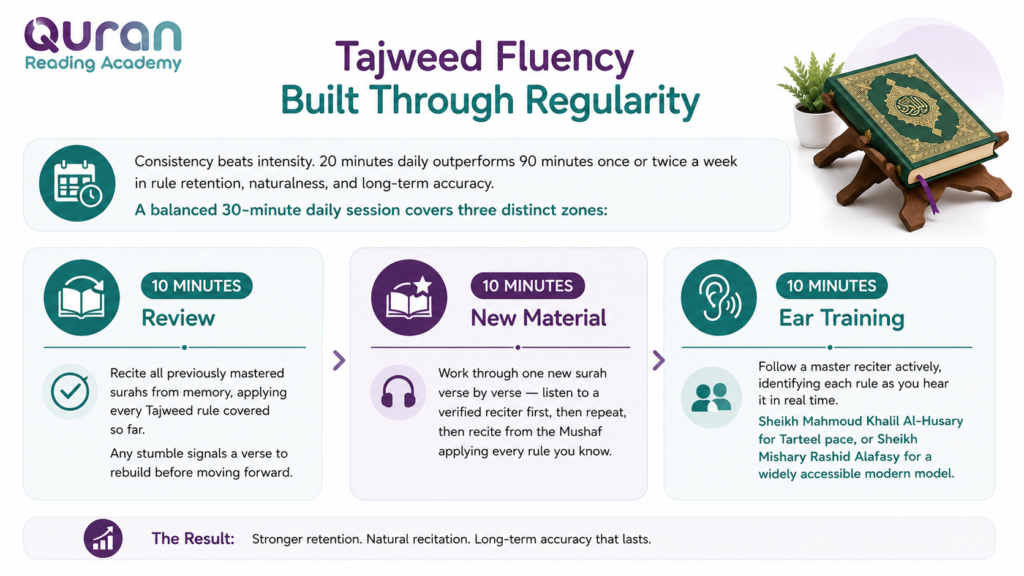
- 10 minutes — Review: Recite all previously mastered surahs from memory, applying every Tajweed rule covered so far. Any stumble signals a verse to rebuild before moving forward.
- 10 minutes — New material: Work through one new surah verse by verse — listen to a verified reciter first, then repeat, then recite from the Mushaf applying every rule you know.
- 10 minutes — Ear training: Follow a master reciter actively, identifying each rule as you hear it in real time. Sheikh Mahmoud Khalil Al-Husary for Tarteel pace, or Sheikh Mishary Rashid Alafasy for a widely accessible modern model.
One Decision That Determines Long-Term Retention
Never add a new surah until every previously learned surah can be recited with all applicable Tajweed rules correctly applied. Moving forward on shaky foundations is the primary reason learners finish Juz 30 and cannot recite it months later. Consolidation is not optional — it is the method.
Quran Reading Academy’s Online Quran Reading Course with Tajweed follows exactly this progression — building each surah correctly before advancing — with certified instructors providing real-time correction in every session.
Read Also: How to Learn Noorani Qaida Online Step by Step

Join the Online Quran Reading Course with Tajweed and recite Juz 30 with full precision
Read Also: How to Concentrate While Reading Quran
Step 8. Work with a Qualified Teacher for Real-Time Correction
No Tajweed textbook, app, or audio course replaces the trained human ear. Makhraj errors are often completely inaudible to the reciter themselves and are only detectable by a trained instructor listening in real time. This is why Tajweed has always been an oral tradition transmitted from teacher to student through verified chains.
Read Also: How to Start Reading Quran Daily in 7 Proven Steps
Three Error Categories Only a Teacher Catches
Three categories of errors consistently escape self-study detection. First: subtle Makhraj displacement — producing a letter one region away from its correct point — which changes the letter’s identity without sounding obviously wrong to the untrained ear. Second: incorrect Tafkhim and Tarqiq application in specific word contexts. Third: inconsistent Madd counts that drift slightly across a session without the learner noticing.
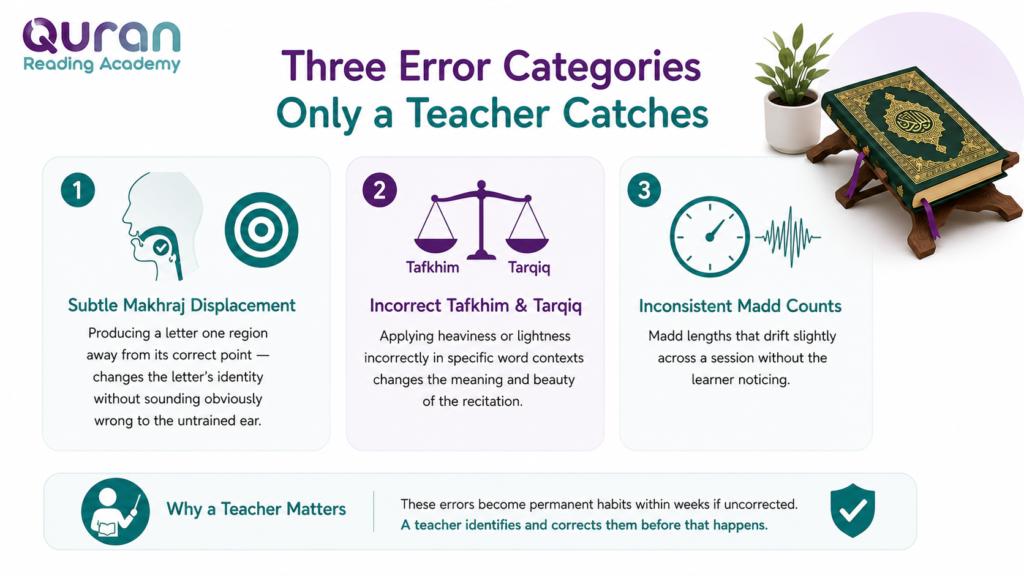
Each of these errors solidifies into permanent habit within weeks if left uncorrected. A teacher identifies and eliminates them before that happens.
Read Also: How to Learn to Read Quran Online for Kids Step by Step
Criteria for Choosing a Qualified Tajweed Teacher
Three criteria determine genuine qualification. The teacher must hold Ijazah — a verified chain of transmission connecting their recitation to the Prophet ﷺ through authenticated teachers. The teacher must have demonstrable experience teaching non-native Arabic speakers specifically. And the teacher must conduct real-time correction in every session, not simply model recitation for the student to imitate passively.
Inside Our Live Classroom
We believe in complete transparency. Take a look inside our virtual classrooms to experience our premium teaching tools and engaging learning environment firsthand.
Start Your Quran Learning Journey Today
Join Quran Reading Academy and begin structured, step-by-step Quran reading with expert guidance.
Try your first class for freeBook Your Free Trial Session at Quran Reading Academy
You have the sequence. You have the structure. The only remaining step is sitting with a qualified teacher who can hear your recitation, identify your specific errors, and give you a precise correction plan from session one.
Quran Reading Academy connects students with certified instructors for one-on-one online sessions built around your level, your schedule, and your goals. Whether you are just starting to learn Quran reading with Tajweed Juz 30 or refining an existing foundation, the first session is completely free — no commitment required.
Our Quran Courses
- Quran Reading Classes
- Quran Reading Classes for Kids
- Quran Reading Classes for Adults
- Quran Reading Classes for Female/Sisters
- Quran Reading Classes for New Muslims
- Quran Reading Course for Beginners
- Online Quran Reading Course with Tajweed
- Reading and Memorizing the Quran Course
- Noorani Qaida Course
- Quran Course for Beginners
- Quran Tajweed Course
- Quran Recitation Course
- Quran Hifz Course
- Online Quran Qirat Classes
- Quranic Arabic Course
- Arabic Reading Practice Course
Book your free trial session now and start reciting Juz 30 the way it was meant to be recited
Conclusion
To learn Quran reading with Tajweed Juz 30 correctly, the path follows a fixed sequence that cannot be shortcut: reading fluency first, then articulation points, then letter qualities, then combination rules applied in actual surahs. Each layer depends entirely on the one before it.
Juz 30 is where that sequence produces results fastest. Its short, rhythmic surahs place every foundational rule within reach immediately, and its surahs are the ones you already recite in every prayer. Correcting them is not merely a study achievement — it is an act of worship with every letter. Work through these eight steps consistently, pair them with a qualified teacher, and the recitation you want begins with the surah you open tonight.
Frequently Asked Questions
Why Juz 30 Is the Most Efficient Place to Learn Quran Reading with Tajweed?
Juz 30 is not just the shortest section of the Quran — it is the most densely practical training ground for anyone beginning their Tajweed journey. Its 37 surahs are short, rhythmically structured, and contain concentrated examples of every foundational rule a beginner must master.
Surah An-Naba has 40 verses. Most surahs in the second half drop below 20 verses. The final 10 surahs each contain fewer than 10 verses. This progressive shortness allows you to apply each new rule immediately in real Quranic context, without facing long passages before your pronunciation is solid.
The surahs most Muslims recite daily — Al-Ikhlas, Al-Falaq, An-Nas, Al-Kawthar, Al-Asr — are all from Juz 30. Every rule you correct in study immediately improves your Salah. That direct feedback loop between learning and worship keeps motivation high. The following eight steps show you exactly how to learn Quran reading with Tajweed Juz 30, from your first letter to your first correctly recited surah.
How long does it take to learn Quran reading with Tajweed in Juz 30?
A committed adult studying 20 to 30 minutes daily with a qualified teacher typically reads all of Juz 30 with correct foundational Tajweed within four to six months. Children with consistent structured sessions often reach basic recitation fluency in three to four months. The determining factor is daily consistency and qualified correction from the start.
Can a complete beginner start directly with Juz 30 Tajweed recitation?
Yes, provided the beginner first completes basic Arabic letter recognition through the Noorani Qaida. Attempting to learn Quran reading with Tajweed Juz 30 before reading Arabic fluently creates a cognitive load that slows both skills simultaneously. One to two months on the Noorani Qaida makes every subsequent step significantly faster.
What is the correct order to learn Tajweed rules for Juz 30?
Begin with Makharij al-Huruf, then Sifat al-Huruf including Tafkhim and Qalqalah, then Noon Sakinah and Tanween rules, then Meem Sakinah rules, then Madd elongations. This sequence matches how rules build on each other — later rules are impossible to apply correctly without the earlier ones firmly in place.
Is it possible to learn Juz 30 Tajweed without a live teacher?
Theory can be studied independently, but correct application cannot be verified without a qualified teacher. Makhraj displacement and incorrect Tafkhim are frequently inaudible to the learner and are only reliably caught by a trained instructor in real time. Self-study combined with even one free trial lesson provides a quality checkpoint that transforms independent practice accuracy.
Why do most beginners sound flat when reciting Juz 30 surahs?
Flat-sounding recitation is almost always caused by ignoring Madd elongation. When long vowels are not stretched to their required count, the rhythmic character of the verse collapses entirely. Proper Madd application is the single most impactful correction a beginner can make — it transforms recitation quality within a single focused session.
How many surahs should a beginner target per week in Juz 30?
One short surah every two to three days is a sustainable pace for most adult beginners working 20 to 30 minutes daily. The critical principle is never to add a new surah until all previous surahs can be recited correctly with full Tajweed applied. Moving forward on an unsteady foundation is how learners finish Juz 30 and cannot recite it three months later.
Related Articles
How to read Quran








Leave a Reply