 How to read Quran
For many adults, Arabic script can make learning the Quran feel difficult, especially after years without structured study. However, learning to read Quran for adults is achievable with the right sequence of steps. Adults bring focus, motivation, and strong intention to the process. What matters most is following a structured path from the foundations toward confident Quran reading.
1. Arabic Letters Are the True Starting Point for Adults
No adult can begin learning to read Quran for adults without first confronting the Arabic alphabet directly. The Quran is written in classical Arabic, and every letter carries a unique sound that does not exist in English. Skipping this stage produces a learner who guesses rather than reads.
The Arabic alphabet contains 28 letters. Each letter changes its shape depending on its position in a word:
| Position | Shape Behavior |
| Beginning of word | Letter takes its initial form |
| Middle of word | Letter takes its medial form |
| End of word | Letter takes its final form |
| Standalone | Letter takes its isolated form |
Beyond shape, every letter has a specific articulation point called Makhraj, which determines exactly where in the mouth or throat the sound originates. Mastering both shape and sound at this stage prevents errors that compound over time.
Struggling with Arabic letters as an adult is the most common reason people give up before they start. The Quran Reading Academy’s Quran Reading Classes for Adults guides you through every letter with certified tutors who specialize in teaching adults from zero.
Start your journey with the right support today.
2. Noorani Qaida Builds the Bridge Between Letters and Words
Once the 28 letters are familiar, the next challenge is connecting them into readable units. This is where most adults stall without structured guidance. The Noorani Qaida is a purpose-built methodology that solves this problem through a carefully sequenced progression.
The Noorani Qaida teaches the following in order:
- Short vowels (Harakat): Fatha, Kasra, and Damma and how each changes a letter’s sound.
- Tanwin: Double vowel sounds that appear at the end of words.
- Sukoon: The marker indicating a vowel-less letter requiring a hard stop.
- Shaddah: The doubling marker that requires a letter to be held and emphasized.
- Letter connection rules: How letters join and which ones never connect to the letter following them.
Working through the Noorani Qaida under a qualified teacher ensures that each unit is mastered before the next is introduced. Adults who complete this stage can read any Arabic word they encounter, not just memorized ones.
See Our Academy in Action
Discover what a typical session looks like! Watch these brief highlights from our live, interactive classes to see how our instructors engage with students of all ages.
Start Your Quran Learning Journey Today
Join Quran Reading Academy and begin structured, step-by-step Quran reading with expert guidance.
Try your first class for free3. Makharij Mastery Determines Whether Your Reading Is Correct
Reading Arabic letters by shape alone is insufficient for Quranic recitation. Every letter must be produced from its correct anatomical point of origin, known as its Makhraj. Producing a letter from the wrong point changes its sound entirely and can alter the meaning of a verse.
The articulation points are distributed across the following regions:
| Region | Letters Produced There |
| Throat (Halq) | Hamza, Ha, Ain, Ghain, Kha, Kha |
| Tongue (Lisan) | The majority of Arabic letters |
| Lips (Shafatan) | Ba, Mim, Waw, Fa |
| Nasal cavity (Khayshoom) | Ghunna sounds in Mim and Nun |
An adult learning to read Quran for adults must practice each letter in isolation before moving to connected reading. A qualified teacher corrects Makharij errors in real time, which self-study tools cannot replicate.
4. Tajweed Rules Protect the Meaning of Every Verse You Read
Tajweed is the science governing how Quranic letters and words are pronounced during recitation. It is not an advanced topic reserved for scholars. Basic Tajweed rules must be introduced early in the learning process because bad habits formed without them are extremely difficult to unlearn.
The foundational Tajweed rules every adult learner must know are:
- Noon Sakinah and Tanwin rules: Izhar, Idgham, Iqlab, and Ikhfa each governs what happens when a vowel-less Noon meets different letters.
- Meem Sakinah rules: Ikhfa Shafawi and Idgham Shafawi govern how a vowel-less Meem behaves before specific letters.
- Madd (elongation): Rules determining how long a vowel sound is held, measured in counts called Harakat.
- Qalqalah: The echoing bounce produced on five specific letters when they carry a Sukoon.
- Waqf rules: The correct positions to pause and stop within a verse without distorting meaning.
Adults who learn these rules alongside their reading progress far more efficiently than those who try to add them later.
Many adults reach this stage and feel overwhelmed trying to apply Tajweed rules alone. The Quran Reading Academy’s Quran Tajweed Course delivers every rule through live one-on-one sessions with Ijazah-certified tutors who correct your recitation in real time.
Enroll and fix your Tajweed today.
5. A Qualified Teacher Accelerates Adult Progress Significantly
Self-study resources such as apps and YouTube videos provide exposure but cannot replace structured correction. An adult learning to read Quran for adults needs a teacher who identifies specific errors and corrects them before they become permanent habits.
A qualified Quran teacher provides the following that no app can replicate:
- Real-time Makharij correction during live recitation.
- Personalized feedback on individual error patterns unique to each student.
- Structured lesson progression paced to the adult learner’s specific speed.
- Accountability that keeps weekly sessions consistent and goal-oriented.
- Spiritual guidance that connects the technical reading to its deeper purpose.
When selecting a teacher, adults should verify Tajweed certification, Ijazah in recitation, and demonstrated experience specifically with adult students. A trial session before committing to a program is always advisable.
6. Daily Practice Consistency Matters More Than Session Length
One of the most common mistakes adults make is attempting long study sessions infrequently. The brain consolidates new language skills through repetition distributed across time, not through volume in a single sitting. For learning to read Quran for adults, consistency is the most important variable.
A practical daily practice structure for adult learners:
- Minutes 1 to 5: Review letters or rules covered in the previous session.
- Minutes 6 to 15: Practice new reading material introduced by the teacher.
- Minutes 16 to 20: Listen to a qualified reciter reading the same passage and compare.
Even 20 focused minutes daily produces measurable improvement within weeks. Adults who practice this way consistently report reaching independent surah reading within a few months of starting from zero.
7. Short Surahs Build Reading Fluency Before Longer Passages
After establishing letter recognition, Makharij accuracy, and basic Tajweed, the next stage is applied reading. Beginning with short Surahs from Juz Amma is the correct approach for adults at this stage. These Surahs are short, frequently heard, and structurally simple.
The recommended progression for early Surah reading:
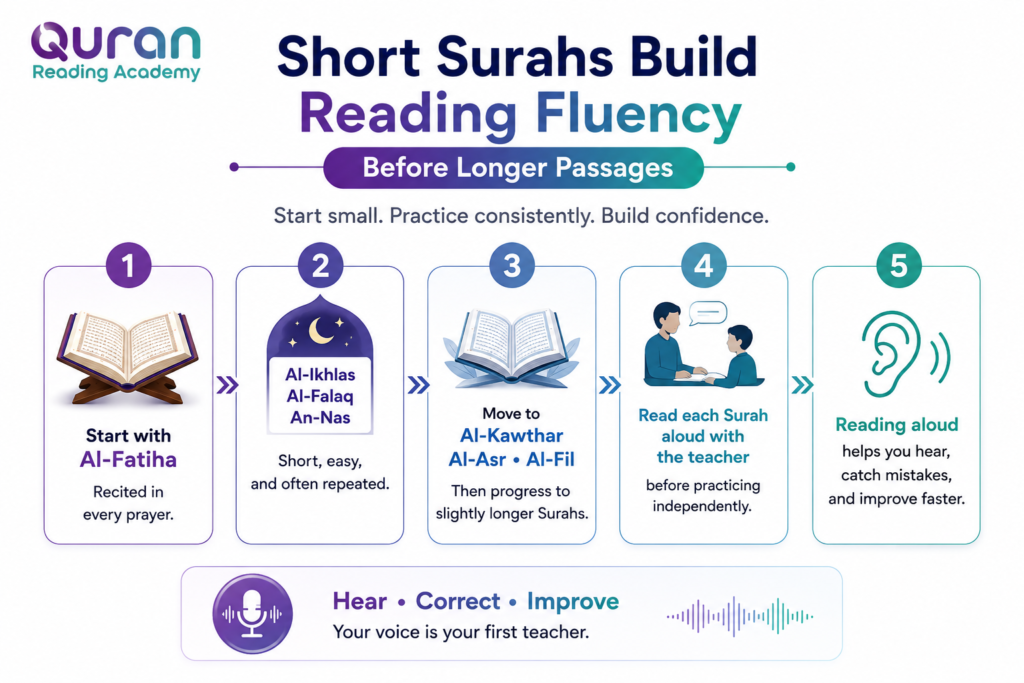
- Start with Surah Al-Fatiha as it is recited in every prayer.
- Move to Surah Al-Ikhlas, Al-Falaq, and An-Nas for their brevity and repetition.
- Progress to slightly longer Surahs such as Al-Kawthar, Al-Asr, and Al-Fil.
- Read each Surah aloud with the teacher before practicing independently.
Reading aloud, even softly, is essential at this stage. It activates hearing as a self-correction mechanism, allowing the learner to catch errors in their own voice rather than waiting for teacher feedback alone.
Read Also: How to Learn Quran Recitation with Tajweed?
8. Tracking Your Progress Keeps Adult Learners Motivated Long-Term
Adult learners carry responsibilities that children do not. Work, family, and daily obligations create genuine pressure that disrupts learning routines. Without a visible record of progress, adults frequently underestimate how far they have come and become discouraged.
Practical tracking methods for adult Quran learners:
- Keep a written log of letters mastered, rules learned, and Surahs completed.
- Record a short recitation each week and compare recordings across months.
- Set one measurable milestone per month, such as completing a new Juz Amma Surah.
- Review monthly written feedback from your teacher to identify specific improvements.
Seeing concrete evidence of progress over time is one of the strongest motivators for adult learners to continue through difficult stages of the journey.
Read Also: How to Learn Quran Reading with Tajweed for Beginners?
Inside Our Live Classroom
We believe in complete transparency. Take a look inside our virtual classrooms to experience our premium teaching tools and engaging learning environment firsthand.
Start Your Quran Learning Journey Today
Join Quran Reading Academy and begin structured, step-by-step Quran reading with expert guidance.
Try your first class for freeStart Your Quran Reading Journey with Expert Guidance
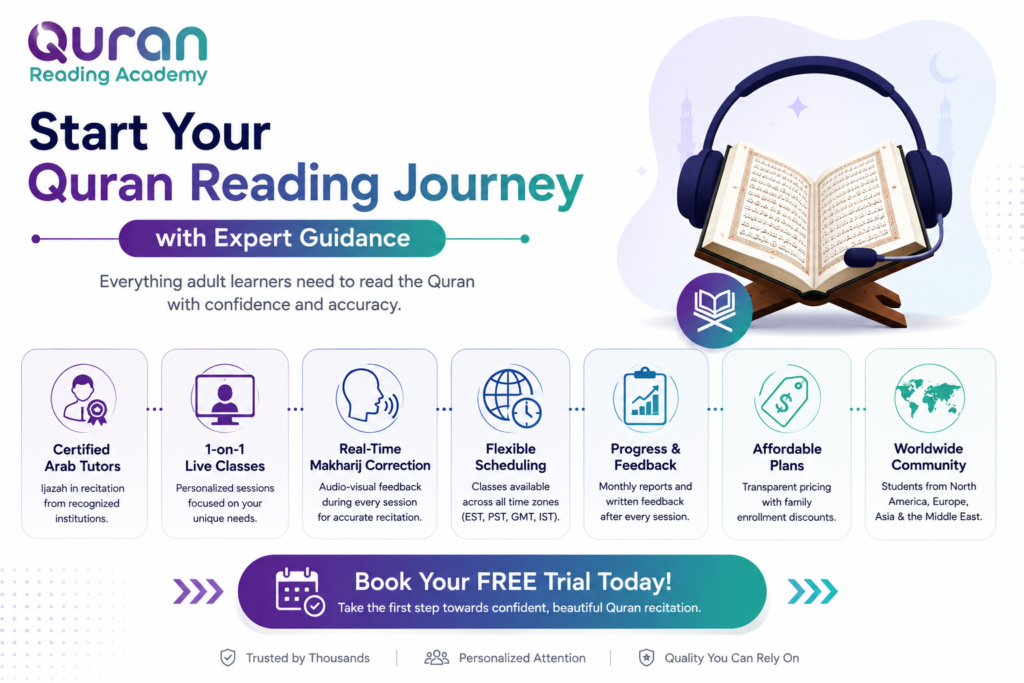
The Quran Reading Academy gives adult learners everything they need to reach confident, accurate recitation:
- Certified Arab tutors holding Ijazah in recitation from recognized institutions.
- One-on-one live sessions tailored specifically to each student’s individual mistakes.
- Real-time Makharij correction using audio-visual feedback during every session.
- Flexible scheduling covering all global time zones including EST, PST, GMT, and IST.
- Monthly progress reports and written feedback provided after every session.
- Affordable pricing with transparent packages and family enrollment discounts.
- Serves students across North America, Europe, Asia, and the Middle East.
Our Quran Courses
- Quran Reading Classes
- Quran Reading Classes for Kids
- Quran Reading Classes for Adults
- Quran Reading Classes for Female/Sisters
- Quran Reading Classes for New Muslims
- Quran Reading Course for Beginners
- Online Quran Reading Course with Tajweed
- Reading and Memorizing the Quran Course
- Noorani Qaida Course
- Quran Course for Beginners
- Quran Tajweed Course
- Quran Recitation Course
- Quran Hifz Course
- Online Quran Qirat Classes
- Quranic Arabic Course
- Arabic Reading Practice Course
Register now and book your free trial today.
Conclusion
Learning to read Quran for adults is not a distant goal reserved for those who started young. It is an achievable reality for any adult who follows the correct sequence: Arabic letters, Noorani Qaida, Makharij, Tajweed fundamentals, a qualified teacher, daily practice, short Surah reading, and consistent progress tracking. Each step builds directly on the one before it. The only requirement is beginning. Register at The Quran Reading Academy and take your first lesson today.
Frequently Asked Questions
Can adults really learn to read Quran from scratch?
Yes. Thousands of adults worldwide have reached confident recitation starting from zero with structured guidance and consistent daily practice.
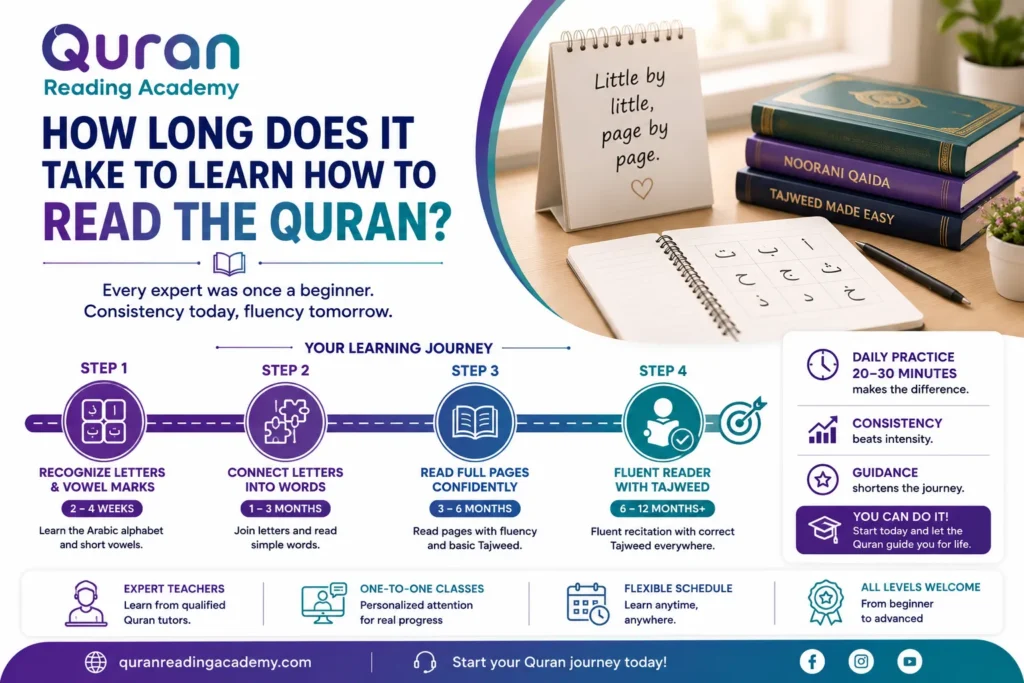
How long does it take an adult to learn Quran reading?
Most adults reach basic reading fluency within three to six months of consistent daily practice under a qualified teacher.
Is prior Arabic knowledge required to start?
No prior Arabic knowledge is needed. Adults begin with the Noorani Qaida, which teaches everything from the first letter.
What is the best method for learning to read Quran for adults?
The Noorani Qaida methodology combined with one-on-one sessions with a certified teacher is the most effective proven method.
How many minutes per day should an adult practice Quran reading?
Fifteen to twenty focused minutes daily is sufficient. Consistency across days matters more than the length of individual sessions.
Should adults learn Tajweed from the beginning?
Yes. Introducing basic Tajweed rules early prevents mispronunciation habits that are difficult to correct later in the learning process.
Related Articles
How to read Quran




Leave a Reply