 Quran Reading Plans
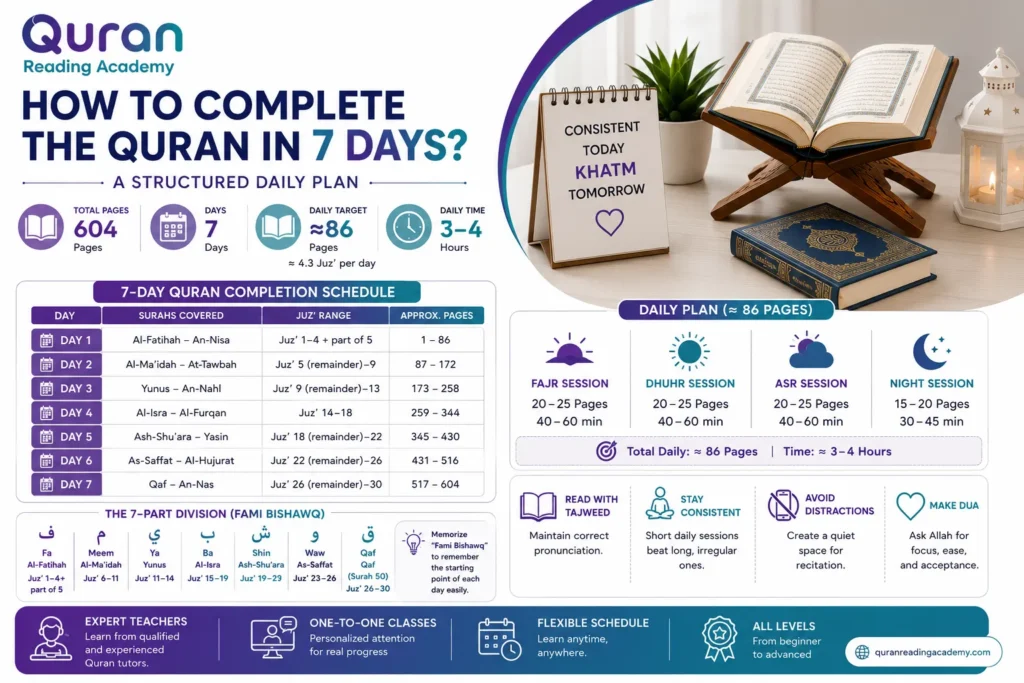
The Quran contains 604 pages across 30 Juz’. If you’re searching for how to complete Quran in 7 days, the short answer is you need to recite approximately 86 pages daily — roughly 4.3 Juz’ per day.
This is not a modern invention. It follows a documented practice from the time of the Prophet Muhammad ﷺ, who instructed a companion to complete the Quran within seven days, a narration recorded in Sahih al-Bukhari 5054.
This guide walks you through exactly how to read Quran in 7 days without losing recitation quality, using a proven daily structure, page targets, and session breakdown built for real students juggling work, family, and prayer times — not idealized free time.
How To Complete the Quran In 7 Days?
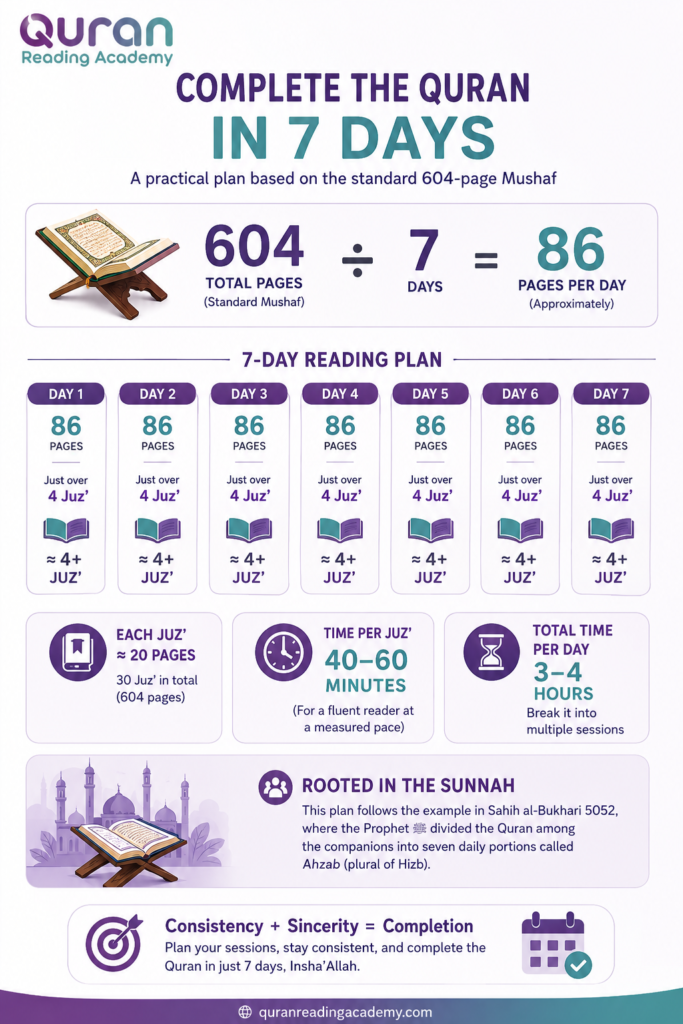
To complete the Quran in 7 days, you must recite about 86 pages daily, based on the standard 604-page Mushaf (604 ÷ 7 = 86.3 pages). This equals just over 4 Juz’ per day.
Each Juz’ contains roughly 20 pages. Covering 30 Juz’ over 7 days means completing slightly more than 4 Juz’ daily. For a fluent reader, one Juz’ takes between 40 and 60 minutes at a measured, correct pace. Across a full day, this plan requires roughly 3 to 4 hours of recitation time, broken into sessions rather than one long sitting.
This is the same reasoning behind the well-known Sahih al-Bukhari 5052 hadith, where the Quran was divided among the early companions into seven daily portions called Ahzab (plural of Hizb).
Read also: How Long Does It Take to Learn How to Read the Quran?
The 7-Day Quran Completion Schedule By Juz’ And Surah
The table below lays out the daily portions using the standard 15-line Mushaf, matching the division followed by early companions such as Ibn Mas’ud, Uthman, and Zaid ibn Thabit.
| Day | Surahs Covered | Juz’ Range | Approx. Pages |
| Day 1 | Al-Fatihah through An-Nisa | Juz’ 1–4 + part of 5 | 1–86 |
| Day 2 | Al-Ma’idah through At-Tawbah | Juz’ 5 (remainder)–9 | 87–172 |
| Day 3 | Yunus through An-Nahl | Juz’ 9 (remainder)–13 | 173–258 |
| Day 4 | Al-Isra through Al-Furqan | Juz’ 14–18 | 259–344 |
| Day 5 | Ash-Shu’ara through Yasin | Juz’ 18 (remainder)–22 | 345–430 |
| Day 6 | As-Saffat through Al-Hujurat | Juz’ 22 (remainder)–26 | 431–516 |
| Day 7 | Qaf through An-Nas | Juz’ 26 (remainder)–30 | 517–604 |
Each day covers approximately 86 pages, though exact page counts can shift slightly depending on the Mushaf edition you use.
Read also: How To Read the Quran In 2 Weeks? A Complete Daily Plan
How Did Classical Scholars Divide The Quran Into Seven Parts?
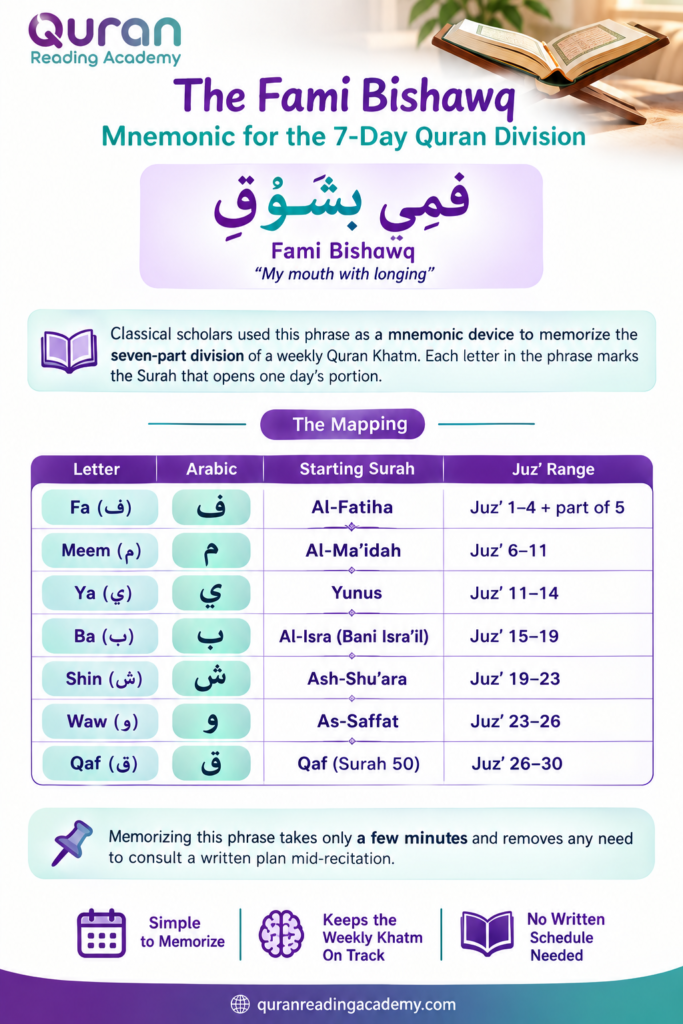
Classical scholars developed a mnemonic device to memorize this seven-part division: the phrase “فَمِي بِشَوْقٍ” (Fami Bishawq), meaning “my mouth with longing.” Each letter in this phrase marks the Surah that opens one day’s portion.
This is not a modern shortcut — it is a transmitted scholarly tool used for generations to make weekly Khatm easier to recall without a written schedule.
| Letter | Arabic | Starting Surah | Juz’ Range |
| Fa (ف) | ف | Al-Fatiha | Juz’ 1–4 + part of 5 |
| Meem (م) | م | Al-Ma’idah | Juz’ 6–11 |
| Ya (ي) | ي | Yunus | Juz’ 11–14 |
| Ba (ب) | ب | Al-Isra (Bani Isra’il) | Juz’ 15–19 |
| Shin (ش) | ش | Ash-Shu’ara | Juz’ 19–23 |
| Waw (و) | و | As-Saffat | Juz’ 23–26 |
| Qaf (ق) | ق | Qaf (Surah 50) | Juz’ 26–30 |
Memorizing this phrase takes only a few minutes and removes any need to consult a written plan mid-recitation.
At Quran Reading Academy, our certified tutors introduce this mnemonic early in weekly Khatm coaching because it shifts a student’s mindset away from counting pages and toward Surah-based orientation — which produces steadier, more consistent daily completion.
If you want to build this kind of structured practice under expert guidance, our Quran Reading Course for Beginners incorporates classical tools like this alongside modern teaching methods.
Read also: How Long Does It Take To Read One Juz Of The Quran?
How Should You Structure Each Day Into Recitation Sessions?
Reciting 86 pages in a single sitting is impractical and increases the risk of losing focus or rushing through Tajweed rules. Splitting the daily target into three or four sessions anchored around the five daily prayers produces far better consistency — and it’s the detail most guides on how to complete Quran in 7 days skip over.
| Session | Suggested Time | Pages | Notes |
| Fajr Session | After Fajr prayer | ~22 pages | Begin with Ta’awwudh and Bismillah; steady pace |
| Morning Session | Mid-morning | ~22 pages | Avoid rushing; maintain measured recitation |
| Asr Session | After Asr prayer | ~22 pages | Review any unclear passages from earlier sessions |
| Isha Session | After Isha prayer | ~20 pages | Complete the day’s target; make Du’a after finishing |
This structure uses the five daily prayers as natural anchors — an approach rooted in how the Salaf organized their own recitation.
In practice, students who split their target into timed sessions rather than one extended sitting are noticeably less likely to fall behind on Days 3 and 4, which tend to be the hardest in any 7-day cycle once the initial motivation has worn off.
Read also: How Long Does It Take to Read 20 Pages of Quran?
See Our Academy in Action
Discover what a typical session looks like! Watch these brief highlights from our live, interactive classes to see how our instructors engage with students of all ages.
Start Your Quran Learning Journey Today
Join Quran Reading Academy and begin structured, step-by-step Quran reading with expert guidance.
Try your first class for freeDay-By-Day Guide To Reading Quran In 7 Days
Each day below breaks down exactly what to recite and what to watch for, so you always know where you stand in the plan.
Day 1 — Al-Fatiha Through An-Nisa (Pages 1–86)
Day 1 covers Al-Fatiha through the beginning of An-Nisa. Start with a sincere intention (Niyyah) and recite Ta’awwudh and Bismillah before beginning. Do not rush through Al-Fatiha — its seven verses carry weight, and reciting them with precision sets the tone for the entire week.
Juz’ 1 and 2 contain Al-Baqarah, the longest Surah in the Quran, which makes Day 1 the heaviest in sheer volume for many students. Pace yourself across your sessions rather than speeding through longer Surahs to compensate. The instruction in the Quran itself is direct on this point:
وَرَتِّلِ الْقُرْآنَ تَرْتِيلًا
“And recite the Qur’an with measured recitation.” (Al-Muzzammil 73:4)
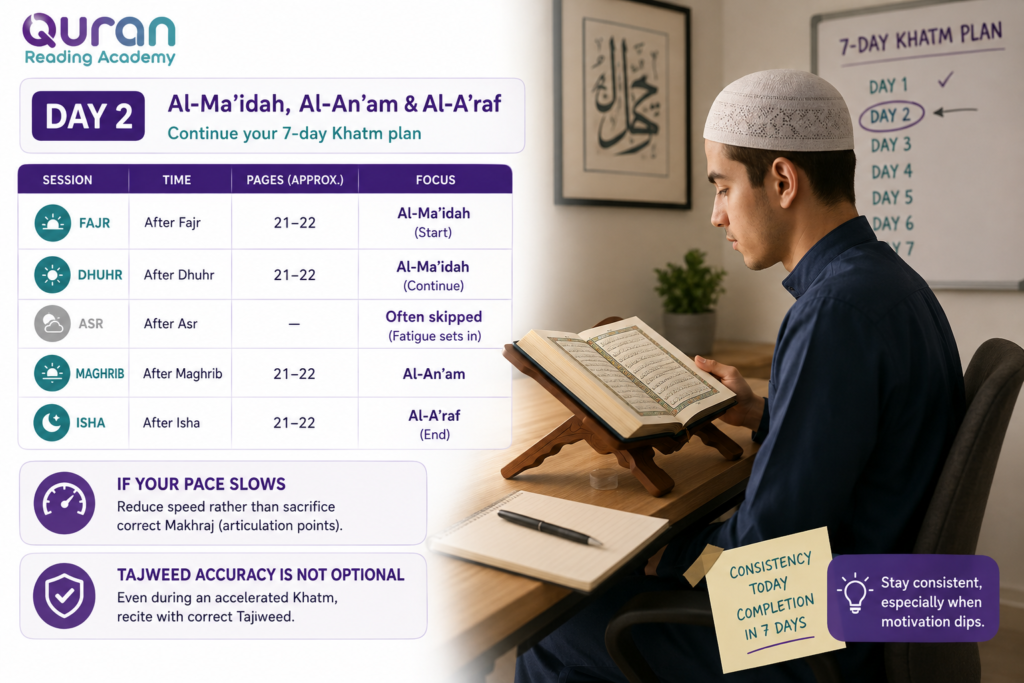
Day 2 — Al-Ma’idah Through At-Tawbah (Pages 87–172)
Day 2 moves through Al-Ma’idah, Al-An’am, and Al-A’raf, which contain dense legal and narrative content. Keep your four-session structure intact — students commonly skip the Asr session on Day 2 due to early fatigue, which is exactly when consistency matters most.
If your pace slows, reduce speed rather than sacrifice correct Makhraj (articulation points). Tajweed accuracy is not optional, even during an accelerated khatm.
Day 3 — Yunus Through An-Nahl (Pages 173–258)
Day 3 covers the remainder of Al-A’raf, Al-Anfal, At-Tawbah, Yunus, Hud, and Yusuf. This is typically the most difficult day psychologically — the initial motivation has faded and the midpoint still feels distant. Students who complete every session on Day 3 without skipping almost always finish the full plan.
Surah Yusuf, found in Juz’ 12, is one of the most narratively rich Surahs in the Quran and can genuinely re-energize a tired reciter. A brief moment of reflection on its meaning after recitation strengthens endurance without meaningfully extending your time.
For students who want to deepen their understanding of the Surahs they recite while working through this schedule, our Quran Reading Classes for Adults build contextual understanding alongside recitation fluency.
Day 4 — Al-Isra Through Al-Furqan (Pages 259–344)
Day 4 brings you past the midpoint, covering Al-Isra, Al-Kahf, Maryam, Ta-Ha, and into Al-Anbiya. Surah Al-Kahf is itself a weekly Sunnah recitation, and many students find renewed energy reading it within this larger commitment.
By Day 4, your reading rhythm should feel established — this is the day to maintain pace, not accelerate it. Pay particular attention to Ghunnah (nasal resonance on Noon and Meem mushaddad) and Madd lengths, since these are typically the first Tajweed rules to slip under time pressure.
Day 5 — Ash-Shu’ara Through Yasin (Pages 345–430)
Day 5 covers Al-Hajj, Al-Mu’minun, An-Nur, Al-Furqan, Ash-Shu’ara, An-Naml, Al-Qasas, and into Ar-Rum. These mid-length Surahs alternate between prophetic narratives, legal guidance, and reflections on creation.
Keep the four-session model intact here. Students who collapse this day into two long sessions typically report fatigue and pronunciation slippage by the fourth hour. Shorter, focused sessions preserve Tarteel (measured recitation) far better than marathon sittings.
Day 6 — As-Saffat Through Al-Hujurat (Pages 431–516)
Day 6 covers Luqman, As-Sajdah, Al-Ahzab, Fatir, Ya-Sin, As-Saffat, Sad, Az-Zumar, and several Surahs through Al-Jathiyah — including Ya-Sin and Az-Zumar, among the most frequently recited chapters in the Quran.
With the end in sight, energy typically rises. Resist the urge to speed up. Completing the Quran is not diminished by an extra 15–20 minutes of careful recitation; it is strengthened by it.
Day 7 — Qaf Through An-Nas (Pages 517–604)
Day 7 concludes with Al-Ahqaf through An-Nas — the final Juz’ containing many of the shorter Surahs most Muslims have already memorized. This familiarity can cause attention to drift, so stay conscious of maintaining full presence through the final pages.
After reciting Surah An-Nas, make sincere Du’a. The moment of completing the Quran (Khatm) is considered one of the more favorable times for supplication in classical Islamic scholarship.
Read also: How Long Does It Take To Read 10 Pages Of The Quran?
Common Mistakes That Derail A 7-Day Khatm
Most students who try to figure out how to complete Quran in 7 days on their own make one of the same three errors. Skipping a session rather than shortening it compounds the workload the next day and creates a snowball effect by Day 4.
Reciting too fast to “catch up” degrades Tajweed accuracy, which defeats the purpose of the khatm itself. And attempting the full 86 pages in one sitting instead of three or four sessions leads to burnout well before the week is over.
A useful decision rule: if you fall behind by more than 15 pages on any single day, redistribute the shortfall across your remaining sessions that same day rather than pushing it entirely into tomorrow’s target.
Read Also: How to Make Reading Quran More Interesting?
Inside Our Live Classroom
We believe in complete transparency. Take a look inside our virtual classrooms to experience our premium teaching tools and engaging learning environment firsthand.
Start Your Quran Learning Journey Today
Join Quran Reading Academy and begin structured, step-by-step Quran reading with expert guidance.
Try your first class for freeStart Your 7-Day Khatm Journey With Quran Reading Academy Today
Reciting the entire Quran in a week is one of the most rewarding acts of worship you can commit to — but doing it correctly requires structure, not just motivation.
Quran Reading Academy’s certified tutors guide you through every session, correct your Tajweed in real time, and keep you accountable through all seven days.

Our Quran Courses:
- Quran Reading Classes
- Quran Reading Classes for Kids
- Quran Reading Classes for Adults
- Quran Reading Classes for Female/Sisters
- Quran Reading Classes for New Muslims
- Quran Reading Course for Beginners
- Online Quran Reading Course with Tajweed
- Reading and Memorizing the Quran Course
- Noorani Qaida Course
- Quran Course for Beginners
- Quran Tajweed Course
- Quran Recitation Course
- Quran Hifz Course
- Online Quran Qirat Classes
- Quranic Arabic Course
- Arabic Reading Practice Course

Start Your Quran Learning Journey Today
Join Quran Reading Academy and begin structured, step-by-step Quran reading with expert guidance.
Try your first class for freeConclusion
Learning how to complete Quran in 7 days comes down to a clear daily target of roughly 86 pages, split across three or four sessions anchored to your prayer times. This is not a rushed shortcut — it is a practice rooted in the Sunnah and followed by companions of the Prophet ﷺ for generations.
The students who succeed are the ones who protect their sessions, maintain Tajweed accuracy over speed, and use tools like the Fami Bishawq mnemonic to stay oriented without a written plan in hand.
Whether you attempt this khatm independently or with structured support, the goal remains the same: to complete the Quran in 7 days with the reflection and precision the recitation deserves. Quran Reading Academy’s tutors are ready to help you build a sustainable, accurate reading practice — for this khatm and beyond.
Frequently Asked Questions About Completing The Quran In 7 Days
Below are direct answers to the most common questions students ask about how to complete Quran in 7 days.
1. Is it possible to complete the Quran in 7 days as a beginner?
It is difficult but not impossible for a beginner, since the plan assumes reasonably fluent Arabic reading. Beginners typically need more time per page, which can stretch total daily reading time beyond 4 hours. If you are still building fluency, our Quran Reading Course for Beginners helps you develop the reading speed needed before attempting an accelerated khatm.
2. How many hours a day does this schedule require?
Completing the Quran in 7 days typically requires 3 to 4 hours of recitation daily, depending on your pace. Fluent readers average 2–3 minutes per page, while slower readers may need closer to 4–5 hours split across sessions.
3. Can children read Quran in 7 days using this schedule?
This intensive schedule is generally not recommended for children, who benefit more from a gradual, supervised reading pace. Our Quran Reading Classes for Kids build steady reading habits appropriate for a child’s attention span and comprehension level.
4. What if I fall behind on a day during the khatm?
If you fall behind, redistribute the missed pages across your remaining sessions that same day rather than doubling up the next day. Letting a shortfall carry over compounds quickly and is one of the main reasons students abandon the plan by Day 4.
5. Is this schedule suitable for new Muslims?
New Muslims can attempt this schedule once they have developed basic Arabic reading fluency, though many benefit from starting with a slower structured plan first. Our Quran Reading Classes for New Muslims are designed specifically to build that foundation before attempting an accelerated khatm.
6. Does this plan require reading in Arabic only?
Yes, the traditional khatm counts recitation of the Arabic text itself, not translation reading. Reading translations alongside your recitation for understanding is encouraged, but the page count and khatm itself refer to the Arabic Mushaf.
Related Articles
Quran Reading Plans






Leave a Reply