 Fatawa
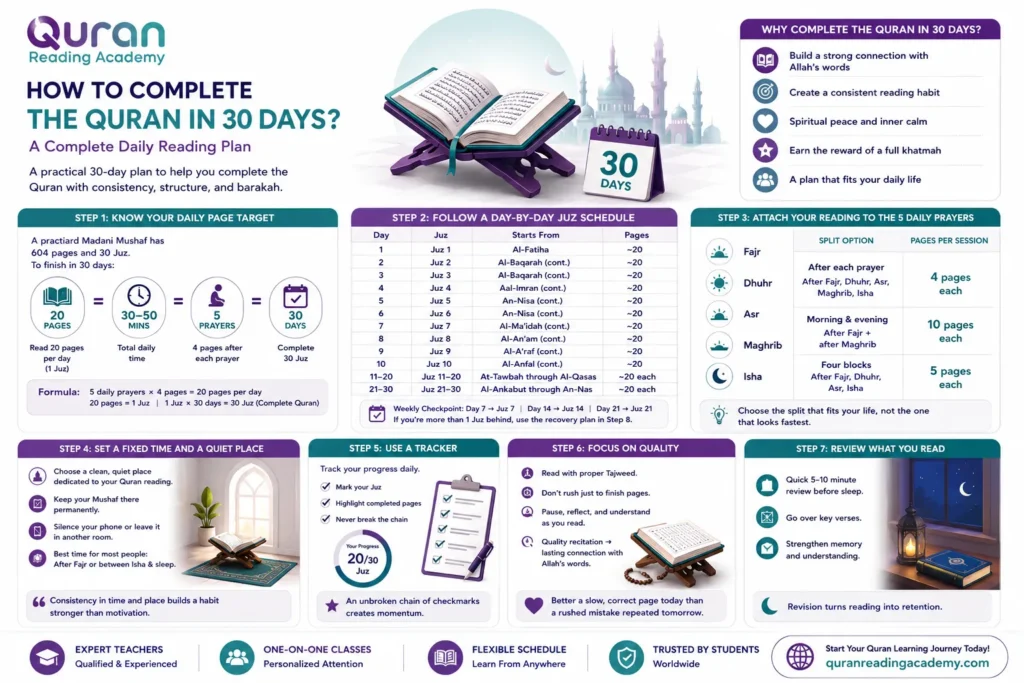
Every Muslim who has tried to read the whole Quran in 30 days knows the feeling: you start strong on day one, read with energy on day two, then somewhere around day five, life takes over and the plan quietly falls apart.
The problem is rarely motivation. It is almost always the lack of a realistic structure. When you know exactly how many pages to read, when to read them, and what to do when you miss a session, finishing the Quran in one month becomes a matter of routine rather than willpower.
If you have been searching for how to complete the Quran in 30 days with a plan that actually works, this guide is built for you.
Every tip here comes from methods used by actual Quran teachers and students who complete a full khatmah (recitation) every single month, whether during Ramadan or any other time of the year.
Step 1: Know Your Daily Page Target
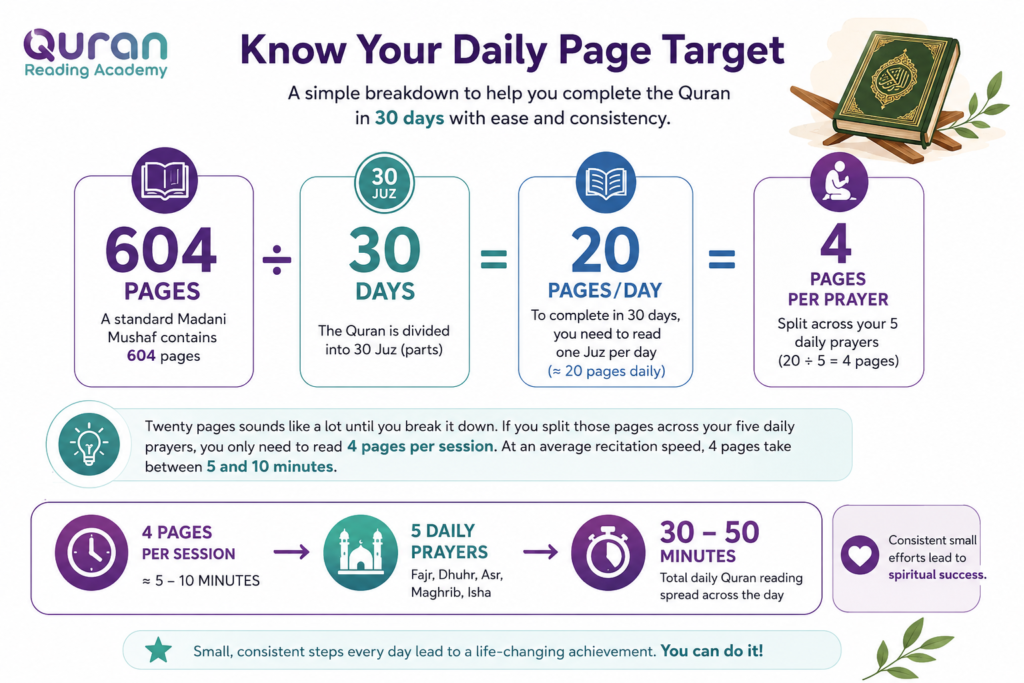
The foundation of how to complete the Quran in 30 days is simple math. A standard Madani Mushaf contains 604 pages divided into 30 Juz (parts). To finish the Quran in one month, you need to complete one Juz per day, which equals approximately 20 pages daily.
Twenty pages sounds like a lot until you break it down. If you split those pages across your five daily prayers, you only need to read 4 pages per session. At an average recitation speed, 4 pages take between 5 and 10 minutes.
That means your total daily Quran reading time is roughly 30 to 50 minutes spread across the entire day, not concentrated in one exhausting sitting.
Here is the simple formula that makes the whole plan work:
5 daily prayers × 4 pages = 20 pages per day 20 pages = 1 Juz 1 Juz × 30 days = 30 Juz (complete Quran)
Read Also: 10 Benefits Of Reading The Quran In Arabic
Step 2: Follow A Day-By-Day Juz Schedule
Print this schedule, pin it next to your prayer area, and check off each day as you finish. Tracking progress visually is one of the strongest motivators because an unbroken chain of checkmarks creates psychological momentum that makes you reluctant to break the streak.
| Day | Juz | Starts From | Pages |
| 1 | Juz 1 | Al-Fatiha | ~20 |
| 2 | Juz 2 | Al-Baqarah (cont.) | ~20 |
| 3 | Juz 3 | Al-Baqarah (cont.) | ~20 |
| 4 | Juz 4 | Aal-Imran (cont.) | ~20 |
| 5 | Juz 5 | An-Nisa (cont.) | ~20 |
| 6 | Juz 6 | An-Nisa (cont.) | ~20 |
| 7 | Juz 7 | Al-Ma’idah (cont.) | ~20 |
| 8 | Juz 8 | Al-An’am (cont.) | ~20 |
| 9 | Juz 9 | Al-A’raf (cont.) | ~20 |
| 10 | Juz 10 | Al-Anfal (cont.) | ~20 |
| 11–20 | Juz 11–20 | At-Tawbah through Al-Qasas | ~20 each |
| 21–30 | Juz 21–30 | Al-Ankabut through An-Nas | ~20 each |
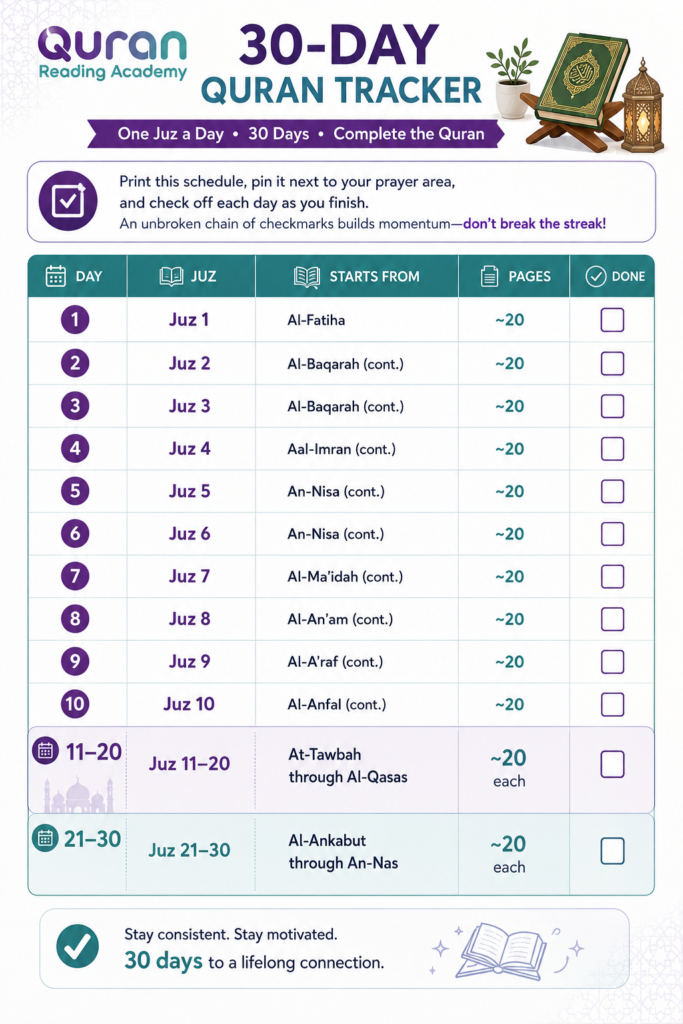
Set a weekly checkpoint: by the end of day 7, you should have completed 7 Juz. By day 14, you should be at Juz 14. If you are more than one Juz behind at any checkpoint, use the recovery strategy described in Step 8.
Step 3: Attach Your Reading To The Five Daily Prayers
The single most effective technique for how to finish reading the Quran in 30 days is tying each reading session to a prayer you already perform.
You are already in a state of wudu, already sitting on your prayer mat, and already in a spiritual mindset. Reading 4 pages immediately after each salah takes advantage of a habit that already exists rather than trying to create an entirely new one.
Here are three split options depending on your schedule:
| Split Option | When You Read | Pages per Session |
| After each prayer | After Fajr, Dhuhr, Asr, Maghrib, Isha | 4 pages each |
| Morning and evening | After Fajr + after Maghrib | 10 pages each |
| Four blocks | After Fajr, Dhuhr, Asr, Isha | 5 pages each |
A common mistake is choosing the option that looks fastest instead of the one that fits your actual day.
If you work from 9 to 5, reading 10 pages after Fajr and 10 after Maghrib may be more realistic than trying to read after every prayer. Choose the split that matches your life, not the one that sounds impressive.
Read Also: How To Complete Quran In 3 Days
See Our Academy in Action
Discover what a typical session looks like! Watch these brief highlights from our live, interactive classes to see how our instructors engage with students of all ages.
Start Your Quran Learning Journey Today
Join Quran Reading Academy and begin structured, step-by-step Quran reading with expert guidance.
Try your first class for freeStep 4: Set A Fixed Time And A Quiet Place
Decide exactly when you will read, and sit in the same spot each time. This is not a minor detail. The experience of countless Quran students confirms that location consistency builds habit faster than motivation alone.
Choose a clean, quiet corner where you will not be interrupted. Keep your Mushaf there permanently so you never waste time looking for it. Silence your phone or leave it in another room entirely.
Even a five-second notification glance breaks your concentration and costs you several minutes of re-engagement.
The best reading time for most people is immediately after Fajr. Your mind is fresh, your house is quiet, and you have not yet been pulled into the demands of the day.
If Fajr does not work for you, the time right before bed is the second-best option because it creates a calming end-of-day routine.
Students enrolled in Quran Reading Classes for Adults at Quran Reading Academy benefit from fixed class schedules that reinforce this daily consistency with the added layer of instructor accountability.
Read Also: One Year Quran Reading Plan
Step 5: Use The Same Mushaf And Read In Short Sessions
Using the same physical copy of the Quran throughout your 30-day journey is a technique experienced Quran teachers consistently recommend. Your eyes develop visual memory of where specific verses sit on the page.
By the second week, you will start remembering that a particular ayah is in the top-left corner of a right-hand page, and this spatial familiarity speeds up your reading noticeably.
Pair this with short, focused sessions rather than marathon sittings. A 20-page session done all at once leads to fatigue, skipped words, and a sense of dread the next day.
Four or five sessions of 4 to 5 pages each are easier on the mind and produce better recitation quality.
Short sessions also protect against the all-or-nothing trap. When people set aside one hour for the Quran and then get interrupted 20 minutes in, they often abandon the entire session. When your target is only 4 pages, you can finish in 7 minutes and count it as a completed block.
If you find yourself rushing through pages just to hit the number, slow down. It is better to read 15 pages with proper Tajweed than 20 pages carelessly. Quality protects the reward; speed without accuracy does not.
Read Also: How to Read the Quran If You Don’t Know Arabic?
Step 6: Listen Along With A Skilled Reciter
Reading along with an audio recitation solves two problems at once: it keeps your pace steady and it corrects your pronunciation in real time.
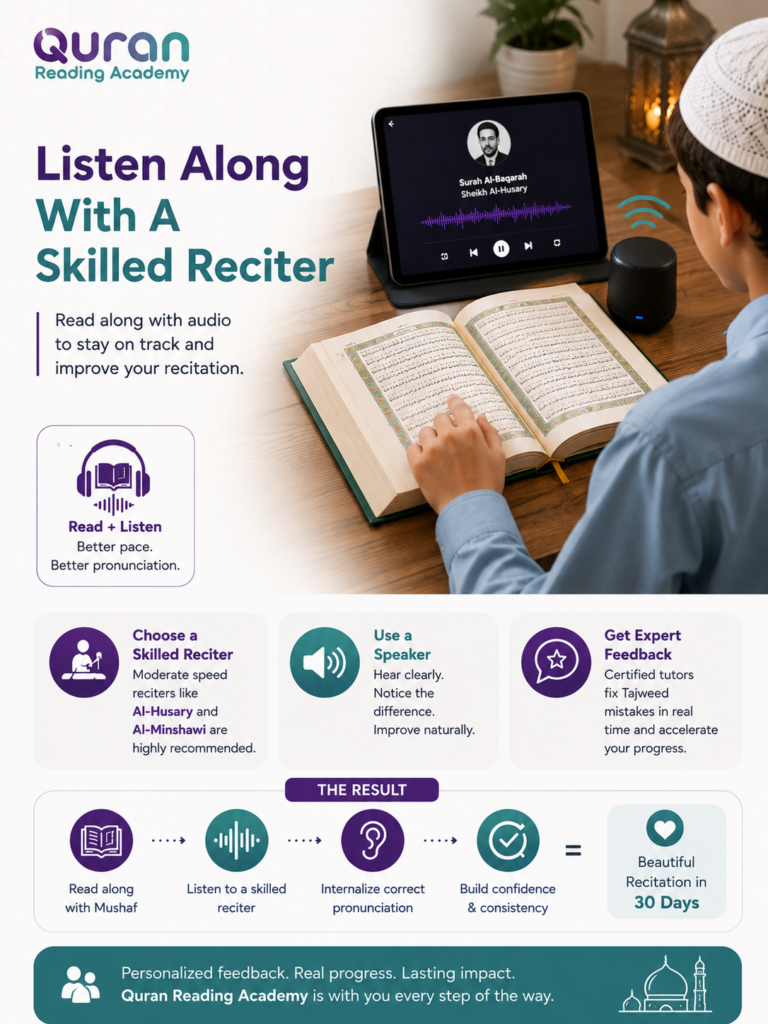
Choose a reciter who reads at a moderate speed. Sheikh Al-Husary (murattal style) and Sheikh Al-Minshawi (murattal, not mujawwad) are widely recommended because their pace allows you to follow comfortably without rushing.
Play the audio through a speaker rather than headphones when you are at home. This allows your ears to catch the difference between the reciter’s pronunciation and your own more naturally. Over 30 days, this passive Tajweed correction can improve your recitation significantly.
Students enrolled in Quran Reading Classes for Kids and Quran Reading Classes for New Muslims at Quran Reading Academy receive personalized feedback from certified tutors who identify specific Tajweed errors in real time, which accelerates progress far beyond self-study alone.
Step 7: Find an Accountability Partner
Reading the Quran alone for 30 consecutive days is harder than reading it alongside someone who shares the same goal. This is why group khatmah programs are so common during Ramadan and why they work outside Ramadan too.
Choose one person — a friend, a sibling, a spouse, or a fellow student — and agree to check in daily. A simple text message after Fajr saying “done with today’s Juz” creates gentle social pressure that prevents skipping.
The Prophet ﷺ said, “A man is upon the religion of his best friend, so let one of you look at whom he befriends” (Sunan at-Tirmidhi).
The right companion turns an individual effort into a shared act of worship.
You can also form a small WhatsApp group where each member reports their daily progress. When one person shares a screenshot of their checked-off tracker, it motivates the rest to keep up.
Read Also: 30 Day Ramadan Quran Reading Schedule

Quran Reading Academy offers structured group classes where this accountability is built into the program, with instructors and fellow students who keep you on track through every Juz.
Step 8: Track Daily And Recover Quickly When You Fall Behind
Keep a visible tracker. A printed chart on your wall, a simple notebook with boxes to check, or a basic spreadsheet on your phone all work. The format does not matter as long as you can see your streak at a glance.
The critical rule is this: never go to sleep with a deficit. If you miss your Dhuhr reading block, add those 4 pages to your Asr or Maghrib session the same day.
A one-day delay is easy to fix; a three-day backlog feels insurmountable and is the number-one reason people abandon their 30-day plan entirely.
If you do fall behind by two or three Juz despite your best efforts, here is a practical recovery approach: for the next few days, add just 5 extra pages to your daily target. Five extra pages take roughly 12 additional minutes.
Within four to five days, you will be back on schedule without overwhelming yourself. Never try to read two or three full Juz in a single day to catch up, as this leads to fatigue and often causes people to give up entirely.
Step 9: Reflect Briefly On What You Read
You do not need to study the full Tafseer of every verse during a 30-day plan, but reading a one-paragraph summary of each Juz’s main themes before you start gives your recitation context and keeps you engaged.
A reader who understands what Surah Al-Kahf is about will read it with more focus than one who sees only Arabic script.
A practical method: spend 2 to 3 minutes before each Juz reading a brief overview of its major topics. Many Quran apps include Juz summaries, or you can use a printed Tafseer guide.
This small investment of time transforms your reading from a mechanical page count into an act of understanding and connection with the words of Allah.
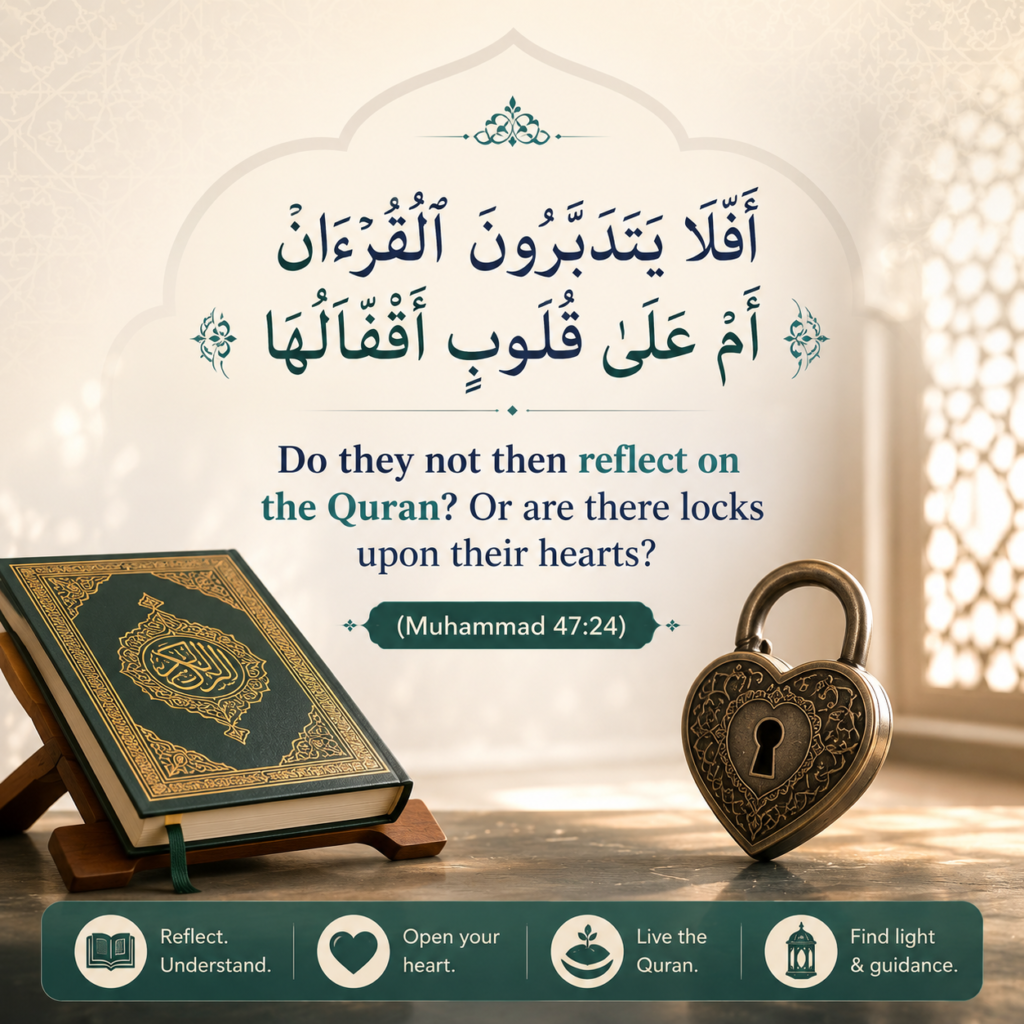
The Quran itself addresses this. Allah says:
“Do they not then reflect on the Quran? Or are there locks upon their hearts?” (Surah Muhammad, 47:24).
Even brief reflection elevates the entire experience of how to read the whole Quran in 30 days.
Step 10: Avoid These Common Mistakes
Knowing what to do is only half the equation. Most people who fail to complete the Quran in 30 days make one of these avoidable errors:
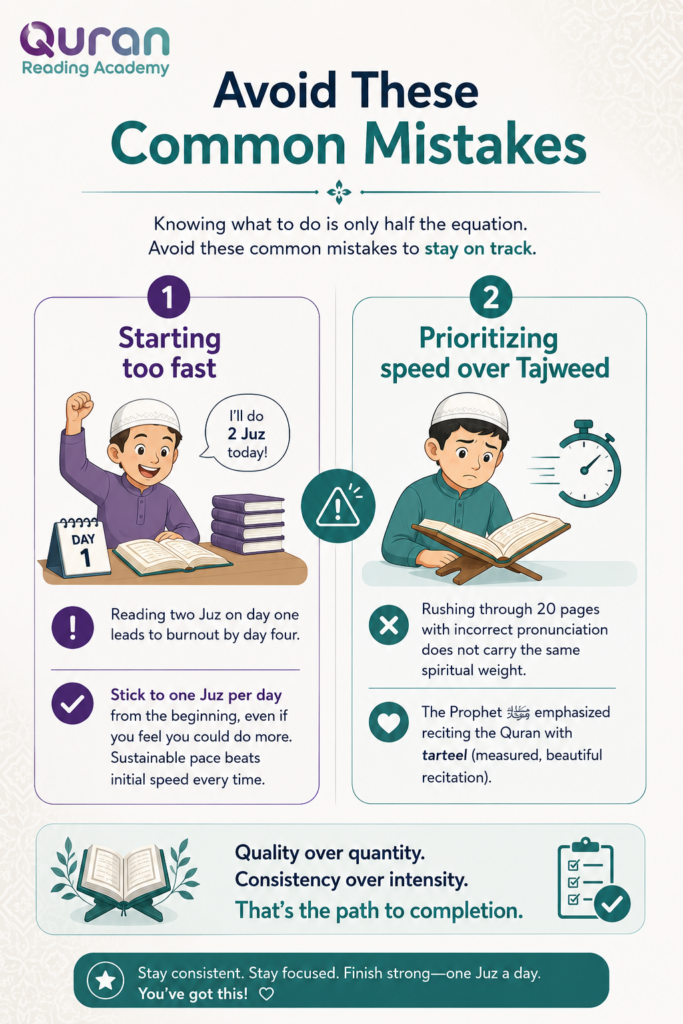
Starting too fast. Reading two Juz on day one out of enthusiasm leads to burnout by day four. Stick to one Juz per day from the beginning, even if you feel you could do more. Sustainable pace beats initial speed every time.
Prioritizing speed over Tajweed. Rushing through 20 pages with incorrect pronunciation does not carry the same spiritual weight as reading 15 pages properly.
The Prophet ﷺ emphasized reciting the Quran with tarteel (measured, beautiful recitation).
If your Tajweed needs work, consider joining a course at Quran Reading Academy where tutors correct your recitation verse by verse through Quran Reading Classes for Female/Sisters or any of their specialized programs.
Not having a physical or visual tracker. Mental tracking fails. You will lose count by week two. Use a tangible tracker and check it daily.
Reading without any purpose or context. Pure mechanical reading without even a basic understanding of the Surah’s theme leads to disengagement. The brief reflection method in Step 9 prevents this with minimal extra time.
Read Also: Reading Quran Without Understanding
Inside Our Live Classroom
We believe in complete transparency. Take a look inside our virtual classrooms to experience our premium teaching tools and engaging learning environment firsthand.
Start Your Quran Learning Journey Today
Join Quran Reading Academy and begin structured, step-by-step Quran reading with expert guidance.
Try your first class for freeStart Your 30-Day Quran Journey With Quran Reading Academy
You now have a complete roadmap for how to finish reading the Quran in 30 days. You have the schedule, the daily page targets, and a recovery plan for the days when life gets in the way. The final piece is the support system that turns a plan into a completed khatmah.
Quran Reading Academy provides one-on-one sessions with certified instructors who guide your recitation, correct your Tajweed in real time, and hold you accountable to your reading goals.

Book your free trial class today and take the first step toward completing the Quran this month.
Our Quran Courses:
- Quran Reading Classes
- Quran Reading Classes for Kids
- Quran Reading Classes for Adults
- Quran Reading Classes for Female/Sisters
- Quran Reading Classes for New Muslims
- Quran Reading Course for Beginners
- Online Quran Reading Course with Tajweed
- Reading and Memorizing the Quran Course
- Noorani Qaida Course
- Quran Course for Beginners
- Quran Tajweed Course
- Quran Recitation Course
- Quran Hifz Course
- Online Quran Qirat Classes
- Quranic Arabic Course
- Arabic Reading Practice Course
Start Your Quran Learning Journey Today
Join Quran Reading Academy and begin structured, step-by-step Quran reading with expert guidance.
Try your first class for freeConclusion
Understanding how to complete the Quran in 30 days comes down to a simple daily commitment: one Juz, 20 pages, split across your five prayers at roughly 4 pages each. The entire daily reading takes between 30 and 50 minutes when spread throughout the day.
Attach your reading to prayers you already perform, track your progress visually, catch up immediately whenever you miss a session, and use a skilled reciter’s audio to keep your Tajweed sharp.
The difference between people who finish and people who abandon the plan is not talent or free time.
It is structure and accountability. With a clear schedule, a printed tracker, and ideally an accountability partner or a class at Quran Reading Academy, how to read the Quran in 30 days stops being a question and becomes a monthly habit.
Frequently Asked Questions
Below are the most common questions readers ask about how to read the Quran in 30 days, answered directly to help you plan with confidence.
1. How long does it take to read one Juz of the Quran?
One Juz takes approximately 25 to 40 minutes to read at a moderate pace with proper Tajweed. Faster readers may finish in 20 minutes, while beginners who are still learning pronunciation rules may need up to 50 minutes. Splitting the Juz into 4-page blocks across your daily prayers keeps each session under 10 minutes.
2. Can a beginner complete the Quran in 30 days?
A beginner who reads slowly can complete the Quran in 30 days, but it requires more daily time, roughly 60 to 90 minutes total. If this feels too demanding, a 60-day plan at half a Juz per day is a realistic alternative. Quran Reading Academy’sQuran Reading Classes help beginners build reading speed so that a 30-day completion becomes achievable within a few months of consistent practice.
3. Do I have to read the Quran in order from Juz 1 to Juz 30?
No. There is no religious obligation to read the Quran sequentially. Some readers prefer to start with Juz 30 (Juz Amma) because its shorter Surahs build early confidence. Others alternate between familiar and unfamiliar sections to maintain engagement. The only requirement is that all 30 Juz are completed by the end of the month.
4. Can I read the Quran on my phone instead of a physical Mushaf?
Yes, reading from a Quran app counts as valid recitation according to the majority of scholars. However, using a physical Mushaf for your main sessions is recommended because it reduces screen distractions and builds stronger visual memory of the page layout. Use the app as a backup when you are traveling or away from your Mushaf.
5. Is it better to read the Quran fast or slow?
Slow, clear recitation with proper Tajweed is always better than fast reading with errors. The Prophet ﷺ instructed Muslims to recite the Quran with tarteel, meaning measured and deliberate recitation. If finishing 20 pages with correct pronunciation means taking slightly longer, that is preferable. Never sacrifice accuracy for speed.
6. What should I do if I miss two or three days?
Add 5 extra pages per day to your regular 20-page target until you catch up. Five extra pages take about 12 minutes and close a three-day gap within roughly five days. Avoid trying to read two or three full Juz in a single day, as this leads to fatigue and often causes people to give up entirely.








Leave a Reply