 Quran
Quran
| Key Takeaways |
| Listening to Quran while following along in the mushaf is permissible across all four major schools of Islamic jurisprudence and produces measurable gains in pronunciation accuracy. |
| The majority of scholars hold that attentive listening to Quran is mustahabb (highly recommended) outside of prayer, not a personal obligation. |
| Combining Quran audio with active reading corrects letter articulation errors that neither method catches on its own, particularly for non-Arabic speakers still building recitation fluency. |
| Listening to a Quran recording cannot substitute for independent verbal recitation in Salah, Hifz review sessions, or ruqyah, where active recitation by the reader is required. |
Many students who begin learning to read Quran develop a natural habit: they play a certified recitation while tracking the same words in the mushaf. This practice raises a genuine question that touches on Islamic etiquette, scholarly ruling, and sound learning method.
Whether you can listen to Quran while reading Quran is answered by Islamic scholarship through the lens of intent, etiquette, and educational outcome. This article examines the ruling, the scholarly evidence, and the practical advantages of combining Quran audio with mushaf reading, so you can approach both with clarity and confidence.
Is Listening to Quran While Reading Along in the Mushaf Permissible?
Yes, following a Quran recording while reading the same text in the mushaf is permissible according to all four major schools of Islamic jurisprudence.
Islamic scholars confirm that a recorded recitation differs from a live recitation in terms of which specific etiquette rules apply, but the combined practice of reading alongside audio is sound and free of prohibition across all major scholarly positions.
For students who are not yet proficient enough to self-correct their own pronunciation, this method moves beyond mere permissibility into active benefit.
Hearing a certified reciter while tracking the same words visually trains both the ear and the eye at once, producing faster and more accurate reading development than silent reading alone can achieve.
What Surah Al-A’raf 7:204 Requires When Quran Is Recited
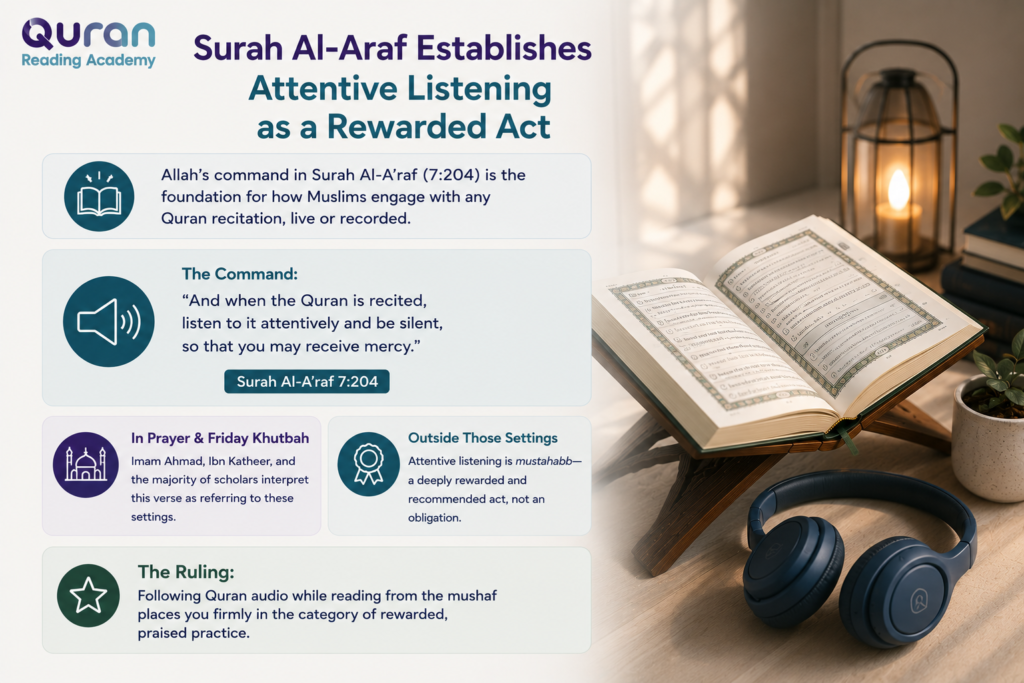
Attentive listening is required when Quran is recited in prayer and during the Friday khutbah, while outside those settings it is highly recommended. Allah’s command in Surah Al-A’raf provides the foundation for engaging with Quran recitation, whether live or recorded.
Allah Almighty says:
وَإِذَا قُرِئَ الْقُرْآنُ فَاسْتَمِعُوا لَهُ وَأَنصِتُوا لَعَلَّكُمْ تُرْحَمُونَ
(Wa idhā quri’a al-Qur’ānu fastami’ū lahu wa anṣitū la’allakum turḥamūn)
(“And when the Quran is recited, listen to it attentively and be silent, so that you may receive mercy.”)
Imam Ahmad, Ibn Katheer, and the majority of classical scholars interpreted this verse as referring specifically to the context of prayer and the Friday khutbah. Outside of those settings, the dominant scholarly position classifies attentive listening as mustahabb, a deeply rewarded and recommended act rather than a personal obligation. This ruling means that following Quran audio while reading from the mushaf places you firmly in the category of rewarded, praised practice.
Read also: Can You Read Quran During Khutbah?
How Reading and Listening to Quran Combine Their Rewards
Islamic scholarship draws a precise distinction between the reward of recitation and the reward of listening, and this distinction clarifies what a student gains when combining the two activities.
Reading Quran aloud earns a good deed for every letter, with each good deed multiplied tenfold. Listening to Quran with genuine attention carries its own significant reward that scholars describe in generous terms.
The late Sheikh Ibn Baz stated: “Whoever listens is considered a partner to the reciter. He receives a great reward, equal to or even greater than that of the reciter, if he listens with sincerity and truthfulness, and a genuine desire for what is with Allah.”
When a student reads aloud alongside an audio recitation, both rewards combine. Reading softly but audibly activates the recitation reward. Tracking with attentive listening adds the listening reward on top of it.
| Activity | Reward Category | Tajweed Benefit |
| Reading aloud without audio | Full recitation reward per letter | Self-dependent; errors may go uncorrected |
| Listening only, no reading | Listening reward (significant) | Passive hearing; no active articulation |
| Reading aloud alongside Quran audio | Recitation reward plus listening reward | Active audio correction in real time |
| Silent reading while audio plays | Listening reward plus reading engagement | Eye-training combined with audio modeling |
Quran Reading Academy offers an Online Quran Reading Course with Tajweed that trains students to apply correct articulation through structured one-on-one sessions with Ijazah-certified instructors who identify and correct pronunciation errors live during every class.
Start Your Tajweed Reading Journey with a Free Lesson
Read also: Can You Read from the Quran During Tahajjud?
Three Etiquette Rules for Audio-Assisted Quran Reading
Following Quran audio alongside the mushaf carries specific behavioral expectations that honor the sanctity of Allah’s words and preserve the full educational benefit of the session.
1. Keep Your Voice Below the Recording Volume
When reading aloud alongside a recitation, your voice should remain lower than the level of the audio playing.
This preserves the principle of not overriding the reciter’s voice and ensures you are genuinely following rather than competing with the audio. Speaking at the same volume as the recording fragments your attention and reduces the corrective effect.
2. Select a Certified Reciter Whose Tajweed Is Verified
Not every available Quran recording carries certified Tajweed accuracy. Students should choose reciters whose articulation is established and widely recognized: Sheikh Mahmoud Khalil al-Husary, Sheikh Abdul Basit Abd us-Samad, and Sheikh Mishary Rashid Alafasy are consistently reliable references.
Following a reciter who has embedded errors into their recording trains the ear to imitate those errors rather than correct them.
3. Reserve Dedicated Time for Reading-and-Listening Sessions
Playing Quran audio in the background while working or driving carries general reward. Attempting to read from the mushaf during genuinely distracted parallel tasks, however, splits attention in ways that eliminate the pronunciation benefit.
Sessions where you use audio alongside your reading should be treated as structured study time with full focus on both the text and the reciter.
Quran Reading Academy offers a Quran Recitation Course that develops the measured, rhythmic Tarteel cadence through one-on-one instruction with qualified teachers who model correct recitation live and provide immediate correction within the same session.
Book a Free Recitation Session Today
Read also: Can You Read Quran with Tayammum?
See Our Academy in Action
Discover what a typical session looks like! Watch these brief highlights from our live, interactive classes to see how our instructors engage with students of all ages.
Start Your Quran Learning Journey Today
Join Quran Reading Academy and begin structured, step-by-step Quran reading with expert guidance.
Try your first class for freeWhen Quran Audio Cannot Replace Verbal Recitation
Several Islamic contexts impose a strict requirement for verbal recitation that no audio device can fulfill, regardless of the permissibility of audio-assisted reading in all other settings.
Recitation During Salah
Surah Al-Fatihah must be recited verbally by each worshipper in every rak’ah, whether praying alone, as an imam, or behind an imam. No recording replaces this. A person who plays Quran audio during prayer instead of reciting independently has not fulfilled the recitation pillar of that prayer.
Memorization Review and Hifz Testing
Hifz requires the memorizer to reproduce verses from memory without external support. Relying on audio during dedicated review sessions trains association with the recording rather than genuine independent recall.
A structured Hifz program alternates between audio-supported learning in the early stages and unassisted verbal recitation in review, so the student builds real retention rather than audio dependency.
Ruqyah Practice
Ruqyah, the recitation of specific Quranic verses and supplications for protection and healing, requires active verbal recitation by the practitioner with intentional breath engagement.
Passive listening to a ruqyah recording does not fulfill the deliberate, personally enacted recitation that the practice demands.
Quran Reading Academy offers a Noorani Qaida Course that builds the phonetic foundation every student needs for fully independent recitation, starting from precise letter articulation before connecting sounds into Quranic words and verses.
Start Your Noorani Qaida Foundation Free
Read also: Can You Read Quran Without Covering Awrah?
How Audio-Assisted Quran Reading Corrects Pronunciation Errors
Reading while following a certified audio track produces measurable improvements in letter accuracy, stopping positions, and vowel execution, especially for students who have not yet developed the ear to self-correct.
Non-Arabic speakers frequently internalize mispronunciation without awareness, because there is no external reference to reveal the gap. Reading while a certified reciter plays provides exactly that reference.
Each vowel, nasal sound, and elongation modeled by the audio creates an immediate comparison point that silent reading alone cannot generate.
At Quran Reading Academy, instructors consistently observe that students who practice reading alongside certified audio between their sessions arrive to the next class with fewer recurring articulation errors than those who read without audio support.
The combination trains the ear to detect its own mistakes, which is the prerequisite for meaningful self-correction outside of formal class time.
Audio-assisted mushaf reading is especially effective for the following Tajweed elements:
- Madd (elongation) rules: Hearing the precise two-count or four-count duration in context builds intuition faster than counting silently from a chart.
- Ghunnah nasalization: The nasal resonance requires an acoustic reference before the learner’s ear can reliably produce and detect it independently.
- Waqf stopping positions: Hearing a certified reciter stop or continue at specific points teaches breath management and meaning-conscious pausing far more effectively than text markers alone.
Quran Reading Academy offers a Quran Tajweed Course that transforms ordinary reading into precise, rule-bound recitation through structured instruction covering Makharij al-Huruf, Sifat, and all applied Tajweed rules from foundational to advanced.
Enroll in a Free Tajweed Trial Lesson
Inside Our Live Classroom
We believe in complete transparency. Take a look inside our virtual classrooms to experience our premium teaching tools and engaging learning environment firsthand.
Start Your Quran Learning Journey Today
Join Quran Reading Academy and begin structured, step-by-step Quran reading with expert guidance.
Try your first class for freeBuild Accurate Quran Recitation With One-on-One Tajweed Instruction
Quran Reading Academy brings together Ijazah-certified instructors, one-on-one live sessions, and a structured curriculum that progresses students from letter recognition through fully applied Tajweed in a measurable, stage-by-stage sequence.
Every session involves a qualified teacher who hears your recitation in real time, identifies errors as they occur, and provides immediate correction that no recorded audio can replicate.
What sets Quran Reading Academy apart:
- Ijazah-certified instructors with verified chains of transmission tracing back to the authentic Prophetic recitation.
- One-on-one live sessions that deliver real-time pronunciation correction at every single class.
- A structured curriculum covering Makharij, Sifat, and all applied Tajweed rules with no stage skipped or compressed.
Our Quran Courses
- Quran Reading Classes
- Quran Reading Classes for Kids
- Quran Reading Classes for Adults
- Quran Reading Classes for Female/Sisters
- Quran Reading Classes for New Muslims
- Quran Reading Course for Beginners
- Online Quran Reading Course with Tajweed
- Reading and Memorizing the Quran Course
- Noorani Qaida Course
- Quran Course for Beginners
- Quran Tajweed Course
- Quran Recitation Course
- Quran Hifz Course
- Online Quran Qirat Classes
Conclusion
Reading Quran while listening to a certified recitation is permissible, recommended, and effective for learners at every level. Most scholars regard attentive listening outside prayer as highly rewarded. When used properly, following audio while reading improves pronunciation more than either practice alone.
Audio should support active recitation, not replace it. Salah, Hifz review, and ruqyah require independent verbal recitation, but in other learning settings, a qualified reciter provides a live model for correct articulation and Tajweed.
You can listen while reading as long as you observe proper etiquette and choose a verified reciter. Combine this method with regular aloud practice and guidance from an Ijazah-certified teacher for faster, more accurate recitation.
Frequently Asked Questions
Does Listening to Quran While Reading the Mushaf Earn a Double Reward?
Yes. When a student reads aloud softly alongside a Quran audio track, they engage both the recitation reward (a good deed per letter, multiplied tenfold) and the listening reward simultaneously. Listening with genuine attention and sincerity is described by scholars as potentially equal to or greater than the reciter’s own reward.
Is It Permissible to Play Quran Audio in the Background While Working?
Yes, playing Quran audio while working is permissible. Scholars advise that the listener should pay attention to the extent possible and should avoid playing Quran in settings where those nearby are unable or unwilling to listen respectfully. If others in the space are distracted and inattentive, using personal earphones is the recommended alternative.
Can I Learn Tajweed by Following Certified Reciters Without a Teacher?
No, audio from certified reciters is an essential support tool for Tajweed development, but it does not replace instruction from a qualified teacher. A live instructor hears your specific articulation errors in real time and corrects them immediately. A recording can only model correct output; it cannot respond to what you actually produce during your session.
Does Reading Along With Quran Audio Help With Hifz Memorization?
Yes, audio-assisted reading strengthens familiarity with the melodic flow of each verse and benefits auditory learners during the early learning stage. Hifz consolidation, however, requires dedicated unassisted recitation sessions that build genuine independent recall. Audio support during initial learning should give way progressively to solo review as memorization deepens.
Should I Recite Aloud or Read Silently When Following Quran Audio?
Reciting softly aloud while following the audio is the more complete method. It captures both the recitation reward and the listening reward at once and activates the physical articulation that builds long-term muscle memory in the mouth and tongue. Keep your voice lower than the recording to maintain the correct listening etiquette throughout the session.








Leave a Reply