 benefits of reading quran

Some days the weight is too heavy to carry alone. A worry that will not leave, a door that will not open, a pain you cannot explain to anyone. In those moments, the Quran is the first place a believer turns, because Allah Himself taught us to ask Him for help.
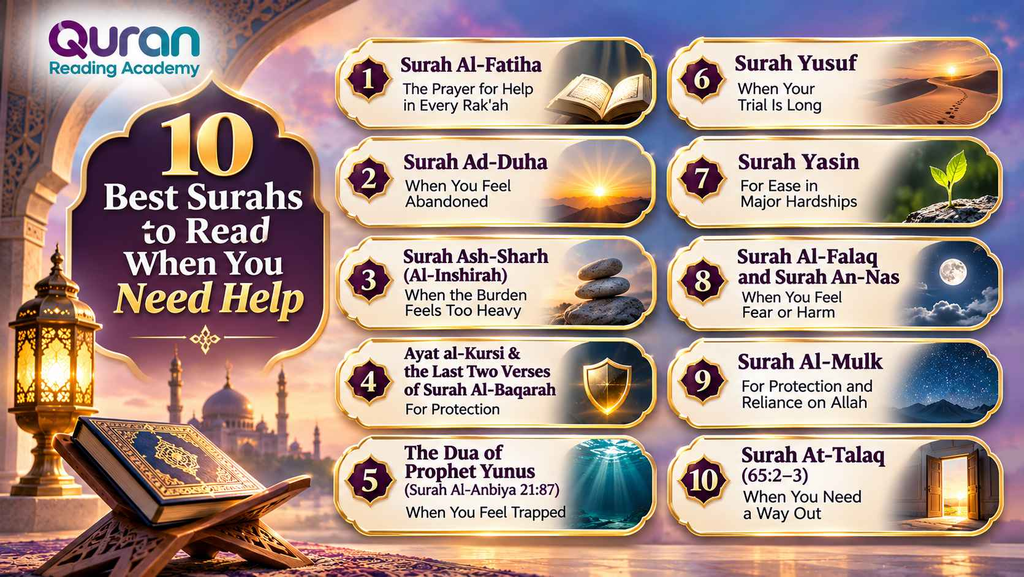
So, What Surah to Read When You Need Help? Start with Surah Al-Fatiha, the Quran’s own prayer for help. Then recite Surah Ad-Duha and Surah Ash-Sharh for comfort, Ayat al-Kursi and the last two verses of Surah Al-Baqarah for protection, and the dua of Prophet Yunus when you feel trapped. Recite with reflection, then ask Allah directly.
Every hardship is different, so match the surah to what you are going through. Use this table as a quick guide, then read the full explanation of each surah below.
| Your situation | Surah or verse to read | Why it helps |
|---|---|---|
| You need help in general | Surah Al-Fatiha (1:5) | You directly ask Allah alone for help |
| You feel sad or forgotten | Surah Ad-Duha (93) | Allah reassures that He has not abandoned you |
| The burden feels too heavy | Surah Ash-Sharh (94) | “With hardship comes ease,” repeated twice |
| You need protection | Ayat al-Kursi (2:255) and Al-Baqarah 2:285–286 | Authentic hadith say they protect and suffice the reciter |
| You feel trapped or regretful | Dua of Yunus (Al-Anbiya 21:87) | A dua the Prophet ﷺ said Allah answers |
| Your trial is long | Surah Yusuf (12) | A full story of patience ending in relief |
| You feel fear or anxiety | Surah Al-Falaq and Surah An-Nas (113–114) | Seeking refuge in Allah from every harm |
| You face financial hardship or a dead end | Surah At-Talaq (65:2–3) | Allah promises a way out and provision |
| You are ill | Surah Al-Fatiha as ruqyah | The Companions recited it for healing |
| You face a hard decision | Salat al-Istikhara | The Prophet ﷺ taught it for every important matter |
10 Best Surahs and Verses to Read When You Need Help
These are the best surahs to read when you need help from Allah, chosen because the Quran or authentic hadith connect each one to help, relief, or protection. Each one includes its key verse, why it helps, and when to read it.
1. Surah Al-Fatiha as the Prayer for Help in Every Rak’ah
Surah Al-Fatiha is the most direct answer to the question of what surah to read when you need help. Its fifth verse is a declaration that help comes from Allah alone, and its sixth verse asks Him for guidance on the straight path.
إِيَّاكَ نَعْبُدُ وَإِيَّاكَ نَسْتَعِينُ
“You alone we worship, and You alone we ask for help.” (Surah Al-Fatiha, 1:5)
The Prophet ﷺ reported that Allah responds to each verse of Al-Fatiha as you recite it. When you say “You alone we ask for help,” Allah says: “This is between Me and My servant, and My servant shall have what he asked for” (Sahih Muslim, 395). You are not reciting into silence. You are in a conversation.
When to read it: In every prayer, and on its own whenever you need help. Recite it slowly and pause after each verse.
2. Surah Ad-Duha for When You Feel Abandoned
Surah Ad-Duha was revealed after a pause in revelation, when the angel Jibreel had not come to the Prophet ﷺ for some time and a woman from Quraysh mocked him (Sahih al-Bukhari, 1125). Allah answered with this surah, swearing by the morning light that He had not abandoned His Messenger.
مَا وَدَّعَكَ رَبُّكَ وَمَا قَلَىٰ
“Your Lord has not forsaken you, nor is He displeased with you.” (Surah Ad-Duha, 93:3)
The surah then reminds the Prophet ﷺ how Allah sheltered him as an orphan, guided him, and provided for him. That is a lesson for you too: remember how Allah helped you before, and trust that His help will come again. For more on this, read our guide to the best Quran surah for anxiety and depression.
When to read it: When you feel alone, forgotten, or that your prayers are not being heard.
3. Surah Ash-Sharh (Al-Inshirah) for When the Burden Feels Too Heavy
Surah Ash-Sharh was revealed close to Surah Ad-Duha and continues its comfort. It names the burden that “weighed down your back” and then promises ease, twice. The repetition is deliberate: Allah removes any doubt that relief will come.
فَإِنَّ مَعَ ٱلْعُسْرِ يُسْرًا إِنَّ مَعَ ٱلْعُسْرِ يُسْرًا
“So surely with hardship comes ease. Surely with hardship comes ease.” (Surah Ash-Sharh, 94:5–6)
Notice the wording too. The verse says ease comes with hardship, not only after it. Even inside a difficult time, Allah places something that makes it bearable.
When to read it: When stress, debt, or responsibility feels crushing. It is also an excellent surah for children to memorize early.
See Our Academy in Action
Discover what a typical session looks like! Watch these brief highlights from our live, interactive classes to see how our instructors engage with students of all ages.
Start Your Quran Learning Journey Today
Join Quran Reading Academy and begin structured, step-by-step Quran reading with expert guidance.
Try your first class for free4. Ayat al-Kursi and the Last Two Verses of Surah Al-Baqarah for Protection
Ayat al-Kursi is the greatest verse in the Quran. The Prophet ﷺ taught that whoever recites it before sleep remains under a guardian from Allah until morning (Sahih al-Bukhari, 2311).
ٱللَّهُ لَآ إِلَـٰهَ إِلَّا هُوَ ٱلْحَىُّ ٱلْقَيُّومُ
“Allah: there is no god except Him, the Ever-Living, the Sustainer of all existence.” (Surah Al-Baqarah, 2:255)
The last two verses of Surah Al-Baqarah (2:285–286) carry a similar promise: whoever recites them at night, they will suffice him (Sahih al-Bukhari, 5009; Sahih Muslim, 807). Verse 286 also contains one of the most reassuring lines in the Quran: “Allah does not burden a soul beyond what it can bear.”
When to read it: Every night before sleep, after each obligatory prayer, and whenever you feel vulnerable.
5. The Dua of Prophet Yunus (Surah Al-Anbiya 21:87) for When You Feel Trapped
Prophet Yunus called out with these words from the darkness of the whale’s belly, and Allah rescued him. The next verse adds: “And thus do We save the believers” (21:88), so the promise extends to you.
لَّآ إِلَـٰهَ إِلَّآ أَنتَ سُبْحَـٰنَكَ إِنِّى كُنتُ مِنَ ٱلظَّـٰلِمِينَ
“There is no god except You. Glory be to You. Indeed, I have been among the wrongdoers.” (Surah Al-Anbiya, 21:87)
The Prophet ﷺ said that no Muslim calls upon Allah with this dua for anything except that Allah answers him (Jami’ at-Tirmidhi, 3505).
When to read it: When you feel stuck, when you regret a mistake, or when no way out seems possible.
6. Surah Yusuf for When Your Trial Is Long
The story ends with Yusuf honored, his family reunited, and his father’s sight restored. It teaches that Allah’s plan unfolds over years, not days.
فَصَبْرٌ جَمِيلٌ ۖ وَٱللَّهُ ٱلْمُسْتَعَانُ عَلَىٰ مَا تَصِفُونَ
“So patience is most fitting, and Allah is the One whose help is sought against what you describe.” (Surah Yusuf, 12:18)
Surah Yusuf tells the full story of a life of trials: betrayal by his brothers, being sold into slavery, false accusation, and years in prison. His father, Prophet Yaqub, lost his beloved son and responded with “beautiful patience,” calling Allah Al-Musta’an, the One whose help is sought.
When to read it: During long trials, family conflict, or injustice. Read it with its translation over several days.
7. Surah Yasin for Ease in Major Hardships
Many Muslims recite Surah Yasin in times of hardship. Its closing verses remind you that nothing is difficult for Allah. A situation that looks impossible to you needs only His command.
إِنَّمَآ أَمْرُهُۥٓ إِذَآ أَرَادَ شَيْـًٔا أَن يَقُولَ لَهُۥ كُن فَيَكُونُ
“His command, when He wills something, is only to say to it ‘Be,’ and it is.” (Surah Yasin, 36:82)
Be careful with popular claims about its “special benefits” that circulate online, as several are based on weak narrations. Read it for its meaning, which is powerful on its own. Learn more in our guides on when to read Surah Yaseen and reading Surah Yaseen with Tajweed.
When to read it: When facing a major hardship or a situation that feels beyond your control.
8. Surah Al-Falaq and Surah An-Nas for When You Feel Fear or Harm
The Prophet ﷺ advised reciting Al-Ikhlas, Al-Falaq, and An-Nas three times every morning and evening, saying they would suffice you against everything (Sunan Abu Dawud, 5082).
قُلْ أَعُوذُ بِرَبِّ ٱلْفَلَقِ
“Say: I seek refuge in the Lord of daybreak.” (Surah Al-Falaq, 113:1)
These two short surahs are called Al-Mu’awwidhatayn, the two surahs of seeking refuge. Al-Falaq seeks protection from external harm and envy. An-Nas seeks protection from the whispers that disturb the heart, which makes it especially relevant to anxiety and intrusive thoughts.
When to read it: Morning and evening, before sleep, and whenever fear or worry takes hold.
9. Surah Al-Mulk for Reliance on Allah
Surah Al-Mulk opens by reminding you that all dominion is in Allah’s hand, including the matter that worries you. The Prophet ﷺ said it is a surah of thirty verses that will intercede for its reader until he is forgiven (Jami’ at-Tirmidhi, 2891).
تَبَـٰرَكَ ٱلَّذِى بِيَدِهِ ٱلْمُلْكُ وَهُوَ عَلَىٰ كُلِّ شَىْءٍ قَدِيرٌ
“Blessed is He in whose hand is all dominion, and He is over all things competent.” (Surah Al-Mulk, 67:1)
When to read it: Every night before sleep. See our guide on when to read Surah Mulk for the best times.
10. Surah At-Talaq (65:2–3) for When You Need a Way Out
These verses are a direct promise for anyone in a financial crisis, a job loss, or a situation with no visible exit. They tie Allah’s help to two actions you control: Taqwa (mindfulness of Allah) and Tawakkul (reliance on Him).
وَمَن يَتَّقِ ٱللَّهَ يَجْعَل لَّهُۥ مَخْرَجًا وَيَرْزُقْهُ مِنْ حَيْثُ لَا يَحْتَسِبُ ۚ وَمَن يَتَوَكَّلْ عَلَى ٱللَّهِ فَهُوَ حَسْبُهُۥٓ
“Whoever is mindful of Allah, He will make a way out for him, and provide for him from where he does not expect. And whoever relies upon Allah, He is sufficient for him.” (Surah At-Talaq, 65:2–3)
When to read it: When facing debt, unemployment, or any situation where every door seems closed.
Seek Help Through Patience and Prayer
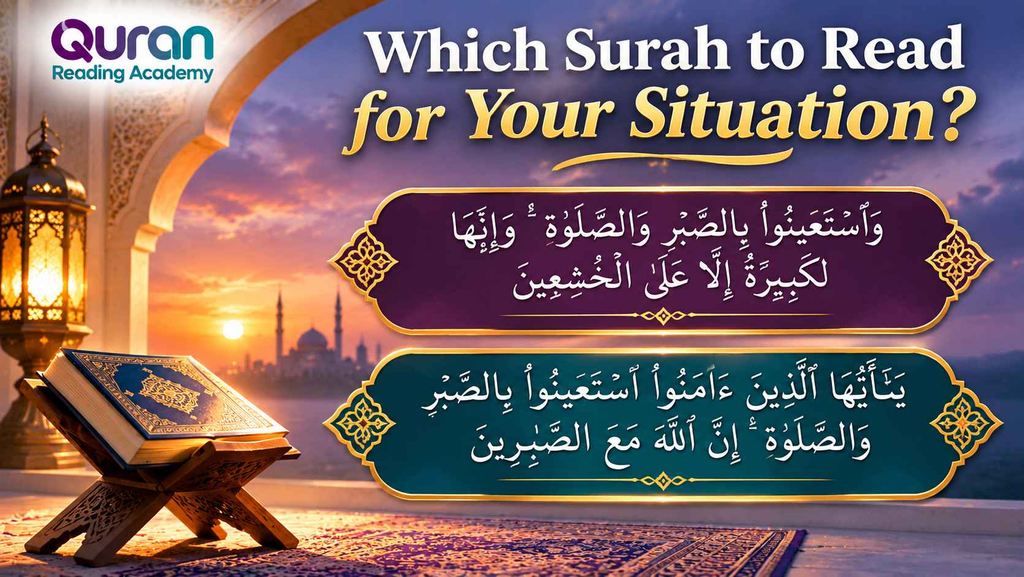
The Quran answers this question directly: seek help through patience and prayer. Before you choose a specific surah, it helps to know the method Allah Himself gave us.
وَٱسْتَعِينُوا۟ بِٱلصَّبْرِ وَٱلصَّلَوٰةِ ۚ وَإِنَّهَا لَكَبِيرَةٌ إِلَّا عَلَى ٱلْخَـٰشِعِينَ
“And seek help through patience and prayer. Indeed, it is difficult except for those who are humble.” (Surah Al-Baqarah, 2:45)
A few verses later, Allah repeats the command and adds a promise:
يَـٰٓأَيُّهَا ٱلَّذِينَ ءَامَنُوا۟ ٱسْتَعِينُوا۟ بِٱلصَّبْرِ وَٱلصَّلَوٰةِ ۚ إِنَّ ٱللَّهَ مَعَ ٱلصَّـٰبِرِينَ
“O you who believe, seek help through patience and prayer. Indeed, Allah is with the patient.” (Surah Al-Baqarah, 2:153)
Help from Allah comes through two doors: Sabr (patience) and Salah (prayer). Reading the Quran is part of both. You recite it in every prayer, and its verses strengthen your patience when the trial feels long.
This is why no surah works like a charm on its own. Each surah in the Quran becomes a source of help when you recite it with understanding, reflect on it, and turn to Allah with Tawakkul (complete reliance on Him).
How to Read a Surah When You Need Help Step by Step
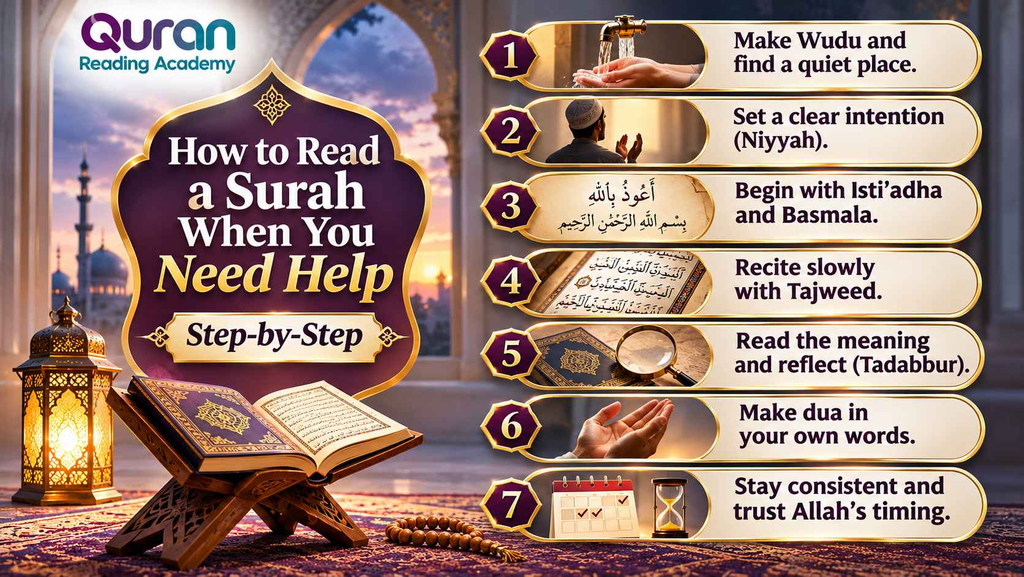
Knowing what surah to read when you need help is only half the answer. How you read it matters just as much. Follow these seven steps to turn your recitation into a sincere request for Allah’s help.
- Make Wudu and find a quiet place. Purify yourself, face the Qiblah if you can, and remove distractions such as your phone’s notifications. A calm setting helps your heart stay present.
- Set a clear intention (Niyyah). Before you begin, name in your heart exactly what you need help with. Your intention turns reading into worship and a direct request to Allah.
- Begin with Isti’adha and Basmala. Say “A’udhu billahi minash-shaytanir-rajim” to seek refuge from Shaytan, then “Bismillahir-Rahmanir-Rahim.”
- Recite slowly with Tajweed. Allah commands us to recite the Quran with measured recitation (Surah Al-Muzzammil, 73:4). Correct pronunciation protects the meaning, so quality matters more than quantity. Review the essential rules for Quran recitation if you are unsure.
- Read the meaning and reflect (Tadabbur). Read the translation or a short Tafsir of the verses. Ask yourself how each verse speaks to your situation. This is where comfort and clarity usually come.
- Make dua in your own words. After reciting, raise your hands and ask Allah for exactly what you need, in any language. The closest a servant is to his Lord is while in sujood, so you can also ask during prostration in prayer (Sahih Muslim, 482).
- Stay consistent and trust Allah’s timing. Make the surah part of your daily routine instead of a one-time reading. The Prophet ﷺ said your dua is answered as long as you do not become impatient and say “I prayed but was not answered” (Sahih al-Bukhari, 6340).
Best times to read and make dua: the last third of the night (Sahih al-Bukhari, 1145), between the Adhan and Iqamah (Sunan Abu Dawud, 521), after obligatory prayers, and on Friday. Read more in our guide Can You Read Quran Anytime? Best Times to Read the Quran.
Powerful Quranic Duas to Say When You Need Help
The Quran contains the duas of the Prophets in their hardest moments. Memorize a few of them and use them after your recitation.
| Dua (Arabic) | Transliteration | Meaning | When to say it |
|---|---|---|---|
| حَسْبُنَا ٱللَّهُ وَنِعْمَ ٱلْوَكِيلُ | Hasbunallahu wa ni’mal wakeel | “Allah is sufficient for us, and He is the best Disposer of affairs.” (3:173) | When you face fear or pressure from people |
| لَّآ إِلَـٰهَ إِلَّآ أَنتَ سُبْحَـٰنَكَ إِنِّى كُنتُ مِنَ ٱلظَّـٰلِمِينَ | La ilaha illa anta subhanaka inni kuntu minaz-zalimin | “There is no god except You. Glory be to You. I have been among the wrongdoers.” (21:87) | When you feel trapped or regretful |
| رَبِّ ٱشْرَحْ لِى صَدْرِى وَيَسِّرْ لِىٓ أَمْرِى | Rabbish-rah li sadri wa yassir li amri | “My Lord, expand my chest for me and ease my task for me.” (20:25–26) | Before an exam, interview, or difficult task |
| رَبِّ إِنِّى لِمَآ أَنزَلْتَ إِلَىَّ مِنْ خَيْرٍ فَقِيرٌ | Rabbi inni lima anzalta ilayya min khayrin faqir | “My Lord, I am in need of whatever good You send down to me.” (28:24) | When you need provision, work, or a fresh start |
| رَبَّنَآ ءَاتِنَا فِى ٱلدُّنْيَا حَسَنَةً وَفِى ٱلْءَاخِرَةِ حَسَنَةً وَقِنَا عَذَابَ ٱلنَّارِ | Rabbana atina fid-dunya hasanatan wa fil-akhirati hasanatan wa qina ‘adhaban-nar | “Our Lord, give us good in this world and good in the Hereafter, and protect us from the Fire.” (2:201) | Anytime, for every need |
Prophet Musa made the dua in 28:24 when he was a stranger in a new land with nothing. Shortly after, Allah gave him shelter, work, and a family. For more verses of comfort, see our guide to the best Quran surah for healing.
Inside Our Live Classroom
We believe in complete transparency. Take a look inside our virtual classrooms to experience our premium teaching tools and engaging learning environment firsthand.
Start Your Quran Learning Journey Today
Join Quran Reading Academy and begin structured, step-by-step Quran reading with expert guidance.
Try your first class for freeFind Strength in the Quran with The Quran Reading Academy
The help in these surahs reaches your heart most deeply when you can recite them correctly and understand what you are saying to Allah. If you struggle to read Arabic, worry about Tajweed mistakes, or want to understand the verses you recite in prayer, the right teacher makes all the difference.
The Quran Reading Academy helps Muslims of all ages build that connection through personal, one-on-one online lessons:
- Ijazah-certified Azhari tutors. Every teacher holds Ijazah with a verified Sanad, so you learn authentic recitation. Meet our teachers.
- One-on-one lessons at your pace. Each lesson is tailored to your age, level, and goals, whether you are a complete beginner or perfecting your recitation.
- Flexible scheduling worldwide. Choose lesson times that fit your routine, including early mornings, evenings, and weekends across time zones.
- Private classes for sisters. Female students learn with qualified Ustadhas in a comfortable, private setting.
Book your free trial lesson today and experience how a dedicated tutor can transform your relationship with the Quran.
Our Quran Courses
- Online Quran Reading Course with Tajweed
- Reading and Memorizing the Quran Course
- Noorani Qaida Course
- Quran Course for Beginners
- Quran Tajweed Course
- Quran Recitation Course
- Quran Hifz Course
- Online Quran Qirat Classes
- Quranic Arabic Course
- Arabic Reading Practice Course
Conclusion
So, what surah to read when you need help? Start with Surah Al-Fatiha, find comfort in Ad-Duha and Ash-Sharh, seek protection with Ayat al-Kursi and Al-Mu’awwidhatayn, and call out with the dua of Yunus when you feel trapped.
Whichever surah you choose, recite it slowly, reflect on its meaning, and ask Allah with full trust. As He promised, “Surely with hardship comes ease” (94:6). Keep reading, and explore more guidance like the best Quran surah for success.
Want to recite these surahs with confidence and understanding? Start your free trial with The Quran Reading Academy.
FAQs
What is the most powerful surah to read when you need help?
Surah Al-Fatiha is the most direct surah for seeking help, because its fifth verse declares “You alone we ask for help” and Allah responds to it as you recite. For relief from hardship, add Surah Ash-Sharh, Ayat al-Kursi, and the dua of Prophet Yunus.
Can I read a surah for a specific need, like a job or debt?
Yes. You can recite any surah and then ask Allah for your specific need in your own words. For financial hardship, Surah At-Talaq 65:2–3 promises a way out and provision from unexpected sources. The dua of Musa (28:24) is also ideal when you need work or provision.
How many times should I recite a surah for help?
There is no fixed number for most surahs. Some practices have specific numbers from the Sunnah, such as reciting Al-Ikhlas, Al-Falaq, and An-Nas three times morning and evening. For everything else, consistency and reflection matter more than counting.
Can I read these surahs in English translation?
Reading the translation is an excellent way to understand and reflect. However, the reward of reciting the Quran comes from reciting it in Arabic. The best approach is to recite the Arabic and then read the translation, which our Quranic Arabic Course can help you do.
Is there a special prayer when you need help?
Yes. For an important decision, the Prophet ﷺ taught Salat al-Istikhara, two voluntary rak’ahs followed by a specific dua (Sahih al-Bukhari, 1162). For any other need, pray two voluntary rak’ahs and make dua in sujood. The commonly shared “Salat al-Hajah” narration is graded weak by many scholars.
Related Articles
benefits of reading quran








Leave a Reply