 How to read Quran
Learning how to learn Noorani Qaida online starts with a clear sequence rather than random Arabic exercises. You first recognize individual letters and their sounds, then learn vowel marks, connected forms, Sukoon, Tanween, Shaddah, and Madd before applying those skills to Quranic words.
A structured approach prevents beginners from depending on memorized word shapes or transliteration. Whether you study through guided lessons or use noorani qaida master reading the quran pdf for additional practice, your goal should be accurate decoding that gradually prepares you for independent Quran reading.
Step 1. Master Arabic Letters and Sounds
The first step is recognizing every Arabic letter independently and connecting its written form with the correct sound. The aim is immediate recognition without reciting the alphabet mentally, guessing from surrounding letters, or relying on English transliteration.
Arabic pronunciation also requires attention to Makharij, the articulation points from which letters are produced. Letters that seem similar to an English speaker may originate from different parts of the tongue, throat, lips, or oral cavity.
Build Instant Letter Recognition
Start by learning small groups of letters instead of repeatedly reading the entire alphabet in order. Small groups make differences easier to notice and allow you to concentrate on both the visual shape and sound of each letter.
Similar shapes deserve deliberate comparison because beginners commonly confuse letters distinguished mainly by dots. For example, ب, ت, and ث share a basic shape, while ج, ح, and خ require careful attention to both dots and pronunciation.
Test recognition in random order after every practice session. If you recognize a letter only when it appears in its familiar Qaida sequence, you have memorized the exercise rather than developed transferable reading ability.
Separate Letter Names and Sounds
Knowing the name of an Arabic letter does not automatically mean you can produce its sound correctly. Qaida practice should teach you to identify the letter while also training the mouth to reproduce its sound without adding unnecessary vowels.
Listen to a correct model, pronounce the letter aloud, and compare your production with what you heard. Repetition becomes useful only after the original sound is accurate because repeatedly practicing an approximation can make that pronunciation increasingly automatic.
This is especially important for letters such as ح, ع, خ, ص, ض, ط, ظ, and ق. Their articulation cannot be learned reliably from English spelling alone because transliteration provides only an approximate representation of the Arabic sound.
Quran Reading Academy’s Noorani Qaida Course builds letter recognition and basic sound production simultaneously, creating the reading fluency that every Tajweed step that follows depends on.
Start your free lesson today and let an expert assess exactly where you stand
Step 2. Master Short Arabic Vowels
Short vowels transform letter identification into actual Arabic decoding. Fathah, Kasrah, and Dammah change the sound attached to a consonant, so learners must recognize the letter and its vowel as one readable unit.
This stage should be mastered before attempting more complicated combinations. The objective is not simply remembering what each Harakah means, but producing the correct short sound immediately whenever the mark appears above or below a letter.
Distinguish All Three Harakat
Fathah produces a short a sound, Kasrah produces a short i sound, and Dammah produces a short u sound. Practice each Harakah separately across different letters before mixing all three within the same exercise.
Once individual patterns are stable, alternate them unpredictably. Reading بَ, بِ, and بُ in random order forces the eyes to process the vowel mark rather than allowing the learner to predict the next sound from repetition.
Keep every short vowel genuinely short during practice. Stretching Fathah, Kasrah, or Dammah can blur the distinction between short vowels and the long vowel patterns that appear later in Noorani Qaida.
Practice New Combinations Aloud
Every serious Qaida exercise should be read aloud because silent practice cannot reveal whether the tongue is producing what the eyes recognize. Spoken repetition connects visual decoding directly with the physical movements required for Quranic recitation.
Do not repeatedly read the same row until its sequence becomes memorized. Return to previous exercises in random order, move between different rows, and ask a teacher to point to unexpected examples when possible.
When an error appears repeatedly, stop and correct it before continuing. Practicing the wrong sound ten more times does not create fluency, it makes the incorrect movement easier for the tongue to reproduce automatically.
See Our Academy in Action
Discover what a typical session looks like! Watch these brief highlights from our live, interactive classes to see how our instructors engage with students of all ages.
Start Your Quran Learning Journey Today
Join Quran Reading Academy and begin structured, step-by-step Quran reading with expert guidance.
Try your first class for freeStep 3. Recognize Connected Arabic Letter Forms
Arabic letters can change shape according to their position within a word, so recognizing isolated letters is only the beginning. Learners must identify familiar letters when they appear at the beginning, middle, or end of connected combinations.
This stage is essential for reading al quran noorani qaida exercises because Quranic Arabic is read as connected script rather than isolated alphabet characters. The learner must preserve letter identity even when its visible form changes.
Identify Letters Inside Connected Words
Compare each isolated letter with examples showing its connected forms. Instead of memorizing every form as a new symbol, focus on the visual features that allow you to recognize the same underlying letter across different positions.
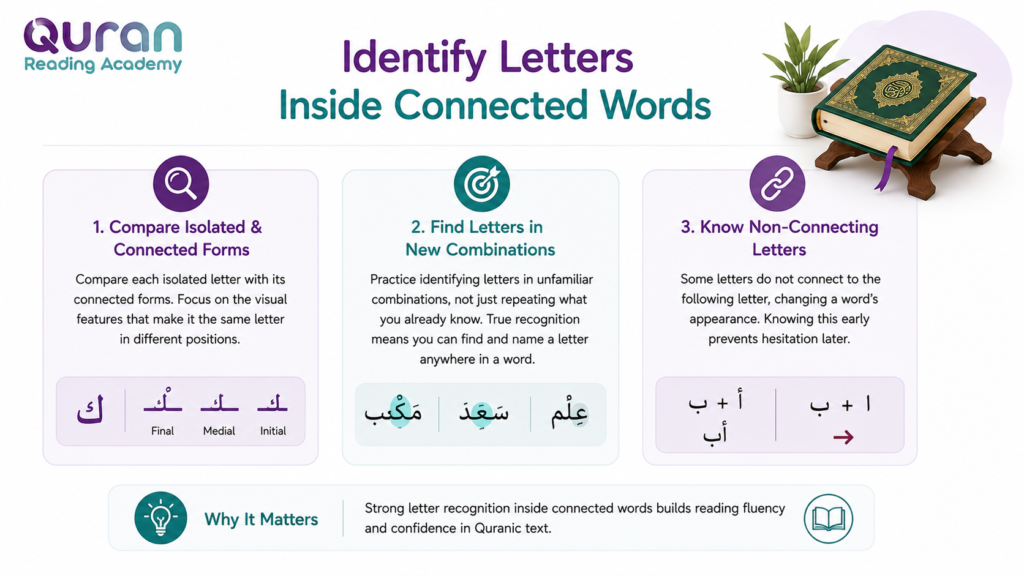
Practice identifying letters inside unfamiliar combinations rather than only repeating examples already memorized from the page. Genuine recognition means you can locate and name a letter even when its neighboring letters and position have changed.
Some Arabic letters also do not connect to the following letter, which affects the appearance of a word. Recognizing these connection patterns early prevents unnecessary hesitation when the same structures appear later in Quranic text.
Blend Sounds Without Extra Vowels
After identifying connected letters, pronounce their written sounds continuously without inserting vowels that are not present. Beginners sometimes add extra sounds between letters because separating every character feels easier than moving directly between Arabic sound units.
Begin slowly and preserve accuracy while reducing pauses between letters. Speed should emerge from increasingly automatic recognition rather than forcing the tongue to move faster than the eyes can correctly decode the written pattern.
A useful test is reading an unfamiliar combination containing rules you already know. If you can decode it accurately without memorization or transliteration, the foundational reading process is beginning to work as intended.
Step 4. Master Tanween and Sukoon Patterns
Tanween and Sukoon introduce reading patterns that require greater control than basic short vowels. Tanween adds an audible n ending, while Sukoon indicates that a letter carries no vowel and connects directly to the sound before it.
These patterns should be practiced slowly before increasing reading speed. The learner must recognize the written mark immediately, produce exactly what it indicates, and avoid inserting extra vowel sounds between consonants during connected reading.
Read Tanween as a Complete Sound
Tanween appears as double Fathah, double Kasrah, or double Dammah and produces an ending n sound. Practice each form separately until you can distinguish the three patterns immediately without stopping to identify the marks.
Read examples aloud while keeping the vowel and final n sound connected. Avoid exaggerating the ending or separating it into another syllable because the objective is smooth recognition of the complete written sound pattern.
After mastering each type independently, mix all three within the same exercise. Randomized practice confirms whether you recognize the written mark itself instead of predicting the sound from a memorized sequence on the Qaida page.
Control Letters Carrying Sukoon
Sukoon means that the marked letter has no vowel of its own. The tongue moves from the preceding vowel directly into the Sakin letter, making accurate articulation especially important when two sounds meet closely.
Beginners commonly add a hidden Fathah, Kasrah, or Dammah after the Sakin letter. This changes the written pronunciation, so practice should focus on stopping the sound cleanly without creating an additional syllable.
Use short combinations first, then move into longer patterns containing familiar letters. When Sukoon becomes comfortable, Quranic words become easier to decode because the learner can connect consonants without needing a vowel after every letter.
Start Your Quran Learning Journey Today
Join Quran Reading Academy and begin structured, step-by-step Quran reading with expert guidance.
Try your first class for freeStep 5. Master Shaddah and Madd Patterns
Shaddah and Madd require the learner to control sound duration rather than simply identify letters. Shaddah strengthens a consonant through doubling, while Madd introduces vowel extension according to recognizable written patterns.
Both skills expose weak foundations quickly. If letter recognition or short vowels remain uncertain, learners often hesitate, overextend sounds, or ignore the marks completely, so earlier lessons should remain part of regular review.
Read Shaddah as a Doubled Letter
Shaddah indicates that a consonant effectively combines a Sakin letter with the same letter carrying a vowel. Understanding this structure helps you produce the sound correctly instead of treating Shaddah as simple visual emphasis.
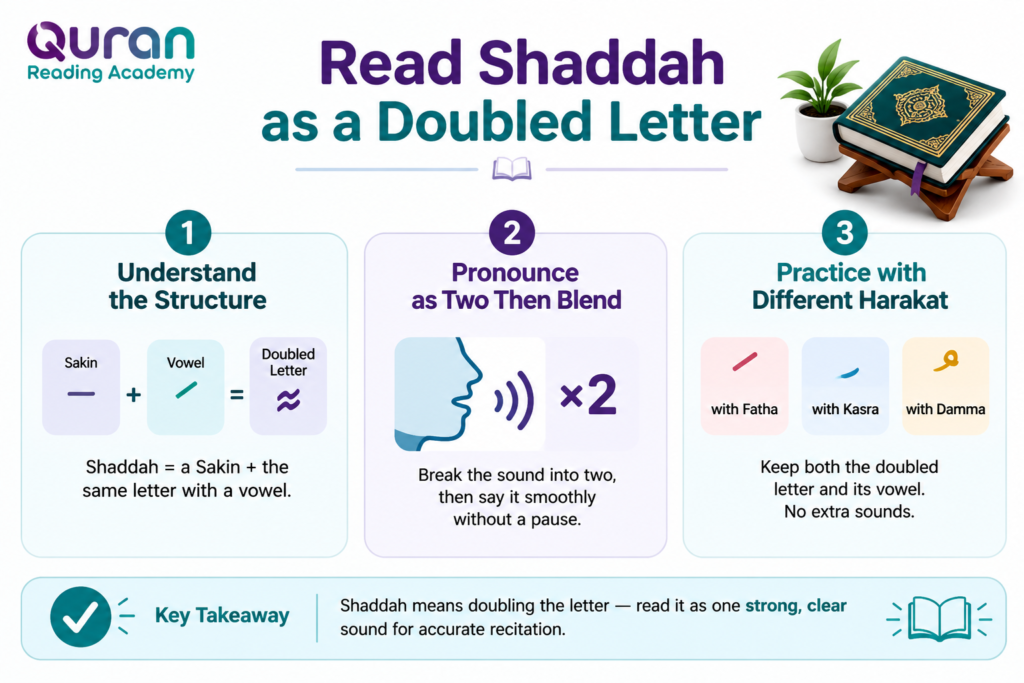
Begin by breaking the doubled sound into its two components, then blend them without an artificial pause. This method makes the physical action of Shaddah clearer and prevents the learner from pronouncing the marked consonant as an ordinary single letter.
Practice Shaddah with different Harakat because the vowel following the doubled consonant can change. Accuracy means preserving both elements, the strengthened consonant and its written vowel, without adding sounds that do not appear in the text.
Distinguish Short and Long Vowels
Madd introduces extended vowel sounds that must remain clearly different from ordinary Fathah, Kasrah, and Dammah. A learner who stretches every vowel cannot preserve this distinction when reading longer Quranic passages.
Compare short and extended forms directly during practice. Alternating between them trains the ear and tongue to recognize that vowel duration carries a specific reading function rather than serving as optional vocal decoration.
At this stage, recording your practice can expose obvious inconsistencies, but recordings cannot confirm every articulation error. Teacher feedback remains important because learners may repeatedly produce a sound incorrectly without recognizing the difference themselves.
Step 6. Build Fluency Through Daily Practice
Fluency develops when correct decoding becomes increasingly automatic through consistent practice. It should never mean rushing through exercises, because faster repetition of unstable pronunciation simply strengthens the same errors at a higher speed.
A productive routine combines previous lesson review, focused practice of one new pattern, and unfamiliar examples that test transfer. This structure develops retention while revealing whether the learner genuinely understands a rule or merely remembers the page.
Review Before Learning New Material
Begin each session with material you studied previously rather than immediately opening the next lesson. Reviewing older combinations forces the brain to retrieve established patterns and shows which skills have remained stable between practice sessions.
Do not review only yesterday’s page. Regularly return to earlier letters, Harakat, Sukoon, Tanween, and connected forms so foundational skills remain active while more complicated patterns are added to your reading.
A noorani qaida master reading the quran can support this review by giving you accessible exercises between lessons. It should function as practice material, however, rather than replacing listening and pronunciation correction from a qualified teacher.
Use Accuracy Before Reading Speed
Set an accuracy target before thinking about speed. Read a short exercise slowly without guessing, unnecessary pauses, inserted vowels, or uncertain letters, then repeat it slightly more smoothly while preserving the same pronunciation.
If accuracy drops when speed increases, return to the slower pace. Fluent Quran reading develops when correct responses become automatic, not when a learner deliberately forces faster movement through material that has not yet become stable.
Quran Reading Academy’s Arabic Reading Practice Course helps learners strengthen reading speed, automatic letter recognition, and confidence through repeated drills and guided recitation after foundational decoding skills have been established.
Build smoother Quran reading with guided practice and start your free lesson today
Step 7. Apply Qaida Skills to Quranic Words
The transition from Qaida exercises to Quranic text should happen gradually rather than through an abrupt jump into long passages. Start with short Quranic words containing letter and vowel patterns you have already mastered.
This stage reveals whether your skills are transferable. Familiar Qaida rows can become easy through repetition, while an unfamiliar Quranic word forces you to recognize each mark and apply the same reading principles independently.
Decode Unfamiliar Quranic Words
Choose short words containing known letters, Harakat, Sukoon, Tanween, Shaddah, or Madd patterns. Read them by decoding what appears on the page rather than trying to remember how you have previously heard the word recited.
Break a difficult word into manageable sound units when necessary, then reconnect those units until the pronunciation becomes continuous. This keeps the learner focused on the written structure while gradually developing smoother reading.
This is the practical purpose of reading al quran noorani qaida exercises. Qaida mastery matters because its rules must eventually work outside the primer when the learner encounters unfamiliar words and verses in the Mushaf.
Compare Reading with Correct Recitation
After attempting a word or short passage yourself, listen to a reliable recitation and compare the pronunciation. Pay attention to letters you hesitated over, vowel length, doubled consonants, and places where your reading sounded different.
Listen after making your own attempt rather than copying audio immediately every time. Independent decoding tests whether you can actually read the written text, while comparison afterward gives you a reference for detecting noticeable differences.
Do not imitate melody at the expense of pronunciation. At this stage, accurate letters, vowels, and sound lengths matter more than reproducing the voice or rhythm of a favorite Quran reciter.
Step 8. Correct Pronunciation Before It Becomes Habit
Pronunciation errors become harder to remove after repeated practice because the tongue begins treating the incorrect movement as normal. Effective Qaida learning therefore requires correction while each new sound and reading pattern is still developing.
Self study can strengthen recognition and repetition, but learners cannot always hear their own Makharij mistakes. Qualified feedback is especially valuable when letters sound similar to an untrained ear despite requiring different articulation inside the mouth or throat.
Identify Similar Letter Errors
Several Arabic letters require deliberate comparison because beginners may replace an unfamiliar Arabic sound with the closest sound from their native language. This can happen even when the learner correctly recognizes the written letter.
Practice difficult pairs separately and then place them inside short combinations. Comparing س with ص, ت with ط, د with ض, ك with ق, and ه with ح helps train both auditory discrimination and physical articulation.
Do not judge pronunciation only by whether the sound feels comfortable. A familiar mouth movement can still be incorrect, especially when years of speaking another language have trained the tongue to substitute its nearest native sound.
Use Teacher Feedback Strategically
Teacher correction is most valuable when it identifies the cause of an error rather than simply asking you to repeat the word. You need to know whether the problem involves Makhraj, vowel length, letter recognition, or sound connection.
Keep a small record of recurring corrections and review those sounds before each session. This creates targeted practice instead of repeatedly reading material you already handle correctly while persistent weaknesses remain untouched.
Quran Reading Academy’s Quran Reading Course for Beginners provides guided reading practice for learners progressing from foundational Arabic decoding toward fluent Quran reading, with correction focused on pronunciation and essential reading patterns.
Strengthen your foundation with expert guidance and start your free lesson today
Step 9. Move from Qaida to Quran Reading
Completing Qaida pages is not the real measure of readiness for Quran reading. You are ready to progress when you can recognize familiar rules inside unfamiliar Arabic combinations without guessing, transliteration, or constant prompting.
The transition should remain gradual because Quranic verses combine several reading patterns at once. Start with manageable passages, maintain the accuracy developed during Qaida study, and increase reading volume only when that accuracy remains stable.
Test Skills with Unfamiliar Text
Choose a short Quranic passage that you have not memorized and identify its letters, Harakat, Sukoon, Shaddah, Tanween, and Madd patterns. The unfamiliar text prevents memory from hiding weaknesses in actual reading ability.
Read slowly on the first attempt and mark every place where you hesitate. Those hesitation points reveal which foundational patterns still require review more accurately than repeatedly completing familiar Qaida exercises from beginning to end.
This transfer test is one of the clearest ways to evaluate how to learn Noorani Qaida online successfully. The objective is independent decoding that continues working when the learner leaves the Qaida page and opens the Mushaf.
Read Also: How to Read Quran If You Don’t Know Arabic
Maintain Accuracy During Longer Reading
Reading complete verses creates a new challenge because attention must remain accurate across longer sequences. Learners sometimes begin carefully but lose vowel length, articulation, or letter distinctions as they approach the end of a verse.
Use short passages until consistent pronunciation can be maintained throughout them. Gradually increase the amount you read while continuing to stop whenever an uncertain letter or unfamiliar combination appears instead of guessing and moving forward.
The strongest transition occurs when Qaida skills become automatic enough that your attention can gradually shift toward Tajweed and recitation quality. Foundational decoding remains active, but it no longer consumes all your concentration.
Read Also: How to Learn Quran Reading with Tajweed Juz 30
Avoid Common Noorani Qaida Mistakes
Small practice mistakes can slow your progress even when you study consistently. The most important rule is to prioritize accurate reading over finishing lessons quickly, especially when pronunciation or letter recognition remains uncertain.
Read Also: How to Concentrate While Reading Quran
Avoid Moving Forward Too Quickly
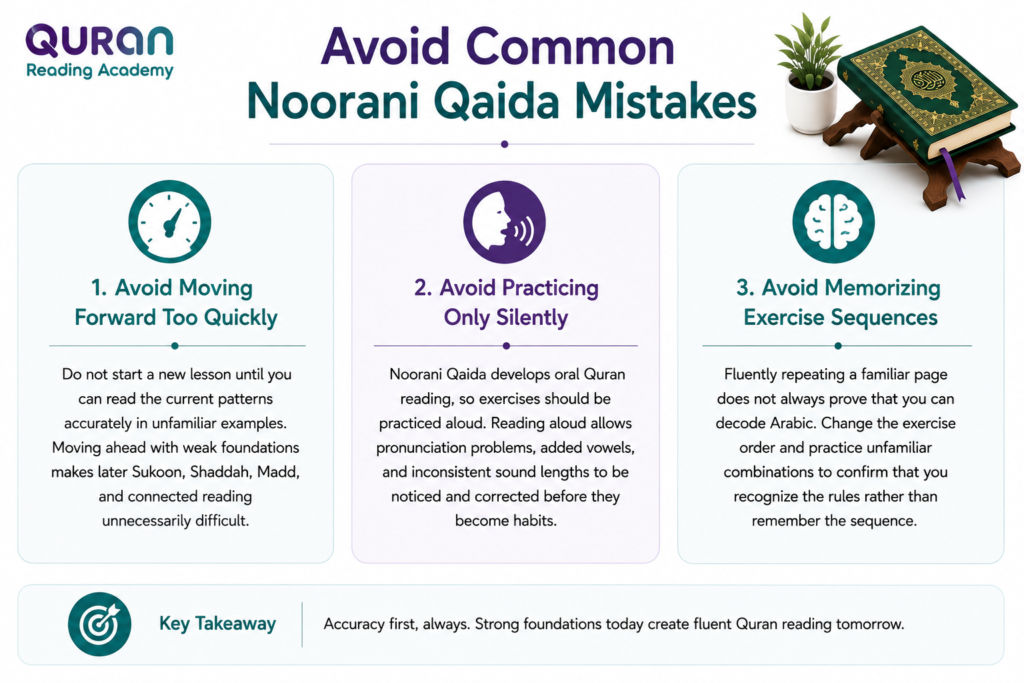
Do not start a new lesson until you can read the current patterns accurately in unfamiliar examples. Moving ahead with weak foundations makes later Sukoon, Shaddah, Madd, and connected reading unnecessarily difficult.
Read Also: How to Start Reading Quran Daily in 7 Proven Steps
Avoid Practicing Only Silently
Noorani Qaida develops oral Quran reading, so exercises should be practiced aloud. Reading aloud allows pronunciation problems, added vowels, and inconsistent sound lengths to be noticed and corrected before they become habits.
Read Also: How to Learn to Read Quran Online for Kids Step by Step
Avoid Memorizing Exercise Sequences
Fluently repeating a familiar page does not always prove that you can decode Arabic. Change the exercise order and practice unfamiliar combinations to confirm that you recognize the rules rather than remember the sequence.
Inside Our Live Classroom
We believe in complete transparency. Take a look inside our virtual classrooms to experience our premium teaching tools and engaging learning environment firsthand.
Start Your Quran Learning Journey Today
Join Quran Reading Academy and begin structured, step-by-step Quran reading with expert guidance.
Try your first class for freeStart Guided Noorani Qaida Training
Quran Reading Academy’s Noorani Qaida Course gives beginners structured one to one guidance from Arabic letter recognition through connected reading, helping students correct pronunciation as they build the foundation required for Quran recitation.
Start your free lesson today and build your Quran reading foundation with expert guidance
Begin Your Free Trial Session
A free trial session gives you a practical starting point before committing to a study plan. Your current reading can be assessed so you know which Qaida skills are already stable and which require focused correction.
Instead of restarting material you already understand or skipping weaknesses you cannot identify yourself, guided assessment helps place your practice at the appropriate level and gives your next sessions a clearer direction.
Our Quran Courses
- Quran Reading Classes
- Quran Reading Classes for Kids
- Quran Reading Classes for Adults
- Quran Reading Classes for Female/Sisters
- Quran Reading Classes for New Muslims
- Quran Reading Course for Beginners
- Online Quran Reading Course with Tajweed
- Reading and Memorizing the Quran Course
- Noorani Qaida Course
- Quran Course for Beginners
- Quran Tajweed Course
- Quran Recitation Course
- Quran Hifz Course
- Online Quran Qirat Classes
- Quranic Arabic Course
- Arabic Reading Practice Course
Conclusion
Learning Noorani Qaida successfully depends on progression, not speed. Begin with accurate letter recognition and pronunciation, then build through Harakat, connected forms, Tanween, Sukoon, Shaddah, Madd, and increasingly independent reading.
The most useful practice combines reading aloud, regular review, unfamiliar examples, and correction before mistakes become automatic. A PDF can provide exercises, but actual reading ability develops when you can apply those patterns beyond memorized pages.
Once you can decode unfamiliar Quranic words accurately without transliteration or guessing, Noorani Qaida has achieved its central purpose. You can then move into Quran reading while continuing to refine Makharij, Tajweed, fluency, and recitation quality.
Frequently Asked Questions
How long does Noorani Qaida take to learn?
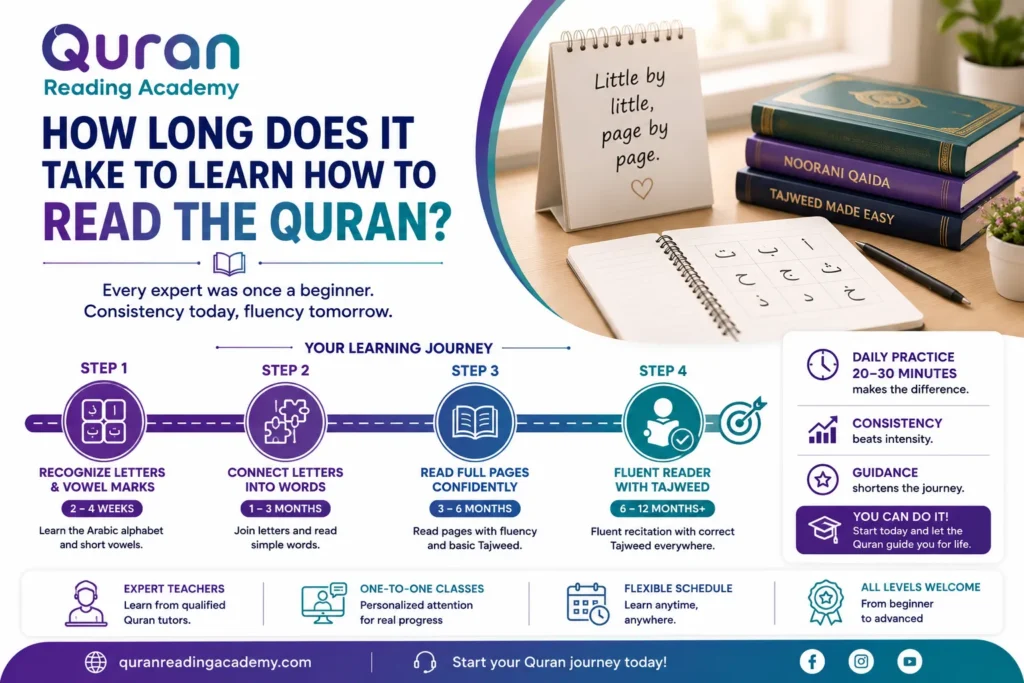
The learning period depends on your starting level, practice consistency, pronunciation difficulties, and lesson frequency. Progress should be measured by accurate recognition and transferable reading ability rather than finishing the book within a fixed number of weeks.
Can adults learn Noorani Qaida online?
Yes. Adults can learn Noorani Qaida online from the beginning by following the same progression from letters and vowels toward connected reading. Adults should prioritize correct pronunciation rather than rushing because familiar language habits can influence Arabic sounds.
Can I learn Noorani Qaida without a teacher?
You can independently practice letter recognition, written patterns, and lesson review, but pronunciation is harder to evaluate alone. Teacher feedback is particularly useful for Makharij because beginners may not hear subtle differences between their pronunciation and the target sound.
Should I learn Tajweed with Noorani Qaida?
Noorani Qaida establishes the reading foundation needed for later Tajweed study. Basic pronunciation principles can be introduced during Qaida lessons, while detailed Tajweed becomes more useful once letters, vowels, and connected Arabic reading no longer require constant conscious decoding.
When should I start reading the Quran?
Start transitioning into short Quranic passages when you can accurately decode unfamiliar combinations containing the Qaida patterns you have studied. You should not need transliteration, memorized word shapes, or constant prompting to recognize basic letters and vowel marks.
Is a Noorani Qaida PDF enough for beginners?
A Noorani Qaida PDF can provide useful exercises and structured review, but it cannot hear your pronunciation or correct articulation mistakes. Combining written practice with accurate audio and qualified feedback gives beginners a more complete learning process.







Leave a Reply