 Quran
Quran

Reading the Quran consistently is one of the most rewarding spiritual commitments a Muslim can make — yet most readers struggle not with motivation, but with follow-through. A quran reading tracker turns scattered good intentions into a visible, measurable daily practice that compounds over time.
The difference between readers who finish a full Khatam and those who stall at Surah Al-Baqarah almost always comes down to one thing: a system. Without a structured way to log what you read, when you read it, and what needs revision, progress becomes invisible — and invisible progress is the fastest route to quitting.
This guide breaks down exactly why tracking works, the best methods and tools available, and how to build a tracking system that fits your schedule — whether you are a beginner, a Hifz student, or a parent helping your child stay consistent.
At Quran Reading Academy, we see this pattern daily: students who track their recitation outperform those who don’t, not because they are more talented, but because they never lose sight of where they are.
Quran Reading Tracker
Record your reading, review your progress, and adjust your goal to build a consistent Quran habit.
0
Total Pages
0
Day Streak
0
Sessions
0
Minutes
Khatam Progress
0%
0 / 604 pages
604 pages remaining
Log Your Quran Reading
Record your session immediately after reading.
Current Daily Goal:
2 pages
Keep your target realistic and sustainable.
Recent Sessions
Your latest Quran reading activity.
Weekly Review
Review your last 7 days and identify your real reading pattern.
0
Total Pages
0
Reading Days
0
Avg. Pages / Day
0
Minutes
Reading Breakdown
New reading and Muraja’ah are tracked separately.
New Reading
0
pages this week
Muraja’ah / Revision
0
pages this week
Your Weekly Insight
Start recording your reading to see your weekly insight.
The goal is consistency, not simply reading a large number of pages.
Monthly Recalibration
Compare your target with your actual reading pattern and set a sustainable goal.
Current Daily Goal
2 pages
Actual Monthly Average
0 pages
Suggested Goal
2 pages
Recommendation
Keep recording your sessions.
After you have enough data, this section will
help you adjust your goal based on reality.
Long-Term Progress
Your total reading progress toward a complete Khatam.
Quran Completion
0%
Saved successfully.
The Importance Of Tracking Quran Recitation
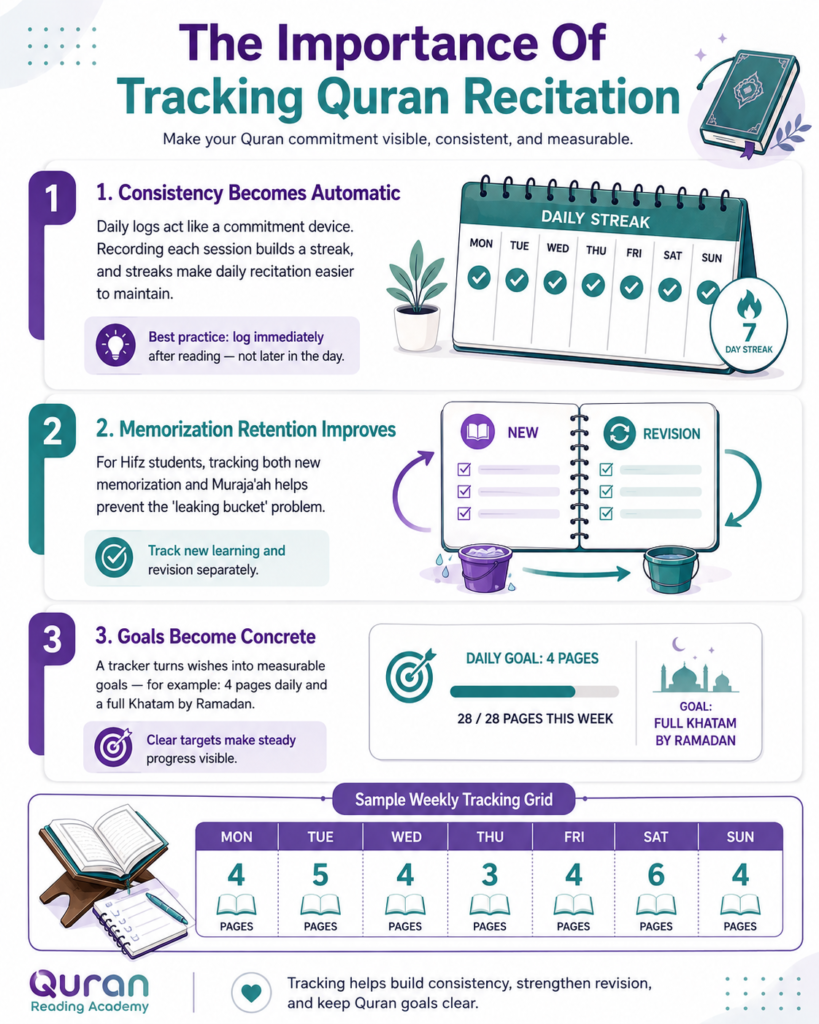
Tracking Quran recitation is not about turning worship into a spreadsheet exercise. It is about making your commitment visible so your mind treats it as non-negotiable — the same psychological principle behind every successful habit-building system.
1. Consistency Becomes Automatic
Daily logs create what behavioral researchers call a “commitment device.” When you record each session, you build a streak — and breaking a streak feels costly.
This is why students at Quran Reading Academy who use a quran reading tracker maintain daily recitation at significantly higher rates than those relying on memory alone.
A practical pattern that works: log immediately after reading, not at the end of the day. Delayed logging leads to estimation, and estimation leads to skipped entries within the first week.
2. Memorization Retention Improves Through Scheduled Revision
Tracking is especially critical for Hifz students. Memorizing new ayahs without scheduling Muraja’ah (revision) of older portions leads to what Quran teachers call “the leaking bucket” — new surahs go in while old ones slip out.
A well-structured tracker assigns specific revision slots, so you always know which Juz needs attention this week.
The common mistake here is tracking only new memorization. Effective trackers log both new learning and revision separately, because they serve different purposes and require different time allocations.
3. Goals Become Concrete
“I want to read more Quran” is not a goal — it is a wish. “I will complete 4 pages daily and finish a full Khatam by Ramadan” is the goal. A quran reading tracker forces this clarity by requiring you to define a target and then measure against it daily.
Read also: How To Read The Whole Quran In 10 Days?
Read Also: Reading Quran Without Understanding
Three Core Methods For Tracking Quran Reading Progress
Not every reader needs an app, and not every tracker needs to be digital. The right method depends on your learning style, your environment, and whether you are tracking for yourself or for a child.
A. Paper Journals
A dedicated notebook where you write the date, Surah name, ayah range, and session duration after each reading.
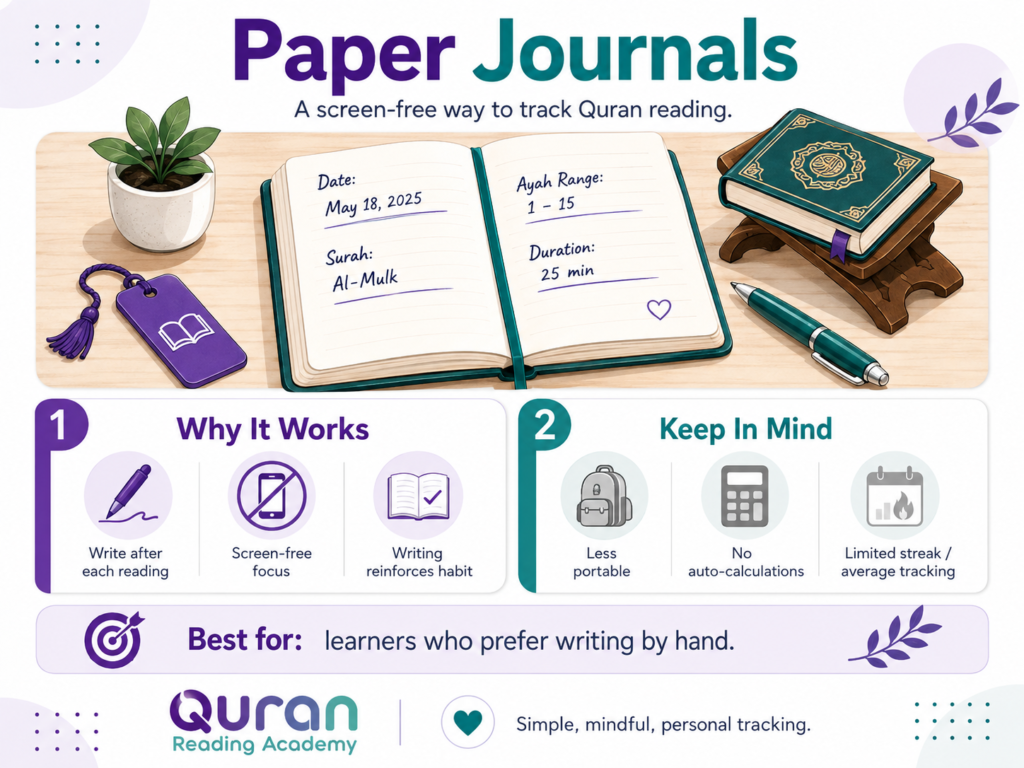
Paper journals work best for readers who find screens distracting during or after recitation, and for those who benefit from the physical act of writing as a reinforcement tool.
The limitation is portability and calculation. Paper cannot auto-calculate your weekly averages, streaks, or completion percentages — so if data visibility motivates you, a journal alone may not be enough.
B. Digital Apps
Mobile applications designed specifically for Quran tracking offer automated streaks, reminders, goal-setting, and progress dashboards. They suit readers who already use their phones for daily Quran audio or text and want everything in one place.
The risk with apps is notification fatigue. If the tracker becomes just another ignored push notification, it stops working. The best approach: choose one app, configure it once, and commit to it for 30 days before evaluating — app-hopping is the most common digital tracking failure.
Read also: How To Read The Quran In 15 Days?
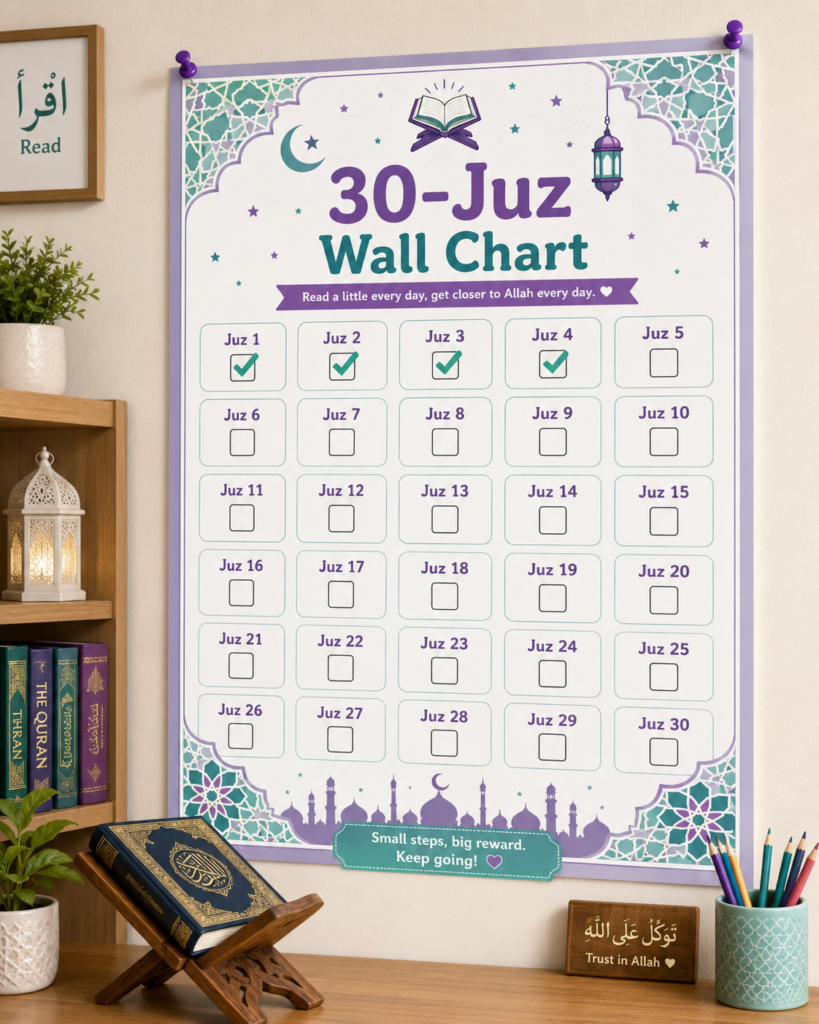
C. Wall Charts and Printed Checklists
A printed chart of all 30 Juz pinned to your reading area. You physically cross off each completed section. This method is especially effective for children and for family-wide Khatam goals during Ramadan, because progress is publicly visible and creates gentle social accountability.
At Quran Reading Academy, we recommend wall charts for younger students paired with a digital log maintained by the parent or teacher — combining the child’s visual satisfaction with the adult’s data accuracy.
Quran Reading Academy’s structured courses integrate tracking directly into the learning experience, so students do not need to build a system from scratch. Explore the available programs at Quran Reading Academy to see how guided tracking accelerates progress.
Read also: How To Complete The Quran In 30 Days?
See Our Academy in Action
Discover what a typical session looks like! Watch these brief highlights from our live, interactive classes to see how our instructors engage with students of all ages.
Start Your Quran Learning Journey Today
Join Quran Reading Academy and begin structured, step-by-step Quran reading with expert guidance.
Try your first class for freeBest Quran Reading Tracker Apps Compared
Choosing the right app matters more than most readers realize. Each tool has a distinct strength, and picking one that does not match your primary goal leads to abandonment within weeks.
1. Tarteel AI
Best for Hifz students and anyone who recites aloud. Tarteel uses AI voice recognition to follow your live recitation, flag pronunciation errors, and track which portions you have reviewed.

No other app currently matches its real-time recitation feedback. The trade-off: it requires consistent microphone access and works best in quiet environments.
2. Quranly
Built specifically for habit tracking with daily streaks, customizable verse-count goals, and a hasanat (good deeds) counter.

Quranly is the strongest choice for readers whose primary challenge is consistency rather than memorization. Its focused feature set avoids the bloat that makes all-in-one apps feel overwhelming.
3. Quran.com
Completely free, ad-free, and the cleanest Mushaf interface available online. Quran.com offers precise bookmarking, translation toggles, and solid progress retention.
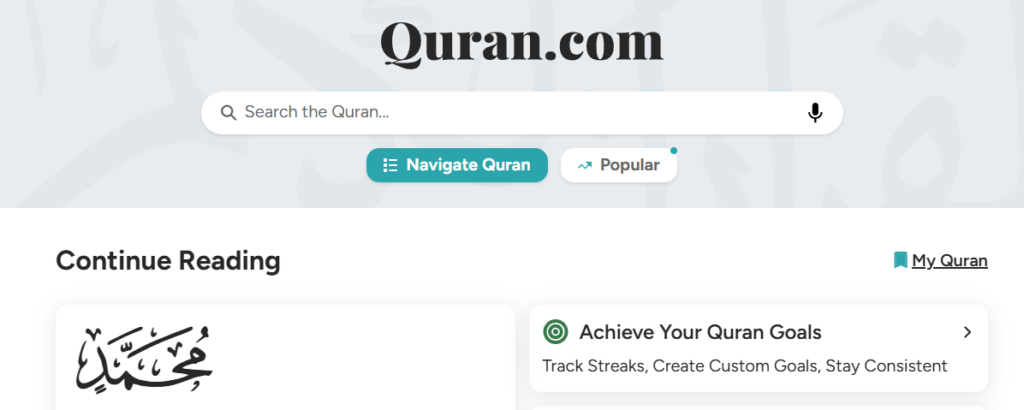
It suits readers who want a no-cost, distraction-free digital reading experience with basic tracking. It does not offer streak-based motivation features — if gamified tracking drives you, look elsewhere.
4. Al Quran (Tafsir & by Word)
Al Quran is excellent for readers focused on understanding — it tracks word-by-word learning progress alongside standard reading bookmarks. This is the right choice if your goal is comprehension-based reading rather than speed or volume.

5. Ayat (KSU)
Developed by King Saud University, Ayat provides authentic Madinah Mushaf pages with academic-grade accuracy.

It suits readers who prioritize textual authenticity and want a quran reading tracker backed by a recognized scholarly institution.
The 3R Tracking Framework: Record, Review, Recalibrate
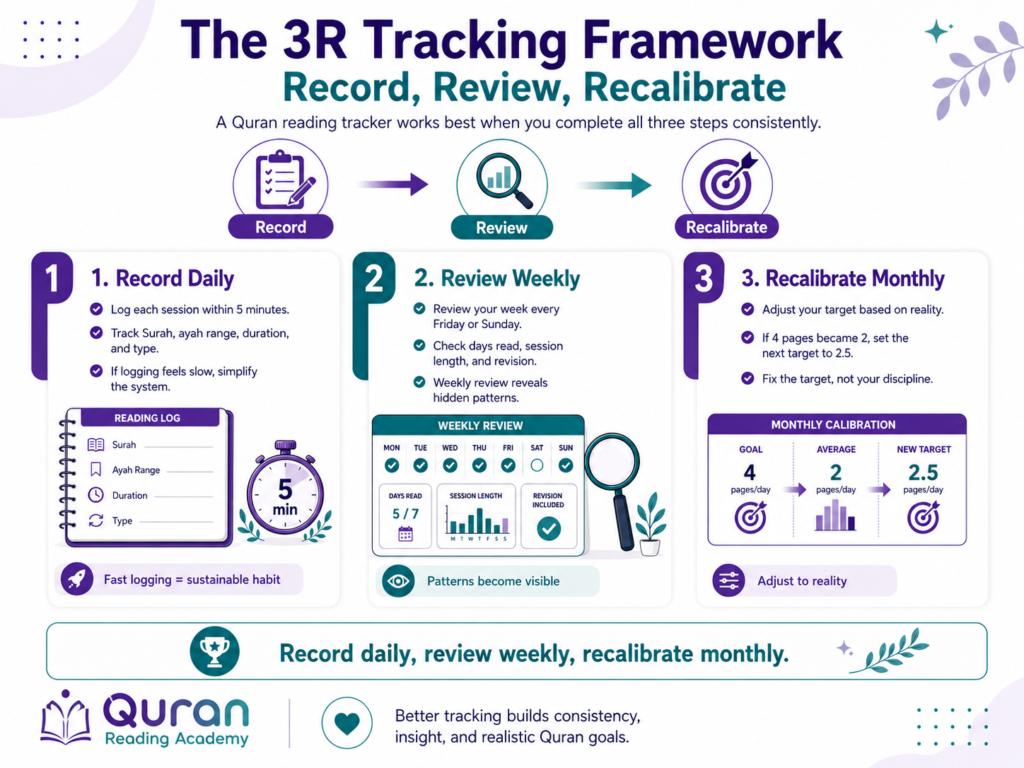
Most tracking systems fail not because the tool is wrong, but because the reader only does one-third of the work — recording. A Quran reading tracker only delivers results when you complete all three steps weekly.
1. Record Daily
Log every session within five minutes of finishing. Capture the Surah, ayah range, duration, and whether it was new reading or revision. Speed matters here — if logging takes more than 60 seconds, your system is too complex. Simplify it.
2. Review Weekly
Every Friday or Sunday, spend five minutes scanning the week. How many days did you actually read? Did your session lengths hold steady or shrink? Did you complete any revision, or was it all new reading? These patterns are invisible without a deliberate weekly review.
3. Recalibrate Monthly
At the end of each month, adjust your daily target based on reality, not ambition. If you set 4 pages daily but averaged 2, your target is wrong — not your discipline. Set it to 2.5 for the next month and build from there.
Quran Reading Academy instructors use this same principle with students: sustainable targets that increase gradually outperform aggressive plans that collapse in week two.
Common Quran Reading Tracker Mistakes That Kill Consistency
Even readers who start with a well-designed Quran reading tracker can lose momentum — not because the tool fails, but because of a few subtle habits that quietly erode the tracking routine from the inside.
Recognizing these mistakes early is the difference between a tracker that lasts for years and one that gets abandoned within a month.
1. Tracking Too Many Variables
Recording Surah, ayah, page, Juz, duration, Tajweed rule, mood, and energy level turns every session into a data-entry chore. Track the minimum that gives you useful insight — typically just date, what you read, and how long.
2. Ignoring Revision In The Log
Logging only new pages creates a false sense of progress. A reader who covers 10 new pages but revises nothing is building on sand. Your tracker must distinguish new reading from Muraja’ah — both count, but they serve different purposes.
3. Abandoning The Tracker After A Missed Day
A single missed day is not a failure — it is data. The tracker’s job is to show you that gap honestly so you can respond, not to judge you. The readers who sustain long-term recitation habits are not the ones who never miss a day; they are the ones who never miss two days in a row.
Read Also: How to Concentrate While Reading the Quran?
Inside Our Live Classroom
We believe in complete transparency. Take a look inside our virtual classrooms to experience our premium teaching tools and engaging learning environment firsthand.
Start Your Quran Learning Journey Today
Join Quran Reading Academy and begin structured, step-by-step Quran reading with expert guidance.
Try your first class for freeStart Building Your Quran Reading Habit With Expert Guidance
A Quran reading tracker gives you the system — but the right teacher gives you the structure, accountability, and correction that no app or spreadsheet can replace.
At Quran Reading Academy, every student receives personalized lesson plans, Tajweed feedback, and built-in progress tracking from certified instructors who understand what it takes to build a lasting daily recitation habit.

Whether you are starting from Alif-Ba-Ta or preparing to complete your Hifz, Quran Reading Academy’s one-on-one online sessions meet you exactly where you are.
Our Quran Courses:
- Quran Reading Classes
- Quran Reading Classes for Kids
- Quran Reading Classes for Adults
- Quran Reading Classes for Female/Sisters
- Quran Reading Classes for New Muslims
- Quran Reading Course for Beginners
- Online Quran Reading Course with Tajweed
- Reading and Memorizing the Quran Course
- Noorani Qaida Course
- Quran Course for Beginners
- Quran Tajweed Course
- Quran Recitation Course
- Quran Hifz Course
- Online Quran Qirat Classes
- Quranic Arabic Course
- Arabic Reading Practice Course

Start Your Quran Learning Journey Today
Join Quran Reading Academy and begin structured, step-by-step Quran reading with expert guidance.
Try your first class for freeConclusion
A quran reading tracker is not a luxury — it is the single most practical tool for turning irregular Quran reading into a consistent, measurable daily habit.
The method matters less than the commitment: whether you choose a paper journal, a mobile app like Tarteel or Quranly, or a simple spreadsheet, the act of recording your progress creates the visibility and accountability that sustain long-term recitation.
The key takeaway is this: track daily, review weekly, and recalibrate monthly. That rhythm — not willpower, not motivation — is what separates readers who finish a Khatam from those who stall.
And when you pair that system with structured guidance from the Quran Reading Academy, you remove the last barrier between intention and consistent action.

Frequently Asked Questions
Below are the most common questions readers ask about building and maintaining a Quran reading tracking habit.
1. What is the best Quran reading tracker app for beginners?
Quran.com is the best starting point for beginners because it is completely free, ad-free, and offers a clean Mushaf interface with simple bookmarking. It does not overwhelm new readers with advanced features, letting you focus on building a daily reading habit first before adding complexity.
2. How many pages of the Quran should I track per day?
Two pages per day completes a full Khatam in approximately 10 months. Four pages per day finishes one in about 5 months. Start with whatever number you can sustain seven days a week without strain — consistency matters far more than daily volume, and a target you actually hit builds momentum faster than an ambitious one you abandon.
3. Can I use a Quran reading tracker for Hifz memorization?
Yes, but your tracker must separate new memorization from Muraja’ah (revision) in distinct columns. Tracking only new ayahs creates a false picture of progress. Effective Hifz tracking logs both — and allocates roughly 70% of total session time to revision of previously memorized portions, which is the ratio most Quran teachers recommend.
4. How do I get back on track after missing several days?
Open your tracker, log the gap honestly, and resume with your normal daily target — not a larger “catch-up” session. Doubling your reading to compensate for missed days increases the chance of burnout and a second, longer gap. The tracker’s value is showing you the pattern: if gaps cluster on certain days, restructure your schedule around those days rather than fighting them.
5. Does the Quran Reading Academy provide tracking tools for students?
Yes. Quran Reading Academy integrates structured progress tracking into every course, so students receive regular feedback on their recitation consistency, Tajweed improvement, and memorization retention without needing to build a separate system. Learn more at Quran Reading Academy.
6. Is a paper tracker better than a digital app?
Neither is inherently better — the best tracker is the one you will actually use every day. Paper works well for readers who find screens distracting after recitation. Digital apps work better for readers who want automated streaks, reminders, and dashboards. Many successful students at Quran Reading Academy use both: a quick app log during the day and a written weekly reflection on Friday.









Leave a Reply