 Quran Reading Plans
You open a Quran app or walk into an Islamic bookshop, and suddenly there are a dozen choices. Different translators, different scripts, editions with notes and editions without. If you have ever wondered what version of the Quran you should read, you are not alone, and the answer is simpler than it looks.
So, What Version of the Quran Should I Read? There is only one Quran in Arabic. What differs is the translation and format. Most English readers should start with Sahih International for accuracy or The Clear Quran for readability, in an Arabic-English edition, and then learn to read the Arabic itself.
Below, you will find a clear 7-step guide to choosing, a quick answer to which version of the Quran you should read based on who you are, and an honest comparison of the most trusted English translations.
Is There More Than One Version of the Quran?
No. Muslims around the world read the same Quran, word for word, in the same order of 114 Surahs. What people call “different versions” are usually one of three things, and none of them changes the Quran itself.
- One Arabic text. The Quran was compiled in writing during the time of the Companions and has been preserved since. Today’s standard printed text follows the 1924 Cairo edition, and the widely used Madinah Mushaf printed by the King Fahd Glorious Quran Printing Complex is based on it.
- Recognized recitations (Qira’at). These are authentic ways of reciting the Quran, transmitted from the Prophet ﷺ through unbroken chains. Hafs an Asim is the most widespread worldwide, while Warsh is common in North and West Africa. Small differences in pronunciation or vowelling do not change the core message.
- Translations. An English translation is a human rendering of the meaning, not the Quran itself. This is where real differences exist, and where your choice matters.
If you want to understand how the text is organized, our guide to the 114 Surahs of the Quran is a good primer. And if the recitation styles interest you, you can study recognized recitation styles (Qira’at) with a qualified teacher.
See Our Academy in Action
Discover what a typical session looks like! Watch these brief highlights from our live, interactive classes to see how our instructors engage with students of all ages.
Start Your Quran Learning Journey Today
Join Quran Reading Academy and begin structured, step-by-step Quran reading with expert guidance.
Try your first class for freeWhat Version of the Quran Should I Read? 7 Steps to Choose
Follow these steps in order. Each one narrows your choice, so by the end you will know exactly which edition to pick up.
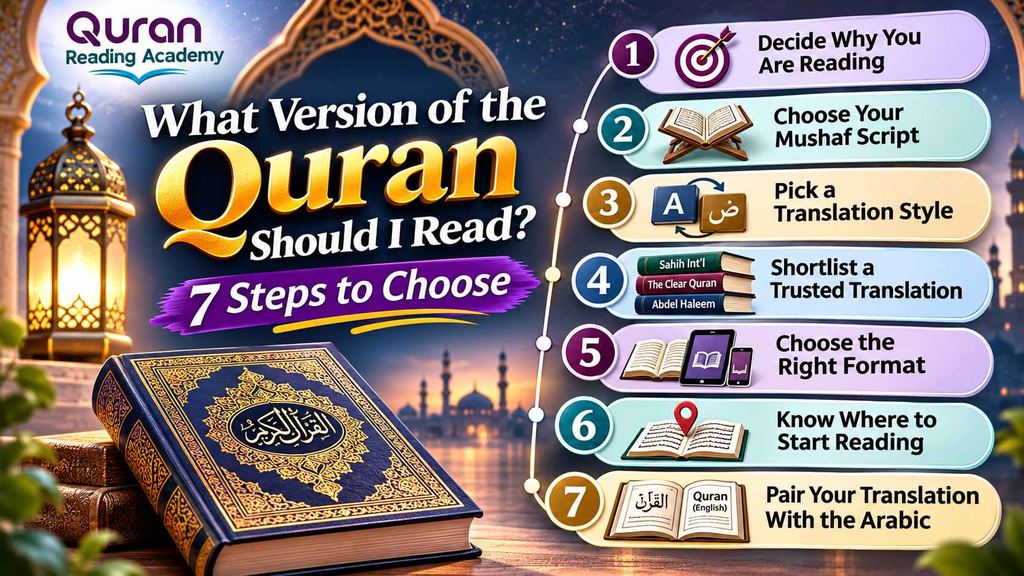
Step 1: Decide Why You Are Reading
Start with your goal, because it shapes every other choice. Most readers fall into one of four groups:
- Daily reflection: you want to read regularly and connect with the meaning.
- Serious study: you want accuracy, notes, and context for each verse.
- Learning about Islam: you are a non-Muslim or new to the faith and want a clear overview.
- Teaching children: you need simple language and a path toward reading the Arabic.
Be honest about which group you are in today. Your needs will grow, and you can always add a second edition later.
Step 2: Choose Your Mushaf Script
The Arabic text itself is printed in two common script styles. The Uthmani (Madani) script is used across most of the Arab world, in most Quran apps, and in the Madinah Mushaf. The IndoPak script is common in South Asia and among many families in the UK, and it adds extra vowel marks that some readers find helpful.
Both contain the same Quran. The best choice is usually the script your teacher, family, or local mosque uses, so you can follow along and ask for help easily. If you are still learning the Arabic alphabet, you can learn the Arabic letters with Noorani Qaida before choosing.
Step 3: Pick a Translation Style
English translations generally follow one of three approaches:
- Literal: stays very close to the Arabic wording. Ideal for study and comparison, but can feel stiff.
- Meaning-based: focuses on conveying the intended message in natural English. Easier for beginners.
- Modern: uses contemporary language and flowing paragraphs. Best for daily reading, younger readers, and new Muslims.
If you are looking for a Quran translation for beginners, a meaning-based or modern style is usually the better starting point.
Step 4: Shortlist a Trusted Translation
For most English readers, two translations are safe, reliable defaults: Sahih International for precision and The Clear Quran by Dr. Mustafa Khattab for readability. You will find a full comparison of seven translations further down.
Whatever you consider, check three things. Does the translator have formal training in Arabic and tafsir? Is the publisher reputable? Is the translation widely accepted by mainstream scholars? A translation that passes all three is a safe choice.
Step 5: Choose the Right Format
The same translation can come in different formats, and the format affects how you learn:
- Arabic-English parallel: Arabic on one side, English on the other. This is the format we recommend for almost everyone.
- Word-by-word: each Arabic word has its English meaning underneath. Excellent if you are learning Quranic Arabic.
- With tafsir (commentary): includes explanations and context. Best for study.
- With transliteration: Arabic sounds written in English letters. Useful only as a temporary bridge, because English letters cannot capture correct Arabic pronunciation.
If you rely on transliteration today, make a plan to practice reading Arabic instead of transliteration.
Step 6: Know Where to Start Reading
You do not have to start at page one. Many teachers suggest this order:
- Surah Al-Fatihah, the opening chapter you recite in every prayer.
- Juz Amma, the 30th and final part, made of short Surahs that are easy to memorize and rich in meaning.
- A narrative Surah, such as Surah Yusuf (Chapter 12) or Surah Maryam (Chapter 19), if you enjoy following a story.
Consistency matters more than length. Learn about the best times to read the Quran, and consider reading Quran after Fajr, when the mind is calm and the day has not yet begun.
Step 7: Pair Your Translation With the Arabic
A translation helps you understand the meaning. Reciting the Arabic is an act of worship in itself, and it connects you to the words exactly as they were revealed. That is why the best long-term answer to “what version of the Quran should I read” is: a good translation now, and the Arabic as soon as you can.
Learning to recite with Tajweed is more achievable than most people expect. Start with the essential rules for Quran recitation, then build from there with a teacher.
Which Version of the Quran Should I Read? Picks by Reader
If you want a fast answer to which version of the Quran you should read, find yourself in the table below.
| Reader | Recommended version | Why |
|---|---|---|
| New Muslim | The Clear Quran, Arabic-English edition | Natural, modern English with no archaic language. Pair it with Quran reading classes for new Muslims. |
| Adult beginner | Sahih International or The Clear Quran, word-by-word edition | Builds meaning and Arabic vocabulary together. See our Quran reading course for beginners. |
| Kids and teens | The Clear Quran (or its children’s edition) | Simple sentences and an easy reading flow. Combine with Quran classes for kids. |
| Student of Islamic knowledge | Sahih International plus a tafsir such as Tafsir Ibn Kathir | Close to the Arabic, with scholarly context. Deepen it with a Quranic Arabic course. |
| Non-Muslim or academic reader | M.A.S. Abdel Haleem (Oxford World’s Classics) | Fluent, scholarly English with helpful notes. |
| Reader from a South Asian background | Your preferred translation in an IndoPak-script Mushaf | Matches the script used in many local mosques and madrasas. |
| Someone memorizing (Hifz) | An Arabic-only Mushaf in one fixed script, plus a translation for review | One layout helps visual memory. Explore our Quran Hifz course. |
Best English Translations of the Quran Compared
There is no single best English translation of the Quran for everyone, but some are clearly more reliable and readable than others. Here is how the most widely used translations compare.
| Translation | Translator | First published | Style | Best for | Less suited for |
|---|---|---|---|---|---|
| Sahih International | Saheeh International team | 1997 | Precise, modern | Study, apps, reference | Readers wanting flowing prose |
| The Clear Quran | Dr. Mustafa Khattab | 2016 | Readable, natural English | New Muslims, daily reading, youth | Word-for-word study |
| The Qur’an (Oxford World’s Classics) | Dr. M.A.S. Abdel Haleem | 2004 | Scholarly, fluent | Non-Muslims, academic settings | Readers wanting Arabic alongside |
| The Study Quran | Seyyed Hossein Nasr (ed.) | 2015 | Academic, heavy commentary | Deep study of interpretation | Beginners, daily reading |
| The Holy Qur’an | Abdullah Yusuf Ali | 1934 | Classical, poetic | Historical reference, footnotes | Modern readers (archaic English) |
| The Meaning of the Glorious Koran | Marmaduke Pickthall | 1930 | Literal, archaic | Comparative study | Daily reading |
| The Noble Quran | Hilali and Khan | 20th century | Literal with many bracketed additions | Reference | Primary daily reading |
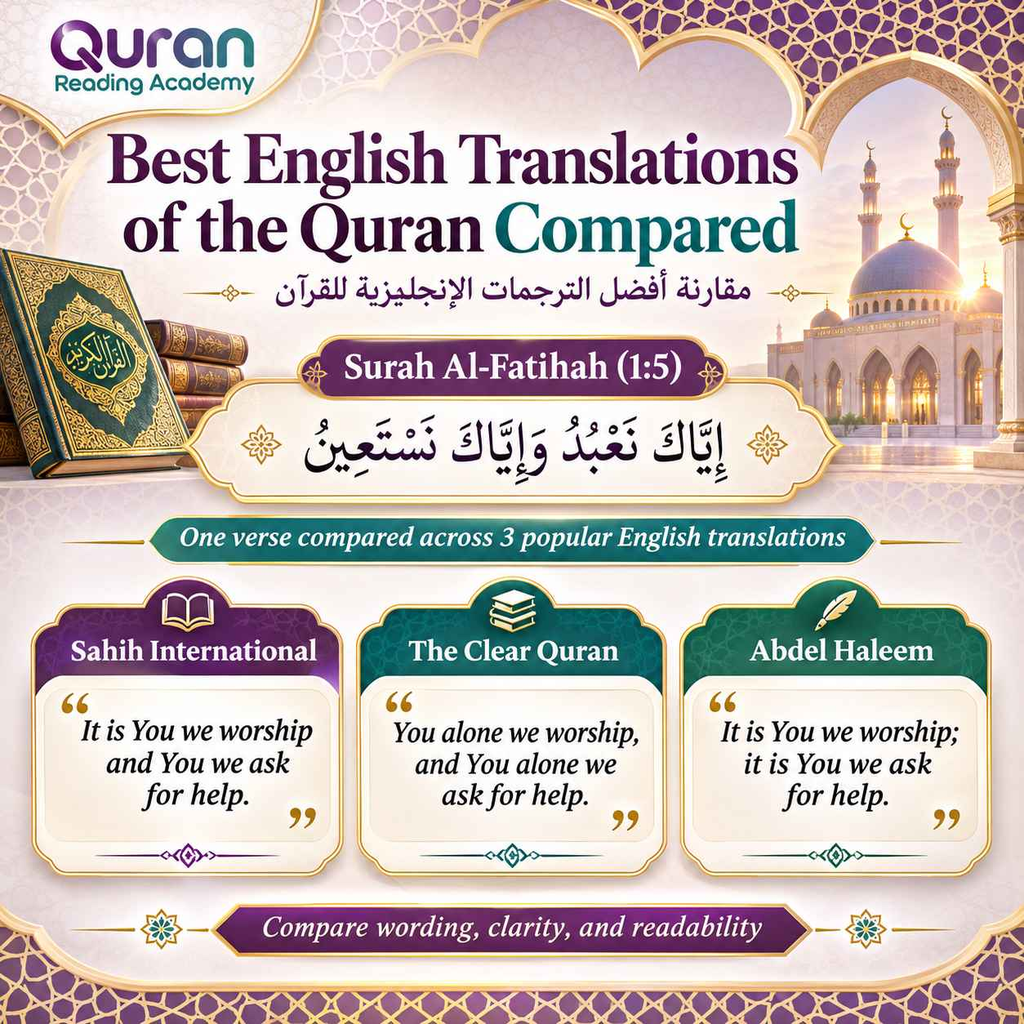
Sahih International
The most widely referenced English translation today, and the default in many apps, including Quran.com. It uses modern English and stays close to the Arabic, which makes it ideal for study and for checking the meaning of a verse precisely. In theologically dense passages, its precision can make the English feel a little stiff.
The Clear Quran
Translated by Dr. Mustafa Khattab, an Al-Azhar graduate, The Clear Quran is written for modern readers. Sentences flow naturally, and the language avoids archaic phrasing. It is one of the most recommended choices for new Muslims and for anyone who finds formal English a barrier to daily reading.
Abdel Haleem (Oxford)
Professor M.A.S. Abdel Haleem’s translation, published by Oxford University Press, combines academic rigor with clear, fluent English. It is often the best choice for non-Muslim readers, university courses, or sharing the Quran with friends who are curious about Islam.
Many Muslims also ask whether they may read the meanings in English at any time, including during menstruation. We cover that in our guide to reading a translation during your period.
Translations to Approach With Caution
Most well-known translations are made in good faith, but not every edition is equally reliable. Before you commit to a translation, watch for these warning signs:
- Commentary inside the verse text. Some editions insert long bracketed explanations that read as if they were part of the Quran. This can blur the line between Allah’s words and a translator’s interpretation.
- Translators without recognized training. A strong command of Classical Arabic and tafsir is essential. Be cautious with translations whose authors lack both.
- Editions that omit or rearrange verses. For example, Rashad Khalifa’s translation removes the last two verses of Surah At-Tawbah (9:128-129), and mainstream scholars reject it for this reason.
When you are unsure which Quran translation is best for you, ask a qualified teacher. A short conversation can save years of confusion.
Inside Our Live Classroom
We believe in complete transparency. Take a look inside our virtual classrooms to experience our premium teaching tools and engaging learning environment firsthand.
Start Your Quran Learning Journey Today
Join Quran Reading Academy and begin structured, step-by-step Quran reading with expert guidance.
Try your first class for freeTranslation, Tafsir or Arabic: What Should Come First?
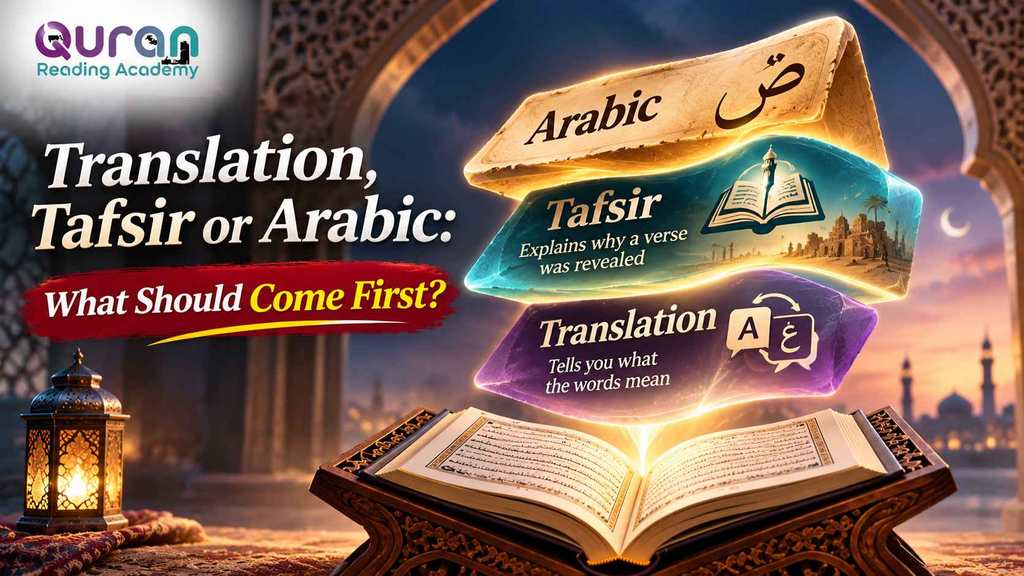
Think of them as three layers. A translation tells you what the words mean. Tafsir explains why a verse was revealed and how scholars have understood it, with classical works such as Tafsir Ibn Kathir available in English. The Arabic is the Quran itself, the words of Allah as revealed.
Most readers benefit from a reliable translation every day, a tafsir for verses they want to explore more deeply, and steady progress toward reading the Arabic. Allah describes the Quran as accessible to every sincere heart:
“وَلَقَدْ يَسَّرْنَا الْقُرْآنَ لِلذِّكْرِ فَهَلْ مِن مُّدَّكِرٍ”
“And We have certainly made the Quran easy for remembrance, so is there any who will remember?” (Surah Al-Qamar, 54:17)
The Prophet ﷺ also encouraged everyone to engage with the Quran, whatever their starting level. He said that the best of people are those who learn the Quran and teach it (Sahih al-Bukhari 5027). And he promised that the one who recites with difficulty, struggling through the words, receives a double reward (Sahih Muslim 798).
So do not wait until you are “good enough.” If you dream of understanding the Quran without a translation, a structured Quranic Arabic course can help you understand the Quran in its original Arabic, step by step.
Go Beyond Translation: Learn to Read the Quran with The Quran Reading Academy
Even the finest translation is a reflection of the meaning, not the Quran itself. Reading Allah’s words in Arabic, with correct pronunciation, opens a connection that no English edition can fully replace. That is exactly what The Quran Reading Academy helps you build.
Whatever version of the Quran you read today, our tutors can take you from translation to recitation:
- Ijazah-certified Azhari tutors with a verified Sanad, so you learn recitation through an authentic, unbroken chain of transmission.
- Personalized one-on-one online lessons tailored to your age, level, and pace.
- A clear path from zero to fluency, starting with Noorani Qaida and progressing to Tajweed and correct Makharij.
- Qualified female tutors (Ustadhas) offering private, comfortable classes for sisters.
- Flexible scheduling across US, UK, and Canadian time zones, including early mornings, evenings, and weekends.
Book Your Free Trial Lesson and experience The Quran Reading Academy’s teaching for yourself.
Our Quran Courses
- Online Quran Reading Course with Tajweed
- Noorani Qaida Course
- Quran Course for Beginners
- Quran Tajweed Course
- Quran Recitation Course
- Quran Hifz Course
- Online Quran Qirat Classes
- Quranic Arabic Course
- Arabic Reading Practice Course
Final Word
So, what version of the Quran should you read? There is one Quran, and the right translation is the one that helps you understand it and keep coming back every day.
Start with Sahih International or The Clear Quran, choose an Arabic-English edition, and begin with the short Surahs. Then take the step that changes everything: learning to read Allah’s words in Arabic. The Quran Reading Academy is here to guide you, one letter at a time.
FAQs
Which version of the Quran should I read as a beginner?
Start with The Clear Quran or Sahih International in an Arabic-English parallel edition. Both are accurate and use modern English. Begin with Surah Al-Fatihah and the short Surahs of Juz Amma. If you also want to learn to read the Arabic, our Quran course for beginners is designed for absolute beginners.
Is Sahih International or The Clear Quran better?
Neither is better for everyone. Sahih International is closer to the Arabic wording, so it suits study and reference. The Clear Quran reads more naturally, so it suits daily reading and new Muslims. Many readers keep both: one for study and one for reflection.
Is reading a Quran translation the same as reading the Quran?
No. A translation conveys the meaning in another language, but the Quran itself is the Arabic text revealed to the Prophet ﷺ. Reading a translation is valuable for understanding, while reciting the Arabic is the recitation that is rewarded letter by letter.
Can I read the Quran on my phone?
Yes. Reading on a phone or tablet is widely accepted, and most Quran apps let you switch between translations instantly. Some etiquette questions do come up, which we answer in our guide to reading Quran on your phone.
What version of the Quran should a non-Muslim read?
M.A.S. Abdel Haleem’s translation from Oxford World’s Classics is a strong choice. It is fluent, scholarly, and includes helpful introductions and notes. The Clear Quran is also a good option for readers who prefer simpler language.
Related Articles
Quran Reading Plans
Leave a Reply