 Fatawa
Reading Quran for the deceased is among the most heartfelt questions Muslims ask after losing a loved one. The desire to continue giving, to offer something of spiritual value across the boundary of death, is deeply rooted in Islamic ethics of family and community.
Scholars have debated this issue since the early centuries of Islam. Understanding both positions and what is undisputedly established gives you the knowledge to act with sincerity, confidence, and alignment with your school of thought.
Does Quran Recitation Benefit a Deceased Person?
Yes, scholars differ on whether the reward for Quran recitation can reach a deceased person. This is a recognized issue of khilaf among classical scholars, with evidence and reasoning presented by both sides.
Some scholars hold that the deceased can benefit from the reward of Quran recitation when it is dedicated to them, while others maintain that there is no specific authentic evidence establishing that recitation reaches the deceased. Therefore, the issue should be treated as a legitimate scholarly disagreement, rather than automatically labeling the opposing view as bid‘ah or heresy.
Scholarly Views on Quran Recitation for the Deceased
The core debate is whether the reward (thawab) of a recitation performed by a living person transfers to someone who has died. One group of scholars draws an analogy with dua and sadaqah, both of which are explicitly proven to reach the dead through Prophetic evidence.
The other group requires a direct Prophetic text for reward transfer and finds none specific to Quran recitation.
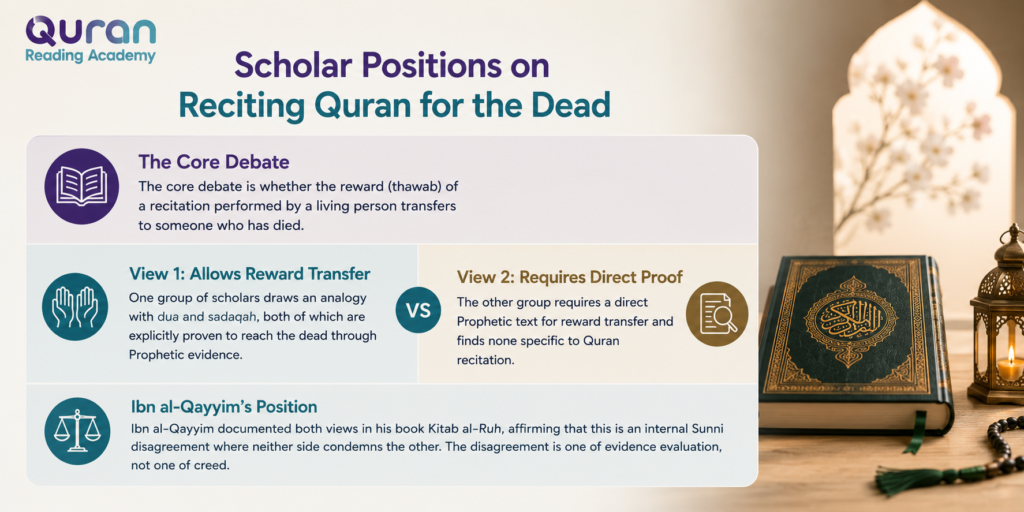
Ibn al-Qayyim documented both views in his book Kitab al-Ruh, affirming that this is an internal Sunni disagreement where neither side condemns the other. The disagreement is one of evidence evaluation, not one of creed.
Read also: Do You Get Reward for Reading Quran on Phone
Hanbali View on Gifting Quran Recitation Reward to the Deceased
Imam Ahmad ibn Hanbal and the majority of Hanbali jurists held that reciting Quran and dedicating its reward to the deceased is valid and reaches them.
Their argument is an analogy (qiyas) with established acts: since sadaqah, dua, fasting, and Hajj performed on behalf of the dead demonstrably reach them, Quran recitation follows the same principle as an act of worship.
Hanbali scholars stated broadly that any act of worship a Muslim performs and sincerely dedicates to a deceased Muslim benefits that person. The key conditions are correct pronunciation and sincere intention, not memorization or any formal ritual gathering around the deceased.
Shafi‘i View on Quran Recitation Reward for the Deceased
Imam al-Shafi’i and a portion of the early scholars held that Quran recitation reward does not transfer because no direct Prophetic text establishes it.
Acts of worship in Islam are governed by divine authorization (tawqifiyyah), meaning their scope cannot be expanded beyond what is explicitly proven.
Those who hold this position direct mourners toward dua, sadaqah jariyah, and the continuation of beneficial knowledge, all explicitly named by the Prophet as acts that reach the dead. Followers of this view are not wrong, and followers of the Hanbali view are not innovating.
Recitation with correct Tajweed carries far greater spiritual weight than rushed or mispronounced reading.
Quran Reading Academy offers the Online Quran Reading Course with Tajweed, where certified instructors guide you through proper articulation, vowel length, and the rules of stopping and continuation.
Read Quran with precision and spiritual depth
Read also: Can You Read Quran in State of Janaba
Prophetic Evidence for Deeds That Benefit the Deceased
Both scholarly positions draw on the same Prophetic texts. The difference lies in how broadly those texts are applied.
Knowing the primary evidence helps you understand why scholars reach different conclusions from the same sources.
a. Hadith on Three Deeds That Continue After Death
The foundational text on this topic is recorded in Sahih Muslim. The Prophet, peace be upon him, said:
إِذَا مَاتَ الإِنْسَانُ انْقَطَعَ عَنْهُ عَمَلُهُ إِلاَّ مِنْ ثَلاَثَةٍ إِلاَّ مِنْ صَدَقَةٍ جَارِيَةٍ أَوْ عِلْمٍ يُنْتَفَعُ بِهِ أَوْ وَلَدٍ صَالِحٍ يَدْعُو لَهُ
(Idhā māta l-insānu nqataʿa ʿanhu ʿamaluhu illā min thalātha: ṣadaqatin jāriyatin, aw ʿilmin yuntafaʿu bih, aw waladin ṣāliḥin yadʿū lah)
(“When a person dies, his deeds are cut off except three: ongoing charity, beneficial knowledge, or a righteous child who prays for him.”)
This hadith is the agreed-upon foundation. The three acts named here are not derived by analogy. They are directly stated by the Prophet and accepted by all four madhabs without reservation.
a. Hadith About Reciting Surah Yasin for the Dying
Those who permit reciting Quran for the dead also cite a hadith reported by Ma’qil ibn Yasar. The Prophet, peace be upon him, said:
اقْرَءُوا يس عَلَى مَوْتَاكُمْ
(Iqra’ū Yāsīna ʿalā mawtākum)
(“Recite Yasin over your dead.”)
Hanbali scholars and others use this hadith as direct evidence that reciting Quran for someone who has passed away is authorized. The text is cited in classical fiqh works as supporting the permissibility of reading Quran for the dead.
Before gifting the reward of your recitation, you need to ensure your recitation is correct. Quran Reading Academy provides the Noorani Qaida Course, the foundational program that teaches Arabic phonetics, letter forms, and vowel sounds to non-Arabic speakers from the ground up.
Build a strong Quranic foundation with the Noorani Qaida Course
Read also: Can You Read Quran from Phone While Praying
Acts That Benefit the Deceased Without Scholarly Disagreement
Every Muslim seeking to help a loved one who has passed should know which acts carry unanimous scholarly agreement. These form the undisputed core of what you can do, regardless of which school you follow.
Making Dua and Istighfar for the Deceased
Making dua for the dead is established by the Quran itself. Ibrahim, peace be upon him, supplicated for his parents, and the Quran records this as a model for believers:
رَبَّنَا اغْفِرْ لِي وَلِوَالِدَيَّ وَلِلْمُؤْمِنِينَ يَوْمَ يَقُومُ الْحِسَابُ
(Rabbanā ghfir lī wa li-wālidayya wa lil-mu’minīna yawma yaqūmu l-ḥisāb)
(“Our Lord, forgive me and my parents and the believers on the Day when the account is established.”)
Dua is the most powerful and undisputed act you can perform for a deceased Muslim. Shaykh Ibn Uthaymin stated explicitly that dua for the deceased is superior to charity, fasting, or any other deed gifted on their behalf, because dua is a direct appeal to Allah with no intervening scholarly debate about transfer of reward.
Read also: Can You Read Quran While Praying Taraweeh?
Giving Sadaqah Jariyah on Behalf of the Deceased
The Prophet named ongoing charity as one of the three deeds that continue benefiting the deceased. Giving sadaqah on behalf of a dead person, such as funding a mosque, a school, a well, or Islamic education is agreed upon across all four madhabs as genuinely reaching and benefiting them.
This is the most practical long-term act available to you. A monthly donation to an Islamic education fund in your parent’s name provides continuous reward as people benefit from that knowledge and those facilities over years and decades.
Becoming a person who recites the Quran consistently, with proper pronunciation and understanding, is itself an act of worship that honors those who came before you.
Quran Reading Academy offers Quran Reading Classes for Adults, structured one-on-one sessions that guide adult learners from wherever they are to confident, accurate recitation.
Join Quran reading classes designed for adult learners
Can You Read Quran at the Grave of a Deceased Person?
Yes, reading the Quran at the grave of a deceased person is a matter of scholarly disagreement. Some scholars permit it and consider that the deceased may benefit from the recitation, while others hold that there is no established Sunnah specifically supporting Quran recitation at graves.
This should be distinguished from reciting the Quran elsewhere and dedicating its reward to the deceased, since the two practices involve different scholarly discussions and evidence.
Scholarly Rulings on Quran Recitation at Graves
Shaykh al-Islam Ibn Taymiyyah stated that the early Hanbali scholars disliked recitation at graves, and that this was the majority position of the salaf.
Shaykh Ibn Uthaymin affirmed that Quran recitation at the grave was not the practice of the Prophet or his Companions, and making it a regular fixed ritual is an innovation.
Visiting graves for the purpose of remembering death is an established Sunnah. Reciting Quran there as a habitual practice on a set schedule was not part of the Companions’ documented behavior, and this applies regardless of one’s school on the broader question of gifting reward.
Gifting Quran Reward vs. Reciting Quran at the Grave
The ruling on Quran recitation for the deceased depends on where and how the recitation is performed. Understanding the distinction between dedicating its reward and reciting at the grave helps clarify the different scholarly views on each practice.
| Act | Ruling |
| Gifting recitation reward from any location with sincere intention | Disputed: Hanbali permits it; Shafi’i finds no evidence |
| One-time Quran recitation at the grave | Disliked by majority of early scholars |
| Regular, fixed habit of Quran at the grave | Bid’ah per Ibn Taymiyyah and Ibn Uthaymin |
| Dua at the grave for the deceased | Clearly established Sunnah, agreed upon |
You can follow the Hanbali view on gifting recitation reward without practicing gravesite recitation as a habit. The two questions are independent rulings and should not be confused.
Read also: Can You Read Quran for Someone Else?
How to Honor Deceased Parents Through Quran and Dua
The Prophetic hadith in Sahih Muslim describes a righteous child who prays for their parents as one of the three deeds that continue benefiting the deceased.
Building your own Quran recitation as an act of continuous worship is the most sustained tribute you can offer a parent who has passed.
Daily Recitation for Deceased Loved Ones
If you follow the Hanbali position, a consistent daily practice of reading one page or more with the intention of sending its reward to your deceased parents is valid and recognized.
The conditions are correct recitation, sincere intention, and no paid reciters or public mourning rituals attached to the practice.
Consistency over volume is the practical principle here. A small amount recited daily over years carries more cumulative weight than large single-occasion readings that are not sustained over time.
Combining Quran Recitation with Dua for the Deceased
Regardless of which scholarly position you follow on reading Quran for someone who has passed away, dua for the deceased is never in dispute.
After reciting, raising your hands and asking Allah to forgive your parents, expand their graves, and raise their ranks combines the disputed and the undisputed in one session.
This approach is sound across all schools. You recite Quran as an act of personal worship and spiritual connection, and you follow with dua that benefits the deceased in a way that carries full scholarly consensus.
Reciting Quran with Tajweed ensures that every letter is pronounced as the Prophet recited it, making your worship correct and your dedication to the deceased one of genuine quality.
Inside Our Live Classroom
We believe in complete transparency. Take a look inside our virtual classrooms to experience our premium teaching tools and engaging learning environment firsthand.
Start Your Quran Learning Journey Today
Join Quran Reading Academy and begin structured, step-by-step Quran reading with expert guidance.
Try your first class for freeRead also: Can You Read Quran If You Are Impure?
Start Your Quran Journey with Quran Reading Academy
Whether you want to recite Quran for someone who has passed away or to deepen your own connection with Allah’s Book, correct recitation is the foundation that makes every session meaningful.
Quran recited with mispronounced letters or wrong rhythm does not carry the same weight as Quran recited according to the rules of Tajweed.
Quran Reading Academy provides personalized one-on-one online Quran education for beginners and advanced students alike, taught by certified instructors in flexible sessions scheduled around your life.
Every course is designed to take you from where you are to where you want to be with the Quran.
Book your free trial session today and experience guided, accurate Quran learning from your first lesson.
Our Quran Courses
- Quran Reading Classes
- Quran Reading Classes for Kids
- Quran Reading Classes for Adults
- Quran Reading Classes for Female/Sisters
- Quran Reading Classes for New Muslims
- Quran Reading Course for Beginners
- Online Quran Reading Course with Tajweed
- Reading and Memorizing the Quran Course
- Noorani Qaida Course
- Quran Course for Beginners
- Quran Tajweed Course
- Quran Recitation Course
- Quran Hifz Course
- Online Quran Qirat Classes
Register for your free trial class and start your Quran journey today
Conclusion
Whether you can read Quran for a dead person has been a genuine scholarly disagreement for centuries. The Hanbali school and many classical scholars hold that gifting the reward of your recitation to the deceased is valid and reaches them by analogy with dua and sadaqah.
The Shafi’i school holds that no direct Prophetic evidence establishes this reward transfer, and that dua and charity are the clearest channels to the deceased.
What all scholars agree on is that dua, sadaqah jariyah, and beneficial knowledge continue reaching the deceased and benefit them without dispute. Reciting Quran at the grave as a fixed habit is separately discouraged by most classical scholars.
The most powerful thing you can do for someone who has passed away is to become a righteous person who prays sincerely for those you love, exactly as the Prophet described. That begins with learning to recite the Quran correctly, with proper Tajweed and consistent sincerity.
Read also: Why Do I Feel Sleepy When Reading Quran?
Frequently Asked Questions
Can you read Quran for a dead person if you are not a hafiz?
Yes. No condition requires memorization to gift recitation reward to the deceased. Reading from a printed Mushaf is valid. What matters is the sincerity of your intention and the correctness of your pronunciation. Improving your Tajweed through structured lessons makes your recitation a more sound act of worship.
Does reading Quran for the dead benefit them according to all scholars?
No, this is a scholarly disagreement. The Hanbali school and many classical scholars hold that the reward of recitation does reach the deceased when sincerely intended. The Shafi’i school holds there is no direct Prophetic proof for this transfer. Both positions are recognized and legitimate within Sunni Islam.
Can you recite Quran for the dead at their grave?
Making it a regular, fixed habit of reciting Quran at a grave is discouraged by most classical scholars and considered bid’ah by Ibn Taymiyyah and Ibn Uthaymin. Visiting graves for remembrance of death is an established Sunnah. Reciting Quran there as a habitual, scheduled ritual was not the practice of the Prophet’s Companions.
Can you read Quran for someone who has passed away from outside your immediate family?
Yes, the Hanbali position does not restrict gifting recitation reward to immediate family members. Any Muslim may sincerely intend the reward of their recitation for any deceased Muslim. The key condition is sincere intention, not a family relationship.
How often can you read Quran for a dead person?
There is no prescribed frequency in classical sources. Daily recitation with sincere intention is valid according to the Hanbali position. In any case, dua is more firmly established and can be performed any time, after every prayer or throughout the day, for the ongoing benefit of deceased loved ones.
What is the most beneficial act for a deceased Muslim?
Dua and istighfar are the most beneficial and undisputedly established acts for the deceased. Shaykh Ibn Uthaymin stated explicitly that dua is superior to charity, fasting, Hajj, or any other dedicated act. A consistent habit of making dua after every salah for deceased parents is the most reliably beneficial practice available.






Leave a Reply