 Quran
Quran
Grave visits hold a powerful spiritual reality in Islam. Standing near death invites reflection on accountability, the brevity of life, and the Hereafter. Muslims have visited graves since the early generations, while reciting the Quran there has remained a scholarly question for centuries.
The four schools of Islamic law discussed Quran recitation in graveyards, with views ranging from permissibility to dislike. The discussion includes the positions of the four schools, the reasoning behind them, and the acts the Prophet (peace be upon him) specifically established for grave visits.
Is Reciting Quran at a Graveyard Permissible?
Yes, reciting Quran at a graveyard is permissible according to the Shafi’i school, later Hanafi authorities, and the majority Hanbali position, while the Maliki school regards it as disliked rather than prohibited. Each school reaches its view through a different legal approach, and none treats individual recitation as outright forbidden.
The disagreement did not arise from a clear prohibition in the Quran or an authentic hadith banning graveyard Quran recitation. Rather, it arose because no authentic hadith explicitly reports the Prophet (peace be upon him) reciting Quran at a graveyard.
Scholars who emphasized strict adherence to established prophetic acts classified graveyard recitation as an addition without direct precedent. Scholars who evaluated acts by whether they are intrinsically beneficial and free from prohibition reached permissibility.
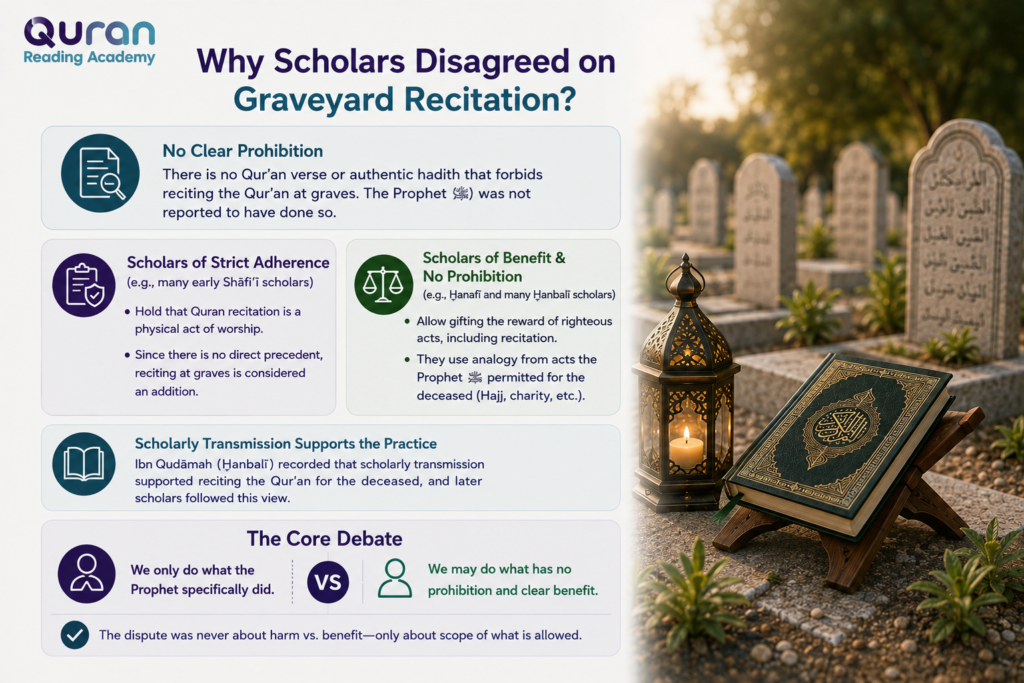
Ibn Qudamah, the authoritative Hanbali scholar, documented that scholarly transmission supported the practice, and later scholars built on that foundation.
The core debate was never between “Quran recitation is harmful at graves” and “it is beneficial”; it was between “we only do what the Prophet specifically did” and “we may do what has no prohibition and clear benefit.”
Read also: Do You Get Reward for Reading Quran on Phone
How Do the Four Schools Rule on Quran Recitation at Graveyards?
The Shafi’i school, later Hanafi authorities, and the majority Hanbali position permit Quran recitation at graveyards, while the Maliki school considers it disliked but not prohibited. The table below summarizes each position and the key reasoning behind it.
| School | Position | Key Reasoning |
| Shafi’i | Permissible | Recitation is inherently a good act; reward can be conveyed to the deceased through du’a |
| Hanafi | Later majority: permissible | Abu Hanifa disliked; Muhammad ibn al-Hasan permitted; later scholars followed Muhammad ibn al-Hasan |
| Hanbali | Majority: permissible | Three narrations from Imam Ahmad; majority position is not disliked; Ibn Umar narration supports it |
| Maliki | Disliked (not prohibited) | Concern over mixing the mindset of death-reflection with active Quran engagement; later Maliki scholars relaxed this |
The Quran itself makes clear that every soul will encounter death and stand before Allah. Surah Al-Jumu’ah places this reality in precise terms Allah describes the certainty of death in the following verse:
قُلْ إِنَّ الْمَوْتَ الَّذِي تَفِرُّونَ مِنْهُ فَإِنَّهُ مُلَاقِيكُمْ ثُمَّ تُرَدُّونَ إِلَىٰ عَالِمِ الْغَيْبِ وَالشَّهَادَةِ فَيُنَبِّئُكُم بِمَا كُنتُمْ تَعْمَلُونَ
(Qul inna al-mawta alladhi tafirroona minhu fa-innahu mulaqeekum thumma turaddoona ila ‘alimi al-ghaybi wal-shahadati fa-yunabbi’ukum bima kuntum ta’maloon)
“Say, ‘Indeed, the death from which you flee, indeed, it will meet you. Then you will be returned to the Knower of the unseen and the witnessed, and He will inform you about what you used to do.'”
Grave visits are, at their core, a reminder of this reality. Every permitted act within a grave visit, including recitation for those scholars who permit it, is framed against this backdrop of death-consciousness and reflection on accountability.
Quran Reading Academy offers a Quran Recitation Course that builds the foundational recitation skills required for accurate, confident Quran reading in study settings, in private devotional contexts, and in grave visits.
Start Your Quran Recitation Training Today
Read also: Can You Read Quran in State of Janaba
Hanbali Views on Quran Recitation at Graveyards
The majority Hanbali position permits individual Quran recitation at graveyards, although Imam Ahmad ibn Hanbal left three separate narrations on the question. Reading all three prevents the common error of citing one narration as the school’s definitive ruling.
The three narrations can be stated clearly:
- The first narration from Imam Ahmad, recorded by al-Khallal, affirmed by al-Qadi Abu Ya’la and Ibn Tamim, holds that graveyard Quran recitation is not disliked. This is the majority position within the Hanbali school. Al-Khallal recorded that Imam Ahmad was asked about reciting Surah Al-Ikhlas at a graveyard and explicitly said there was no problem with it.
- The second narration records that Imam Ahmad considered it disliked. Ibn Taymiyyah adopted this position and argued that it was the practice of the majority of the early Salaf not to recite Quran at graves. His reasoning was that specific acts of worship require specific establishment from the Prophet (peace be upon him).
- A third narration permits recitation at the time of burial specifically but not during regular return visits. This narration draws on reports that some companions recited Surah Al-Fatihah and Surah Al-Baqarah at the graveside during burial.
The Hanbali transmission attributed to Ibn Umar further supports individual permissibility: Ibn Umar reportedly instructed that Surah Al-Baqarah be recited at his grave at the time of burial.
This narration was cited by al-Khallal and formed part of the basis for the majority Hanbali ruling of permissibility.
Read also: Can You Read Quran from Phone While Praying
Hanafi View on Quran Recitation at Graveyards
The Hanafi school’s position evolved from its founding scholar’s personal preference to a clearly established ruling of permissibility in the hands of later authorities.
Abu Hanifa himself reportedly disliked reciting Quran at graves, though the basis was not a prohibition but a preference about the appropriate setting for Quran recitation.
Muhammad ibn al-Hasan al-Shaybani, one of Abu Hanifa’s principal students, held that graveyard recitation is permissible. Later Hanafi scholars followed Muhammad ibn al-Hasan, making his position the operative ruling within the school.
Al-Bukhari al-Hanafi added a refinement: silent recitation carries no objection, while reciting loudly in a way that disturbs others was considered disliked.
This progression from founding dislike to later permissibility reflects how the Hanafi school often operates: individual imam preference, student refinement, and later scholarly consensus building toward a workable ruling.
By the time classical Hanafi fiqh literature was codified, graveyard Quran recitation was no longer treated as problematic for an individual Muslim visiting a grave and reciting privately.
Quran Reading Academy offers an Online Quran Reading Course with Tajweed that trains students in proper recitation mechanics, including the articulation precision and Tajweed application required for dignified, accurate Quran reading in any setting.
Book a Free Trial Lesson with a Certified Instructor
Read also: Can You Read Quran While Praying Taraweeh?
Maliki View on Quran Recitation at Graveyards
The Maliki school’s position is that reciting Quran at graves is disliked, but this dislike falls well short of prohibition. Ibn Abi Hamzah, a classical Maliki scholar, articulated the reasoning clearly: the state of mind a person should bring to a grave visit is reflection on death and the deceased’s condition.
Actively engaging in Quran recitation, he argued, shifts the mental posture away from that reflection.
This is a coherent concern grounded in the purpose of grave visits, not a textual prohibition. The Maliki position never characterized graveyard recitation as sinful, only as misaligned with the primary purpose of the visit.
Later Maliki scholars relaxed even the dislike in specific circumstances. Alish, a prominent later Maliki authority, held that if a person recites Quran without believing it to be an established Sunnah specifically for grave visits, meaning they do it as a general act of worship and not as a prescribed grave-visit practice, there is no dislike.
Ibn Rushd’s position on gifting reward carries weight in every school, not only the Maliki. He affirmed that gifting the reward of Quran recitation to the deceased is permissible.
The mechanism is not that the recitation itself automatically transfers; it is that the person makes du’a to Allah asking Him to convey the reward to the deceased.
This framing is accepted by the Shafi’i, Hanbali, and later Hanafi scholars as well, and it reframes the entire discussion: the question is not only whether recitation is permitted at the grave, but whether the intent and the du’a that follows it constitute a recognized benefit for the deceased.
See Our Academy in Action
Discover what a typical session looks like! Watch these brief highlights from our live, interactive classes to see how our instructors engage with students of all ages.
Start Your Quran Learning Journey Today
Join Quran Reading Academy and begin structured, step-by-step Quran reading with expert guidance.
Try your first class for freeRead also: Can You Read Quran for a Dead Person?
Sunnah of Visiting Graves
Regardless of where a scholar stands on graveyard Quran recitation, the established prophetic practice at grave visits is well-documented and agreed upon by all four schools.
The Prophet (peace be upon him) taught the graveyard greeting supplication, the du’a addressed to the inhabitants of the graves beginning with the salaam, and he made du’a for the deceased during grave visits.
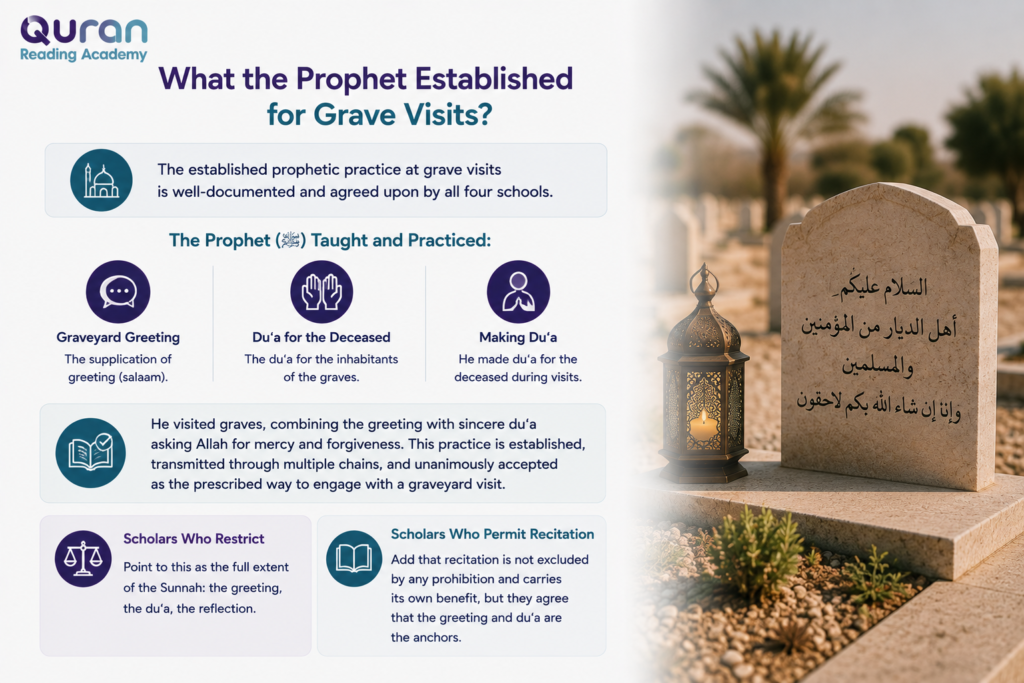
He visited graves, and his visits combined the supplication of greeting with sincere du’a asking Allah for mercy and forgiveness for those buried. This practice is established, transmitted through multiple chains, and unanimously accepted as the prescribed way to engage with a graveyard visit.
Scholars who restrict graveyard activity to what the Prophet specifically performed point to this as the full extent of the Sunnah of grave visits: the greeting, the du’a, the reflection. Scholars who permit recitation add that recitation is not excluded by any prohibition and carries its own benefit, but they agree that the greeting and du’a are the anchors.
The Prophet (peace be upon him) explicitly identified three categories of deeds whose reward reaches the deceased:
- Du’a made by the living for the deceased.
- Ongoing charity, or sadaqah jariyah, established during the deceased’s life.
- Beneficial knowledge the deceased left behind.
On the question of whether Quran recitation reward also reaches the deceased, the majority of Hanbali, later Hanafi, and Shafi’i scholars hold that it does, specifically when the reader makes du’a to Allah after the recitation asking that its reward be conveyed.
This framework explains how scholars who permit graveyard Quran recitation view its benefit. The recitation does not automatically transfer to the deceased like a mechanical transaction.
The living person recites, then turns to Allah in du’a, asking that the reward reach their deceased family member or companion. Allah then conveys it at His will.
Quran Reading Academy offers a Quran Tajweed Course that gives students the precision and rule-application needed to recite with the accuracy that reflects proper respect for the Quran, in daily prayer, personal recitation, and devotional acts such as reciting for a deceased loved one.
Enroll in Expert-Led Tajweed Training
Read also: Can You Read Quran for Someone Else?
Individual Recitation and Organized Graveyard Ceremonies
Individual Quran recitation at a graveyard is distinguished from organized paid ceremonies, which have no established basis in the Sunnah.
Hiring professional reciters to attend a grave for three days, forty days, or any fixed period after death is therefore treated differently from a personal visit and recitation.
Ibn Baz explicitly addressed this: such organized arrangements were not practiced by the Prophet (peace be upon him), by the Companions, or by the early generations of Muslims.
The reasoning is that Islamic practice requires a basis in revelation or authentic prophetic practice, and these organized recitation ceremonies, whatever their intent, represent something added to the religion without that basis.
Scholars who are otherwise permissive on individual graveyard recitation, including many classical Shafi’i and Hanafi authorities, did not advocate or endorse organized group ceremonies at graves as a practice with religious standing.
The distinction matters practically: a Muslim who visits a family member’s grave and recites a few ayat before making du’a is engaging in an act that the scholarly majority views as permissible.
A family that arranges a hired reciter to perform at the grave on fixed days following death is engaging in something the scholars consistently describe as without prescribed basis.
Quran Reading Academy offers The Best Quran Reading Classes for students seeking structured, one-on-one instruction that builds genuine recitation competence from the ground up, with certified instructors who correct errors in real time.
Read also: Can You Read Quran If You Are Impure?
Inside Our Live Classroom
We believe in complete transparency. Take a look inside our virtual classrooms to experience our premium teaching tools and engaging learning environment firsthand.
Start Your Quran Learning Journey Today
Join Quran Reading Academy and begin structured, step-by-step Quran reading with expert guidance.
Try your first class for freeImprove Quran Recitation With Qualified Instructors
Whether you are working to strengthen your own recitation or want to recite for a deceased loved one with accuracy and dignity, building real Quran recitation skills requires structured instruction from qualified teachers.
Quran Reading Academy connects students with Ijazah-certified instructors for live, one-on-one sessions that correct Makharij and Tajweed errors that self-study cannot identify.
Why students choose Quran Reading Academy
- Certified instructors with Ijazah authorization teach each class; credentials are verifiable, not self-reported.
- Live one-on-one lessons mean your recitation is heard and corrected in real time; not through pre-recorded content.
- Structured course progression from foundational letter articulation through full Tajweed rule application.
Our Quran Courses
- Quran Reading Classes
- Quran Reading Classes for Kids
- Quran Reading Classes for Adults
- Quran Reading Classes for Female/Sisters
- Quran Reading Classes for New Muslims
- Quran Reading Course for Beginners
- Online Quran Reading Course with Tajweed
- Reading and Memorizing the Quran Course
- Noorani Qaida Course
- Quran Course for Beginners
- Quran Tajweed Course
- Quran Recitation Course
- Quran Hifz Course
- Online Quran Qirat Classes
Schedule your free trial lesson
Conclusion
Classical scholars discussed Quran recitation in graveyards with important nuance. The Shafi‘i school, the later Hanafi position, and most Hanbali scholars permit individual recitation followed by du‘a that Allah conveys its reward to the deceased.
The Maliki school considers it disliked, though later Maliki scholars were more flexible when it is not treated as a fixed Sunnah.
All scholars agree on the established Prophetic practice: greeting the people of the graves, making sincere du‘a for them, and reflecting on death. Organized ceremonies, such as hiring reciters for fixed mourning periods, are distinct from personal recitation and have no Prophetic basis.
If you wish to recite Quran for a deceased family member, visit the grave, recite what you can attentively, then ask Allah to convey the reward to them. Most scholars regard this individual practice as permissible when done sincerely and without treating it as a prescribed ritual.
Read also: Why Do I Feel Sleepy When Reading Quran?
Frequently Asked Questions
Can you read Quran at the graveyard according to Islamic law?
Yes, according to the scholarly majority. The Shafi’i school, later Hanafi authorities, and the majority Hanbali position all hold that reciting Quran at a graveyard is permissible. The Maliki school considers it disliked but not prohibited, and later Maliki scholars further relaxed that position.
Does Quran Recitation at a Graveyard Benefit the Deceased?
Yes, most Hanbali, later Hanafi, and Shafi’i scholars hold that Quran recitation can benefit the deceased when the reciter asks Allah to convey its reward after finishing. The reward does not transfer automatically; it is conveyed through Allah’s acceptance of the du’a that follows the recitation.
Is hiring reciters for 40-day graveyard ceremonies allowed in Islam?
No. Organizing paid recitation ceremonies at graves for fixed periods such as 3 days or 40 days after death has no basis in the Sunnah. Scholars who otherwise permit individual graveyard recitation, including classical Shafi’i and Hanafi authorities, consistently distinguish this from unorganized individual practice and do not endorse it.
What Did the Prophet Do When Visiting Graves?
The Prophet (peace be upon him) greeted the inhabitants of the graves with salaam and made du’a asking Allah for mercy and forgiveness for the deceased. These established acts are recognized by all four schools as the prescribed practice for grave visits.
Which School of Thought Does Not Permit Quran Recitation at Graveyards?
No school holds that it is outright forbidden. The Maliki school classifies it as disliked, Ibn Taymiyyah within the Hanbali school preferred that it not be done, and scholars who emphasize strict adherence to prophetic precedent classify it as without specific basis, but none of these positions reach prohibition.








Leave a Reply