Surah To Read For Dead Parents – A Complete Guide To Honoring Them After Death
The day you lose a parent, something quiet and enormous disappears with them. The phone calls stop. The dua they made for you every night goes silent. And in the middle of the grief, one question keeps coming back: what can I still do for them?
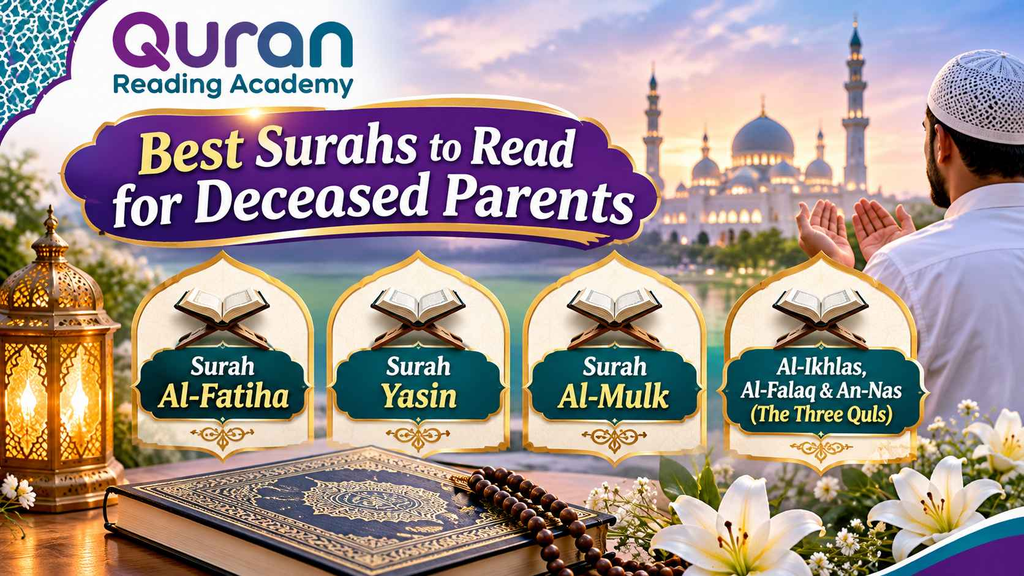
Islam’s answer is that you can do a great deal. There is no single surah to read for dead parents that the Quran or Sunnah require, but most Muslims recite Surah Al-Fatiha, Surah Yasin, Surah Al-Mulk, and the three Quls (Al-Ikhlas, Al-Falaq, An-Nas), then ask Allah to grant the reward to their parents.
Above all of these stands the one deed the Prophet ﷺ named directly: a righteous child’s dua, which keeps reaching a parent after every other deed has stopped (Sahih Muslim 1631).
In this guide, you’ll find the surahs Muslims recite for their parents and an honest look at the evidence behind each one, the Quranic duas for your mother and father in Arabic with transliteration, a simple way to recite and pray for them starting today, and what scholars say about whether the reward reaches them. Your parents spent years praying for you. Now it’s your turn to pray for them.
Is There a Specific Surah to Read for Dead Parents?
No. The Quran and authentic Sunnah do not name one surah that must be read for deceased parents. What the Sunnah does make clear is that a righteous child’s dua is one of the few deeds that keeps reaching a parent after death.
The Prophet ﷺ said: “When a person dies, his deeds come to an end except for three: ongoing charity, beneficial knowledge, or a righteous child who prays for him.” (Sahih Muslim 1631)
This is why honoring parents (birr al-walidayn) does not end at the graveside. Many Muslims combine the two: they recite chosen surahs of the Quran, then make heartfelt dua for their mother and father. If you are new to the structure of the Quran, our guide on what a surah is in the Quran explains all 114 chapters.
Start Your Quran Learning Journey Today
Join Quran Reading Academy and begin structured, step-by-step Quran reading with expert guidance.
The surahs below are the ones Muslims most often recite for deceased parents. Each has a recognized virtue, though the strength of the evidence linking it to the dead varies, and we note that honestly below.
Surah
Verses
Approx. recitation time
Evidence
Best occasion
Al-Fatiha
7
1 minute
General virtue is authentic; narrations about reciting it for the dead are weak
Any time, especially right after hearing the news
Yasin
83
15-20 minutes
Hadith about reciting it for the dead is graded weak by many scholars
Fridays and weekly remembrance
Al-Mulk
30
5-7 minutes
Intercession hadith graded hasan (Tirmidhi 2891)
Nightly, for yourself and your parents
Al-Ikhlas, Al-Falaq, An-Nas
4, 5, 6
1-2 minutes
Authentic general virtues
When grief makes longer recitation hard
Al-Baqarah 2:285–286
2
1-2 minutes
Authentic virtue (Bukhari 5009)
At night
Surah Al-Fatiha
Al-Fatiha, the “Mother of the Book,” is the most commonly recited surah for the deceased. In just seven verses, it praises Allah, affirms His mercy, and asks for guidance, which makes it a complete prayer in itself. A narration in al-Tabarani about reciting it at the head of the deceased has a disputed chain, so treat Al-Fatiha as a beloved general recitation rather than a specific Sunnah for the dead.
Surah Yasin
Surah Yasin is often called the “heart of the Quran,” and many families recite it for their parents every Friday. The well-known hadith “Recite Yasin over your dead” (Abu Dawud 3121) is graded weak by many hadith scholars, and some understood “your dead” to mean those who are dying.
Surah Al-Mulk carries one of the strongest narrations about the grave. The Prophet ﷺ said that a surah of thirty verses interceded for a man until he was forgiven, referring to Al-Mulk (Tirmidhi 2891, graded hasan).
Its themes of Allah’s dominion over life and death make it deeply fitting for remembering a parent. See when to read Surah Mulk for the best times.
Al-Ikhlas, Al-Falaq & An-Nas (The Three Quls)
These three short surahs are ideal when grief makes long recitation feel impossible. Surah Al-Ikhlas alone is described by the Prophet ﷺ as equal to a third of the Quran (Sahih al-Bukhari 5013). Children who are still learning can recite them for their grandparents too.
The Last Two Verses of Surah Al-Baqarah
Verses 285-286 close Surah Al-Baqarah with a powerful supplication for forgiveness and mercy. The Prophet ﷺ said that whoever recites them at night, they will suffice him (Sahih al-Bukhari 5009). Their closing words, “pardon us, forgive us, and have mercy on us,” make a natural bridge into dua for your parents.
Quranic Duas for Your Deceased Mother and Father
Alongside any surah, the Quran itself preserves supplications for parents. These are among the most powerful words you can say for them, because they come directly from Allah’s Book. To understand every word you pray, explore our Quranic Arabic Course.
1. Mercy for both parents (Surah Al-Isra 17:24)
Allah Himself teaches this dua in the verses commanding kindness to parents. You ask Allah to show your mother and father the same tender mercy they showed you as a helpless child, which makes it the most fitting dua for parents, living or deceased.
رَّبِّ ارْحَمْهُمَا كَمَا رَبَّيَانِي صَغِيرًا
Rabbir-hamhuma kama rabbayani sagheera
“My Lord, have mercy upon them as they brought me up when I was small.”
2. Forgiveness on the Day of Judgment (Surah Ibrahim 14:41)
Prophet Ibrahim made this dua for himself, his parents, and all believers. It looks ahead to the Day of Judgment, the moment your parents will need forgiveness most, and asks Allah to grant it to them then.
Rabbana-ghfir li wa li-walidayya wa lil-mu’minina yawma yaqumul-hisab
“Our Lord, forgive me and my parents and the believers on the Day the reckoning is established.”
3. The dua of Prophet Nuh (Surah Nuh 71:28)
Prophet Nuh made this dua after a lifetime of calling his people to Allah. It begins with forgiveness for yourself and your parents, then widens to every believing man and woman, so your prayer for your parents also becomes a gift to the whole Ummah.
Rabbigh-fir li wa li-walidayya wa liman dakhala baytiya mu’minan wa lil-mu’minina wal-mu’minat
“My Lord, forgive me and my parents and whoever enters my house a believer, and the believing men and believing women.”
4. For those who went before us in faith (Surah Al-Hashr 59:10)
Allah praises the believers who pray for those who came before them in faith. Your parents are the first of those who “preceded you in faith,” so this dua lets you pray for them in the very words Allah approved.
Rabbana-ghfir lana wa li-ikhwaninal-ladhina sabaquna bil-iman
“Our Lord, forgive us and our brothers who preceded us in faith.”
5. The Prophet’s funeral dua (Sahih Muslim 963)
This is the dua the Prophet ﷺ made in the funeral prayer of a companion, as narrated by ‘Awf ibn Malik. It asks for four things at once: forgiveness, mercy, safety, and pardon. It is short enough to memorize, so you can say it for your parent at any time; the table below shows how to adjust it for your mother, father, or both.
Allahummagh-fir lahuma warhamhuma wa ‘afihima wa’fu ‘anhuma
If you are unsure of the Arabic, you may also pray in your own language. Allah hears every sincere dua.
See Our Academy in Action
Discover what a typical session looks like! Watch these brief highlights from our live, interactive classes to see how our instructors engage with students of all ages.
How to Read Quran for Your Dead Parents: Step-by-Step
Knowing the right surah to read for dead parents is only half the answer. Here is exactly how to do it, from intention to closing dua.
Make a sincere intention. In your heart, intend to recite for the sake of Allah and to pray for your mother or father. No spoken formula is required.
Prepare yourself. Perform wudu if you will touch a printed mushaf, and choose a clean, quiet place where you can focus.
Begin properly. Say the ta’awwudh (A’udhu billahi minash-shaytanir-rajim) and the basmala (Bismillahir-Rahmanir-Rahim).
Recite your chosen surah. Pick from the surahs above. If you have only a few minutes, recite Al-Fatiha and the three Quls; on Fridays, add Surah Yasin or Surah Al-Mulk.
Ask Allah to send the reward to your parent. Raise your hands and say, in Arabic or your own language: Allahumma awsil thawaba ma qara’tu ila walidi (my father) or walidati (my mother), meaning “O Allah, convey the reward of what I recited to my father/mother.” Many scholars, including later Shafi’i jurists, recommend asking in this way through dua.
Make the Quranic duas for parents. Add Rabbir-hamhuma kama rabbayani sagheera (17:24) and the other supplications from the section above, using the right pronoun for your mother or father.
Seek forgiveness on their behalf. The Prophet ﷺ said a person’s rank in Paradise is raised, and when he asks why, he is told: “Because your child sought forgiveness for you” (Ibn Majah 3660, graded hasan). Say Astaghfirullaha li walidayya often.
Make it a routine. Consistency matters more than volume. A simple plan: the three Quls and a dua every day, and Surah Yasin or Al-Mulk every Friday.
Can I Read Quran for My Dead Parents? What Scholars Say
Yes, you can recite the Quran and pray for your parents; the scholarly discussion is only about whether the reward of recitation itself reaches them. Here are the main positions, presented fairly.
View
Who holds it
Main reasoning
The reward of recitation reaches the deceased
Hanafi and Hanbali scholars, many later Shafi’i and Maliki scholars, Ibn Taymiyyah and Ibn al-Qayyim (Kitab al-Ruh)
Analogy with charity, Hajj, and fasting, which authentic hadiths confirm benefit the dead
The reward of recitation itself does not transfer; make dua instead
The well-known classical Shafi’i view (reported by Imam al-Nawawi) and many contemporary scholars
Surah An-Najm 53:39: “A person will have nothing except what he strove for”
On one point, scholars broadly agree: dua, seeking forgiveness, charity, Hajj, and paying a parent’s debts all benefit the deceased. So whichever view you follow, reciting the Quran and then making sincere dua for your parents is safe and rewarding. For a personal ruling, follow the scholar or school you trust.
Other Ways to Benefit Your Parents After Death
Recitation and dua are only the beginning. The Sunnah describes several other deeds that continue to benefit your mother and father:
Give sadaqah jariyah on their behalf. A man told the Prophet ﷺ his mother had died suddenly and asked if charity for her would benefit her; he answered yes (Sahih al-Bukhari 2760). Wells, mosques, and Quran copies keep giving.
Perform Hajj or Umrah for them. The Prophet ﷺ permitted a woman to perform the Hajj her mother had vowed (Sahih al-Bukhari 1852).
Fast the days they owed. “Whoever dies owing fasts, his heir fasts on his behalf” (Sahih al-Bukhari 1952).
Pay their debts and fulfill their will. Settling their obligations is a priority and a direct service to them.
Keep ties with their loved ones. “The finest act of goodness is that a person maintains ties with his father’s loved ones” (Sahih Muslim 2552).
Teach or gift the Quran in their name. Donating a mushaf or sponsoring someone’s Quran learning is beneficial knowledge that keeps spreading.
Common Mistakes and Myths
Grieving families often hear conflicting advice. Here is what the evidence actually says.
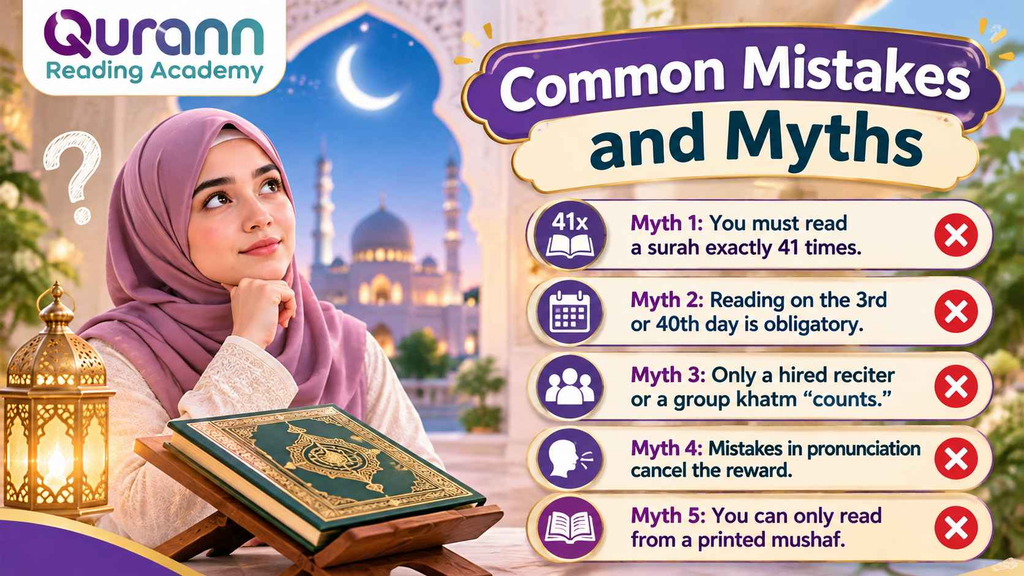
Myth 1: You must read a surah exactly 41 times. No authentic hadith sets a count for reciting for the dead. One sincere, focused recitation is better than many rushed ones.
Myth 2: Reading on the 3rd or 40th day is obligatory. These dates come from cultural custom, not the Quran or Sunnah. You can read and pray for your parents on any day.
Myth 3: Only a hired reciter or a group khatm “counts.” Your own recitation and dua as their child carry special weight, as Sahih Muslim 1631 shows. Do not wait for a gathering to start.
Myth 4: Mistakes in pronunciation cancel the reward. The Prophet ﷺ said the one who recites with difficulty receives a double reward (Sahih Muslim 798). Keep reading, and keep improving.
Myth 5: You can only read from a printed mushaf. Reading from an app is permissible; see our guide on reading Quran on your phone.
When visiting their grave. Greet them with the Sunnah greeting: As-salamu ‘alaykum ahlad-diyar minal-mu’minina wal-muslimin, wa inna in sha’ Allahu bikum lahiqun (Sahih Muslim 975), then make dua for them.
Inside Our Live Classroom
We believe in complete transparency. Take a look inside our virtual classrooms to experience our premium teaching tools and engaging learning environment firsthand.
Start Your Quran Learning Journey Today
Join Quran Reading Academy and begin structured, step-by-step Quran reading with expert guidance.
Recite for Your Parents with Confidence at Quran Reading Academy
Many sons and daughters want to read Surah Yasin or Al-Mulk for their parents but feel held back by weak Arabic or uncertain tajweed.
At Quran Reading Academy, qualified teachers help you turn that wish into a confident, beautiful recitation through live one-to-one online classes that fit your schedule. Meet our teachers, compare our plans, and take the first step today.
Your parents carried you before you could walk, fed you before you could ask, and prayed for you long before you knew what prayer was. Their deeds have now come to an end, but yours haven’t, and Allah has made a righteous child one of the few doors still open to them.
So don’t wait for the perfect surah or the perfect day. Tonight, recite Al-Fatiha and the three Quls, raise your hands, and say Rabbir-hamhuma kama rabbayani sagheera.
On Friday, add Surah Yasin or Al-Mulk. Give a small charity in their name when you can, and seek forgiveness for them often. A few minutes every day will stay with you far longer than one big effort that fades after a week.
And if weak Arabic or uncertain tajweed has held you back from reciting for them the way you want to, that doesn’t have to stay true. Every verse you learn to read correctly is one more verse you can recite for them.
Your first class is completely free, with no commitment.
There is no single required surah. The most common choices are Al-Fatiha, Yasin, Al-Mulk, and the three Quls. After reciting, make dua asking Allah to forgive your parents, have mercy on them, and grant them the reward of your recitation.
Can I read Surah Yasin for my deceased father?
Yes. Reciting Surah Yasin is a righteous act at any time, and many Muslims read it for deceased parents, especially on Fridays. The specific hadith about reciting it for the dead is graded weak by many scholars, so follow it with sincere dua for your father.
What is the best dua for my deceased mother?
Recite Rabbir-hamhuma kama rabbayani sagheera (Quran 17:24) and Allahummagh-fir laha warhamha wa ‘afiha wa’fu ‘anha, “O Allah, forgive her, have mercy on her, keep her safe, and pardon her.” Use laha (her) for your mother.
Can I read for my parents if I can’t read Arabic well?
Yes. Read what you can, pray in your own language, and keep learning; the struggling reciter earns a double reward. Our Quran Course for Beginners can help you read fluently.
Can I read Quran for my parents on my phone?
Yes. Reciting from a phone or app is permissible and carries the reward of recitation. It is a practical way to read for your parents during your commute or at night.

 Times for Reading









Leave a Reply