 Quran

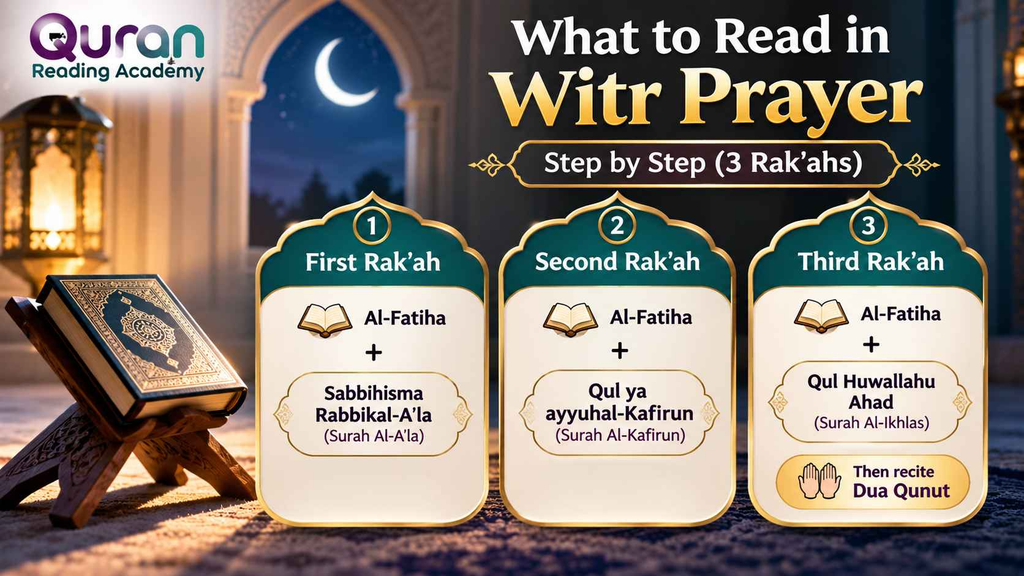
If you’re wondering what to read in Witr, the Sunnah is simple: after Surah Al-Fatihah, recite Surah Al-A’la in the first rak’ah, Surah Al-Kafirun in the second, and Surah Al-Ikhlas in the third, then make Du’a al-Qunut. Witr is the final prayer of the night, prayed any time after Isha until the start of Fajr.
This guide covers every part of it: the Sunnah surahs in Arabic with transliteration and meaning, both versions of Dua Qunut, what to read if you’re still a beginner, and how the four schools of thought differ. It’s written so you can follow it tonight, whichever school you follow.
What to Read in Witr – The Quick Answer
In a 3-rak’ah Witr, recite Surah Al-Fatihah in every rak’ah, followed by Surah Al-A’la (87) in the first, Surah Al-Kafirun (109) in the second, and Surah Al-Ikhlas (112) in the third. Du’a al-Qunut is recited in the last rak’ah in most schools, before or after ruku’, and its ruling differs by school, as the table in the Qunut section shows.
| Rak’ah | What to recite after Al-Fatihah | Extra |
|---|---|---|
| First | Surah Al-A’la (Chapter 87) | None |
| Second | Surah Al-Kafirun (Chapter 109) | Tashahhud (in the connected method) |
| Third | Surah Al-Ikhlas (Chapter 112) | Du’a al-Qunut, then Tashahhud and Taslim |
Some narrations add Surah Al-Falaq and Surah An-Nas after Al-Ikhlas in the third rak’ah, so all three Quls are recited. To learn more about the best times to recite at night, see our related guide.
Which Surah to Recite in Witr Prayer?
Which surah to recite in Witr prayer is answered by the Prophet ﷺ himself. Ubayy ibn Ka’b and Ibn Abbas both narrated that he recited Sabbihisma Rabbikal-A’la, Qul ya ayyuhal-Kafirun and Qul Huwallahu Ahad in his Witr (Sunan Abi Dawud, Sunan an-Nasa’i, Sunan Ibn Majah). Reciting them is a recommended Sunnah, not a condition for the prayer to be valid. If you’re new to the terms, here’s a short explanation of what a surah is.
Surah Al-A’la in the First Rak’ah (Chapter 87)
Surah Al-A’la has 19 verses and opens with a command to glorify Allah, the Most High. Its opening verses:
“سَبِّحِ اسْمَ رَبِّكَ الْأَعْلَى ﴿١﴾ الَّذِي خَلَقَ فَسَوَّىٰ ﴿٢﴾ وَالَّذِي قَدَّرَ فَهَدَىٰ ﴿٣﴾ وَالَّذِي أَخْرَجَ الْمَرْعَىٰ ﴿٤﴾ فَجَعَلَهُ غُثَاءً أَحْوَىٰ”
Sabbihisma rabbikal-a’la. Alladhi khalaqa fasawwa. Walladhi qaddara fahada. Walladhi akhrajal-mar’a. Faja’alahu ghutha’an ahwa.
Glorify the name of your Lord, the Most High, who created and gave form, who measured out and guided, who brought out the pasture and then turned it into dark stubble.
Why it suits Witr: it opens with tasbih, glorifying Allah, and reminds the believer that the Hereafter is better and more lasting than this world.
Surah Al-Kafirun in the Second Rak’ah (Chapter 109)
Why it suits Witr: it is a clear declaration that worship belongs to Allah alone, freeing the heart from every form of shirk before the night ends.
Arabic:
“قُلْ يَا أَيُّهَا الْكَافِرُونَ ﴿١﴾ لَا أَعْبُدُ مَا تَعْبُدُونَ ﴿٢﴾ وَلَا أَنتُمْ عَابِدُونَ مَا أَعْبُدُ ﴿٣﴾ وَلَا أَنَا عَابِدٌ مَّا عَبَدتُّمْ ﴿٤﴾ وَلَا أَنتُمْ عَابِدُونَ مَا أَعْبُدُ ﴿٥﴾ لَكُمْ دِينُكُمْ وَلِيَ دِينِ”
Qul ya ayyuhal-kafirun. La a’budu ma ta’budun. Wa la antum ‘abiduna ma a’bud. Wa la ana ‘abidun ma ‘abadtum. Wa la antum ‘abiduna ma a’bud. Lakum dinukum wa liya din.
Say: O disbelievers, I do not worship what you worship, nor do you worship what I worship. I will never worship what you have worshipped, nor will you worship what I worship. You have your religion, and I have mine.
Surah Al-Ikhlas in the Third Rak’ah (Chapter 112)
Why it suits Witr: Al-Ikhlas is pure Tawhid. Witr itself means “odd,” and the Prophet ﷺ said that Allah is Witr (One) and loves what is odd, so closing the night with the surah of His Oneness is fitting.
“قُلْ هُوَ اللَّهُ أَحَدٌ ﴿١﴾ اللَّهُ الصَّمَدُ ﴿٢﴾ لَمْ يَلِدْ وَلَمْ يُولَدْ ﴿٣﴾ وَلَمْ يَكُن لَّهُ كُفُوًا أَحَدٌ”
Qul huwallahu ahad. Allahus-samad. Lam yalid wa lam yulad. Wa lam yakul-lahu kufuwan ahad.
Say: He is Allah, the One. Allah, the Self-Sufficient on whom all depend. He does not beget, nor was He begotten, and there is none comparable to Him.
Reciting the Three Quls in the Last Rak’ah
Aisha (may Allah be pleased with her) narrated that the Prophet ﷺ recited Al-A’la in the first rak’ah, Al-Kafirun in the second, and Al-Ikhlas together with Al-Falaq and An-Nas in the third (Sunan Abi Dawud, Jami’ at-Tirmidhi). Many scholars treat both practices as Sunnah. You can alternate between them: Al-Ikhlas alone on some nights, all three Quls on others.

Can You Read Other Surahs in Witr?
Yes. The surahs above are recommended, but any surah or group of verses after Al-Fatihah makes your Witr valid. Al-Fatihah itself must be recited in every rak’ah. If you haven’t memorized Al-A’la or Al-Kafirun yet, that should never stop you from praying Witr.
- If you only know short surahs: recite any of them, such as Al-Kawthar, Al-Asr or An-Nasr, and keep learning. Our Quran course for beginners helps you build that list step by step.
- If you read from a Mushaf or phone: many scholars permit reading from the Mushaf in voluntary night prayers, especially for longer recitation. Here’s more on reading Quran from your phone.
- In Ramadan or Tahajjud: you may recite longer passages, since the Prophet ﷺ often lengthened his night prayer.
Inside Our Live Classroom
We believe in complete transparency. Take a look inside our virtual classrooms to experience our premium teaching tools and engaging learning environment firsthand.
Start Your Quran Learning Journey Today
Join Quran Reading Academy and begin structured, step-by-step Quran reading with expert guidance.
Try your first class for freeWhat to Read in Witr Step by Step (3 Rak’ahs)
Here is what to read in Witr in 3 rak’ahs, from intention to Taslim. Recite clearly and at a steady pace; these essential rules for Quran recitation will help.
First rak’ah
- Make the intention (niyyah) in your heart to pray Witr, face the Qiblah, and say Allahu Akbar.
- Recite the opening supplication (such as Subhanakallahumma), then A’udhu billahi minash-shaytanir-rajim and Bismillahir-Rahmanir-Rahim.
- Recite Surah Al-Fatihah, then Surah Al-A’la.
- Perform ruku’ and sujud as in any prayer, then stand for the second rak’ah.
Second rak’ah
- Recite Surah Al-Fatihah, then Surah Al-Kafirun.
- Perform ruku’ and sujud, then sit for Tashahhud (connected method) or complete the Tashahhud and end with Taslim (two-plus-one method).
Third rak’ah
- Stand (or begin a new single rak’ah) and recite Surah Al-Fatihah, then Surah Al-Ikhlas (or the three Quls).
- Recite Du’a al-Qunut: in the Hanafi school, say Allahu Akbar while raising your hands, then recite it before ruku’; in the Hanbali school, recite it after rising from ruku’; in the Shafi’i school, recite it after rising from ruku’ in the second half of Ramadan.
- Complete ruku’ and sujud, sit for the final Tashahhud, send salawat on the Prophet ﷺ, and end with Taslim to the right and left.
Dua Qunut in Witr and When to Recite It
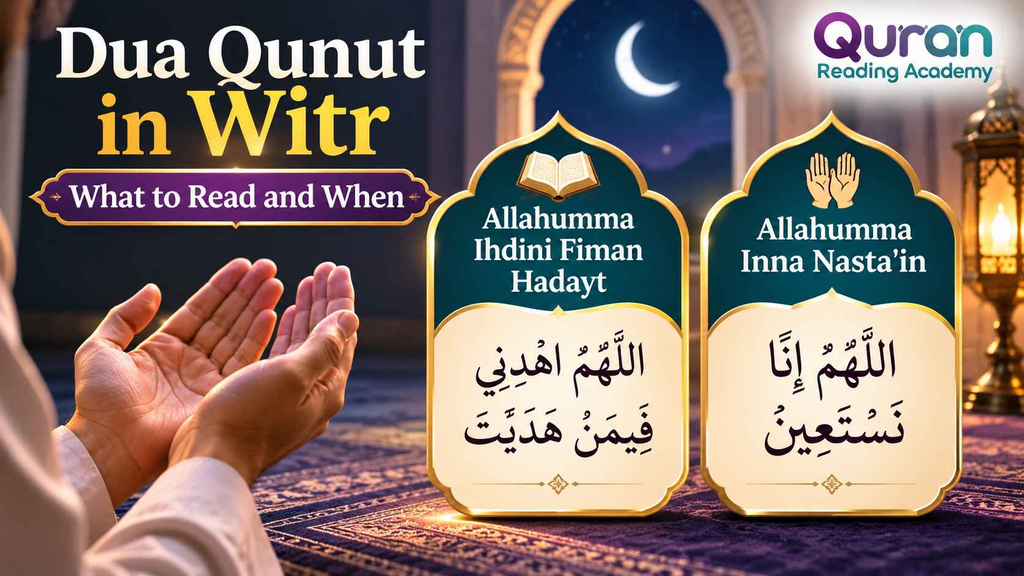
Dua Qunut in Witr is a supplication made in the last rak’ah, and its ruling and position differ between the schools. Two versions are widely used and accepted.
Allahumma Ihdini Fiman Hadayt
The Prophet ﷺ taught this du’a to his grandson Al-Hasan ibn Ali to say in Witr (Sunan Abi Dawud, Jami’ at-Tirmidhi, Sunan an-Nasa’i).
اللَّهُمَّ اهْدِنِي فِيمَنْ هَدَيْتَ، وَعَافِنِي فِيمَنْ عَافَيْتَ، وَتَوَلَّنِي فِيمَنْ تَوَلَّيْتَ، وَبَارِكْ لِي فِيمَا أَعْطَيْتَ، وَقِنِي شَرَّ مَا قَضَيْتَ، فَإِنَّكَ تَقْضِي وَلَا يُقْضَى عَلَيْكَ، وَإِنَّهُ لَا يَذِلُّ مَنْ وَالَيْتَ، وَلَا يَعِزُّ مَنْ عَادَيْتَ، تَبَارَكْتَ رَبَّنَا وَتَعَالَيْتَ
Allahummahdini fiman hadayt, wa ‘afini fiman ‘afayt, wa tawallani fiman tawallayt, wa barik li fima a’tayt, wa qini sharra ma qadayt, fa innaka taqdi wa la yuqda ‘alayk, wa innahu la yadhillu man walayt, wa la ya’izzu man ‘adayt, tabarakta Rabbana wa ta’alayt.
O Allah, guide me among those You have guided, grant me well-being among those You have granted well-being, take me into Your care among those You have taken into Your care, bless me in what You have given, and protect me from the evil of what You have decreed. You decree and none can decree over You. Whoever You befriend is never humiliated, and whoever You oppose is never honored. Blessed are You, our Lord, and Exalted.
Allahumma Inna Nasta’inuka
This version is the one most commonly recited in the Hanafi school.
اللَّهُمَّ إِنَّا نَسْتَعِينُكَ وَنَسْتَغْفِرُكَ، وَنُؤْمِنُ بِكَ وَنَتَوَكَّلُ عَلَيْكَ، وَنُثْنِي عَلَيْكَ الْخَيْرَ، وَنَشْكُرُكَ وَلَا نَكْفُرُكَ، وَنَخْلَعُ وَنَتْرُكُ مَنْ يَفْجُرُكَ، اللَّهُمَّ إِيَّاكَ نَعْبُدُ، وَلَكَ نُصَلِّي وَنَسْجُدُ، وَإِلَيْكَ نَسْعَى وَنَحْفِدُ، وَنَرْجُو رَحْمَتَكَ، وَنَخْشَى عَذَابَكَ، إِنَّ عَذَابَكَ بِالْكُفَّارِ مُلْحِقٌ
Allahumma inna nasta’inuka wa nastaghfiruka, wa nu’minu bika wa natawakkalu ‘alayka, wa nuthni ‘alaykal-khayr, wa nashkuruka wa la nakfuruk, wa nakhla’u wa natruku man yafjuruk. Allahumma iyyaka na’budu, wa laka nusalli wa nasjud, wa ilayka nas’a wa nahfid, wa narju rahmataka wa nakhsha ‘adhabak, inna ‘adhabaka bil-kuffari mulhiq.
O Allah, we seek Your help and Your forgiveness, we believe in You and rely on You, and we praise You with all good. We thank You and are not ungrateful to You, and we turn away from and leave whoever disobeys You. O Allah, You alone we worship, to You we pray and prostrate, and toward You we hasten and serve. We hope for Your mercy and fear Your punishment; surely Your punishment will reach the disbelievers.
Qunut Before or After Ruku’ in the Four Schools
| School | Qunut position | When it’s recited in Witr |
|---|---|---|
| Hanafi | Before ruku’, after a takbir with raised hands | Every night of the year (Wajib in the school) |
| Shafi’i | After rising from ruku’ | Recommended in the second half of Ramadan |
| Hanbali | After rising from ruku’ (before is also permitted) | Every night of the year |
| Maliki | Not part of Witr in the school’s main view | Qunut is made in Fajr instead |
All four positions rest on evidence, so follow the practice of your school or your local imam.
What If You Haven’t Memorized Dua Qunut?
You can still pray Witr tonight. Read Qunut from a paper or your phone, or recite a short Quranic supplication in its place, such as:
رَبَّنَا آتِنَا فِي الدُّنْيَا حَسَنَةً وَفِي الْآخِرَةِ حَسَنَةً وَقِنَا عَذَابَ النَّارِ
Rabbana atina fid-dunya hasanah, wa fil-akhirati hasanah, wa qina ‘adhaban-nar (Our Lord, give us good in this world and good in the Hereafter, and protect us from the punishment of the Fire. Al-Baqarah 2:201).
Meanwhile, set a small daily goal to learn Qunut by heart. Our Reading and Memorizing the Quran course pairs you with a teacher who helps you memorize Dua Qunut and short surahs with correct pronunciation.
Witr Recitation for 1, 5, 7 and 9 Rak’ahs
Witr can be any odd number of rak’ahs; the Prophet ﷺ said, “The night prayer is two by two, and Witr is one rak’ah at the end of the night” (Sunan an-Nasa’i). In the Hanafi school, Witr is always 3 rak’ahs.
| Rak’ahs | How it’s prayed | What to read |
|---|---|---|
| 1 | A single rak’ah with one Tashahhud and Taslim | Al-Fatihah + Al-Ikhlas (or the three Quls), then Qunut per your school |
| 3 | Connected, or two plus one | Al-A’la, Al-Kafirun, Al-Ikhlas, as above |
| 5 or 7 | Prayed together, sitting only in the last rak’ah, or in pairs ending with one | Any surahs; end with Al-Ikhlas in the last rak’ah |
| 9 | Sitting after the eighth without Taslim, then the ninth and final Taslim | Any surahs; Tahajjud-length recitation suits it |
Longer Witr prayers are especially common in the last ten nights of Ramadan. Here’s what to read on Laylatul Qadr to make the most of those nights.
What to Say After Witr
After the Taslim, the Sunnah is to say three times:
سُبْحَانَ الْمَلِكِ الْقُدُّوسِ
Subhanal-Malikil-Quddus (Glory be to the King, the Most Holy).
The Prophet ﷺ raised and lengthened his voice on the third time (Sunan an-Nasa’i). After that, take a quiet moment for your own du’a; the last part of the night is among the best times for your supplications to be answered.
Common Mistakes When Reciting in Witr
Witr is short, but small slips in its recitation are easy to make, especially when you are tired at the end of the night. These are the most common mistakes, so check your own prayer against each one and correct it before it becomes a habit.
- Skipping Al-Fatihah: Al-Fatihah is required in every rak’ah, including the one where you make Qunut.
- Going to ruku’ before Qunut (Hanafi method): Qunut comes before ruku’, after a takbir with raised hands.
- Panicking if you forget Qunut: in the Hanafi school, make Sujud al-Sahw (the prostration of forgetfulness) before the Taslim; in the other schools, your Witr remains valid.
- Rushing the surahs: short surahs are easy to rush, but every letter deserves its right; learn where to pause with these Quran stop signs.
- Leaving Witr until after Fajr begins: Witr’s time ends at true dawn. If you’re unsure you’ll wake, pray it after Isha.
See Our Academy in Action
Discover what a typical session looks like! Watch these brief highlights from our live, interactive classes to see how our instructors engage with students of all ages.
Start Your Quran Learning Journey Today
Join Quran Reading Academy and begin structured, step-by-step Quran reading with expert guidance.
Try your first class for freeRecite Witr Surahs Correctly with Quran Reading Academy
Knowing what to read in Witr is the first step. Reciting it beautifully and correctly is the next, and that’s where most people need help. Letters like ص in As-Samad or ع in A’udhu change meaning when they’re mispronounced, and memorizing Qunut alone can feel slow.
At Quran Reading Academy, you learn one-to-one, online, at a time that fits your day:
- Qualified teachers: every class is led by one of our qualified teachers, who correct your recitation in real time.
- Tajweed from the ground up: our online Tajweed course helps you recite Al-A’la, Al-Kafirun, Al-Ikhlas and the rest of the Quran with confidence.
- Memorization made steady: memorize Dua Qunut and short surahs with a structured plan and regular revision.
- Classes for everyone: from classes for new Muslims to Quran classes for kids, every learner gets a path that suits them.
Your first lesson is on us. Book your free trial class and recite your next Witr with confidence.
Our Quran Courses
- Quran Reading Classes
- Quran Reading Classes for Adults
- Noorani Qaida Course
- Quran Course for Beginners
- Quran Tajweed Course
- Quran Recitation Course
- Quran Hifz Course
- Online Quran Qirat Classes
Conclusion
So, what to read in Witr? Recite Al-Fatihah in every rak’ah, followed by Surah Al-A’la in the first, Surah Al-Kafirun in the second, and Surah Al-Ikhlas in the third, and make Du’a al-Qunut in the last rak’ah, where the schools differ on its ruling and position. That is the clearest answer to which surah to recite in Witr prayer, taken directly from the Sunnah of the Prophet ﷺ.
Remember that these surahs are recommended, not required. If you only know a few short surahs, pray Witr with what you know tonight, and add the Sunnah surahs and Dua Qunut as you learn them. Consistency matters more than perfection, and Witr is a nightly chance to end your day with Allah’s remembrance.
If you’d like a teacher to help you recite these surahs with correct Tajweed and memorize Dua Qunut with confidence, Quran Reading Academy is here for you. Book your free trial class and take the first step today.
FAQs
Which Surah Should I Recite in Witr Prayer?
The Sunnah is Surah Al-A’la in the first rak’ah, Al-Kafirun in the second, and Al-Ikhlas in the third, each after Al-Fatihah. You may also add Al-Falaq and An-Nas in the last rak’ah, as narrated by Aisha.
Is It Compulsory to Read Al-A’la, Al-Kafirun and Al-Ikhlas in Witr?
No. These surahs are a recommended Sunnah, not a requirement. Your Witr is valid with Al-Fatihah and any surah or verses after it in each rak’ah.
Can I Read the Same Surah in Every Rak’ah of Witr?
Yes, repeating a surah is permissible, and a Companion is reported to have recited the same surah in both rak’ahs of a prayer. Still, following the Sunnah surahs brings extra reward when you can.
Can I Read Dua Qunut From My Phone?
Many scholars allow reading Qunut from paper or a phone while you’re learning it, especially in voluntary prayers. Aim to memorize it over time so your focus stays on your supplication.
Is Witr Prayed After Isha or Before Fajr?
Both. Witr’s time runs from after Isha until true dawn, and praying it at the end of the night is best for anyone confident they’ll wake up. Read more about reading Quran after Fajr.








Leave a Reply