 Fatawa
The question of Quran recitation during janabah arises in everyday Muslim life, and it deserves a clear, evidence-based answer. Whether it comes up after Fajr prayer, after marital relations, or before finding time for ghusl, the ruling has a direct impact on how you structure your worship.
This article covers the established Islamic ruling on reading the Quran in janabah, the specific acts that remain permitted, how to correctly perform ghusl to restore purity, and what to do when ghusl must be delayed.
Can You Read Quran in a State of Janabah?
The majority position across all four major schools of Islamic jurisprudence is clear. A junub, that is, a person in a state of janabah, is prohibited from reciting the Quran until a complete ghusl is performed.
Ali ibn Abi Talib’s Hadith on Quran Recitation During Janabah
The foundational evidence is a narration reported by Ali ibn Abi Talib (may Allah be pleased with him):
كَانَ رَسُولُ اللَّهِ صلى الله عليه وسلم يَقْرَأُ الْقُرْآنَ عَلَى كُلِّ حَالٍ لَيْسَ الْجَنَابَةَ
(“The Prophet ﷺ would recite Quran to us in all states, except when he was in a state of janabah.”)
This narration is the cornerstone relied upon by all four major schools. It does not limit the prohibition to a specific mode of recitation. It applies to any deliberate recitation of Quranic text by a person who is junub.
Active Quran Recitation During Janabah
All four major schools agree on prohibiting active Quran recitation during janabah. The term “active recitation” refers to moving the lips and tongue to produce Quranic words.
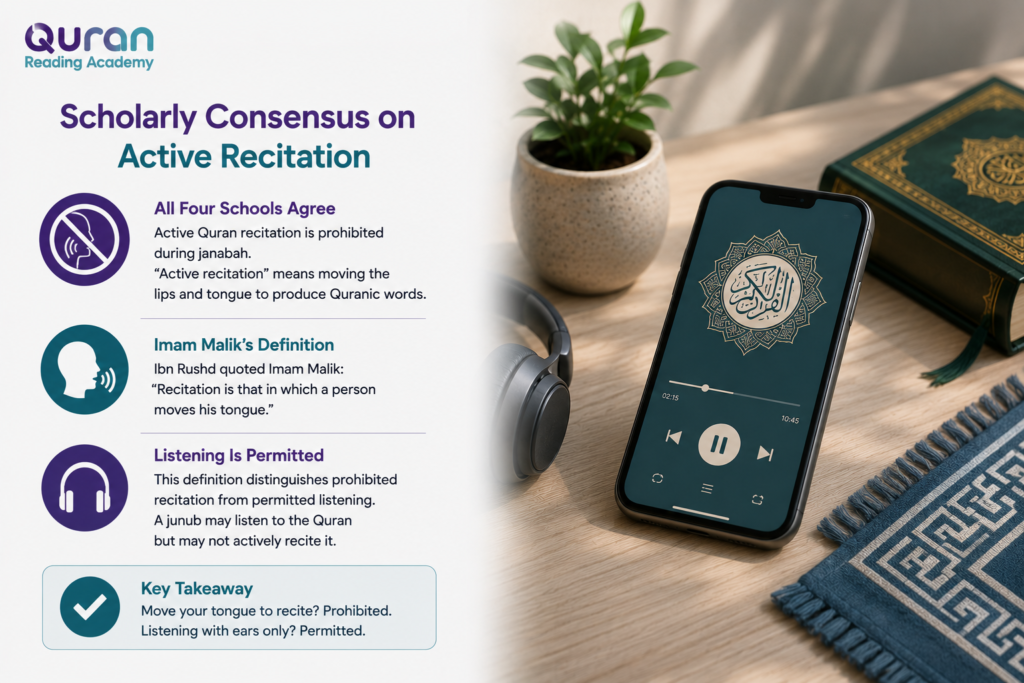
Ibn Rushd quoted Imam Malik as defining recitation as “that in which a person moves his tongue.”
This definition is what separates prohibited recitation from permitted listening, and it is the basis scholars use to permit a junub to listen to the Quran while prohibiting them from reciting it.
Read also: Can I Read Quran Without Wudu?
See Our Academy in Action
Discover what a typical session looks like! Watch these brief highlights from our live, interactive classes to see how our instructors engage with students of all ages.
Start Your Quran Learning Journey Today
Join Quran Reading Academy and begin structured, step-by-step Quran reading with expert guidance.
Try your first class for freeJanabah Definition and Its Causes
Janabah is a state of major ritual impurity distinct from minor impurity. It requires a full ghusl rather than wudu to remove. The distinction matters practically because many restrictions that apply to a junub do not apply to someone who simply lacks wudu.
Causes of Janabah
Janabah is triggered by marital relations, by ejaculation regardless of cause, or by a woman completing her menstrual or postpartum bleeding period. Once any of these causes occurs, the person is junub until ghusl is completed.
The prohibition on reading the Quran in janabah begins from the moment the cause occurs. There is no grace period. The only exception to accountability is genuine forgetfulness, which removes sin but does not change the underlying ruling.
Read also: Can You Read Quran from Phone While Praying
Difference Between Janabah and Minor Impurity
Minor impurity (hadath asghar) requires only wudu and does not prohibit Quran recitation. It restricts touching the physical Mushaf, according to the majority.
Janabah (hadath akbar) is a heavier category that prohibits both touching the Mushaf and actively reciting the Quran.
Performing wudu while in a state of janabah does not resolve the janabah or lift its restrictions. This is a common misunderstanding. Only complete ghusl removes janabah. Wudu performed during janabah provides spiritual composure but does not make Quran recitation permissible.
Students learning to read and recite the Quran correctly benefit from understanding not only how to recite but also the worship conditions that govern when recitation is valid.
Quran Reading Academy‘s Quran Reading Classes build both recitation skill and the foundational awareness every Muslim learner needs.

Begin reading the Quran correctly with guided instruction
Read also: Can You Read Quran While Praying Taraweeh?
Can You Read Quran on a Phone During Janabah?
Some scholars distinguish between touching a digital screen and touching a physical Mushaf, since the screen is not a Mushaf in the classical legal sense. However, there is no scholarly distinction regarding the act of recitation from a digital source.
Quran Recitation During Janabah From Any Source
Reading Quranic text aloud or silently in a manner that constitutes recitation is prohibited during janabah, whether the source is a printed Mushaf, a phone app, or a computer screen. The prohibition attaches to the act of reciting the Quran, not solely to the physical handling of a bound book.
This means switching to a phone app does not provide an exception. If the act is recitation, the restriction applies. The table below summarizes the practical distinctions:
| Act | Permitted During Janabah? |
| Reciting from memory | Not permitted |
| Reciting from printed Mushaf | Not permitted |
| Reciting from phone app | Not permitted |
| Touching a phone screen | Scholarly difference |
| Listening to recorded Quran | Permitted |
| Dhikr and tasbih | Permitted |
| Du’a and supplication | Permitted |
| Performing salah | Not permitted |
Saying Quranic Phrases as Dhikr During Janabah
Scholars distinguish between intending to recite Quran and intending dhikr or supplication using phrases that also appear in the Quran.
Saying “Bismillah” as a routine invocation is generally permitted during janabah, since the intention is dhikr rather than Quranic recitation.
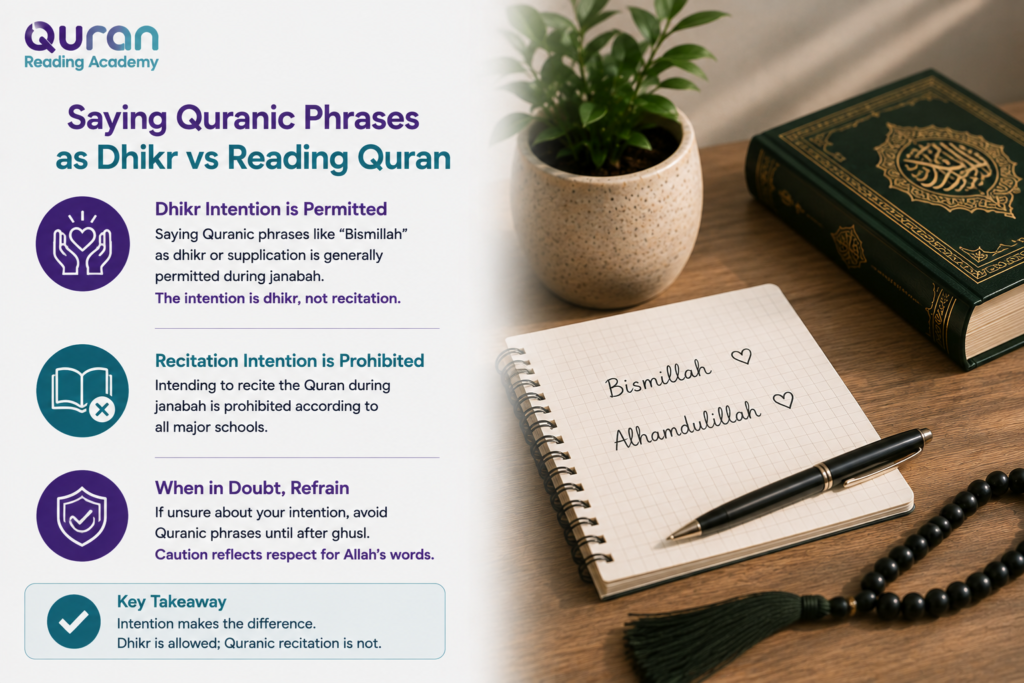
If a person is uncertain about their intention, the safer and more cautious position is to refrain from Quranic phrases until after ghusl. This caution reflects appropriate respect for the Quran’s sacred status.
Read also: Do You Get Reward for Reading Quran on Phone
Permitted Acts of Worship During Janabah
Being in a state of janabah does not prevent a Muslim from maintaining connection with Allah. A number of devotional acts remain fully unrestricted, and these can sustain spiritual engagement during the period before ghusl.
a. Dhikr, Tasbih, and Du’a During Janabah
General remembrance of Allah is not restricted by janabah. Saying SubhanAllah, Alhamdulillah, Allahu Akbar, Astaghfirullah, and similar phrases is fully permitted. Du’a is also unrestricted.
Allah says in the Quran:
ادْعُونِي أَسْتَجِبْ لَكُمْ
(Ud’ūnī astajib lakum)
(“Call upon Me, I will respond to you.”)
This command to call upon Allah carries no condition of ritual purity. Du’a remains open at all times, including during janabah.
b. Listening to Quran During Janabah
Listening to the Quran is fully permitted during janabah. Shaykh Ibn Baz (may Allah have mercy on him) explicitly stated that a person in a state of janabah may listen to Quran recitation because “there is no mention of any prohibition on listening to the Quran in janabah,” adding that it carries great benefit.
A junub may keep Quran recitation playing at home, in the car, or through headphones without any restriction. The act being restricted is recitation, which requires moving the tongue. Passive listening does not involve that act.
Building a daily habit of correct Quran recitation, supported by proper understanding of worship conditions, is what separates students who progress from those who stagnate. Quran Reading Academy‘s Quran Recitation Course is designed for exactly this kind of structured, expert-guided growth.
Recite with clarity, rhythm, and accuracy starting today
Read also: Can You Read Quran for a Dead Person?
How to Perform Ghusl and Remove Janabah
Ghusl is straightforward once its obligatory and recommended acts are understood. Performing it correctly is what lifts janabah and restores all worship permissions.
Allah commands this purification directly:
وَإِن كُنتُمْ جُنُبًا فَاطَّهَّرُوا
(Wa in kuntum junuban fa-ṭṭahharū)
(“If you are in a state of janabah, then purify yourselves.”)
This verse establishes the obligation without ambiguity. All four schools derive the obligatory status of ghusl for janabah from it.
1. Obligatory Components of Ghusl
The obligatory acts of ghusl, according to the majority of scholars, are the sincere intention, rinsing the mouth, rinsing the nose, and washing the entire outer body so that water reaches every surface, including the scalp, hair roots, inside the navel, and between the toes.
Missing any obligatory component means the ghusl is incomplete. A person who washes their body thoroughly but forgets to rinse their mouth is still considered junub and may not recite Quran.
2. Sunnah Components That Complete the Ghusl
The Sunnah method adds recommended acts that enrich the purification. These include washing both hands at the outset, performing wudu before the full body wash, starting from the right side, and pouring water over the head three times before washing the remainder of the body.
These Sunnah elements follow the established practice of the Prophet ﷺ. They are not obligatory, but performing them earns additional reward and ensures a more complete and spiritually meaningful purification.
Reciting the Quran correctly, letter by letter, requires a trained foundation that most self-taught learners never fully build.
Quran Reading Academy‘sQuran Tajweed Course teaches pronunciation rules, articulation points, and recitation standards so every word is produced as it was revealed.
Perfect your Tajweed under expert guidance
Read also: Can You Read Quran for Someone Else?
Janabah When Ghusl Must Be Delayed
Life circumstances sometimes make immediate ghusl difficult: travel, unavailability of warm water in cold climates, medical situations, or the need to sleep before ghusl is possible. Islam provides clear rulings for each of these situations.
Wudu Before Delayed Ghusl
The Prophet ﷺ performed wudu when he needed to delay ghusl before sleeping. This is an established Sunnah act that is recommended for spiritual composure and cleanliness. Performing wudu in this situation does not, however, lift the janabah or restore any of the restricted acts.
The prohibition on reciting the Quran in janabah remains fully in effect even after wudu is performed. This is a point scholars according to the four major schools agree on. The only release from janabah’s restrictions comes through ghusl or, when water is absent, through tayammum.
Tayammum for Janabah When Water Is Unavailable
When water is completely inaccessible, tayammum using clean earth or dust is a legitimate substitute for ghusl.
According to the majority of scholars, valid tayammum performed with the intention of removing janabah lifts the restriction on Quran recitation and permits salah.
When water becomes available again, the person must perform ghusl before their next prayer. Tayammum is a temporary accommodation, not a permanent alternative. Its permissibility is grounded in Allah’s mercy toward those facing genuine hardship.
Read also: Can You Read Quran If You Are Impure?
Quran Recitation After Forgetting Janabah
A person who genuinely forgets they are in a state of janabah and recites the Quran bears no sin for that act. Islamic jurisprudence is consistent on this principle: accountability requires awareness, and forgetfulness removes moral liability.
The moment remembrance returns, however, the person must stop recitation immediately. They should not continue until ghusl is completed. This ruling provides clarity and reassurance, particularly for new Muslims or students still learning the rules of tahara.
Students who want to build a complete, confident foundation in Quran reading, from letter recognition through connected reading, benefit from a course built around their starting level.
Inside Our Live Classroom
We believe in complete transparency. Take a look inside our virtual classrooms to experience our premium teaching tools and engaging learning environment firsthand.
Start Your Quran Learning Journey Today
Join Quran Reading Academy and begin structured, step-by-step Quran reading with expert guidance.
Try your first class for freeRead also: Can You Read Quran at the Graveyard?
Begin Your Quran Journey with a Free Trial Lesson
At Quran Reading Academy, expert instructors provide one-on-one online sessions tailored to each student’s level, schedule, and goals.
Whether you are learning to read for the first time or refining existing recitation, our structured courses cover recitation, Tajweed, and the foundational knowledge that supports correct, confident daily practice.
Book your free trial session today and experience the difference structured, personal instruction makes in how you engage with the Quran.
Our Quran Courses
- Quran Reading Classes
- Quran Reading Classes for Kids
- Quran Reading Classes for Adults
- Quran Reading Classes for Female/Sisters
- Quran Reading Classes for New Muslims
- Quran Reading Course for Beginners
- Online Quran Reading Course with Tajweed
- Reading and Memorizing the Quran Course
- Noorani Qaida Course
- Quran Course for Beginners
- Quran Tajweed Course
- Quran Recitation Course
- Quran Hifz Course
- Online Quran Qirat Classes

Book your free trial class now
Conclusion
Reading the Quran in a state of janaba is not permitted according to the agreed ruling of all four major schools of Islamic jurisprudence, grounded in the authentic hadith of Ali ibn Abi Talib (may Allah be pleased with him) in Sunan Abu Dawud 229. The restriction covers recitation from memory, from a printed Mushaf, and from a digital screen. It is lifted only by complete ghusl, or by tayammum when water is genuinely unavailable.
Listening to Quran remains fully permitted during janabah. Dhikr, tasbih, and du’a are also unrestricted. The ruling does not cut a junub off from all worship, it channels their engagement toward forms that are appropriate while encouraging prompt purification. Once ghusl is complete, every door of Quranic engagement reopens.
Understanding these distinctions, backed by clear evidence and scholarly consensus, is part of what it means to worship Allah with knowledge and intention.
Read also: Why Do I Feel Sleepy When Reading Quran?
Frequently Asked Questions
Can You Read Quran in a State of Janabah?
No. Reciting Quran from memory in a state of janabah is not permitted. The prohibition applies to the act of recitation itself, regardless of whether a Mushaf is physically present. All four major schools agree on this based on the hadith of Ali ibn Abi Talib (RA) narrated in Sunan Abu Dawud 229.
Can you recite Quran in janabat after performing wudu?
No. Wudu does not remove janabah. The prohibition on Quran recitation in janabat is lifted only through complete ghusl, or through tayammum when water is unavailable. Wudu during janabah is a recommended act before sleeping but does not change the status of the janabah itself.
Can you read Quran in janabah from a phone app?
No. Reading Quranic text from a phone app in a state of janabah carries the same ruling as reading from a Mushaf. Some scholars differ on whether touching a digital screen equals touching the Mushaf, but there is no difference of opinion on the act of reciting the Quran text regardless of the medium used.
Is listening to Quran permitted in state of janabah?
Yes. Listening to Quran recitation is fully permitted during janabah. Scholars including Shaykh Ibn Baz have explicitly confirmed that passive listening is not covered by the prohibition. The restriction targets active recitation, defined by Imam Malik as moving the tongue to produce the words.
Does the ruling on janabah apply to a menstruating woman?
Scholars differ here. The majority apply the same prohibition. However, Shaykh al-Islam Ibn Taymiyyah held that no authentic, explicit evidence exists prohibiting a menstruating woman from reciting Quran, particularly given that menstruation extends for days with no option to perform ghusl early. Both positions have scholarly grounding.
Is saying Bismillah considered reading Quran in janabah?
Saying Bismillah as a routine invocation or supplication is generally permitted during janabah, since the intention is dhikr rather than deliberate Quranic recitation. The prohibition applies to intentional recitation of Quranic text as Quran. When uncertain about intention, refraining until after ghusl is the cautious and preferable approach.








Leave a Reply